

Unipeg (uPEG) is a first-of-its-kind on-chain object that blurs the line between ERC-20 tokens and NFTs. Launched in late April 2026, Unipeg serves as a flagship demonstration of Uniswap v4’s programmability. Unlike traditional tokens that simply record a balance, every trade involving uPEG triggers custom logic, known as a hook, that generates a unique, 24×24 pixel unicorn image directly on the Ethereum blockchain.
On April 28, 2026, the project reached a major milestone as high-profile collectors and DeFi experimentalists pushed its market capitalization past $12 million. With a tiny fixed supply of just 10,000 tokens, Unipeg has become a viral case study for Agentic Web assets, objects that react and evolve based on market activity rather than static metadata.
This article examines the technical architecture of uPEG, how Uniswap v4 hooks enable its generative art, the unique integer ownership model, and how to trade Unipeg (UPEG) perpetuals on BingX futures market.
What Is Unipeg (uPEG)?
Unipeg (uPEG) is a derivative on-chain experiment that reclaims a piece of crypto history: Unipeg was one of the original names considered for Uniswap back in 2018. In 2026, this name was revived to describe a token where a peg, or a set of rules, is enforced at the point of exchange via v4 hooks.
The project’s core thesis is that infrastructure should lower the cost of trying new ideas. By leveraging the flexibility of the Uniswap v4 Singleton architecture, Unipeg demonstrates that a token's appearance and behavior can be a direct function of market volume. Key characteristics include:
- 100% On-Chain: The art is not stored on IPFS or a private server. It is rendered as an SVG directly from the Ethereum state.
- Market-Driven Evolution: The unicorn images are generated based on a hash that includes transaction data, colors, and the previous owner’s information.
- Fungible-NFT Hybrid: While the token trades like a standard fungible asset in small amounts, holding whole integers like 1.0, 2.0, etc., grants you the collectible object associated with that number.
How Does Unipeg Work?
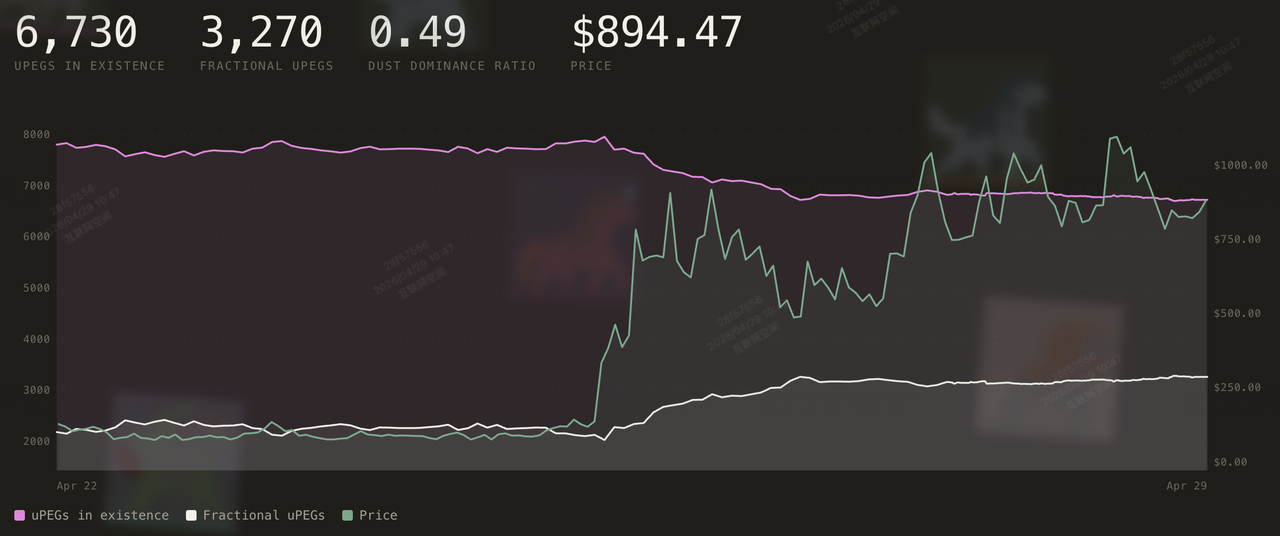
Unipeg's dust dominance ratio | Source: Unipeg
At its core, Unipeg is an application of Hook-driven logic. It moves the complexity of token behavior closer to where the value actually moves.
The Uniswap v4 Hook
In previous versions of Uniswap, logic was bolted on or wrapped around the swap. In v4, Hooks allow custom code to run at specific points: before/after a swap or before/after a liquidity change. Unipeg uses an after-swap hook. Every time a trade touches the uPEG pool, the hook executes a sequence:
- Data Capture: It reads the swap details like amount, price, and participants.
- Hash Generation: It generates a unique seed based on the transaction.
- SVG Rendering: The on-chain renderer uses this seed to assemble the unicorn’s layers and colors in real-time.
The Integer Object Model
Unipeg introduces a unique ownership mechanic:
- Fractional uPEG: If you own 0.5 uPEG, it behaves like a standard meme coin or altcoin. You can trade it, send it, or provide liquidity.
- Integer uPEG: When your balance crosses a whole number, e.g., you buy enough to reach 1.0 uPEG, an on-chain unicorn is born or updated for that slot. If you sell and drop below the integer, that specific object effectively dies or is transferred.
Zero External Dependencies
Most NFTs are pointers to an image on a server. If the server goes down, the art disappears. Unipeg’s SVG renderer is embedded in the smart contract. As long as Ethereum exists, the uPEGs exist.
What Is the uPEG Token Used for?
Unlike traditional utility tokens, $uPEG is an interactive asset. Its utility is derived from its participation in the generative experiment:
- Generative Input: The act of trading $uPEG is what creates the art. Users play the market to see what new visual outputs are generated.
- Scarcity Premium: With only 10,000 tokens ever in existence, the $uPEG token acts as a high-beta bet on the adoption of Uniswap v4.
- On-Chain Identity: Collectors compete for early integer uPEGs, e.g., uPEG #1 or #42, as status symbols within the v4 ecosystem.
What Is Unipeg (UPEG) Tokenomics?
Unipeg (uPEG) features an ultra-scarce tokenomic model characterized by a hard-capped supply of exactly 10,000 tokens. With the total, max, and circulating supply all equal from day one, the project carries zero inflation and no future minting capabilities. This fixed-state architecture ensures that early adopters aren't diluted by unlocking schedules or team vestings, which is rare in modern DeFi and underscores its nature as a pure technical experiment.
This setup creates an aggressive 'low-float, high-demand' environment where price is extremely sensitive to social momentum and trading volume. Because every integer token corresponds to a unique on-chain unicorn, the supply isn't just a currency but is also a limited set of slots for generative art. Consequently, even minor shifts in market interest can trigger massive price volatility, as there are no new tokens entering the market to absorb sudden spikes in buy pressure.
Unipeg vs. Traditional NFTs: Key Differences
|
Feature |
Unipeg (uPEG) |
Traditional NFT (ERC-721) |
|
Storage |
100% On-Chain SVG |
Often Off-Chain (IPFS/Arweave) |
|
Liquidity |
High (AMM Pool) |
Low (Floor-based Marketplaces) |
|
Generation |
Triggered by Trading |
Triggered by Minting |
|
Divisibility |
Fully Divisible (0.001 uPEG) |
Non-Divisible |
Unlike traditional NFTs (ERC-721/1155) that function as static pointers to external data, Unipeg (uPEG) introduces a high-velocity, liquid-metadata model. While 90% of traditional NFTs rely on off-chain storage like IPFS or private servers, creating a link rot risk if the gateway fails, uPEG’s art is generated and rendered 100% on-chain via the Uniswap v4 Singleton. Most critically, uPEG solves the NFT liquidity problem: while traditional NFTs often suffer from floor-price illiquidity and require a counterparty to exit, uPEG is backed by an AMM pool, allowing for instant, fractionalized exits and entries at any time.
Practically, the difference lies in deterministic evolution. Traditional NFT metadata is usually fixed at minting or changed manually by a developer. In contrast, a uPEG object is a direct function of market activity; its visual hash changes based on the specific transaction data of the trade that moved it. This transforms the asset from a passive collectible into an interactive state machine, where the rarity or appearance is not just assigned by an artist, but is a permanent, verifiable byproduct of decentralized market forces.
How to Trade Unipeg (uPEG) on BingX
As an early-stage experimental asset, $uPEG is often subject to rapid price discovery and extreme sentiment shifts. BingX provides the tools needed to navigate this volatility, including BingX AI-powered market analysis. By utilizing real-time sentiment tracking and technical indicator summaries, traders can better gauge the momentum of on-chain unicorn generation events and manage risk more effectively in a high-stakes environment.
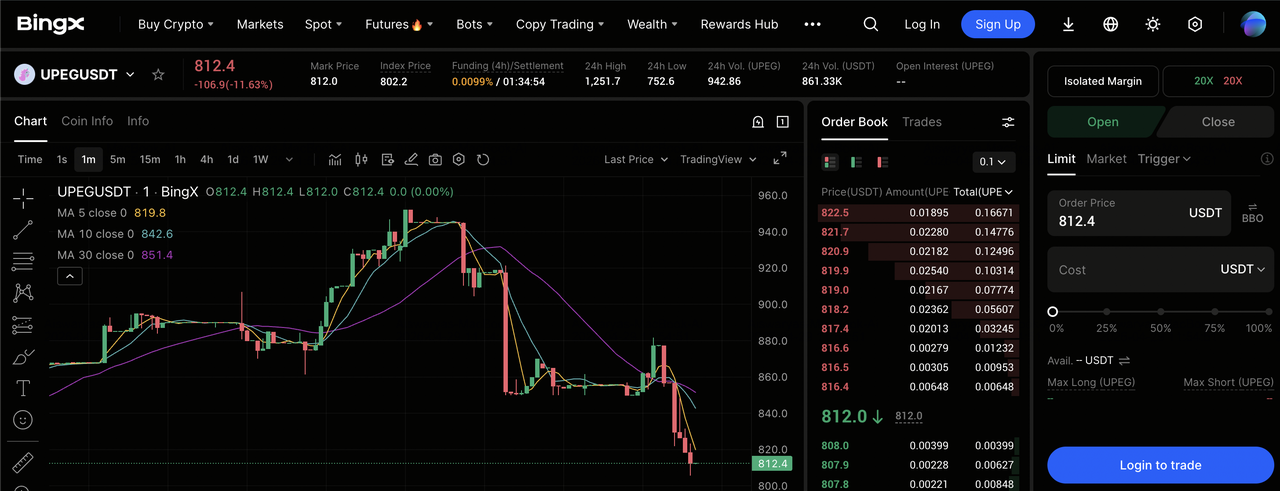
UPEG/USDT perpetuals on BingX futures market
Long or Short uPEG Perpetual Contract on the BingX Futures Market
Trading $uPEG on the futures market allows you to capitalize on its high volatility using leverage. Follow this step-by-step guide to get started:
- Access the Futures Terminal: Log in to your BingX account and navigate to the Futures tab. Search for the UPEG/USDT perpetual contract to open the dedicated trading interface.
- Utilize BingX AI Analysis: Before entering a position, use the BingX AI sidecar to analyze real-time market sentiment and technical trends. Given $uPEG's experimental nature, AI-driven insights can help identify whether current volatility is driven by genuine on-chain activity or short-term hype.
- Select Your Margin Mode: Choose between Isolated Margin to cap your risk to a specific trade or Cross Margin to utilize your entire account balance to prevent liquidation.
- Set Your Leverage and Strategy: Adjust your leverage according to your risk tolerance. Select Open Long if you anticipate the Uniswap v4 narrative will drive prices up, or Open Short if you are hedging your spot holdings against a market correction.
- Execute and Monitor: Use a Limit Order for precise entry during price dips or a Market Order for instant execution. Once live, always set a Take-Profit (TP) and Stop-Loss (SL) to protect your capital from the rapid gap moves typical of low-supply assets.
5 Key Considerations Before Investing in Unipeg (uPEG)
Before allocating capital to the $uPEG ecosystem, it is essential to evaluate the structural risks of its low-float supply and the technical dependencies of its first-of-its-kind Uniswap v4 architecture.
- Extreme Volatility: With only 10,000 tokens, $uPEG can move 50% in hours. It is a high-risk experimental asset.
- Experimental Tech: The project relies on the brand-new Uniswap v4 architecture. Any bugs in the v4 hooks system could affect the token.
- Hype vs. Utility: Currently, $uPEG's value is driven by technical novelty and social momentum. Monitor if it can maintain attention beyond the v4 launch era.
- Concentration Risk: Early adopters who bought near the April 26 launch may hold significant portions of the 10,000 supply.
- Gas Costs: Interacting with complex hooks on Ethereum Mainnet can be expensive during periods of high congestion.
Final Thoughts: Is Unipeg the Future of Programmable On-chain Assets?
As of late April 2026, Unipeg has successfully transitioned from a technical curiosity into a foundational case study for the App-Chain and programmable liquidity era. By moving logic directly into the point of exchange via Uniswap v4 hooks, the project demonstrates that tokens no longer need to be static accounting entries. Instead, they can function as dynamic, responsive objects that bridge the gap between DeFi and generative digital media. For the broader ecosystem, uPEG serves as a precursor to more complex agentic assets, such as self-evolving portfolios or autonomous trading entities that adapt their properties based on real-time market data.
For the strategic investor, $uPEG represents a high-beta bet on the successful adoption of the Uniswap v4 singleton architecture. While the current valuation is heavily influenced by technical novelty and social momentum, the practical shift toward liquid-metadata assets is a trend that is likely to persist. Success in this category requires a balanced approach: utilizing advanced tools like BingX AI to monitor extreme volatility while recognizing that uPEG's long-term viability depends on its ability to evolve beyond a demonstration of code into a sustained cultural and technical ecosystem.
Risk Reminder: Digital asset investments, particularly in experimental tokens like $uPEG, carry high market risk and extreme price volatility. The value of $uPEG is driven entirely by speculative demand and its unique on-chain mechanic; it may fluctuate significantly or lose value entirely. Always perform your own research, utilize BingX risk management tools, and only trade capital you can afford to lose. BingX is not responsible for any trading losses incurred.
