
Cash Cat (CASHCAT) is a meme coin on Robinhood Chain built around a simple origin story: before Robinhood became the green investing app, one of its early brand mascots was known as Cash Cat. CASHCAT turns that forgotten mascot lore into a crypto-native meme, positioning itself as the unofficial cat mascot of the Robinhood Chain narrative.
Unlike utility tokens that focus on infrastructure, yield, or governance, CASHCAT is intentionally meme-first. Its official site describes the token as “zero utility,” “100% cat,” and “backed by historical fact,” making it closer to a pure lore-driven meme coin than a DeFi protocol. The timing is the main reason it has gained attention: Robinhood Chain, tokenized stocks, and RWA narratives are becoming more visible, while CASHCAT gives traders a simple ticker and story to rally around.
This guide explains what Cash Cat is, how the Robinhood Chain narrative works, why CASHCAT is trending, how its tokenomics are structured, the main risks to consider, and how to buy CASHCAT through Uniswap.
What Is Cash Cat (CASHCAT)?
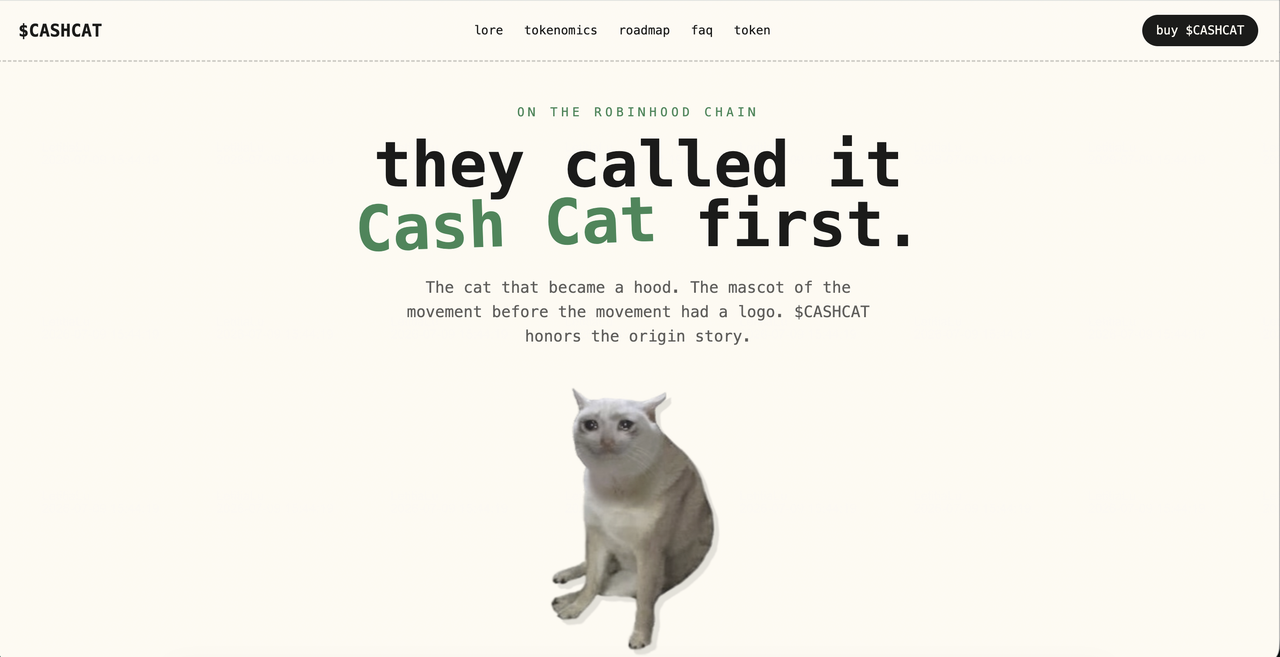
Source: CashCat Token
Cash Cat (CASHCAT) is a meme token on the Robinhood Chain. According to CoinMarketCap, CASHCAT has a total and maximum supply of 1 billion tokens, with the same 1 billion tokens shown as circulating supply. Its contract address is 0x020bfc650a365f8bb26819deaabf3e21291018b4.
The project’s identity comes from Robinhood’s early “Cash Cat” mascot history. The official site frames CASHCAT as the mascot “returning to claim his ticker” on the chain that carries the Robinhood name. This gives the token a simple meme structure: historical trivia, Robinhood Chain attention, and cat-based internet culture.
CASHCAT’s positioning is intentionally different from utility-heavy crypto projects. It does not present itself as a lending protocol, Layer 1, AI token, or DeFi infrastructure platform. Its official site says the utility is “cat,” which is a meme-first way of saying the token’s value depends on culture, attention, liquidity, and community activity rather than protocol revenue.
Key parts of the Cash Cat setup include:
- CASHCAT token: A 1 billion supply meme token on Robinhood Chain.
- Cash Cat lore: The project’s identity is based on the early Robinhood mascot and the “Cash Cat first” narrative.
- Robinhood Chain context: The token uses Robinhood Chain attention as its main ecosystem anchor.
- DEX trading: CASHCAT is designed to be bought through Robinhood Chain DEX liquidity.
- Meme-first positioning: The project openly describes itself as entertainment-driven and unaffiliated with Robinhood Markets, Inc.
How Does Cash Cat Work?
Cash Cat works like a simple on-chain meme token. Its mechanics are not built around staking, governance, emissions, or complex DeFi infrastructure. Instead, the project depends on supply simplicity, DEX liquidity, Robinhood Chain attention, and meme distribution.
https://t.co/xInQZoj2jx pic.twitter.com/5rs2Ki2Ocy
— Vlad Tenev (@vladtenev) April 14, 2021
- CASHCAT runs on Robinhood Chain: The token lives on Robinhood Chain, and users need to use the correct network before swapping or transferring the asset.
- The token trades through DEX liquidity: The official site directs users to buy CASHCAT through Uniswap. Users need to add the Robinhood network, bridge funds, open the DEX, paste the contract address, and swap.
- Tokenomics are intentionally simple: The official site lists 1 billion total supply, 0/0 tax, and says 100% is in the pool with LP burned. This gives the token a cleaner structure than meme coins with large hidden tax systems or complex unlock schedules.
- The meme depends on Robinhood-origin lore: CASHCAT’s main narrative is not technical innovation. It is the idea that the forgotten Cash Cat mascot deserves a ticker on the chain that now carries the Robinhood name.
- Community attention drives momentum: Like other meme coins, CASHCAT depends on social sharing, liquidity, holder growth, DEX volume, and broader appetite for new chain-native memes.
What Is Robinhood Blockchain?
Robinhood Blockchain refers to Robinhood’s broader plan to use blockchain infrastructure for tokenized assets, including stock tokens, ETF tokens, and eventually more 24/7 market access. Robinhood’s first major rollout began with tokenized U.S. stocks and ETFs for eligible European users, using Arbitrum as the initial blockchain layer. Over time, Robinhood has also signaled plans to develop its own blockchain infrastructure to support a wider tokenized asset ecosystem.
The key idea is not to create another generic crypto chain. Robinhood Blockchain is more closely tied to tokenized finance: bringing traditional assets such as stocks, ETFs, and possibly private-market exposure onto blockchain-based rails. This could make trading more flexible, extend market access beyond normal hours, and connect traditional brokerage products with crypto-style settlement and programmability.
Read More: Robinhood Stock Forecast 2026: $130 Hyper-Growth or Valuation Correction?
Is Robinhood Chain Related to Robinhood Trading Platform?
Yes. Robinhood Chain is related to Robinhood Trading Platform, the company behind the Robinhood brokerage and crypto trading platform. It is part of Robinhood’s official tokenization strategy, not a separate community project.
However, Robinhood Chain should not be confused with every token that uses Robinhood-related branding or themes. Robinhood stock tokens are official tokenized asset products offered through Robinhood in supported regions. Meme coins such as Cash Cat (CASHCAT) are community-created tokens using the Robinhood Chain narrative, but they are not official Robinhood-issued assets. CASHCAT’s own site states that it is not affiliated with Robinhood Markets, Inc. or the founder of Robinhood Vlad Tenev.
Read More: What Is Vladimir Tenev’s Net Worth in 2026?
Why Is Cash Cat (CASHCAT) Trending in July 2026?
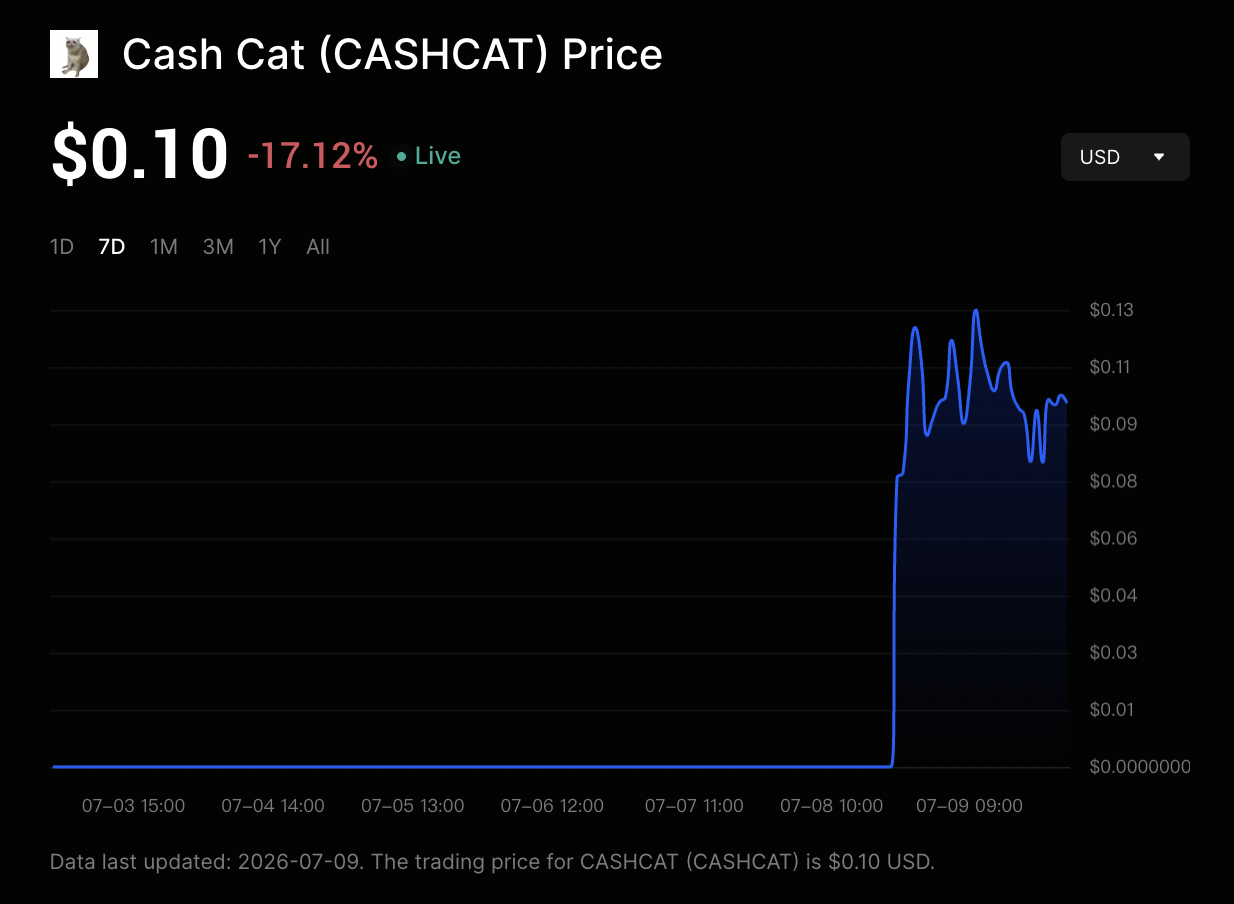
As of July 2026, Cash Cat is trending largely due to its connection to the emerging Robinhood Chain narrative. Robinhood’s tokenization push, announced on June 26, 2026, focuses on stock and ETF tokens for eligible European users and initially runs on Arbitrum, while the company has signaled plans to eventually launch its own blockchain for expanded 24/7 trading. This gives CASHCAT a timely narrative boost: it positions itself as an early meme token tied to a potential new ecosystem.
|
Driver |
Latest Signal (July 2026) |
Impact |
|
Robinhood Chain narrative |
Expansion into tokenized stocks, ETFs, and 24/7 trading |
Adds a strong macro narrative tailwind |
|
Chain transition phase |
Arbitrum used now; native chain still in development |
Creates early-entry speculation appeal |
|
Meme origin story |
Positioned as Robinhood’s “forgotten mascot” |
Simple, shareable narrative hook |
|
Early price action |
Rapid move to all-time high shortly after launch |
Signals strong initial speculative demand |
|
Trading activity |
High 24h volume relative to market cap (CMC data) |
Indicates active short-term liquidity |
|
Tokenomics clarity |
1B fixed supply, fully circulating |
Easy for retail traders to understand |
Cash Cat’s momentum is currently driven more by narrative timing than underlying utility. The Robinhood Chain theme, centered on tokenized assets and continuous trading, provides the backdrop, while CASHCAT adds a meme layer that attracts speculative attention. The key question going forward is whether this early hype can translate into sustained liquidity, community growth, and longer-term relevance.
CASHCAT Tokenomics
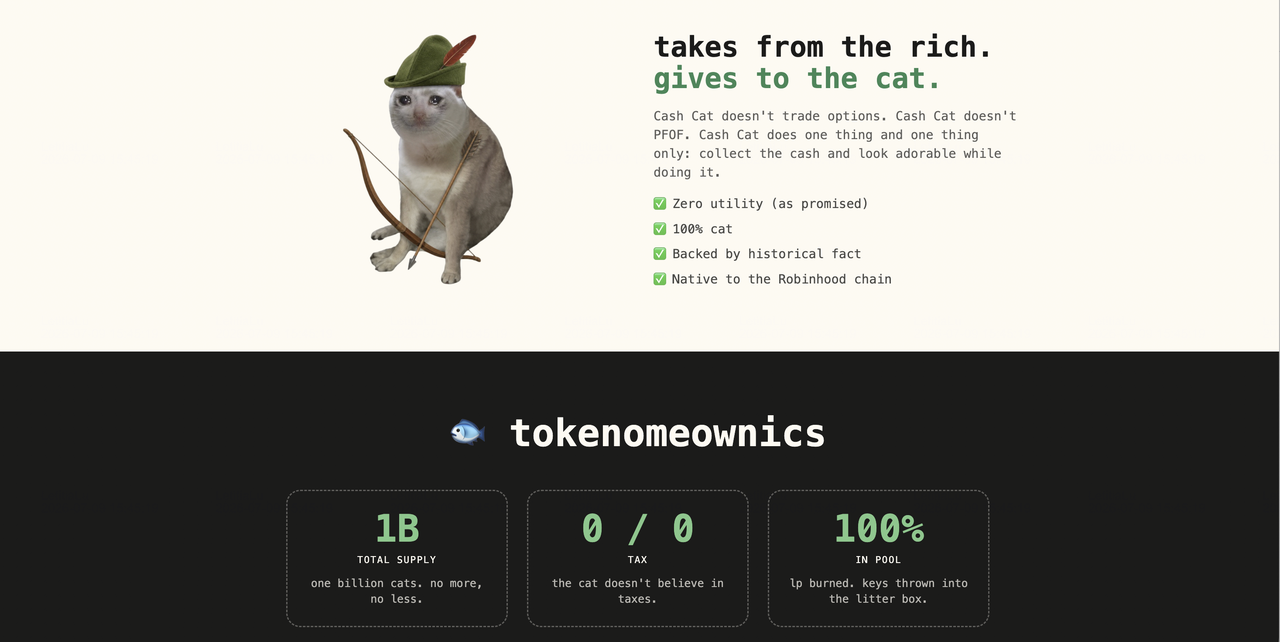
CASHCAT tokenomics are intentionally minimal. The official site lists a 1 billion total supply, 0/0 tax, and says 100% of tokens are in the pool with LP burned. CoinMarketCap also shows 1 billion total supply, 1 billion maximum supply, and 1 billion circulating supply.
|
Tokenomics Item |
Detail |
Why It Matters |
|
Total supply |
1B CASHCAT |
Simple fixed supply, easier for traders to understand than multi-trillion meme coins. |
|
Max supply |
1B CASHCAT |
No larger max supply is shown on CoinMarketCap. |
|
Circulating supply |
1B CASHCAT |
CoinMarketCap shows the full supply as circulating. |
|
Tax |
0/0 |
The official site says there is no buy or sell tax. |
|
Liquidity |
100% in pool, LP burned |
The official site claims liquidity was placed in the pool and LP was burned. |
|
Contract |
0x020bfc650a365f8bb26819deaabf3e21291018b4 |
Users should verify the contract before trading to avoid fake copies. |
Because CASHCAT is new, tokenomics should be treated carefully. A simple supply structure does not remove meme coin risk. Liquidity depth, holder distribution, contract safety, DEX routing, and chain stability still matter.
How to Trade Cash Cat (CASHCAT) on BingX
BingX does not currently offer CASHCAT spot trading, so users cannot buy and hold CASHCAT directly through the BingX spot market. Instead, users who want exposure to CASHCAT price movements can trade CASHCAT perpetual futures if the contract is available on BingX.
Futures Trading: Trade BONK Price Movements
Perpetual futures allow users to trade CASHCAT without holding the underlying token, using USDT as margin. Traders can open long positions if they expect CASHCAT to rise, or short positions if they expect CASHCAT to fall. This makes futures more flexible for short-term trading, but also riskier because leverage can amplify both gains and losses.
Because CASHCAT is a new meme coin tied to Robinhood Chain attention, price swings can be sharp. Futures trading is more suitable for users who already understand leverage, liquidation risk, funding fees, and stop-loss planning.
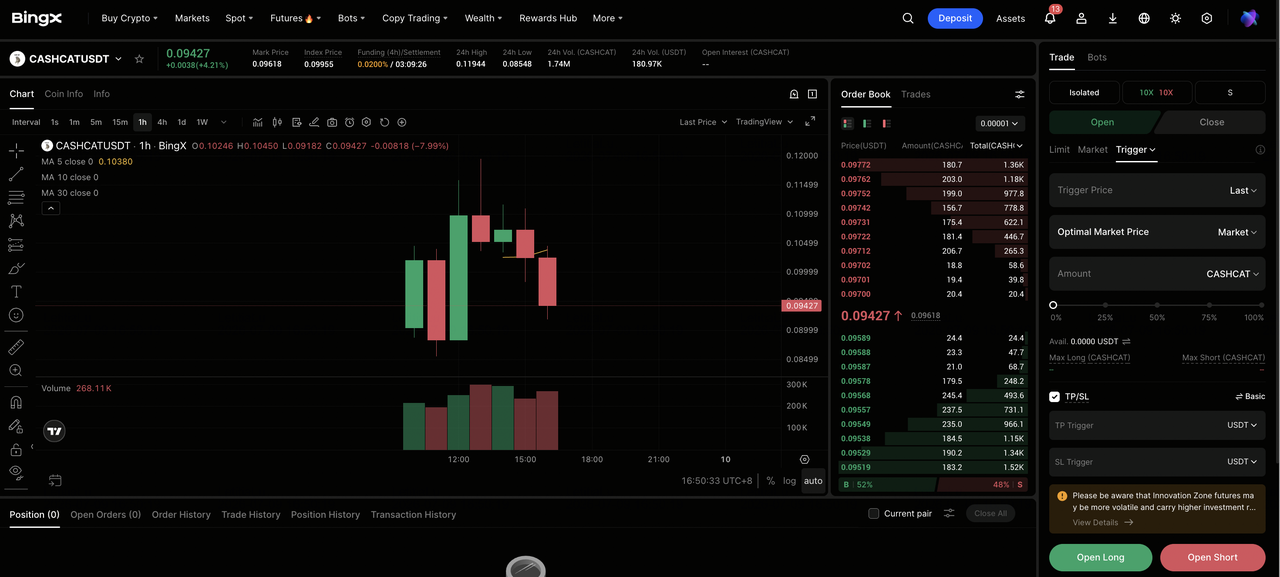
Step 1: Account setup and security. Sign up and log into your BingX account, complete the identity verification (KYC) required in your region, and enable two-factor authentication.
Step 2: Fund your futures account. Deposit USDT into your BingX account, or buy USDT through a supported payment method. Transfer USDT to your futures account, where it will be used as margin.
Step 3: Select the contract. Go to the BingX perpetual futures page and search for the CASHCAT-USDT perpetual contract. Make sure you select the correct contract before placing any order.
Step 4: Execute the trade. Enter the order amount and choose a market or limit order depending on your trading plan. Review the margin requirement, estimated liquidation price, and fees before confirming the trade.
Step 5: Set direction and leverage. Open long if you expect CASHCAT to rise, or open short if you expect CASHCAT to decline. Choose leverage based on your risk tolerance and position size. For new meme coins, lower leverage is generally safer because volatility can be extreme.
Step 6: Manage risk. Set stop-loss and take-profit orders before or immediately after entering the position. Monitor funding rates, position size, and liquidation risk, especially during high-volume meme coin rotations.
5 Critical Risks Before Buying Cash Cat (CASHCAT)
CASHCAT has a clean meme and simple tokenomics, but it is still a very new and highly speculative token.
- Extreme meme volatility: CASHCAT can rise or fall sharply based on short-term social attention, DEX liquidity, and speculative rotation.
- No official Robinhood affiliation: The project says it is not affiliated with Robinhood Markets, Inc. or Vlad Tenev. Traders should not treat CASHCAT as an official Robinhood product.
- New-chain execution risk: Robinhood Chain is still a fresh narrative for many users. Wallet setup, bridging, DEX routing, and explorer support may be less familiar than Ethereum or Solana.
- Liquidity risk: New meme coins can show high volume early, but liquidity can thin quickly if attention rotates elsewhere.
- Contract-copy risk: Meme tickers are easy to imitate. Users should only trade using the verified contract address from official sources.
Final Thoughts: Should You Buy Cash Cat (CASHCAT) in 2026?
Cash Cat is a clean, lore-driven meme coin built around one of the simplest narratives in the current market: Robinhood used to be Cash Cat, and now CASHCAT wants to become the mascot of Robinhood Chain. That makes it more interesting than a random animal meme with no context, especially as Robinhood Chain and tokenized finance narratives attract more attention.
Still, CASHCAT is not Bonk yet. It does not have a mature trading bot, launchpad, DAO treasury, or deep ecosystem of integrations. Its current appeal comes from timing, meme clarity, simple tokenomics, and early Robinhood Chain attention. For traders, the key metrics to watch are DEX volume, liquidity depth, holder growth, social momentum, contract safety, and whether the meme can survive beyond its first hype cycle.
Related Reading
- What Is Vladimir Tenev’s Net Worth in 2026?
- What Is Bonk (BONK)? A Beginner's Guide to Solana's Meme Coin and BONK Ecosystem in 2026
- What Is Dogecoin (DOGE) in 2026? Complete Beginner's Guide to the Original Memecoin
- Robinhood Stock Forecast 2026: $130 Hyper-Growth or Valuation Correction?
- What are Robinhood Tokenized Stocks HOODX (xStocks) and HOODON (Ondo) and How to Buy?
FAQs About Cash Cat (CASHCAT)
1. Is Cash Cat affiliated with Robinhood?
No. The official Cash Cat site says CASHCAT is not affiliated with Robinhood Markets, Inc. or Vlad Tenev.
2. What chain is CASHCAT on?
CASHCAT is on Robinhood Chain. Users should make sure their wallet is connected to the correct network before trading or transferring the token.
3. What is the CASHCAT contract address?
The contract shown on the official site and CoinMarketCap is 0x020bfc650a365f8bb26819deaabf3e21291018b4.
4. Does CASHCAT have utility?
The project presents itself as a meme coin and openly describes its utility as “cat.” Its value depends on meme strength, liquidity, community activity, and Robinhood Chain attention rather than protocol revenue.
5. Is Cash Cat risky?
Yes. CASHCAT is a new meme coin with high volatility, DEX liquidity risk, no official Robinhood affiliation, and limited operating history. Users should not allocate more than they can afford to lose.
