
In late April 2026, the Nikkei 225 (N225) stands at a historic technical and psychological frontier. After breaching the legendary 60,000 mark for the first time on April 23, the index is attempting to solidify its position as the G7's top-performing market of the year. While the Japan Renaissance, driven by corporate governance reforms and semiconductor dominance, remains the primary catalyst, a shadow is being cast by the escalating U.S.-Iran conflict and its impact on energy-dependent Japan. Investors are now weighing an 11.6% projected growth in corporate earnings against a Bank of Japan (BOJ) that is turning hawkish to combat energy-driven inflation.
As the March-fiscal year earnings season kicks into high gear, Japan’s Industrial AI sector is under the microscope. With the Nikkei/TOPIX ratio hitting record highs, the market's focus has shifted from speculative hype to realized profit margins. This guide breaks down the Nikkei 225 price prediction for 2026 using data from Nomura, Reuters, and the Financial Forecast Center.
You will also discover how to trade Nikkei 225 futures through BingX TradFi.
Top 5 Things for Nikkei 225 Investors to Know in 2026
- The 60,000 Psychological Break: The breach of 60,000 in April 2026 signals a definitive exit from the decades-long lost era, marking a new structural bull market for Japanese equities.
- The Industrial AI Edge: Unlike the software-heavy Nasdaq, Japan’s AI play is rooted in hardware. Giants like Tokyo Electron, Advantest, and Kioxia are capturing the global capex surge in semiconductor manufacturing.
- Energy Import Vulnerability: Japan relies on the Middle East for 95% of its crude oil. With Brent crude hovering near $109, high energy costs threaten to crimp household spending and corporate margins.
- The Hawkish BOJ Pivot: In April 2026, the BOJ kept rates at 0.75% but saw a 6-3 split vote. The rise in hawkish dissenters suggests a hike to 1.0% is likely if the yen continues to weaken.
- ROE Governance Milestone: The Tokyo Stock Exchange's reform push has pushed many constituents toward a 10% Return on Equity (ROE) target, a level that is finally attracting sustained global institutional inflows.
What Is the Nikkei 225 Index (N225)?
The Nikkei 225, or N225, is a price-weighted index representing 225 of the largest blue-chip companies listed on the Tokyo Stock Exchange (TSE). It is the primary benchmark for the Japanese economy and a global proxy for advanced manufacturing and technology.
In 2026, the index is heavily weighted toward the Technology (54%) and Consumer Goods sectors. Key constituents include semiconductor testing leader Advantest, investment giant SoftBank Group, and Uniqlo parent Fast Retailing. As of April 2026, the Nikkei 225 is trading at a forward P/E of approximately 21x, elevated by historical standards but viewed as reasonable by analysts given the double-digit earnings growth forecasts.
A Review of Nikkei 225's Performance in 2025
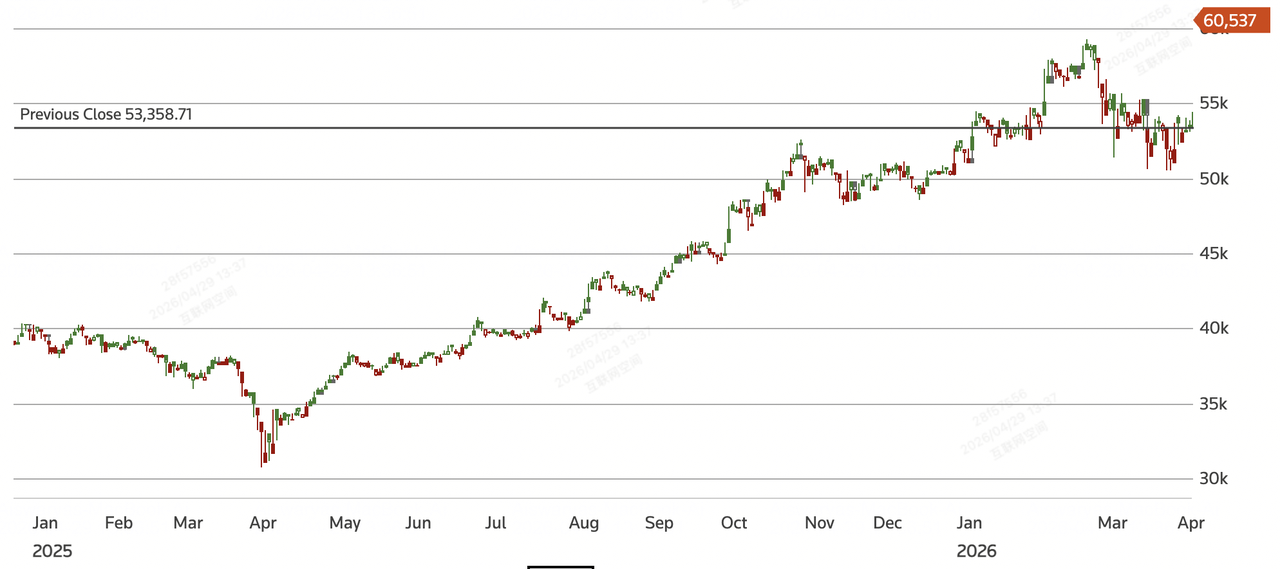
Nikkei 225's performance: Jan 2025 to Apr 2026 | Source: Reuters
2025 was a standout year for Japanese stocks, with the Nikkei 225 delivering a 27% return, outperforming the S&P 500 and most European indices. This rally was fueled by the Takaichi Surge, a wave of optimism following Prime Minister Sanae Takaichi’s election victory and her commitment to strategic investment in AI, defense, and nuclear energy. Throughout 2025, the weak yen provided a massive tailwind for exporters like Toyota and Sony, while the return of moderate inflation allowed Japanese firms to regain pricing power for the first time in a generation.
Nikkei 225's 2026 Strategy: How to Navigate Volatility
- The 58,000 Support Zone: Technical analysts identify 58,000 as the line in the sand. As long as the index holds this floor during geopolitical pullbacks, the path to 65,000 remains open.
- The Yen Sensitivity: A yen trading near 160 per dollar is a double-edged sword. While it boosts repatriated earnings for exporters, it exacerbates the Oil Shock by making imports more expensive.
- MACD Bullish Crossover: On the daily charts, the MACD (moving average convergence divergence) indicator recently flashed a bullish crossover, suggesting that momentum is still favoring the upside despite short-term profit-taking at the 60,000 level.
Nikkei 225 2026 Investment Outlook: 65,000 Bull Run vs. 55,000 Bear Case
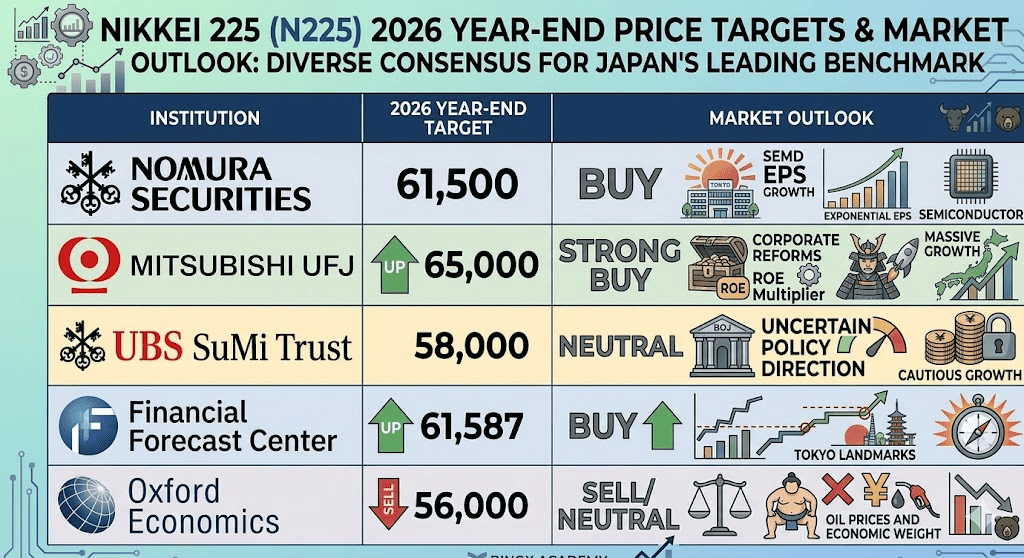
Nikkei 225 forecast 2026 by various financial institutions and analysts
To navigate the historic volatility of the Japanese market, investors must evaluate three probability-weighted scenarios shaped by geopolitical stability, central bank policy, and the global AI capex cycle.
The Bull Case: 65,000 AI and Reform Breakout
The bullish narrative, supported by Nomura and Mitsubishi UFJ, hinges on a Goldilocks resolution to Middle East tensions and a permanent reopening of the Strait of Hormuz. A stabilization of Brent crude toward $80–$85 would spark a massive relief rally, lowering input costs for Japan’s heavy industry and providing the Bank of Japan the breathing room to maintain a supportive 0.75% rate. This macro tailwind allows the Industrial AI theme to take center stage, as global hyperscalers aggressively increase orders for Japanese etching, testing, and lithography equipment.
In this scenario, the projected 11.6% expansion in EPS moves from forecast to reality, driven by record-high profit margins as firms successfully pass on previous price hikes. With the Nikkei 225 clearing the 61,500 resistance, a valuation re-rating toward 23x forward earnings becomes justifiable. Strategic exposure would focus on high-beta semiconductor material players and robotics firms like Fanuc and Keyence, which benefit from both lower energy costs and the secular shift toward automated supply chains, targeting a historic 65,000 year-end finish.
The Base Case: 59,000 – 61,000 Consolidation
The base case envisions a speed correction where the market digests the rapid surge to 60,000 amid a higher-for-longer global interest rate environment. Analysts at Citi and Morningstar suggest that while structural corporate reforms provide a high floor, the BOJ’s rising inflation forecast (now at 2.8%) acts as a persistent ceiling on Price-to-Earnings (P/E) multiples. This creates a distribution phase where the index oscillates between established support at 58,000 and psychological resistance at 61,000, as investors demand proof of concept for the next leg of corporate earnings.
For tactical traders, this is a stock-picker’s market requiring a rotation from momentum-heavy tech into Quality Value. Insights suggest moving toward cash-rich laggards in the Construction, Real Estate, and Finance sectors, which carry significant TOPIX weight and benefit from the normalization of domestic yields. By maintaining a steady ROE near 10%, the index would likely sustain its 60,000 baseline, drifting toward a year-end target of 61,500 as fundamental growth catches up to the post-election valuation spike.
The Bear Case: 55,000 Stagflation Trap
The bear case, warned by Oxford Economics, is triggered by a macro-skunk scenario where Middle East negotiations collapse and oil prices surge north of $110–$120. As a net energy importer, Japan would face a primary driver of demand destruction, turning cost-push inflation into a systemic threat that erodes real household income and forces a contraction in corporate margins. This would leave the BOJ with an impossible choice: hike rates aggressively to 1.0% or 1.25% to defend the yen, or allow currency depreciation to further inflate the national energy bill.
Technically, this downside scenario centers on a decisive break below the 58,000 support level, likely activating systematic trend-following sell programs. A breach of this magnitude would open a trap door toward the 53,000–55,000 zone, effectively wiping out a year of gains and compressing the index's forward P/E back toward its 10-year average of 18.6x. In this hard-landing environment, investors would need to pivot toward defensive hedges, utilizing short futures or inverse ETFs to protect portfolios against a sharp de-rating of growth multiples.
Nikkei 225 Forecasts for 2026 By Financial Institutions
|
Institution |
2026 Year-End Target |
Market Outlook |
|
Nomura Securities |
61,500 |
Buy: Bullish on semiconductor demand and EPS growth. |
|
Mitsubishi UFJ |
65,000 |
Strong Buy: Betting on structural corporate ROE shifts. |
|
UBS SuMi Trust |
58,000 |
Neutral: Cautions on high energy costs and BOJ policy. |
|
Financial Forecast Center |
61,587 |
Buy: Technical momentum suggests a steady climb. |
|
Oxford Economics |
56,000 |
Sell/Neutral: Warns of stagflation risks from oil prices. |
How to Trade the Nikkei 225 (N225) Futures on BingX
Navigate the historic volatility of the 2026 Japanese market using BingX TradFi tools. Whether you are going long on the semiconductor boom or hedging against energy inflation, BingX offers high-liquidity perpetual contracts with competitive leverage.
- Navigate to BingX TradFi and select Global Indices.
- Select the Nikkei-225/USDT perpetual contract.
- Set your leverage, e.g., 2x–20x. Open Long to trade the 65,000 breakout, or Open Short to hedge against BOJ rate hikes.
- Set Take-Profit (TP) and Stop-Loss (SL) based on the 58,000 and 61,500 levels.
Top 5 Risks to Watch for Nikkei 225 Investors in 2026
While the Nikkei 225’s trajectory remains fundamentally bullish, investors must monitor a complex web of geopolitical and macroeconomic black swans that could trigger sudden volatility or a reversal of the 60,000 breakout.
- The Strait of Hormuz: Any disruption to shipping is a direct Black Swan for Japan's energy-heavy economy.
- BOJ Policy Misstep: An overly aggressive rate hike could derail the fragile recovery in domestic consumption.
- Yen (USD/JPY)'s Line in the Sand: A break past 162 against the USD could trigger direct government intervention, causing sudden market spikes.
- U.S. Tech Contagion: As a tech-heavy index, the Nikkei is highly sensitive to earnings misses from the U.S. Magnificent Seven.
- China Slowdown: Any further cooling in Chinese demand could impact Japanese machinery and robotics exports.
Final Thoughts: Is the Nikkei 225 a Buy at 60,000?
In 2026, the Nikkei 225 is no longer just a proxy for a weak yen. It is a barometer of global industrial technology. At the 60,000 level, the index is pricing in significant perfection. For long-term investors, the structural reforms and AI tailwinds offer the most compelling Japan story in 40 years.
However, for tactical traders, the 58,000–61,500 range is a volatile battleground. Until the energy crisis subsides, expect the Nikkei to trade with high intraday sensitivity to crude oil and BOJ rhetoric.
Risk Reminder: Trading global indices involves high volatility. The Nikkei 225 is hypersensitive to geopolitical news and energy prices. Always utilize stop-losses and perform your own due diligence.
Related Reading
- Nasdaq 100 (NAS100) Forecast 2026: 27,000 AI Breakthrough or 22,000 Stagflation Trap?
- S&P 500 Forecast 2026: 7,600 Bull Run or a 6,000 Energy-Driven Crash?
- Crude Oil Price Forecast 2026: $140 War Premium or $60 Surplus Baseline?
- How to Trade Stock Indices With Crypto as TradFi Goes On-Chain in 2026
- Direxion Daily SOXL ETF Forecast 2026: $200 Moonshot or Michael Burry’s Return to Earth Trap?