What Is SK Hynix and Why Is Its US Listing a Big Deal for Global Markets?
If you have been following the artificial intelligence boom, you already know NVIDIA is the undisputed king of AI chips. But there is a hidden gatekeeper to the entire AI gold rush: SK Hynix.
Based in South Korea, SK Hynix is the world’s leading manufacturer of High Bandwidth Memory (HBM), ultra-fast, dense memory chips that are physically stacked and packaged directly alongside NVIDIA's powerhouse AI GPUs like the H100 and B200. Simply put, without SK Hynix’s specialized chips, NVIDIA's AI servers cannot run. SK Hynix currently commands a dominant 50% to 70% share of the global HBM market.
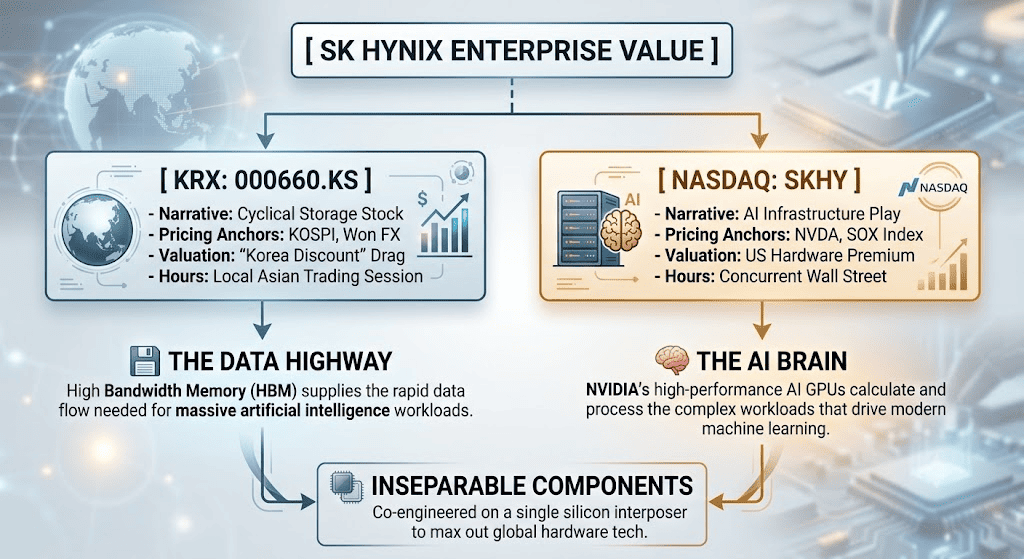
On July 10, 2026, the company will officially list on the Nasdaq Global Select Market under the ticker symbol SKHY. By issuing roughly 17.79 million new common shares structured as ADRs (American Depositary Receipts, simply put, a vehicle allowing foreign stocks to be easily bought and sold on US exchanges), the company plans to raise up to $28.07 billion (43 trillion KRW).
If priced at the upper limit, this won't just be another tech IPO; it will officially surpass Alibaba’s historic 2014 debut valued at $21.8 billion to become the largest ADR listing in Wall Street history.
Read more: SK Hynix (SKHYNIX) Stock Price Prediction 2026: Can AI Memory Leader SKHYNIX Break $1,300?
Why Is SK Hynix Going Public in the US: Overcoming the "Korea Discount"
Up until now, if a US retail investor wanted a piece of SK Hynix, the process was incredibly tedious: you had to set up a specialized international brokerage account, navigate the Korea Exchange (KRX: 000660), and exchange your US dollars for South Korean Won (KRW). By launching an ADR directly on the Nasdaq, anyone can now buy SKHY instantly through standard trading apps, right alongside Apple, AMD, or NVIDIA.
More importantly, this move is designed to shatter the Korea Discount. Historically, South Korean stocks have been deeply undervalued by global investors due to opaque corporate governance, restrictive foreign access rules, and lingering regional geopolitical tensions. If an identical company sits on a US exchange, Wall Street typically assigns it a much higher valuation premium.
By migrating its core AI narrative to New York, SK Hynix aims to ditch its old label as a cyclical commodity memory stock and align its valuation directly with US semiconductor peers like Micron (MU).
Key Timeline of SK Hynix's Nasdaq Listing: The Dates That Matter Most
The structural setup of this listing creates several specific dates in July 2026 that will directly drive trading volume and volatility for both the US ADR and the domestic stock.
SK Hynix Listing Milestone Roadmap
|
Date |
Event |
What It Means for Ordinary Investors |
|
July 6, 2026 |
F-1 Regulatory Price Reset |
The Reference Floor Set: Regulators updated the listing reference price to 2,425,000 KRW, lowering the net funding target by $1 billion to account for recent market dips. |
|
July 10, 2026 |
Nasdaq Exchange Launch |
Trading Begins: This is day one where you can actively buy or sell SKHY directly in your US brokerage account. The ProShares 2x Leveraged ETF (SKHU) also goes live. |
|
July 15, 2026 |
FX Settlement & Capital Inflow |
Currency Shift: Billions of the raised USD will begin converting back into Korean Won to build local factories, potentially boosting a weak Korean currency. |
|
Late July 2026 |
Expected SOX Index Inclusion |
Forced Index Buying: Once fast-tracked into the Philadelphia Semiconductor Index, massive automated index funds like SOXX must automatically buy SKHY shares to match the index, regardless of the price. |
|
July 29, 2026 |
Korean New-Share Listing |
Supply Expansion: The 17.79 million new shares officially enter circulation on the South Korean market, which could introduce short-term selling pressure. |
Unpacking the SK Hynix 2026 Analyst Projections: Financial Engine
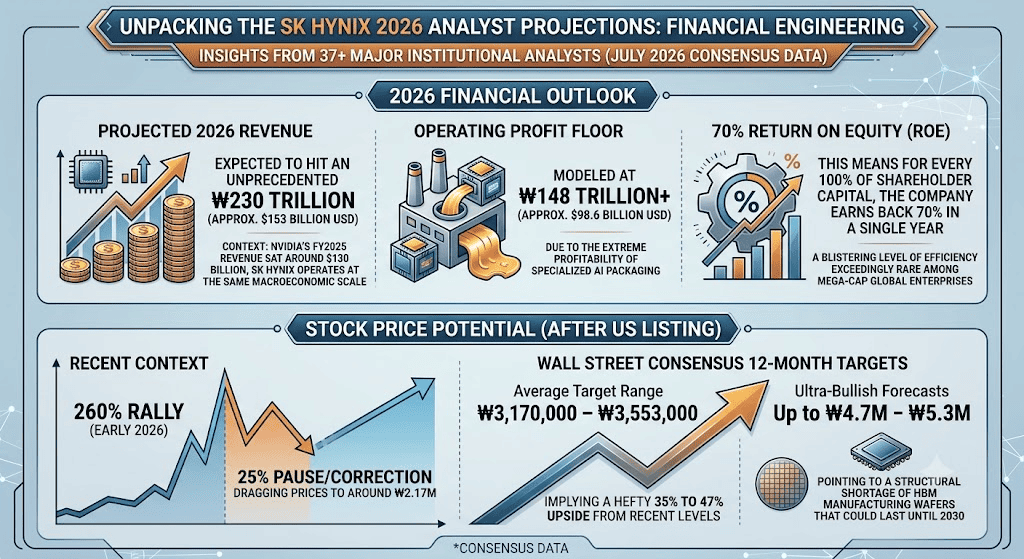
To understand if the stock is fundamentally healthy, we have to look past the IPO noise and check the updated July 2026 consensus data from 37+ major institutional analysts:
- Projected 2026 Revenue: Expected to hit an unprecedented ₩230 Trillion (approx. $153 Billion USD). For context, NVIDIA’s fiscal year 2025 revenue sat around $130 billion, SK Hynix is now operating at that exact same macroeconomic scale.
- Operating Profit Floor: Modeled at ₩148 Trillion+ (approx. $98.6 Billion USD) due to the extreme profitability of specialized AI packaging.
- 70% Return on Equity (ROE): This means that for every 100% of shareholder capital invested, the company is projected to earn back 70% in a single year, a blistering level of financial efficiency that is exceedingly rare among mega-cap global enterprises.
How High Can SK Hynix Stock Go After US Listing?
The stock's massive 260% rally in early 2026 recently paused, giving back 25% of its value during a pre-listing market correction that dragged prices down to around ₩2.17M. However, the broader Wall Street consensus average 12-month target sits between ₩3,170,000 and ₩3,553,000, implying a hefty 35% to 47% upside from recent levels. Ultra-bullish institutional forecasts even stretch as high as ₩4.7M to ₩5.3M, pointing to a structural shortage of HBM manufacturing wafers that could last until 2030.
How Can Everyday Retail Investors Participate in SK Hynix's Listing?
For ordinary market participants looking to gain exposure to the SK Hynix ecosystem, there are now three clear avenues:
- SK Hynix Domestic Common Stock (KRX: 000660): Traded exclusively on the Korea Exchange in Seoul. It requires a local South Korean brokerage account, operates in Korean Won (KRW), and trades during Asian market hours.
- SK Hynix US ADR (Nasdaq: SKHY): Scheduled to officially begin public trading on Wall Street on July 10, 2026. Denominated in USD, 10 ADR shares represent 1 underlying common share.
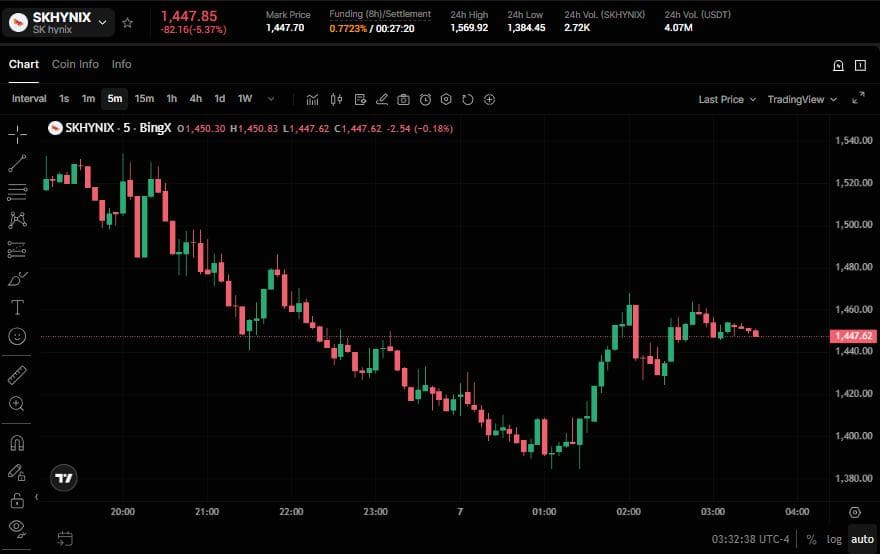
- BingX SKHY (Pre-IPO) Perpetual Futures: Launched on July 6, 2026, this specialized crypto-collateralized derivative allows global traders to speculate on the impending Nasdaq ADR’s valuation before the official July 10 opening bell rings. It trades 24/7 under the ticker SKHY (Pre-IPO), bypassing all traditional market-hour boundaries and traditional banking setup requirements.
- Leveraged ETFs (SKHU): For higher risk tolerance, the new ProShares 2x ETF allows traders to capture amplified daily moves of the Hynix listing directly on the US stock market.
- BingX TradFi Derivatives: For strategic, short-term tactical accounts looking to trade pre-listing momentum or hedge cross-market price gaps between Seoul and New York, the BingX TradFi interface offers equity perpetual contracts to execute long or short strategies with flexible margin configurations.
How to Trade SK Hynix ADR on BingX Pre-IPO
Trading the SKHY(Pre-IPO) contract gives you the unique advantage of front-running Wall Street's official launch day, allowing you to establish long or short exposure based on early retail and institutional sentiment shifts.
Step 1: Transfer Margin
- Log into BingX and ensure you have USDT in your wallet.
- Go to your asset overview and click Transfer.
- Move your trading capital from your Fund Account to your Futures Account.
Step 2: Locate the Contract
- Visit the Pre-IPO or Futures market.
- Type SKHY or SK Hynix into the top-left search bar and click the SKHYNIX perpetual contract to open the trading interface.
Step 3: Configure Risk Parameters
- Select Margin Mode: Choose Isolated (limits risk to the capital allocated to this single trade) or Cross (shares margin across your entire Futures balance).
- Adjust Leverage: Drag the slider to select your leverage multiplier.
Note: Equity perpetuals can experience sharp volatility; using conservative leverage is highly recommended for managing risk.
Step 4: Open a Long or Short Position
- Choose Order Type: Select Market (executes instantly at the current best price) or Limit (executes only when the stock hits your specific target price).
- Enter Position Size: Input the amount of USDT you want to commit or the number of contract units you wish to trade.
- Set Boundaries (Optional): Check the boxes to pre-set your Take-Profit (TP) and Stop-Loss (SL) levels to lock in gains and cap downside exposure.
- Select Direction: Click Buy/Long if you expect the price to rise, or Sell/Short if you want to trade a market drop or hedge an existing spot position.
Step 5: Monitor and Close Your Trade
- Once executed, scroll down to the Positions tab at the bottom of the page to track your live unrealized Profit and Loss (PnL).
- You can adjust your stop-loss targets in real time or click Close to exit the trade instantly.
Five Major Risks Every SK Hynix Investor Must Watch
While the core AI structural narrative is incredibly strong, treating this listing as a guaranteed "up-only" trade is dangerous. Investors should weigh these five critical risks:
- Immediate Shareholder Dilution: Issuing 17.79 million brand-new common shares means existing domestic equity stakes will be diluted by roughly 2.44%, which can act as a short-term drag on share price appreciation.
- Shifting AI Spending Sentiments: The short-term 25% dip in June was caused by Wall Street suddenly questioning whether big tech companies like Meta, Google, and Microsoft will sustain their aggressive AI data center capital expenditures. If AI monetization slows, HBM demand will drop.
- The Leveraged ETF Warning: SK Hynix became a highly crowded, over-leveraged retail momentum trade in South Korea. Local financial watchdogs and the Bank of Korea recently issued formal warnings regarding high-leverage local ETFs, flashing a clear sign that short-term retail speculation had reached overextended levels.
- Currency and Exchange Rate Fluctuation: The South Korean Won is currently hovering near a 17-year low against the US dollar. Because the ADR trades in USD but tracks an asset valued in KRW, any sudden macroeconomic swings in the exchange rate add an extra layer of currency risk for US investors.
- Low Target Bear Case: While the average analyst target is highly bullish, the lowest institutional sell-side models sit between ₩1,030,000 and ₩1,750,000, highlighting that if the semiconductor sector enters a standard cyclical downturn, the downside can be steep.
Final Thoughts: Is SK Hynix (SKHY) a Buy in 2026?
SK Hynix’s Nasdaq launch isn't just a basic corporate fundraising event; it is an epochal re-architecting of how the global financial system prices artificial intelligence infrastructure. The recent 25% dip successfully flushed out over-leveraged retail positions, effectively offering a discounted valuation entry point (20.55 P/E) right before massive US index funds are legally forced to step in and buy billions of dollars worth of stock.
While cyclical memory and macro tech spending risks remain real, owning a piece of the world's premier HBM monopoly through a highly accessible Nasdaq vehicle offers an undeniable structural tailwind for any growth-oriented portfolio.
FAQs on SK Hynix (SKHY) Nasdaq Listing
1. What is the exact stock ticker for the new US listing?
SK Hynix will trade on the Nasdaq Global Select Market under the ticker symbol SKHY starting July 10, 2026.
2. How many US ADR shares equal one original South Korean share?
The structure utilizes a 10-to-1 ratio, meaning 10 Nasdaq ADSs represent 1 underlying common share traded on the Korea Exchange.
3. When will passive index funds start automatically buying SKHY?
A: Fast-track inclusion rules for major semiconductor baskets like the Philadelphia Semiconductor Index (SOX) generally trigger a mid-quarter review or an inclusion sweep within the first 15 to 30 trading days following a mega-cap public debut.
