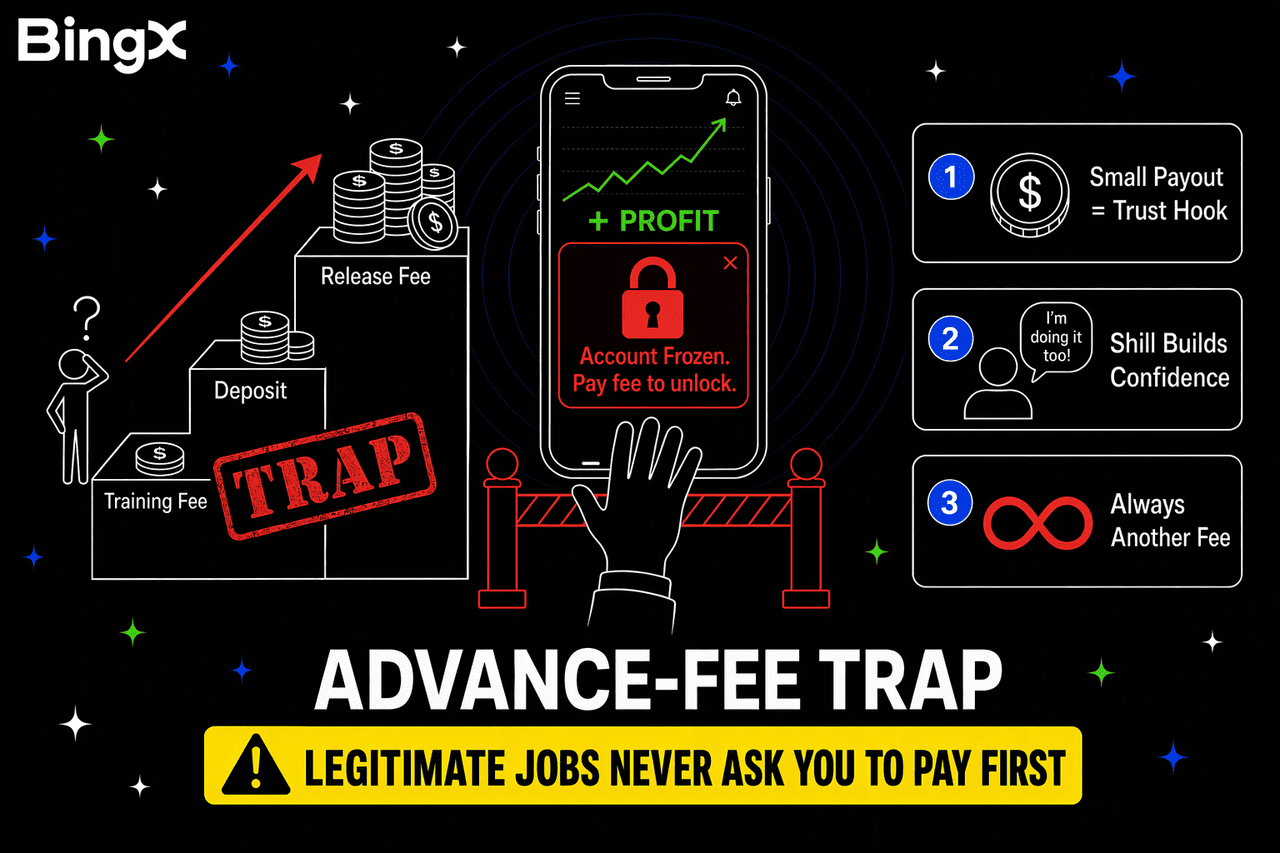
Advance-fee job scams promise easy income through online tasks, remote work, or cryptocurrency-related activities. Instead of paying workers, scammers demand upfront deposits, training fees, or additional payments to access tasks and withdraw supposed earnings. These schemes often begin with small payment requests before escalating into repeated demands for larger amounts.
A typical scheme may start with a work-from-home advertisement promising daily payments and requiring no prior experience. After a brief interview, applicants are offered a position but asked to pay a refundable training fee before starting. Small commissions may arrive on time initially, creating the impression of legitimate employment. However, accessing higher-paying tasks or withdrawing accumulated earnings eventually requires additional deposits and fees. This gradual escalation is designed to build trust before extracting larger payments.
How Do Advance-Fee Job Scams Escalate?
Advance-fee job scams typically develop in stages, starting with small payments to establish credibility before demanding increasingly larger deposits:
- Small payouts build trust: Scammers initially provide small commissions or timely payments to make the tasks appear legitimate and encourage continued participation.
- Fake coworkers reinforce credibility: Other group members share successful withdrawal screenshots or claim to have earned substantial commissions. These accounts may be controlled by the same scam operation to create false social proof.
- Larger deposits promise higher commissions: Once trust is established, participants are encouraged to deposit more money to unlock premium tasks or higher commissions, sometimes advertised at 30% or more.
- Withdrawals become restricted: When participants attempt to withdraw their accumulated earnings, the platform demands additional payments for guarantees, taxes, or account-unfreezing fees. Each payment leads to another requirement until the operation disappears or payments stop.
What Are 3 Common Warning Signs of Advance-Fee Job Scams?
Although these scams take different forms, most share three characteristics:
- Small payments create false confidence: Initial commissions or successful withdrawals make the opportunity appear legitimate and encourage further deposits.
- Fake relationships build trust: Scammers use fake coworkers, mentors, or customer support representatives to reassure participants and make the operation appear credible.
- Additional payments are repeatedly required: Training fees, task deposits, guarantees, and withdrawal charges create ongoing reasons to demand more money without releasing the promised earnings.
The One Rule to Avoid Advance-Fee Job Scams
Legitimate employment should not require workers to deposit cryptocurrency to access tasks, earn commissions, or withdraw their wages. Requests for upfront training fees, account activation deposits, or payments to unlock earnings are major warning signs.
BingX also advises against transferring funds to personal accounts or private wallet addresses in response to job offers or supposed withdrawal requirements. Whether described as a task deposit, release fee, or account guarantee, these requests should be treated as suspicious. Stop communicating with the sender and verify the opportunity through independent official channels before transferring any funds.
Already Paid? Here's What to Do Next
If funds have already been transferred to a suspected advance-fee scam, stop further payments and preserve evidence of the transactions.
- Stop sending additional money: Do not pay further training fees, deposits, taxes, or withdrawal charges, even if the platform promises to release existing earnings.
- Preserve transaction records: Save the platform details, wallet addresses, transaction hashes, payment receipts, chat histories, and screenshots.
- Report the suspicious account: Use the relevant platform's reporting tools and contact BingX Support if the incident involves cryptocurrency transfers or BingX-related impersonation.
- Report the incident to authorities: Contact local law enforcement or an appropriate anti-fraud authority and provide the available transaction records. Cryptocurrency transfers are generally irreversible, so recovery is not guaranteed.
Risk Reminder: Crypto trading involves volatility and the potential loss of principal, while advance-fee scams can result in permanent financial losses. This article is for security education only, not investment advice. Always verify employment opportunities and payment requests through official channels, and contact BingX Support for account-related concerns.
