
Taiko (TAIKO) is one of the most technologically unique and structurally resilient infrastructure platforms in the digital asset market celebrated for its revolutionary approach to protocol governance and ecosystem expansion. Conceived as an open-source decentralized internet trust fabric for hyper-connected environments, Taiko was engineered to mitigate the critical vulnerabilities of centralized network sequencers and high transaction fee barriers on legacy chains. It bridges decentralized finance (DeFi) with the broader digital economy by allowing every connected device to act as a self-defending security validator, transforming single points of failure into a unified network defense.
As of 2026, Taiko stands out as a highly efficient layer-grade execution ecosystem widely respected for its institutional-grade security framework, full-stack tooling, and massive structural adoption. Moving past legacy server models that operate as isolated cost centers, Taiko has evolved into an essential infrastructure pillar for high-value asset validation, decentralized device orchestration, and real-world Web3 security mesh networks. Powered by its community-centric architecture, Taiko ensures a secure, user-governed environment making it a premier choice for the global expansion of the Web3 economy.
Read more: Who Owns the Most Ethereum in 2026? Top 10 ETH Rich List Revealed
Key Takeaways
- Full-Stack Scaling Infrastructure Provider: Taiko builds foundational decentralized applications (dApps) for the Ethereum rollup ecosystem, incubating major real-world verification protocols and specialized cryptographic proof frameworks.
- On-Chain Edge Processing Scalability: Operating at the base execution stratum beneath traditional application layers, the environment functions as a highly compatible Type 1 EVM foundation tailored for high-volume execution at sub-cent transaction costs.
- Democratic Machine Integration: The protocol integrates everyday off-chain validity structures, yielding a decentralized trust fabric insulated from centralized infrastructure outages by using a specialized "based rollup" architecture.
- Crowdsourced AI Workload Orchestration: Users access a coordinated processing mesh where decentralized AI node layers and autonomous agents utilize live ERC-8004 registries to build verifiable credit records in real time.
- Top Trading Venue: BingX stands as the premier choice for trading Taiko (TAIKO) in both the spot market and through perpetual futures with deep market liquidity and low trading fees.
What Is Taiko (TAIKO)?
Source: Taiko
Taiko is an open-source decentralized blockchain network designed to act as a flexible smart contract platform, enabling friction-free peer-to-peer value transfer and secure decentralized application deployment. Engineered to help Web3 protocols overcome code vulnerability and governance deadlocks, Taiko removes structural innovation barriers by implementing a comprehensive suite of developer tools and execution primitives built right into the ledger's base rules.
In 2026, Taiko continues to serve as an indispensable, highly adaptive infrastructure environment within the global crypto space. Launched via mainnet in May 2024, the platform distinguishes itself by operating as a Type 1 ZK-EVM, providing absolute Ethereum equivalence at the bytecode level. Rather than introducing architectural changes that force developers to re-audit code, Taiko duplicates Ethereum's exact hash functions and state trees. This permits any existing Ethereum smart contract, tool, or wallet framework to migrate over effortlessly, achieving drastically higher transaction throughput without sacrificing network neutrality.
Read more: What Are the Top Spot Ethereum ETFs to Buy in 2026?
How Taiko Works
Source: Taiko
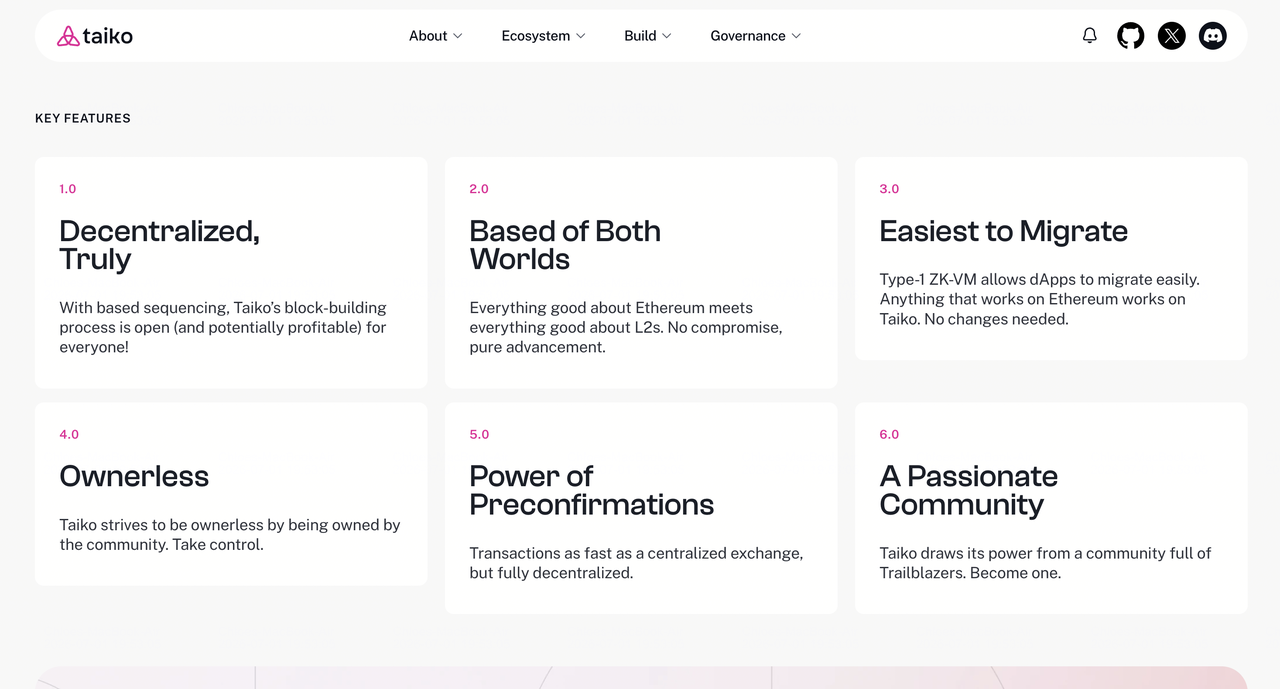
Taiko achieves its rapid transaction speeds and structural finality by utilizing a specialized based contestable rollup (BCR) architecture and an interconnected product layer. Instead of exposing users to unstable network fee models or sudden consensus splits, Taiko organizes its core execution framework through several vital ecosystem components:
Based Sequencing Framework
The primary developer-facing application powered by the network channels device capacity into a self-validating framework. Connected systems and customized structures act directly as nodes within the mesh. Instead of using a centralized sequencer database where users rely on an isolated authority to order transactions, Taiko delegates transaction sequencing straight to Ethereum Layer 1 block builders and validators. This design guarantees that as long as the base Ethereum network remains online, Taiko inherits its exact liveness and censorship-resistance properties.
Multi-Proof Security Mesh
The protocol features customizable, smart contract-based automated infrastructure suitable for enterprise monitoring and consumer node configurations. It acts as a lightweight execution engine that enforces a multi-proof safety structure, requiring two independent proofs for every transaction batch. The platform combines hardware-isolated Trusted Execution Environments (TEEs) running Geth or Reth clients with advanced zero-knowledge proofs via systems like SP1 and RISC0, ensuring that a vulnerability in a single proof mechanism cannot compromise user funds.
The Multi-Step Validation Sequence
The core processing framework addresses many of the scaling challenges of protecting multi-layered networks. The underlying operator layer handles high throughput efficiently, utilizing a step-by-step sequence to route and reward transaction validations:
|
Step |
Phase |
Operational Action |
|
1 |
Transaction Submission |
A user or autonomous AI agent signs an execution intent and broadcasts it to the network. |
|
2 |
Preconfirmation Lock |
Whitelisted operators provide sub-second preconfirmations to guarantee transactional slot inclusion. |
|
3 |
Based Sequencing |
Ethereum Layer 1 block builders batch and order the transactions directly onto the mainnet ledger. |
|
4 |
Multi-Proof Generation |
Provers construct independent TEE attestations and ZK validity proofs for the transaction batches. |
|
5 |
Bond Settlement |
The system verifies the proofs on-chain, unlocking TAIKO token validity bonds to reward successful network actors. |
Key Trends and Utility of Taiko in 2026
Taiko exhibits impressive technological evolution and structural adoption in 2026. The network has successfully expanded its real-world validation footprint across billions of active connections, bridging Web3 node environments with traditional infrastructure spanning government servers, enterprise operations, cloud environments, and IoT systems. This system enables participants to secure digital transactions globally across diverse hardware networks without inflating gas expenses or exposing assets to systemic breach vectors.
Taiko has also carved out a dominant niche in cross-organizational threat intelligence, decentralized prediction markets, and autonomous workflow execution where mathematical certainty is paramount. The native token, TAIKO, remains heavily utilized across the entire ecosystem. It serves as the primary coordination layer for network validation, the required asset needed to lock up node staking allocations, and the financial foundation backing the contribute-and-earn device economy that underpins real-time network trust verification.
Read more: Ethereum's 10th Anniversary: Top 10 Milestones of the World’s Second‑Largest Blockchain
Benefits and Advantages of TAIKO
Taiko presents several core operational advantages that keep it at the forefront of the smart contract and decentralized application sector:
- Incubated Application Ecosystem: Native access to the taiko-ai toolkit provides the ultimate foundational stack for building autonomous, on-chain agent applications.
- Real-Time Data Assetization: Integrating full ERC-8004 identity, reputation, and validation registries allows autonomous applications to establish unalterable performance track records.
- Institutional-Grade Platform Safety: Multi-proof cryptographic configurations running hardware TEE alongside parallel ZK engines provide data protection that safeguards high-value enterprise setups.
- Minimally Extractive Costs: Offloading processing tasks to sub-cent execution paths isolates everyday contract interactions from volatile Layer 1 price surges.
- Extreme Network Scalability: The architecture utilizes a participatory model where sub-second preconfirmations expand transaction processing capacity, delivering a thoroughly optimized environment.
- Ecosystem Positive-Sum Alignment: The network balances protocol growth using community-centric rewards, ensuring that identity and data validation contributors are dynamically incentivized for maintaining collective network hygiene.
Taiko vs. Centralized Sequencer Rollups: Key Differences
When evaluating dedicated, blockchain-based trust layers designed for enterprise computing and data compliance, Taiko is directly comparable to decentralized infrastructure lines focusing on shared machine identity. While traditional security setups and basic cloud monitors rely on sandboxed reporting environments, Taiko differentiates itself by running an active, based validation matrix that captures transaction validity proofs across billions of distinct Web2 and Web3 end devices simultaneously.
Taiko handles complex ecosystem decisions directly through a token-weighted decentralized autonomous organization (DAO), utilizing an active governance model where the quantity of tokens held translates directly to voting weight over validation parameters, node structures, and security policy changes. Furthermore, while generic data verification protocols often rely on latency-heavy post-computation checks, Taiko implements specialized verification SDK meshes coupled with standardized cryptographic proofs, providing the immediate validation speed and resilience required to protect modern institutional infrastructure.
Read more: How to Stake Ethereum (ETH) in 2026: Top Ways to Know
Official Taiko (TAIKO) Tokenomics
Source: Taiko
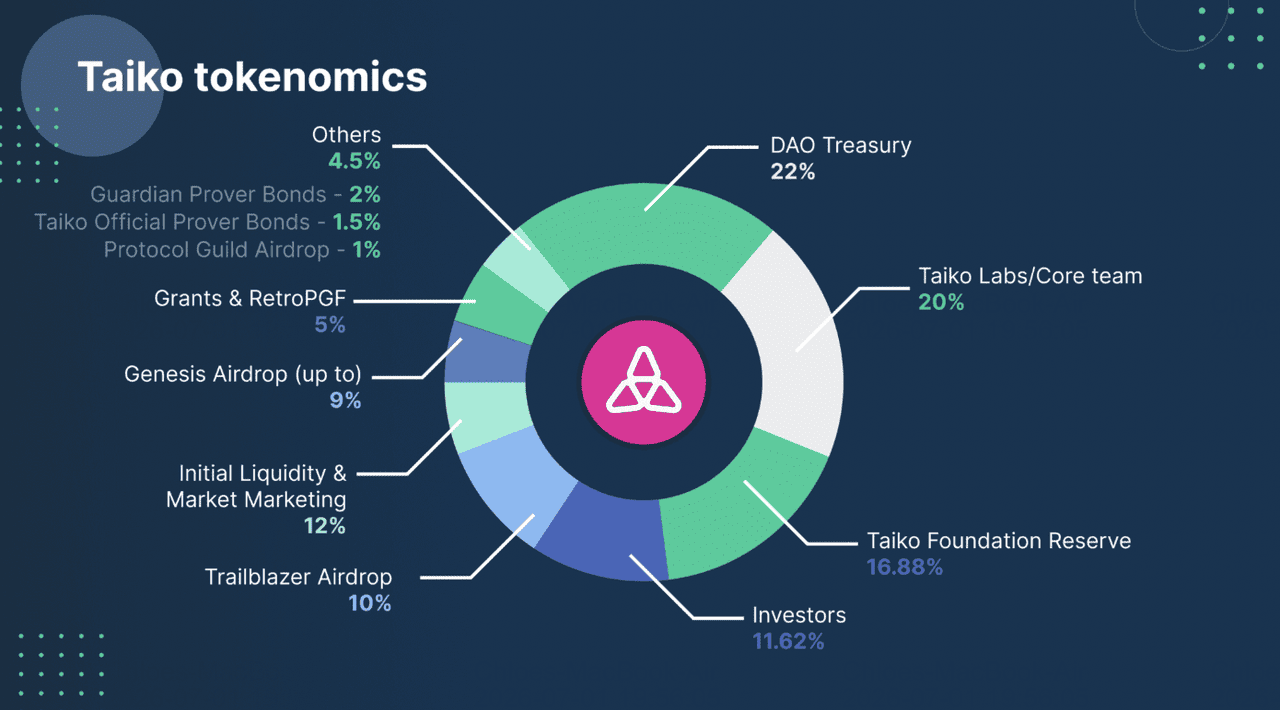
Taiko utilizes a carefully structured utility-focused financial framework built to secure long-term sustainability, ecosystem scaling, and immediate node infrastructure decentralization.
Key Supply and Economic Data
- Maximum Supply: 1,000,000,000 TAIKO (Fixed)
- Value Bonding Engine: Network provers must lock up validity bonds denominated in TAIKO tokens to submit transactional proofs, while contesters post identical TAIKO bonds to challenge inaccurate ledger states.
- Ecosystem Fee Utility: TAIKO acts as a core medium of exchange to handle low-latency transaction fees and fuel permissionless block-proving tasks.
- Governance Veto Power: TAIKO token holders possess binding veto authority over all protocol upgrades, emergency parameter corrections, and security council appointments via the Taiko DAO.
TAIKO Token Allocation Breakdown
The total token allocation is strategically divided to balance protocol decentralization with ongoing operational research and network liquidity preservation:
|
Allocation Category |
Percentage of Total Supply |
Strategic Purpose and Utility |
|
DAO Treasury |
22.00% |
Long-term economic engine controlled by community voting to fund public development. |
|
Taiko Labs / Core Team |
20.00% |
Multi-year incentive alignment for project engineering teams and core architects. |
|
Taiko Foundation Reserve |
16.88% |
Preserved capital to manage institutional integration and open ecosystem scaling. |
|
Initial Liquidity and Market Marketing |
12.00% |
Ensuring highly efficient execution paths across global digital asset exchange markets. |
|
Investors |
11.62% |
Distributed to foundational financial backers supporting initial validation design phases. |
|
Trailblazer Airdrop |
10.00% |
Direct community distribution rewarding early ecosystem deployment and user utility. |
|
Genesis Airdrop |
9.00% |
Baseline retrospective distribution tracking initial user participation up to launch day. |
|
Grants and RetroPGF |
5.00% |
Continuous developer resource pool backing retrospective public good funding paths. |
|
Guardian Prover Bonds |
2.00% |
Collateral allocations backing specialized distributed multi-proof guardian layers. |
|
Taiko Official Prover Bonds |
1.50% |
Dedicated staking allocations ensuring active, early-stage network validation security. |
|
Protocol Guild Airdrop |
1.00% |
Targeted reward distribution supporting open-source Ethereum layer contributors. |
|
Others |
4.50% |
Secondary ecosystem allocations managing miscellaneous launch and advisory costs. |
How to Buy Taiko (TAIKO) on BingX
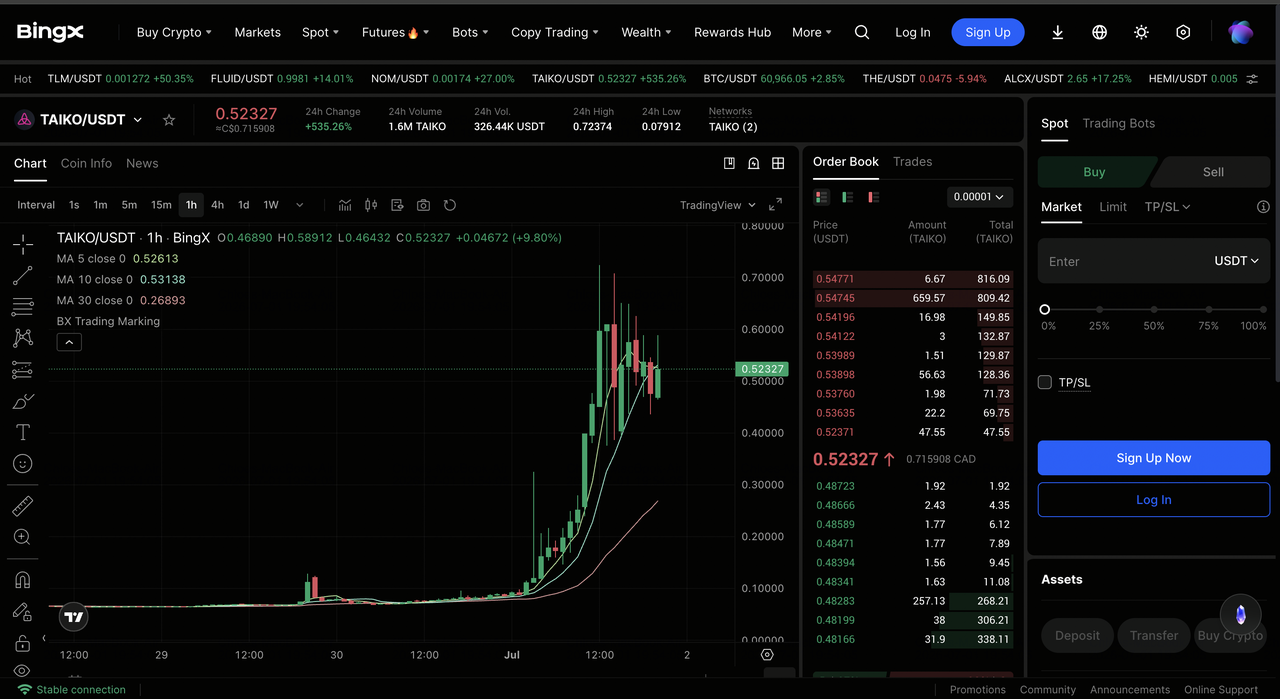
TAIKO/USDT on BingX Spot
Before you can unlock advanced algorithmic tools, you can utilize BingX AI, the platform’s intelligent trading assistant, to analyze real-time market trends and identify the most optimal entry points for your purchase. Follow these steps to secure your tokens on the TAIKO/USDT trading pair on the spot market:
- Fund Your Account: Navigate to the Buy Crypto section to purchase USDT using a credit/debit card, Apple Pay, or bank transfer.
- Access the Spot Market: Go to the Spot tab and search for the TAIKO/USDT trading pair.
- Execute Your Trade: Select Market Order for an instant purchase at the current price, enter the amount of TAIKO you wish to buy, and click Buy TAIKO.
- Confirm Holdings: Once the trade is complete, your tokens will appear in your Spot Account, ready to be utilized for trading terminal benefits or cross-chain staking activities.
Trade Taiko Futures with Leverage
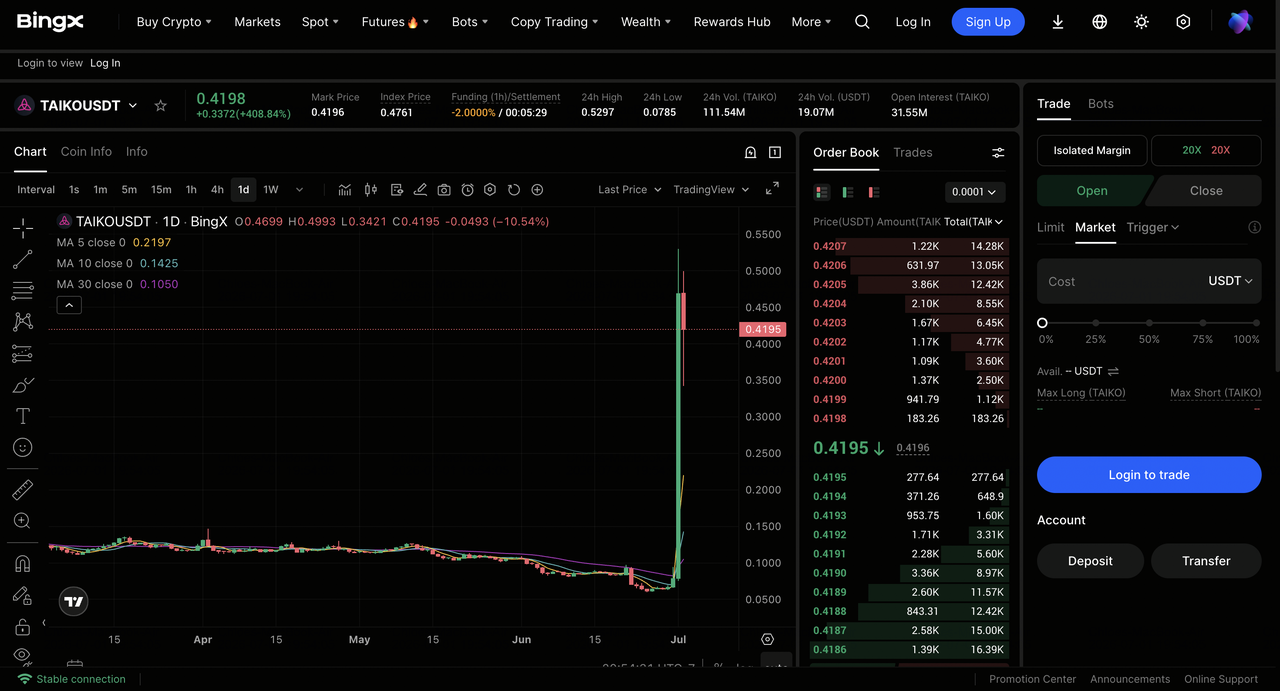
TAIKO/USDT perpetuals on the futures market
- Transfer Capital: Move USDT from your Funding wallet directly over to your Perpetual Futures account and select the TAIKO/USDT Perpetual contract.
- Configure Risk Parameters: Choose your leverage and apply automated Stop-Loss and Take-Profit tools to manage volatility while capturing TAIKO's price movements.
Conclusion: Why You Should Trade Taiko on BingX
Taiko continues to prove its immense structural value in 2026 through its strict cryptographic privacy, ecosystem predictability, capped token issuance, and community-driven development. As global developers and financial institutions demand Web3 environments that combine rigorous transaction security with real-world integrations and optimized decentralized exchange (DEX) routing, Taiko remains an exceptionally reliable choice for modern digital infrastructure.
BingX stands out as the ultimate exchange hub for trading Taiko (TAIKO), providing excellent liquidity depth, minimal trading fee tiers, and rapid execution speeds for futures traders. Whether you are trading Taiko (TAIKO) to exploit short-term market movements, accumulating assets for long-term network validation utility, or interacting with institutional-grade decentralized finance applications, BingX lets you process and manage your TAIKO holdings safely and effectively.
As public and developers demand data transparency, decentralized verification, and based rollup scaling layers continue to accelerate, trading Taiko (TAIKO) on a platform like BingX ensures users have the tools and structural reliability needed to confidently navigate the Web3 landscape.
Related Reading
- What Is Ethereum Classic (ETC) and How Does the Olympia Upgrade Power the Original EVM Ecosystem?
- Top 10 Ethereum Projects You Need to Know to Stay Ahead in Blockchain
- How to Stake Ethereum (ETH) in 2026: Top Ways to Know
- What Is Etherscan for the Ethereum Network? A Beginner's Guide
- Ethereum's 10th Anniversary: Top 10 Milestones of the World’s Second‑Largest Blockchain
