Bitcoin mining stocks have become one of the most dynamic corners of the market in 2026, and the reason is no longer just Bitcoin. Faced with post-halving pressure on mining margins, the largest miners have discovered that their most valuable asset is not their hashrate but their power: gigawatts of secured electricity, grid connections, and data center sites that artificial intelligence (AI) companies are desperate to access. The result is a sector rapidly repositioning from pure Bitcoin miners into AI and high-performance computing (HPC) infrastructure providers, even as Bitcoin itself has traded lower for much of the year.
This guide focuses on the key Bitcoin mining stocks in 2026, grouped by how far each has moved along the AI pivot: from BTC-focused miners, to hybrids running both Bitcoin and AI, to companies that have largely become AI infrastructure providers. The article explains how each name fits this transition and how global traders can gain exposure to selected stocks on BingX TradFi through USDT-margined perpetual contracts.
2026 Bitcoin Mining Market Trend: The Shift From Mining to AI Infrastructure
The 2026 Bitcoin mining cycle is being reshaped by a simple shift: miners already control the power, land, and grid connections that AI data centers need. As mining economics tighten and AI hosting becomes more valuable, several operators are repositioning themselves as digital infrastructure companies rather than pure Bitcoin miners. Four forces explain why the transition is accelerating.
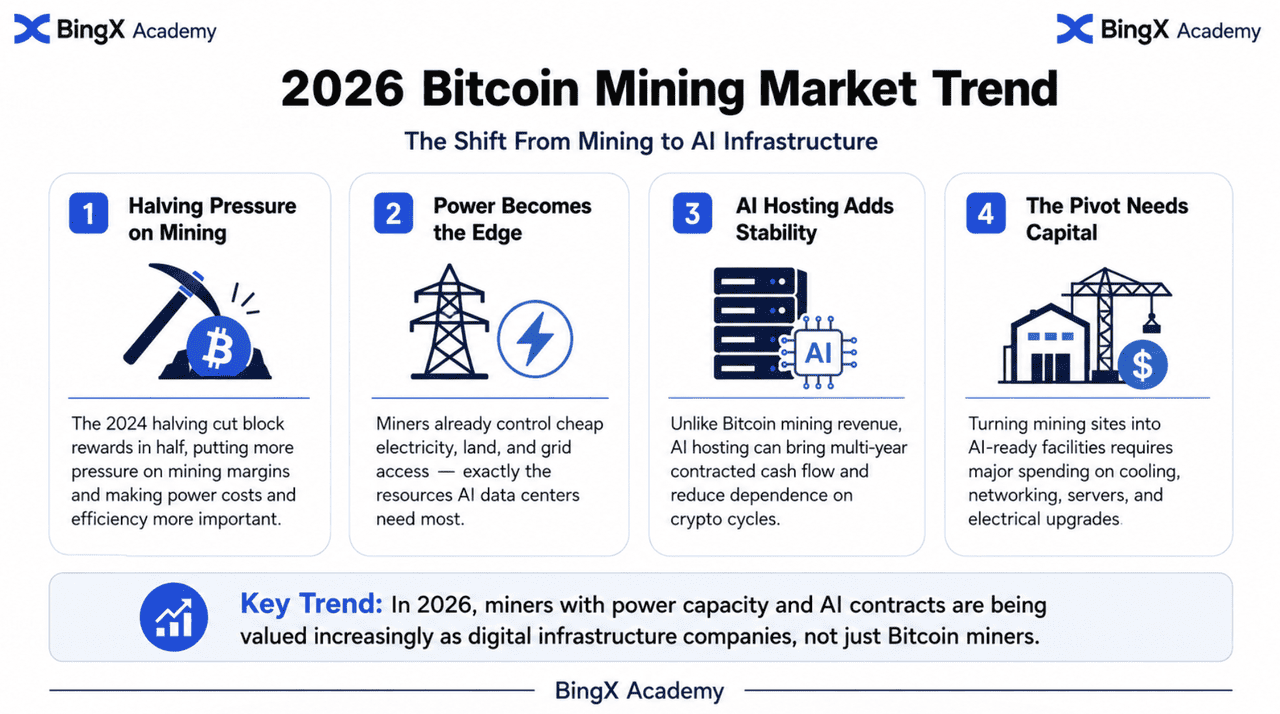
- The 2024 halving made Bitcoin mining less profitable. The block reward was cut in half due to the Bitcoin halving in 2024, putting more pressure on mining margins and increasing the importance of electricity costs and machine efficiency. That has pushed miners to look for higher-value uses for existing sites.
- Miners already control the resource AI needs most: power. Large mining facilities were built around cheap electricity and secured grid connections, exactly what AI data centers increasingly struggle to obtain. Converting part of that capacity to AI and high-performance computing can generate more revenue per megawatt than traditional Bitcoin mining.
- AI hosting can provide longer-term contracted revenue. Bitcoin mining revenue changes with BTC prices, network difficulty, and transaction fees. AI hosting agreements can instead provide multi-year contracted cash flows, helping miners with large customers become less dependent on crypto-market cycles.
- The AI conversion requires billions of dollars in new investment. Mining facilities need major upgrades in cooling, networking, servers, and electrical infrastructure before they can support AI workloads. Miners are therefore raising debt, issuing equity, selling Bitcoin holdings, and partnering with infrastructure investors to fund the transition.
The key trend in 2026 is that Bitcoin miners are increasingly being valued on two businesses at once: Bitcoin production and AI infrastructure. Companies with secured power and signed AI contracts can trade more like data center operators, while miners without meaningful AI exposure remain more closely tied to Bitcoin prices and mining economics.
2026 Bitcoin Mining Key Companies and Comparison by AI-Pivot Stage
Bitcoin mining stocks now range from pure-play miners to companies increasingly focused on AI and high-performance computing infrastructure. This comparison shows where each company sits in the 2026 transition.
|
Company |
Ticker |
Primary Role |
Key Advantages |
What to Watch in 2026 |
|
MARA Holdings |
MARA |
Bitcoin miner and BTC holder |
One of the largest Bitcoin miners with a substantial corporate Bitcoin treasury |
Hashrate growth, Bitcoin holdings, and early AI infrastructure expansion |
|
Riot Platforms |
RIOT |
Hybrid miner and AI hosting developer |
Large-scale power sites that can support both mining and AI data centers |
Texas power capacity, AI/HPC hosting buildout, and customer agreements |
|
CleanSpark |
CLSK |
U.S. Bitcoin miner with AI ambitions |
Efficient mining fleet and expanding infrastructure footprint |
Hashrate growth, AI/HPC pipeline, and power expansion |
|
IREN |
IREN |
AI infrastructure and Bitcoin mining |
Large power portfolio increasingly redirected toward AI cloud and data centers |
AI revenue mix, hyperscaler contracts, and GPU infrastructure expansion |
|
TeraWulf |
WULF |
AI data center and Bitcoin mining operator |
Power-rich sites and growing long-term AI hosting exposure |
AI hosting leases, new data center capacity, and power expansion |
|
Cipher Digital |
CIFR |
HPC data center and Bitcoin mining operator |
Existing power and data center assets being converted toward AI and HPC hosting |
New AI hosting revenue, data center conversions, and project execution |
2026 Bitcoin Mining Market Overview: How AI Is Reshaping the Sector
The 2026 Bitcoin mining cycle is being reshaped by a clear shift: investors are increasingly valuing miners for their power, data center capacity, and AI infrastructure potential rather than Bitcoin exposure alone. Pure miners, hybrid operators, and companies further along the AI pivot are now trading on very different fundamentals. Four forces explain where the strongest re-rating is happening.
- AI-focused miners are outperforming Bitcoin, with some stocks up around 80% to 90%. TeraWulf gained roughly 85% year to date and Riot around 90%, even as Bitcoin traded lower for much of 2026. The divergence shows how strongly the market is rewarding AI infrastructure exposure over pure mining beta.
- AI hosting contracts are creating tens of billions of dollars in potential value. Miners collectively sold more than 32,000 Bitcoin in Q1 2026 as they raised capital for AI infrastructure, while industry-wide hosting agreements are estimated at roughly $70 billion. Multi-billion-dollar contracts with AI cloud providers are giving some miners a new source of long-term revenue.
- Power capacity is becoming a key valuation metric. Investors are paying more attention to how many megawatts or gigawatts of electricity a miner controls and how quickly that capacity can be converted to AI workloads. Riot’s 1-gigawatt Texas site shows why secured power and grid access are becoming as important as hashrate.
- The AI pivot could require more than $50 billion in near-term funding. Converting mining sites into AI-ready data centers requires GPUs, servers, cooling, networking, and major electrical upgrades. Industry estimates point to a near-term funding gap of about $50 billion and long-term capital needs above $221 billion, keeping financing and execution risk high.
What Are the Top Bitcoin Mining Stocks in 2026?
Six companies stand out across the Bitcoin mining and AI infrastructure spectrum:
- Bitcoin mining and treasury: MARA Holdings (MARA)
- Bitcoin mining with growing AI infrastructure exposure: Riot Platforms (RIOT) and CleanSpark (CLSK)
- AI infrastructure and high-performance computing: IREN (IREN), TeraWulf (WULF), and Cipher Digital (CIFR)
Together, these six stocks offer different levels of exposure to Bitcoin mining, power infrastructure, and the AI data center transition shaping the sector in 2026.
A. BTC-Focused Miners
These companies remain primarily Bitcoin miners, offering the most direct equity exposure to Bitcoin's price and network economics. They are exploring AI but still derive most of their value from mining and Bitcoin holdings.
1. MARA Holdings (MARA)
Core Role: Large-scale Bitcoin miner and BTC treasury holder
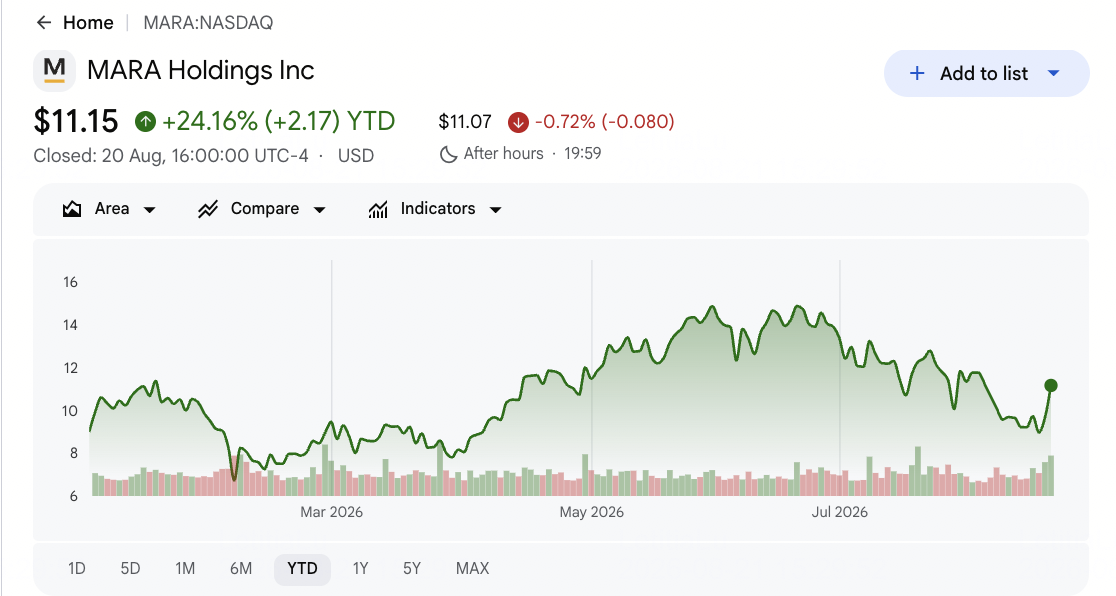
MARA Holdings, formerly Marathon Digital, is one of the world’s largest Bitcoin miners and one of the biggest corporate holders of Bitcoin. Its strategy combines large-scale mining with holding much of the Bitcoin it produces, giving investors relatively direct exposure to both mining economics and BTC prices. MARA has started exploring AI and data center opportunities, including an investment in French AI infrastructure company Exaion, though Bitcoin remains its core business.
MARA operates at roughly 72 EH/s of hashrate and holds a large Bitcoin treasury, making its stock highly sensitive to Bitcoin price movements. Compared with miners moving aggressively into AI hosting, MARA remains closer to a pure Bitcoin play. The main risks are Bitcoin volatility, tighter post-halving mining margins, and potential shareholder dilution as the company raises capital to expand operations and accumulate more BTC.
MARA Price Trend (2020-2026 YTD)
|
Year |
Yearly High |
Yearly Low |
Annual Return |
Market Conditions |
|
2020 |
$12.00 |
$1.00 |
250% |
Early mining expansion; BTC bull market begins |
|
2021 |
$83.00 |
$9.00 |
330% |
Crypto bull run; mining capacity surge |
|
2022 |
$34.00 |
$3.00 |
-87% |
Crypto winter; miner distress |
|
2023 |
$28.00 |
$3.50 |
290% |
Recovery; hashrate expansion |
|
2024 |
$34.00 |
$12.00 |
-12% |
Halving; treasury strategy; volatility |
|
2025 |
$28.00 |
$10.00 |
-35% |
Post-halving pressure; BTC consolidation |
|
2026 YTD |
~$22 (est.) |
~$10 (est.) |
-25% YTD |
~72 EH/s; BTC treasury; slower AI pivot |
B. Hybrid Miners: Bitcoin Plus AI
These companies continue mining Bitcoin at scale while building out AI and HPC hosting on their large power sites. They offer a balance of Bitcoin exposure and AI infrastructure upside, without fully abandoning mining.
2. Riot Platforms (RIOT)
Core Role: Bitcoin miner expanding into AI and HPC hosting
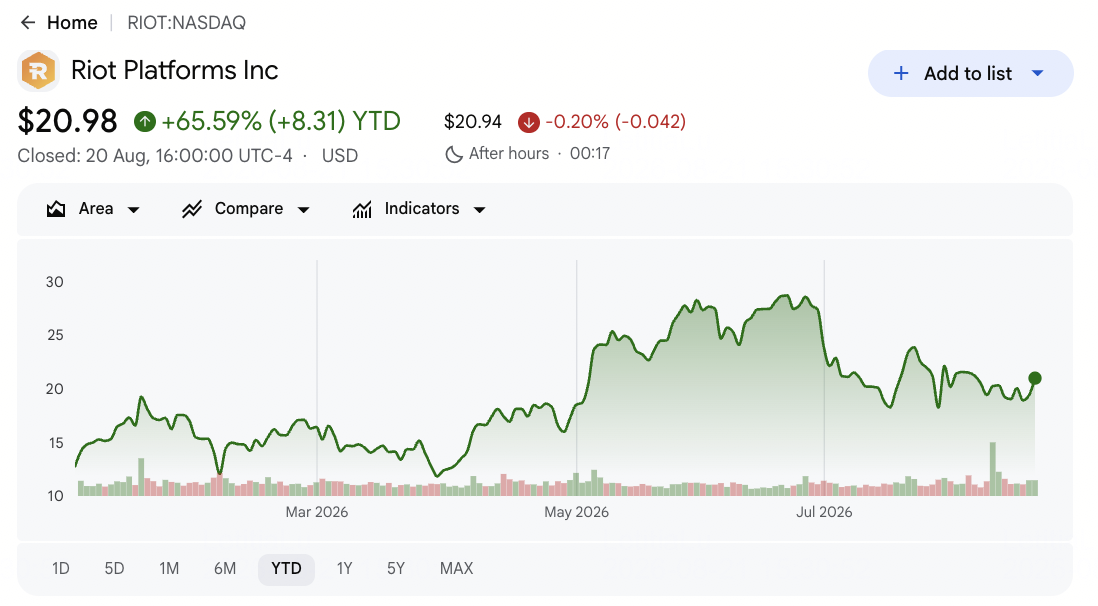
Riot Platforms is one of the largest U.S. Bitcoin miners, with major power infrastructure in Texas, including its Rockdale facility and a 1-gigawatt site in Navarro County. In 2026, the company has increasingly looked to use this power capacity for AI and high-performance computing, giving Riot exposure to both Bitcoin mining and the growing demand for AI data centers.
Riot has also been one of the stronger-performing mining stocks as investors increasingly value its large power footprint and AI potential. The company now generates revenue from both Bitcoin mining and data center operations, with further upside depending on how quickly it can convert available power into AI-ready capacity. The main risks are high development costs, execution delays, and continued exposure to Bitcoin prices, but Riot offers one of the clearest combinations of mining and AI infrastructure in the sector.
RIOT Price Trend (2020-2026 YTD)
|
Year |
Yearly High |
Yearly Low |
Annual Return |
Market Conditions |
|
2020 |
$22.00 |
$1.00 |
300% |
Mining expansion; BTC bull market |
|
2021 |
$79.00 |
$14.00 |
130% |
Crypto bull run; Texas buildout |
|
2022 |
$28.00 |
$4.00 |
-85% |
Crypto winter; mining margin collapse |
|
2023 |
$20.00 |
$4.00 |
350% |
Recovery; power strategy; hashrate growth |
|
2024 |
$18.00 |
$7.00 |
-30% |
Halving; Corsicana buildout; AI exploration |
|
2025 |
$22.00 |
$6.00 |
-10% |
AI/HPC pivot begins; power positioning |
|
2026 YTD |
~$24 (est.) |
~$8 (est.) |
+90% YTD |
1 GW Texas site; AI hosting; data-center revenue |
3. CleanSpark (CLSK)
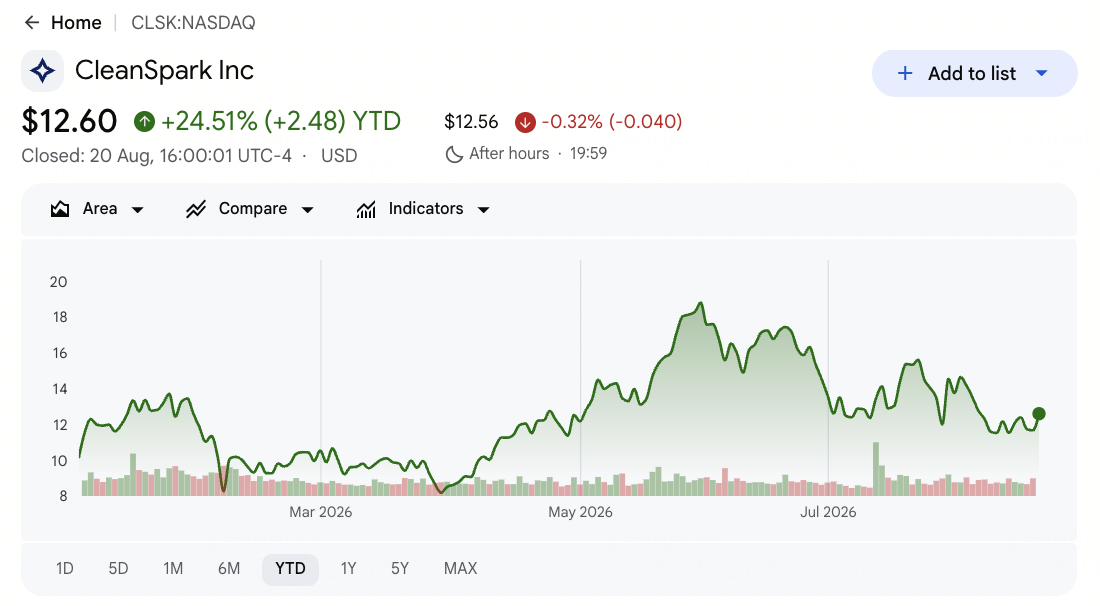
Core Role: Efficient U.S. Bitcoin miner with growing AI infrastructure exposure
CleanSpark is a major U.S. Bitcoin miner known for efficient operations and a large domestic mining footprint. It reached 50 EH/s of hashrate using U.S.-based infrastructure and continues to make Bitcoin mining the center of its business, supported by a sizable BTC treasury and access to large amounts of power.
In 2026, CleanSpark has also started building an AI and high-performance computing pipeline, using its existing energy and data center assets to pursue new infrastructure opportunities. The AI strategy is still earlier than peers such as IREN or TeraWulf, so the stock remains more closely tied to Bitcoin mining. The main risks are Bitcoin price volatility, high capital requirements, and execution on the AI expansion, while the potential upside comes from combining efficient mining with longer-term AI infrastructure growth.
Read More: CleanSpark (CLSK) Price Prediction 2026: $27.00 AI Hyperscaler or 32% Short-Squeezed Mining Trap?
CLSK Price Trend (2020-2026 YTD)
|
Year |
Yearly High |
Yearly Low |
Annual Return |
Market Conditions |
|
2020 |
$22.00 |
$1.50 |
400% |
Early mining pivot; BTC bull market |
|
2021 |
$37.00 |
$8.00 |
-30% |
Crypto bull run; capacity expansion |
|
2022 |
$18.00 |
$2.00 |
-75% |
Crypto winter; efficiency focus |
|
2023 |
$12.00 |
$2.00 |
440% |
Recovery; hashrate growth; acquisitions |
|
2024 |
$24.00 |
$7.00 |
5% |
Halving; 50 EH/s milestone; efficiency lead |
|
2025 |
$22.00 |
$8.00 |
-20% |
Renewable focus; AI pipeline begins |
|
2026 YTD |
~$14 (est.) |
~$8 (est.) |
+20% YTD |
50 EH/s; AI/HPC pipeline; renewable power |
C. Full AI-Pivot Miners
These companies have moved furthest from Bitcoin mining, repurposing their sites into AI and HPC data centers with hyperscaler contracts. They trade increasingly as AI infrastructure names, with Bitcoin now a smaller part of the story.
4. IREN Limited (IREN)
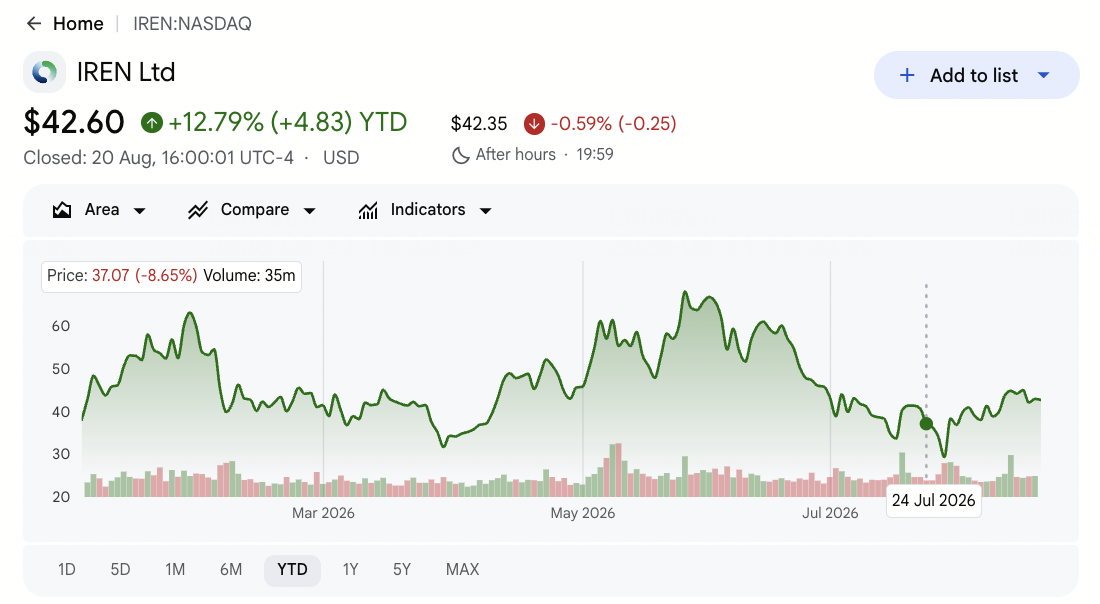
Core Role: AI cloud and data center provider built on former mining infrastructure
IREN, formerly Iris Energy, began as a Bitcoin miner but has moved much further into AI than most of its peers. The company is using its large power and data center footprint to build AI cloud and high-performance computing capacity, supported by major customer contracts and partnerships. With no Bitcoin held in treasury, IREN now offers much more direct exposure to AI infrastructure than to Bitcoin itself.
By the end of 2026, AI and HPC are expected to account for a large share of IREN’s revenue as more of its sites are repurposed for GPU workloads. Its renewable-powered facilities and secured electricity capacity give it a strong position in the AI data center buildout, though the transition requires heavy investment. The main risks are execution on large AI contracts, high capital spending, competition from dedicated AI cloud providers, and stock volatility, but IREN is one of the clearest examples of a Bitcoin miner transforming into an AI infrastructure company.
Read More: IREN Limited (IREN) Stock Outlook 2026: Can Bitcoin Mining and AI Cloud Expansion Drive IREN Higher?
IREN Price Trend (2021-2026 YTD)
|
Year |
Yearly High |
Yearly Low |
Annual Return |
Market Conditions |
|
2021 |
$18.00 |
$9.00 |
5% |
Nasdaq listing; renewable mining focus |
|
2022 |
$12.00 |
$1.50 |
-85% |
Crypto winter; miner distress |
|
2023 |
$8.00 |
$1.50 |
200% |
Recovery; efficient hashrate growth |
|
2024 |
$22.00 |
$5.00 |
90% |
AI pivot begins; data center expansion |
|
2025 |
$70.00 |
$7.00 |
450% |
Microsoft deal; NVIDIA partnership; AI cloud |
|
2026 YTD |
~$70 (est.) |
~$38 (Jul) |
+16% YTD |
~71% AI revenue target; AI cloud scaling |
5. TeraWulf (WULF)
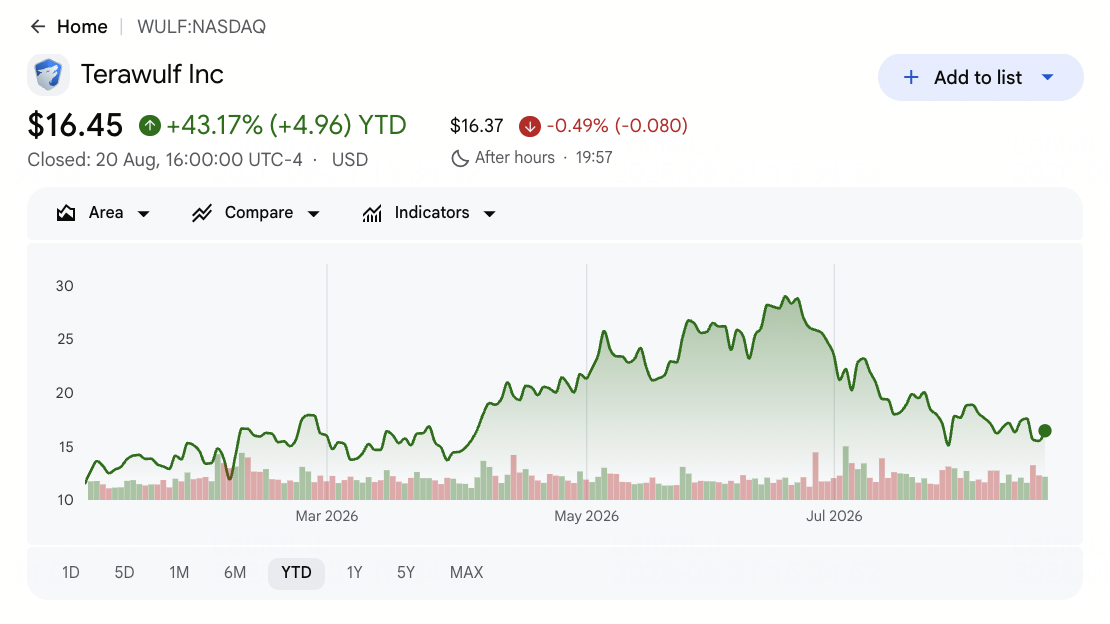
Core Role: AI hosting and Bitcoin mining data center operator
TeraWulf is a Bitcoin miner that has moved aggressively into AI and high-performance computing hosting. The company is using its existing data center sites and access to low-cost power to support AI workloads for large customers, giving it a growing source of contracted infrastructure revenue alongside Bitcoin mining.
In 2026, TeraWulf has been one of the strongest-performing names in the sector as investors rewarded its AI hosting agreements and expanding power capacity. The company now sits between traditional miners and more complete AI-pivot names, with Bitcoin mining still part of the business but AI hosting becoming increasingly important. The main risks are execution on new data center projects, high capital requirements, customer concentration, and stock volatility, while the upside comes from converting existing power capacity into higher-value AI infrastructure.
WULF Price Trend (2021-2026 YTD)
|
Year |
Yearly High |
Yearly Low |
Annual Return |
Market Conditions |
|
2021 |
$18.00 |
$8.00 |
-15% |
Listing; zero-carbon mining focus |
|
2022 |
$12.00 |
$0.70 |
-90% |
Crypto winter; debt pressure |
|
2023 |
$4.00 |
$0.70 |
400% |
Recovery; deleveraging; hashrate growth |
|
2024 |
$9.00 |
$2.00 |
100% |
AI pivot begins; hosting exploration |
|
2025 |
$12.00 |
$3.00 |
40% |
AI hosting leases; power expansion |
|
2026 YTD |
~$12 (est.) |
~$4 (est.) |
+85% YTD |
AI hosting standout; power capacity growth |
6. Cipher Digital (CIFR)
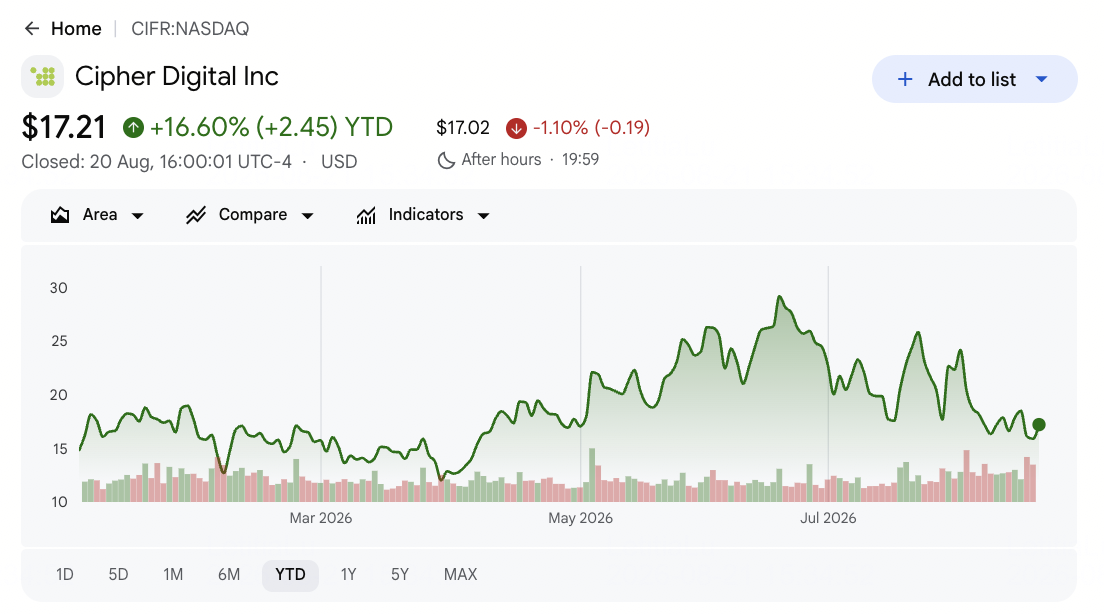
Core Role: AI and HPC data center operator with Bitcoin mining exposure
Cipher Digital started as a Bitcoin miner but has increasingly shifted toward AI and high-performance computing data centers. The company is using the power and infrastructure it originally built for mining to support AI hosting, making it another example of a miner turning existing energy capacity into a broader digital infrastructure business.
In 2026, Cipher has focused more heavily on converting its sites for AI and HPC customers while maintaining Bitcoin mining as part of its operations. The investment case depends on how quickly new hosting projects can generate meaningful revenue and how efficiently the company can fund its buildout. The main risks are high capital requirements, execution on data center conversions, competition from larger AI infrastructure providers, and continued stock volatility.
Read More: Cipher (CIFR) Stock Forecast 2026: Can New Data Center Revenue Push CIFR Toward $43.50?
CIFR Price Trend (2021-2026 YTD)
|
Year |
Yearly High |
Yearly Low |
Annual Return |
Market Conditions |
|
2021 |
$12.00 |
$4.00 |
-20% |
SPAC listing; mining buildout |
|
2022 |
$6.00 |
$1.00 |
-80% |
Crypto winter; miner pressure |
|
2023 |
$6.00 |
$1.50 |
250% |
Recovery; hashrate expansion |
|
2024 |
$7.00 |
$3.00 |
10% |
Halving; power positioning |
|
2025 |
$8.00 |
$3.00 |
15% |
HPC rebrand begins; AI exploration |
|
2026 YTD |
~$9 (est.) |
~$4 (est.) |
+62% YTD |
HPC pivot; AI hosting deals; data center conversion |
How to Trade Bitcoin Mining Stocks on BingX
BingX offers a crypto-native way to gain exposure to leading Bitcoin mining stocks without using a traditional brokerage account. The main execution path is through USDT-margined perpetual contracts on BingX TradFi, which allow active traders to go long or short and trade around earnings, Bitcoin price moves, AI hosting announcements, and broader mining-sector trends.
Long or Short Bitcoin Mining Stock Futures with USDT on BingX TradFi
For active traders looking to capitalize on short-term momentum, Bitcoin volatility, or AI-pivot catalysts, BingX TradFi allows users to trade mining-linked stock futures with USDT. These USDT-settled perpetual contracts mirror the price movements of underlying equities, offering flexible long and short exposure without requiring users to hold the physical stock.
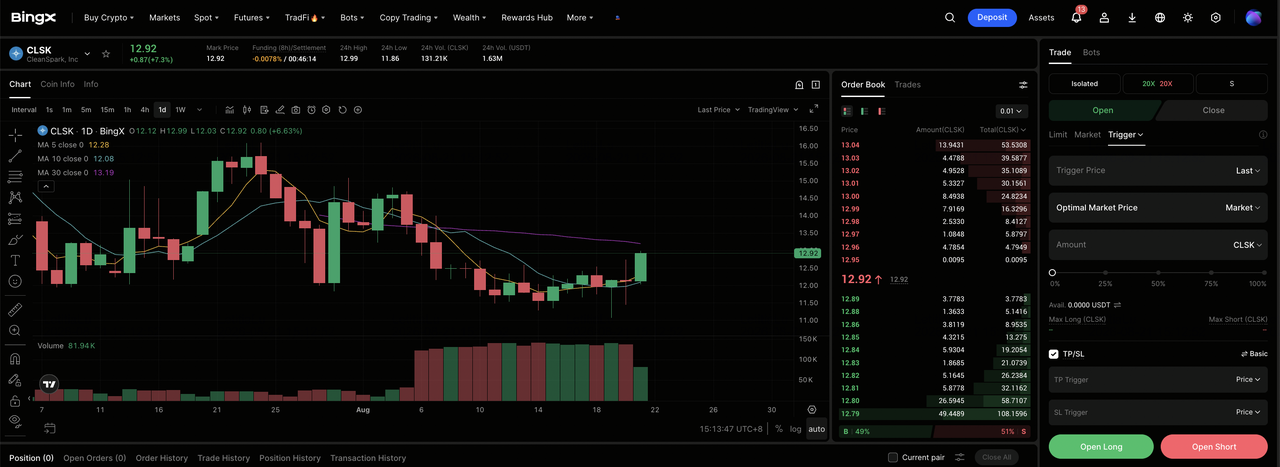
Step 1: Account setup and security. Sign up and log into your BingX account, complete the identity verification (KYC) required in your region, and enable two-factor authentication.
Step 2: Allocate trading capital. Transfer USDT from your spot wallet into your futures account, where it will serve as collateral.
Step 3: Select your contract. Navigate to the TradFi markets page or the futures trading section. Choose mining-linked perpetual contracts such as MARA-USDT, RIOT-USDT, CLSK-USDT, IREN-USDT, WULF-USDT, or CIFR-USDT.
Step 4: Set direction and leverage. Open long if you expect the stock price to rise, or open short if you expect a pullback. Choose leverage based on your risk plan.
Step 5: Execute and manage risk. Set stop-loss and take-profit orders before submitting the trade. PnL settles dynamically in USDT.
Risks and Core Considerations When Trading Bitcoin Mining Stocks
Bitcoin mining stocks offer exposure to both Bitcoin and the AI infrastructure buildout, but they also carry higher volatility, funding needs, and execution risk.
- Bitcoin price volatility: Even miners expanding into AI remain exposed to Bitcoin through mining revenue, treasury holdings, or both. A sharp BTC decline can pressure the entire group.
- AI-pivot execution risk: Converting mining sites into AI-ready data centers requires major upgrades in cooling, networking, and power infrastructure. Delays or weaker-than-expected customer demand could hurt valuations.
- Capital and dilution risk: AI expansion requires substantial investment, pushing miners to raise debt, sell Bitcoin, bring in partners, or issue new shares. Frequent equity issuance can dilute existing shareholders.
- Competition and customer risk: Miners entering AI infrastructure compete with dedicated data center operators, neoclouds, and hyperscalers. Dependence on a small number of large hosting customers can also increase risk.
- Leverage and stock volatility: Mining stocks can move sharply after Bitcoin price changes, earnings, AI contracts, or financing announcements. Traders using USDT-margined futures should manage position size carefully and use clear risk controls.
Final Thoughts: Should You Add Bitcoin Mining Stocks to Your 2026 Portfolio?
The six stocks above offer different ways to gain exposure to the changing Bitcoin mining sector. MARA remains the most direct Bitcoin-focused name, Riot and CleanSpark combine mining with growing AI infrastructure exposure, and IREN, TeraWulf, and Cipher have moved further into AI and HPC data centers. Together, they cover the full spectrum from Bitcoin mining to AI infrastructure.
The main difference is risk. Bitcoin-focused miners are more sensitive to BTC prices and mining economics, while AI-pivot names depend more on data center execution, customer contracts, and heavy capital spending. For traders using BingX TradFi, position sizing, leverage control, and stop-loss orders remain important when trading volatile Bitcoin mining stock futures through USDT-margined perpetual contracts.
Related Reading
- Top 10 AI Infrastructure Stocks to Buy in 2026: Chip Manufacturing and Design Leaders
- Top AI Data Center Stocks to Buy in 2026: Cloud, Servers, and AI Compute Infrastructure
- Top AI Cloud Infrastructure Stocks to Buy in 2026 Amid Hyperscaler Capex and the Neocloud Boom
- Top AI Compute and GPU Stocks to Buy in 2026: The Shift to Inference and Custom Silicon
- Top AI Server Stocks to Buy in 2026: Rack-Scale Systems, GPU Servers, and AI Servers Infrastructure
- Top AI Energy Stocks to Buy in 2026: Nuclear, Gas, Fuel Cells, and the AI Power Buildout
