


As public smart contract networks drift toward highly scalable, transaction-optimized proof-of-stake consensus systems, they increasingly rely on social intervention, slashing, and off-chain governance to manage security. When major exploits, validator cartels, or regulatory compliance pressures threaten a network's integrity, the underlying ledger risks intervention, freezing, or arbitrary modification. For algorithmic purists, censorship-resistant purveyors, and automated machine-to-machine IoT economies, these human interventions introduce severe systemic vulnerabilities.
Ethereum Classic (ETC) eliminates these governance interventions by anchoring its execution environment entirely to programmatic permanence. Born out of ideological resistance to the 2016 "The DAO" hard fork, ETC preserves the original transaction history where the code is the ultimate arbiter of truth. Governed exclusively by objective decentralized hashrate, Ethereum Classic balances full EVM programmatic flexibility with a strict supply cap of 210.7 million coins, bridging the gap between rigorous Turing-complete smart contracts and sovereign, immutable digital scarcity.
What Is Ethereum Classic (ETC)?
Ethereum Classic is an open-source, public Proof-of-Work (PoW) distributed ledger that maintains the foundational, non-forked timeline of the Ethereum protocol launched in 2015. While its sibling chain, Ethereum (ETH), transitioned to a Proof-of-Stake (PoS) framework during "The Merge" in 2022, Ethereum Classic remains dedicated to GPU mining, establishing itself as the largest PoW smart contract base layer in the digital asset economy.
ETC operates the Ethereum Virtual Machine (EVM) utilizing the specialized Etchash mining algorithm (ECIP-1099), providing direct, out-of-the-box compatibility with Ethereum’s development tooling, dApps, and smart contract infrastructure.
From an execution and structural perspective, Ethereum Classic operates as a sovereign, principled platform optimized for total finality and censorship resistance:
- Immutable Execution or "Code Is Law": On Ethereum Classic, applications run exactly as programmed without the possibility of downtime, censorship, or third-party rollbacks. Contract execution is final and binding, protecting the ledger from political, corporate, or legal coercion.
- Fixed Tokenomics: Unlike Ethereum's elastic supply cap, the native ETC asset features a strict monetary policy with a maximum supply hard-capped at 210,700,000 coins.
- The 5M20 Issuance Schedule: New supply generation is throttled programmatically via a Fifthening mechanism. Every 5,000,000 blocks (approximately every 2.5 years), the block reward decreases by 20%, enforcing predictable, Bitcoin-like structural scarcity.
- The 2026 Olympia Catalyst: Targeting mainnet activation by the end of 2026, the comprehensive Olympia upgrade introduces EIP-1559 fee structures and redirects the protocol's base fee into an on-chain treasury and community-led DAO governance framework, solving chronic core development funding gaps without introducing token inflation.
How Does Ethereum Classic Work: "Code Is Law" and the PoW Security Budget
Ethereum Classic rejects the concept of a human-coordinated social consensus. Instead, it enforces network synchronization through an objective, computer-verifiable Proof-of-Work engine. In a Proof-of-Stake system, validators lock capital to determine the valid chain history, which can result in 'nothing-at-stake' forks, subjective fork-choices, and staking centralization within corporate custody providers.
ETC requires miners to expend physical energy and computing cycles to construct blocks, linking real-world physics to digital ledger security. The system processes smart contracts in parallel via the EVM, verifying state transitions across thousands of independent nodes using two core infrastructural principles:
The Etchash Consensus Engine (ECIP-1099)
Following a series of low-hashrate exploits in 2019 and 2020, where bad actors rented mining power to orchestrate deep block reorganizations (reorgs) and double-spend centralized exchanges, the community deployed the Thanos Upgrade.
This hard fork calibrated the DAG epoch length, transitioning the hashing function from Ethash to Etchash. This technical adjustment made the network highly accessible to consumer-grade GPUs with 4GB of memory, broadening mining participation and decentralizing the hashrate distribution globally.
Modified Exponential Subjective Scoring (MESS)
To neutralize the risk of sudden 51% attacks, ETC clients operate a protective client-side algorithm called MESS. When an alternate chain state is broadcast to the network, MESS evaluates the depth of the proposed block reorganization.
If an alternate chain contains an unexpected, deeply buried historical timeline, the algorithm exponentially increases the hashrate weight required to accept that fork. This technical safeguard renders massive, retroactive blockchain rollbacks prohibitively expensive for attackers, achieving robust transactional finality without sacrificing the objective rules of PoW.
Ethereum Classic vs. Bitcoin vs. Ethereum: The Ultimate 2026 Comparison
To understand why technical content strategists and long-term asset allocators look to ETC as a distinct cryptographic asset class, consider how its technical architecture scales against Bitcoin and mainstream Ethereum:
|
Feature |
Bitcoin (BTC) |
Ethereum (ETH) |
Ethereum Classic (ETC) |
|
Consensus Mechanism |
Proof-of-Work (SHA-256) |
Proof-of-Stake (PoS) |
Proof-of-Work (Etchash) |
|
Execution Environment |
Simple Script (Non-Turing Complete) |
EVM (Turing Complete) |
EVM (Turing Complete) |
|
Supply Cap |
21,000,000 (Hard Cap) |
No Hard Cap (Dynamic Burn) |
210,700,000 (Hard Cap) |
|
Deflationary Mechanism |
50% Halving every 210k blocks |
EIP-1559 Base Fee Burn |
5M20 Scheme (20% Cut) & Olympia Treasury |
|
Block Target Time |
~10 Minutes |
~12 Seconds |
~13–15 Seconds |
|
Governance Philosophy |
Social Conservative / Minimalist |
Pragmatic Social Consensus / Hard Forks |
Pure Immutability / "Code is Law" |
|
Ecosystem Niche |
Absolute Store of Value (Digital Gold) |
High-Liquidity DeFi & L2 Scaling |
Sovereign, Immutable Smart Contracts |
While Ethereum provides deep liquidity and rapid application development, its consensus layers introduce ongoing staking regulatory considerations and validation complexities. Bitcoin provides premier sovereign monetary infrastructure but lacks native, high-level smart contract execution. Ethereum Classic carves out its technical niche by combining the exact smart contract programmability of the EVM with the unalterable, predictable supply mechanics of Bitcoin.
Ethereum Classic's 2026 Olympia Upgrade: Resolving ETC’s Development Funding
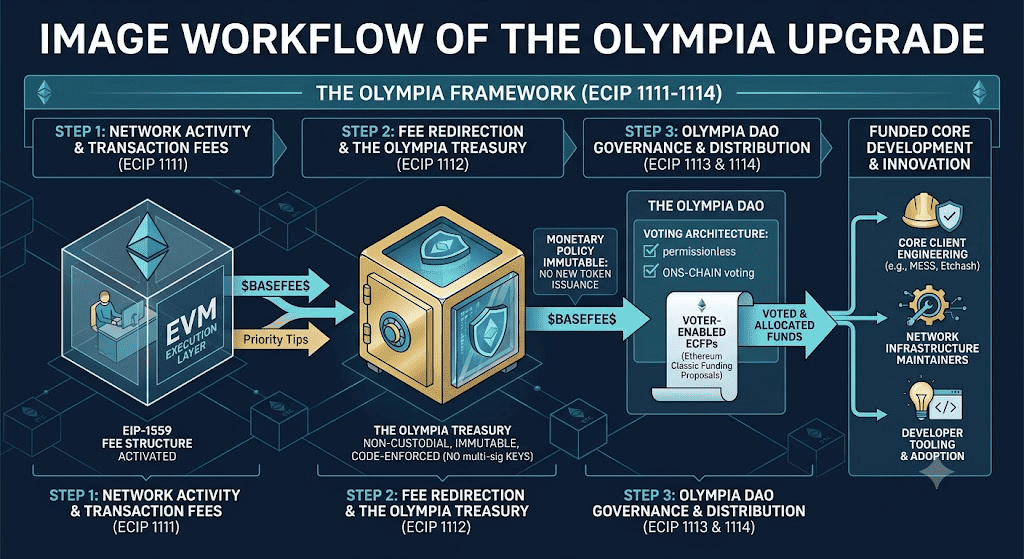
Historically, Ethereum Classic’s core ecosystem development lagged behind other layer-1 networks due to a chronic structural issue: the absence of a central foundation or built-in protocol inflation to bankroll core client engineers. Unlike newer chains backed by multi-billion-dollar Venture Capital foundations, ETC has long relied on disparate community grants, voluntary donations, and ad hoc engineering teams.
The Olympia Upgrade (ECIPs 1111–1114), currently undergoing active alpha testing on the Mordor testnet with mainnet activation scheduled for late 2026, resolves this funding bottleneck through a decentralized, non-inflationary fee redirection framework.
Coordinated Architecture of the Ethereum Classic Upgrade
- EIP-1559 Fee Redirection (ECIP-1111): Olympia implements the EIP-1559 execution client specification to bring advanced gas fee predictability and EVM tooling compatibility to ETC. However, instead of burning the base transaction fee (BASEFEE) as Ethereum does, the protocol redirects this stream directly to the consensus-enforced network treasury.
- The Olympia Treasury (ECIP-1112): This component establishes a non-custodial, immutable smart contract to collect the redirected fee revenue. It contains zero human multi-sig keys or administrative doors, securing funds entirely at the protocol level.
- The Olympia DAO Governance Framework (ECIP-1113): To distribute the accumulated treasury funds, Olympia implements an on-chain voting architecture. ETC token holders can submit permissionless Ethereum Classic Funding Proposals (ECFPs via ECIP-1114) and vote on-chain to allocate capital directly to core client maintainers, infrastructure providers, and developers.
Critically, Olympia is entirely backward-compatible and opt-in. It alters zero mining block subsidies, preserves 100% of standard miner priority tips, and avoids minting any new tokens, protecting the network's foundational monetary supply cap while equipping it with a self-sustaining development engine.
How to Trade Ethereum Classic (ETC) on BingX: A Step-by-Step Guide
For market participants looking to align their portfolios with Ethereum Classic’s upcoming Olympia upgrade and structural token scarcity, BingX offers a high-security, professional platform with advanced order routing.
Buy, Sell, or Accumulate ETC on the BingX Spot Market
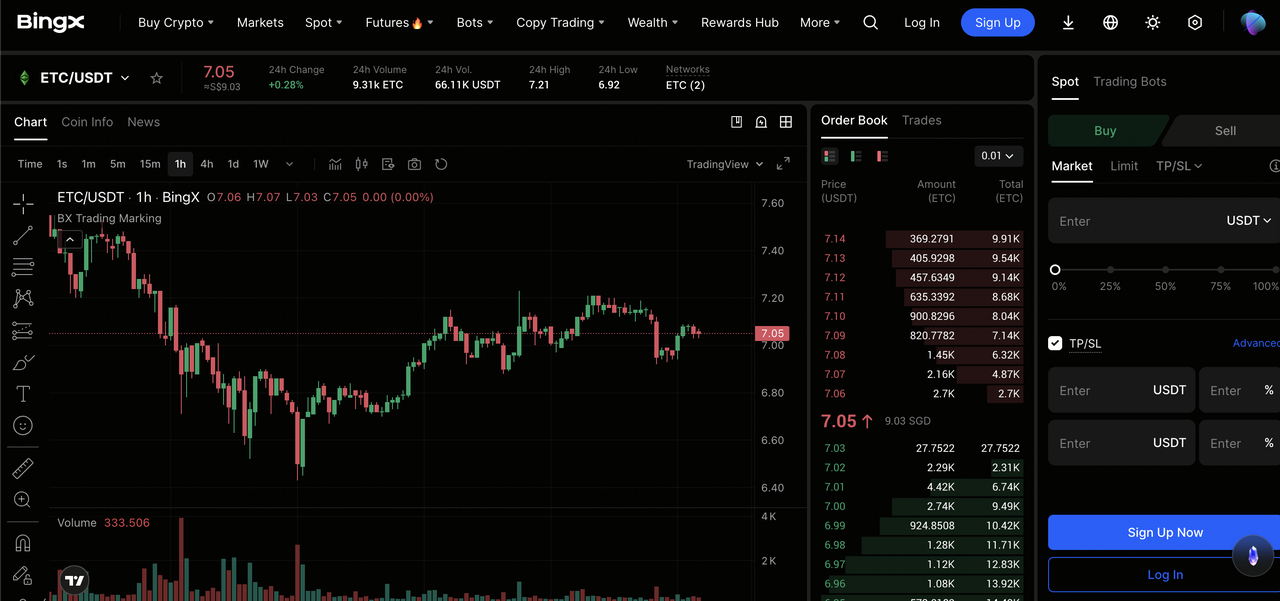
ETC/USDT trading pair on the BingX spot market
- Log In and Asset Allocation: Open your dashboard on the official BingX platform. Deposit USDT or transfer appropriate capital into your Spot Wallet.
- Locate the ETC Trading Dashboard: Navigate to the top navigation bar, hover over Market, and select Spot. Input ETC into the token search index to initialize the ETC/USDT trading pair.
- Configure Your Order Types: Review live order-book depth and structural technical indicators. Select a Limit Order to fill your entry at a precise, pre-calculated historical support coordinate, or execute a Market Order to instantly capture liquidity at current market pricing.
- Confirm Execution: Input the designated USDT asset volume you wish to allocate and click Buy ETC. Your transaction will settle immediately into your spot balance.
Long or Short ETC Perpetuals on the BingX Futures Market
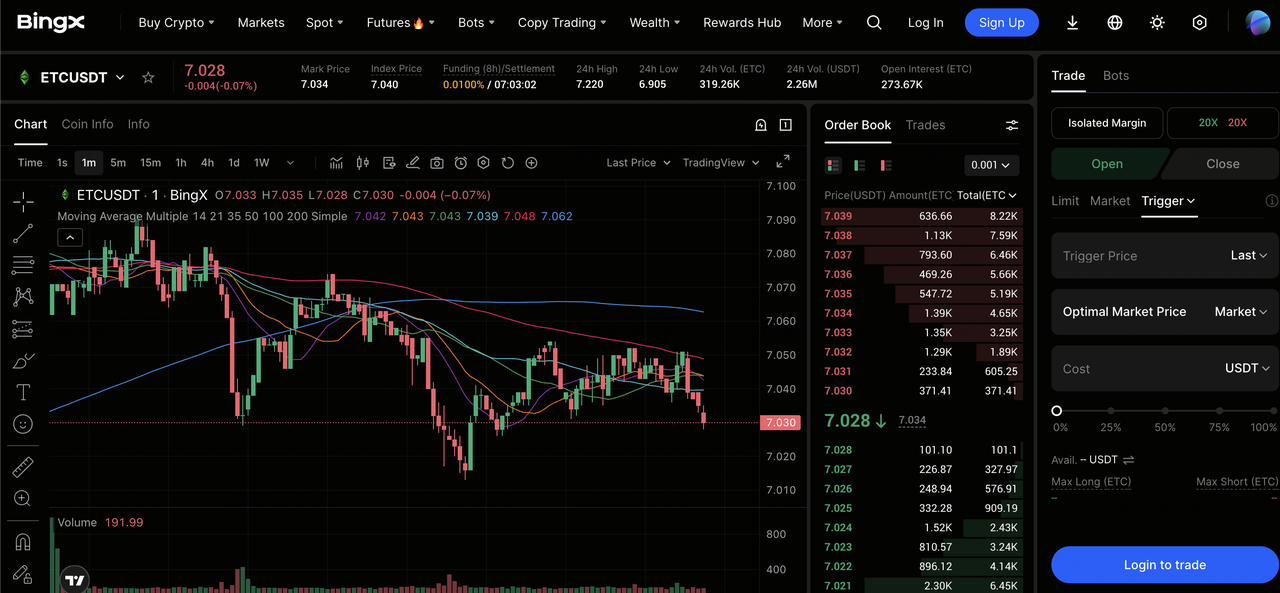
ETC/USDT trading pair on the BingX futures market
For derivatives traders seeking to capture beta volatility surrounding ETC's upcoming 2026 "Fifthening" supply reduction, BingX’s high-throughput matching engine supports leveraged perpetual contracts with comprehensive risk gating.
- Fund Your Margin Wallet: Open the Assets window, select Transfer, and move your available USDT or USDC from your Funding/Spot ledger over to your Perpetual Futures Account.
- Open the ETC Derivatives Portal: Hover over the Derivatives menu and click on Perpetual Futures. Use the contract search asset interface on the left-hand panel to open the ETC/USDT perpetual contract or ETC/USDT perpetual contract.
- Choose Your Margin Isolation Mode: Access the margin settings panel on the right side of your charting screen. Select Isolated Margin to strictly wall off your liquidation risk to the specific capital assigned to this individual trade, or choose Cross Margin to utilize your broader futures balance to absorb volatile intraday price swings.
- Calibrate Leverage and Set Risk Thresholds: Select your target leverage multiplier. Choose your execution type (Limit or Market), and inputs your position size. Before committing capital, activate the TP/SL (Take Profit / Stop Loss) options to define precise profit targets and protective invalidation coordinates.
- Transmit the Position: Click Buy/Long if your technical chart configurations project an upward expansion, or click Sell/Short to capture yield from macro downward trends.
Key Considerations When Investing in Ethereum Classic (ETC)
While Ethereum Classic offers a highly robust, immutable option within the layer-1 landscape, navigating its investment framework requires a balanced evaluation of its structural dynamics and market position:
- The On-Chain Activity Hurdle: ETC features ultra-low transaction costs due to lower relative network usage compared to Ethereum. Under the upcoming Olympia upgrade, the network’s internal funding engine relies entirely on transaction volume. For the DAO treasury to accumulate significant capital and scale long-term development, ETC must successfully transition from a speculative asset into a high-utility, production-grade network.
- The Ecosystem Liquidity Gap: Ethereum Classic's Total Value Locked (TVL) and developer gravity lag behind high-speed, modern layer-1 networks like Solana or Ethereum's scaling Layer-2 ecosystems. The absence of a reflexive, retail-centric DeFi or NFT culture means ETC can experience extended periods of range-bound price action between major altcoin rotation cycles.
- Miner Profitability Compaction: The programmatic Fifthening block reward reduction scheduled for late 2026 structurally tightens token issuance, which is long-term bullish for asset scarcity. However, it compresses miner revenue margins. If market prices do not compensate for the 20% block reward cut, the total network hashrate could face downward pressure, requiring close observation of miner economics.
- Execution and Governance Risks: The Olympia upgrade’s transition to on-chain treasury mechanics represents a significant change to ETC's historical hands-off protocol design. While it aims to supercharge development, any technical delays in the testnet deployment or political friction regarding DAO fund allocation could introduce short-term market volatility.
Final Thoughts: Is Ethereum Classic (ETC) a Good Investment in 2026?
Ethereum Classic maintains a highly distinctive, battle-tested position within the asset economy by anchoring its entire value proposition to programmatic permanence and censorship resistance. By keeping its consensus rooted in a robust Proof-of-Work engine and preserving a fixed, deterministic supply curve, ETC offers an institutional-grade, alternative store of value for market participants wary of centralized proof-of-stake governance risks.
The long-term market valuation of ETC hinges on its ability to successfully execute the late-2026 Olympia upgrade and convert its enhanced EVM compatibility into sustainable, on-chain transaction metrics. As global regulatory frameworks tighten around centralized staking protocols and demand shifts toward immutable base layers, Ethereum Classic’s alignment of Bitcoin-like scarcity with Ethereum-style programmability offers a compelling, principled ecosystem for long-term allocators.
Risk Reminder: Allocating capital to decentralized utility assets and proof-of-work protocols involves significant operational, market, and structural risks. Scheduled block reward reductions and on-chain protocol upgrades can introduce profound changes to mining profitability and network economics. Always conduct comprehensive independent technical analysis, track client developments through the ECIP framework, and never trade with more capital than you can afford to lose. BingX provides zero liability for external portfolio allocations or investment outcomes.
Related Reading
FAQs on Ethereum Classic (ETC)
1. Can I use my existing Ethereum wallets and tools with Ethereum Classic?
Yes. Because Ethereum Classic runs the same foundational Ethereum Virtual Machine (EVM) layer, it maintains out-of-the-box compatibility with major web3 applications. You can use standard web3 wallets like MetaMask by simply configuring a custom RPC connection to the Ethereum Classic network (Chain ID: 61).
2. Can Ethereum Classic tokens be staked to earn passive yield?
No. Ethereum Classic is a Proof-of-Work blockchain, meaning network security is provided exclusively by hardware miners, not asset stakers. There is no protocol-level staking or validator locking mechanism on ETC. While third-party lending platforms or centralized exchanges may offer yield-generating programs on your ETC deposits, these are external financial applications that introduce distinct counterparty and smart contract risks.
3. What exactly is the Fifthening in Ethereum Classic's monetary policy?
The Fifthening is the core disinflationary mechanism built into ETC's monetary policy (ECIP-1017). Modeled after Bitcoin's halving, it mandates that the protocol automatically reduce block rewards by 20% every 5,000,000 blocks (roughly every 2.5 years). The next reduction is scheduled for late 2026, which will drop miner block rewards from 2.048 ETC to 1.6384 ETC, systematically restricting new circulating token supply.
4. How did the 2022 Ethereum Merge affect Ethereum Classic's security posture?
When Ethereum completed "The Merge" in late 2022 and abandoned GPU mining for Proof-of-Stake, an massive fleet of hardware miners migrated overnight to ETC. This massive influx caused Ethereum Classic’s global hashrate to expand multi-fold, climbing to a baseline of 150+ TH/s. This drastically increased the economic cost required to rent or assemble a majority of the hashing power, effectively mitigating the network's historical vulnerability to 51% reorg exploits.
5. Does the upcoming Olympia upgrade change ETC's fixed supply cap?
Absolutely not. The Olympia upgrade is designed from first principles to preserve ETC’s foundational monetary policy. It introduces no new token issuance or inflation. Instead of generating new coins to fund development, Olympia captures the protocol base fees (BASEFEE) that are already spent by users transacting on the network, redirecting those existing asset flows into an on-chain treasury rather than permanently burning them.
