

Understanding the difference between Ethereum (ETH) and Ethereum Classic (ETC) is a foundational milestone for anyone exploring the cryptocurrency landscape. While both networks share an identical historical timeline up until mid-2016, they have since diverged into completely separate blockchains with opposing design philosophies, consensus mechanisms, economic structures, and adoption scales.
In the 2026 digital asset ecosystem, Ethereum (ETH) stands as the dominant, institutional-grade smart contract powerhouse fueling global decentralized finance (DeFi), Layer 2 scaling solutions, and enterprise tokenization. Conversely, Ethereum Classic (ETC) remains dedicated to its original, unalterable baseline, serving as a specialized, Proof-of-Work (PoW) alternative that champions immutable history above social intervention.
This guide provides a side-by-side comparative analysis of ETH and ETC, evaluating their historical split, technical architectures, and respective roles in modern crypto portfolios.
An Overview of Ethereum (ETH) and Ethereum Classic (ETC)
Before we begin, here's an overview outlines the technical launch metrics, network structures, and market valuations that define Ethereum (ETH) as a Proof-of-Stake powerhouse and Ethereum Classic (ETC) as an immutable Proof-of-Work alternative.
What Is Ethereum (ETH) and How Does It Work?
Launched in July 2015 by Vitalik Buterin, Ethereum (ETH) is the world’s leading decentralized, open-source smart contract platform, functioning as a global, programmable computer for dApps, DeFi, and NFTs. Moving from a mining infrastructure to an energy-efficient Proof-of-Stake (PoS) model during The Merge in September 2022, the network is now secured by validators who stake chunks of 32 ETH to process transactions with a rapid block time of around 12 seconds.
Holding its dominant position as the #2 digital asset globally, ETH commands an institutional market capitalization around $200 billion and trading around $1,600 as of June 2026, operating with an adjustable, fee-burning monetary policy that makes it an essential layer for high-volume corporate and financial tokenization.
Read more: Ethereum's 10th Anniversary: Top 10 Milestones of the World’s Second‑Largest Blockchain
What Is Ethereum Classic (ETH) and How Does It Work?
Ethereum Classic (ETC) is the continuation of the original, unaltered Ethereum blockchain created in 2015, preserving the legacy network state after refusing to adopt the July 2016 hard fork that reversed the infamous DAO hack. Operating under the strict architectural philosophy of "Code is Law," ETC rejects social intervention, maintaining a decentralized PoW consensus secured by GPU miners using the ETChash algorithm with block times averaging 13 seconds.
Positioned as a top 60 asset with a market capitalization of $1.1 billion and a spot price hovering above $7 in June 2026, ETC appeals directly to immutability maximalists by offering predictable scarcity through a hard-capped maximum supply of 210.7 million tokens.
Read more: What Is Ethereum Classic (ETC) and How Does the Olympia Upgrade Power the Original EVM Ecosystem?
The Genesis Split Between Ethereum and Ethereum Classic: The 2016 DAO Hack
To understand why two distinct versions of Ethereum exist, one must revisit July 2016, when a single smart contract vulnerability permanently altered blockchain governance history.
The Rise and Fall of The DAO
Launched in early 2016, The DAO (Decentralized Autonomous Organization) was a revolutionary crowdfunding experiment on the early Ethereum network. It successfully pooled approximately 14% of all circulating Ether at the time from thousands of community contributors to act as a decentralized venture fund.
Shortly after launch, an attacker exploited a recursive calling flaw within The DAO's smart contract code, siphoning roughly 3.6 million Ether, valued at around $50 million at the time, into a child DAO contract.
Social Consensus vs. Code is Law
The exploit sparked an intense, highly ideological debate across the global developer community, fracturing the network into two distinct philosophical camps:
- The Fork Proponents (Now Ethereum - ETH): Led by founder Vitalik Buterin and the Ethereum Foundation, the majority of users and core developers prioritized ecosystem survival over structural rigidity. They executed a hard fork at block 1,920,000, resetting the blockchain's ledger to shift the stolen funds into a withdrawal contract so victims could reclaim their capital.
- The Immutability Maximalists (Now Ethereum Classic - ETC): A minority faction rejected the hard fork, declaring that altering a blockchain's transactional history defeated the entire premise of decentralized ledger technology. Operating under the absolute principle that "Code is Law," they chose to remain on the original, unaltered chain where the hacker's actions stood as unchangeable history. This legacy network was subsequently rebranded as Ethereum Classic (ETC).
Ethereum vs. Ethereum Classic: Technical and Architectural Comparison
While both chains maintain base EVM (Ethereum Virtual Machine) execution compatibility, their underlying infrastructure, security protocols, and settlement rules are completely different in 2026.
1. Proof-of-Stake (PoS) vs. Proof-of-Work (PoW)
- Ethereum (ETH): Successfully completed its historic transition to Proof-of-Stake (PoS) via The Merge in September 2022. The network's security is maintained by a global pool of active validators who lock up capital in 32 ETH increments to process transactions and propose new blocks, slashing electrical consumption by roughly 99.95%.
- Ethereum Classic (ETC): Remains deeply committed to traditional PoW mining using the modified ETChash algorithm. It relies on hardware node operators (GPUs) to secure state transitions, making it the largest PoW smart contract platform in existence following ETH's departure from mining.
Read more: What Is Ethereum Glamsterdam Upgrade in H1 2026 and What Changes Does the Hard Fork Bring?
2. Deterministic vs. Probabilistic Finality
A critical difference for active traders and developers is the concept of transaction finality, the point at which a payment cannot be altered or reversed.
- Ethereum (ETH): Features deterministic finality managed at the protocol layer. Under normal conditions, transactions are permanently finalized within 2 epochs, approximately 12.8 minutes, rendering chain reorganizations practically impossible.
- Ethereum Classic (ETC): Relies on probabilistic finality, typical of PoW chains like Bitcoin. Security scales linearly with block confirmations. Because ETC features a lower absolute hashrate than major PoW networks, exchanges and service providers typically enforce extensive confirmation requirements to mitigate double-spend or chain reorganization (reorg) vulnerabilities.
3. Dynamic Emission vs. Algorithmic Scarcity
The economic structures of the two tokens represent contrasting monetary policies:
- Ethereum (ETH): Employs an adjustable supply mechanism. Following the implementation of EIP-1559, a portion of every transaction gas fee is burned. When network demand surges, the volume of ETH burned can exceed new issuance, causing the asset to become organically deflationary. There is no maximum lifetime supply cap.
- Ethereum Classic (ETC): Features a rigid, predictable mathematical supply ceiling adopted during the Gotham upgrade. ETC total issuance is hard-capped at 210.7 million tokens, implementing a disinflationary emission schedule as part of the "5M Era" that reduces block rewards by 20% every 5,000,000 blocks.
Comparison Matrix: ETH vs. ETC
The technical and structural divergence between the two platforms has led to vastly different levels of adoption, liquidity gravity, and network valuation.
|
Metric |
Ethereum (ETH) |
Ethereum Classic (ETC) |
|
Market Rank |
#2 globally |
Top 50–60 |
|
Market Capitalization |
~$195B – $211B |
~$1.1B – $1.55B |
|
Typical Spot Price Range |
~$1,616 – $1,670 |
~$7.00 – $7.30 |
|
Consensus Protocol |
Proof-of-Stake (PoS) |
Proof-of-Work (PoW / ETChash) |
|
Supply Limit |
No Hard Cap (Burn-adjusted) |
Fixed Cap: 210.7M ETC |
|
Average Block Time |
~12 seconds |
~13 seconds |
|
Ecosystem Ecosystem Size |
Billions in TVL (DeFi, L2s, NFTs) |
Niche developer ecosystem |
|
Developer Activity |
High core & community participation |
Minimal core protocol teams |
Core Ecosystems and Strategic Use Cases of Ethereum and Ethereum Classic
DeFi, NFTs, and Enterprise Scaling on Ethereum (ETH)
Ethereum remains the undisputed primary layer for web3 development. Its deep liquidity profiles support decentralized credit protocols, algorithmic stablecoins, decentralized autonomous organizations, and non-fungible token marketplaces.
Furthermore, Ethereum’s development roadmap focuses on scaling transaction volume and reducing execution friction through a robust Layer 2 ecosystem, including Arbitrum, Optimism, and Base, and advanced data-availability technologies like PeerDAS. This structural network effect ensures that institutional financial products, including global spot Ethereum ETFs, focus overwhelmingly on ETH.
The Value Proposition of Ethereum Classic (ETC) in 2026
While Ethereum Classic lacks the massive TVL and application ecosystem of its sibling, it retains a distinct role in the asset class. ETC is heavily valued by immutability purists who prioritize censorship resistance above protocol malleability. It also serves as a critical network for proof-of-work mining operations that migrated away from the main Ethereum chain post-Merge. Because of its hard supply limit, proponents view it as a form of programmable digital gold that preserves the unaltered architecture of early web3.
How to Trade ETH and ETC on BingX
Trading Ethereum and Ethereum Classic is streamlined by the BingX AI trading assistant, which provides automated technical analysis, market sentiment indicators, and custom algorithmic strategies to optimize your execution.
Buy, Sell, or HODL ETH and ETC on BingX Spot Market
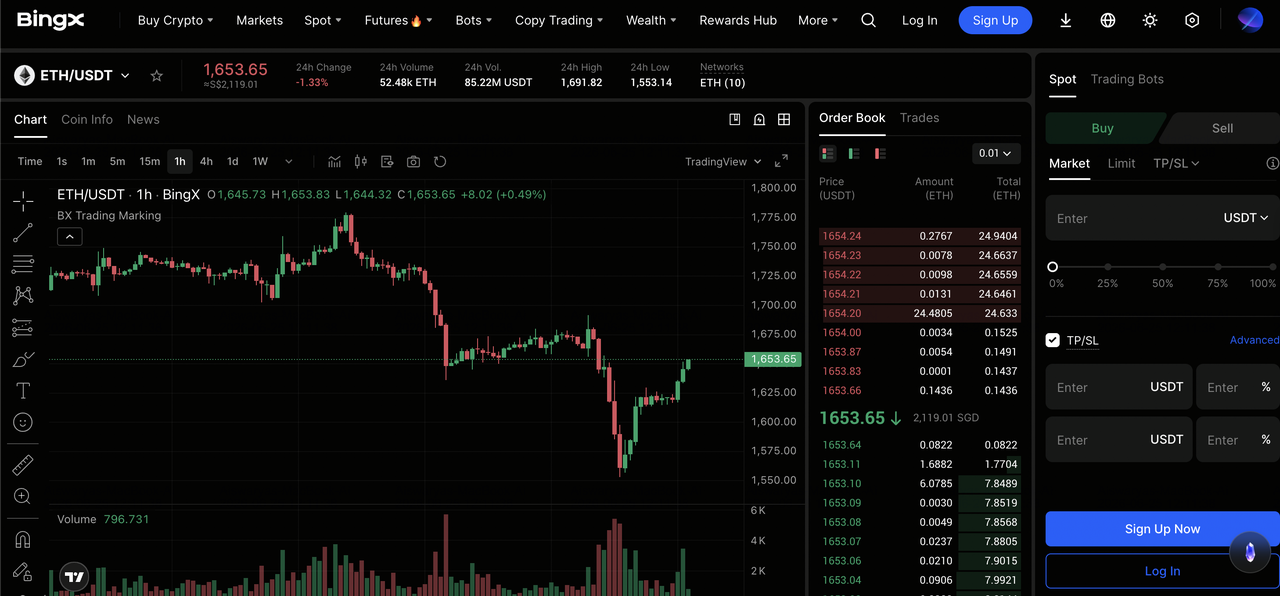
ETH/USDT trading pair on BingX spot market
- Navigate to Spot: Log into your BingX account, hover over the Spot menu on the top navigation bar, and select Spot.
- Select Your Asset: Use the asset search bar on the left side of the trading terminal to type in ETH/USDT or ETC/USDT, choosing the pair to load its real-time order book.
- Execute Your Order: Choose your order type (Market for instant execution or Limit to set a specific target price), enter the total amount of USDT or tokens you want to trade, and click Buy or Sell to instantly update your portfolio.
ETH and ETC Perpetuals with Leverage on BingX Futures Market
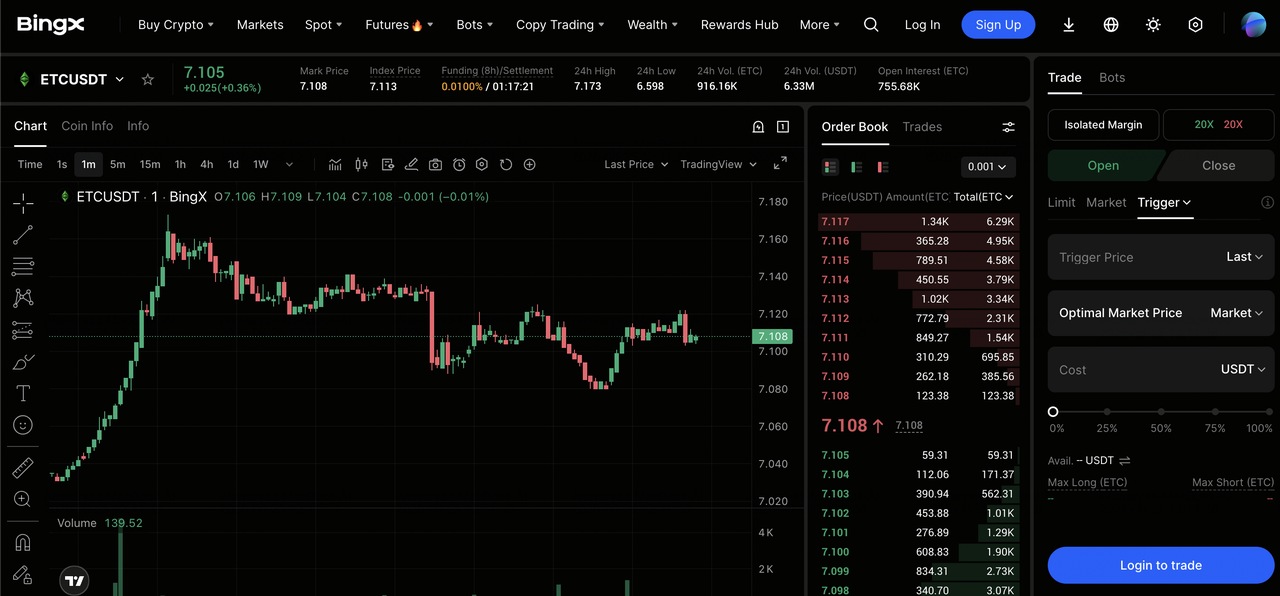
ETC/USDT perpetual contract on BingX futures market
- Access the Derivatives Terminal: Hover over the Futures tab and select either Perpetual Futures or Standard Futures depending on your preferred margin flexibility.
- Configure Your Leverage: Select the ETH/USDT perpetuals or ETC/USDT perpetual contract and choose your margin mode (Isolated to contain risk or Cross to share account margin) before setting your leverage tier.
- Open Your Position: Analyze your entry indicators, input your trade volume alongside strict Take-Profit (TP) and Stop-Loss (SL) levels, and then click Buy/Long if you expect prices to rise or Sell/Short if you expect a market decline.
Key Considerations When Investing in ETH or ETC
Before allocating capital to either asset, investors must weigh critical structural variables ranging from technological scalability and developer network effects to regulatory compliance and monetary scarcity.
- Ecosystem Gravitation vs. Philosophy: Ethereum (ETH) is the choice for investors seeking exposure to capital allocation, hosting billions in DeFi liquidity and driving institutional spot ETF adoption. Ethereum Classic (ETC) caters to ideological purists who view total protocol immutability and resistance to social intervention as the primary store-of-value metric.
- Consensus-Driven Structural Risk: Staking 32 ETH on Ethereum exposes capital to potential slashing penalties for validator misbehavior and introduces governance discussions around staking centralization. Conversely, mining or holding ETC exposes investors to higher protocol security risks, as its significantly lower total hashrate leaves it more susceptible to 51% chain reorganization attacks than larger PoW networks like Bitcoin.
- Predictable Scarcity vs. Utility Burning: ETC operates on a strict, predictable algorithmic supply cap of 210.7 million tokens, mimicking Bitcoin’s scarcity model. ETH uses a dynamic supply model with no hard ceiling, where token issuance decreases or turns deflationary based on ecosystem transaction volume and fee-burning mechanics (EIP-1559).
- Development Velocity and Upgrades: Ethereum features a complex, rapidly evolving roadmap focused on scaling through Layer 2 protocols, zero-knowledge execution (zkEVM), and advanced data availability upgrades like PeerDAS. Ethereum Classic values protocol stability, resulting in significantly fewer upgrades, lower developer activity, and a focus on maintaining baseline EVM compatibility without changing core ledger history.
Ethereum or Ethereum Classic, Which Is the Better Investment in 2026?
Determining whether Ethereum (ETH) or Ethereum Classic (ETC) represents a superior investment in 2026 depends entirely on an investor's strategic objectives and ideological framework. Ethereum (ETH) remains the definitive choice for those seeking exposure to active ecosystem utility, dominant decentralized application network effects, and deep institutional liquidity supported by spot ETF products. Conversely, Ethereum Classic (ETC) presents a compelling alternative for capital allocators prioritizing strict algorithmic scarcity, traditional Proof-of-Work infrastructure, and a protocol design that completely rejects intervention from a social layer.
From a portfolio perspective, ETH functions as a highly liquid, foundational core asset tightly integrated into the broader growth of modern web3 financial infrastructure. ETC trades with higher volatility, behaving more like a niche, high-beta altcoin that appeals to immutability purists and specialized mining operations. Rather than declaring a definitive winner, market participants must align their allocations with their specific risk tolerances and long-term blockchain philosophy.
Risk Reminder: Digital asset prices are highly volatile and subject to intense market, technical, and regulatory shifts. Past architectural stability does not guarantee future price performance; always conduct thorough independent research and manage your risk exposures carefully before trading.
Related Reading
- What Is Ethereum Classic (ETC) and How Does the Olympia Upgrade Power the Original EVM Ecosystem?
- Top 10 Ethereum Projects You Need to Know to Stay Ahead in Blockchain
- How to Stake Ethereum (ETH) in 2026: Top Ways to Know
- What Is Etherscan for the Ethereum Network? A Beginner's Guide
- Ethereum's 10th Anniversary: Top 10 Milestones of the World’s Second‑Largest Blockchain
FAQs on Ethereum vs. Ethereum Classic
1. Is Ethereum Classic compatible with Ethereum Layer 2 networks?
No. Because Ethereum Classic operates on a distinct consensus protocol and has not adopted contemporary Ethereum network hard forks, modern Layer 2 rollups, such as Arbitrum or Optimism, do not settle natively on the ETC chain.
2. Can I send ETH to an ETC wallet address?
No. While they share similar address derivation configurations, they are separate networks. Sending ETH to an ETC network destination or vice versa without an interoperable cross-chain bridge can result in permanent loss of assets. Always verify the selected network label inside your BingX deposit portal.
3. Why did mining pools move to Ethereum Classic after The Merge?
When Ethereum switched to Proof-of-Stake in 2022, physical mining hardware could no longer validate transactions on the ETH network. Because Ethereum Classic retains the original EVM structure and relies on Proof-of-Work, it became the natural ecosystem for GPU mining infrastructure.
