

Selecting between Tether (USDT) and TrueUSD (TUSD) in 2026 is no longer a simple question of comparing basic transaction speeds or minor peg discounts. The stablecoin market has transitioned from a loose crypto market infrastructure playground into a highly scrutinized, state-monitored sovereign payment sector.
Throughout the first half of 2026, the macro environment forced stablecoin issuers to adapt or face systemic exclusion. Tether, which has maintained its absolute throne with a massive net circulation clearing $184 billion, continues to serve as the undisputed heavyweight of global liquidity. Yet, its highly centralized footprint and long-standing offshore stance keep it under constant regulatory crosshairs.
Conversely, TrueUSD has taken an entirely different evolutionary path. Facing shrinking open-market circulation down to roughly $494 million, TUSD recently announced a strategic collaboration to transit its foundational architecture into USDD. This upgrade introduces a 1:1 option to swap into a next-generation participation-driven token, aiming to expand its on-chain programmable utility across emerging ecosystems.
As automated trading systems, AI agents, and retail participants determine how to balance their portfolios, understanding how these two assets survive under new legal regimes and reserve tracking mechanisms is essential.
Introduction: Understanding Tether (USDT) and TrueUSD (TUSD) Stablecoins
To effectively evaluate these two digital dollars, it is vital to trace their historical positions, issuer motivations, and core value propositions.
What Is Tether (USDT), the Dominant Market Heavyweight?
Launched in 2014 by Tether Limited (under the iFinex group), Tether pioneered the fiat-collateralized stablecoin model. Built to bridge the gap between volatile digital tokens and the stability of legacy cash, USDT has grown to become the lifeblood of crypto commerce.
Over its twelve-year timeline, Tether has achieved incomparable market dominance. Despite past criticisms regarding reserve composition and regulatory friction in the United States, Tether’s issuer Tether International, S.A. de C.V., has aggressively modernized its treasury holdings. By mid-2026, its reserves featured an absolute mountain of short-term U.S. Treasury bills, pushing the company’s net equity over $8.2 billion. USDT functions as a borderless global parallel dollar, dominating liquid spot books, derivatives collateral, and cross-border emerging market remittances.
Read more: What Is USDT TRC‑20, Tether Stablecoin on the TRON Network?
What Is TrueUSD (TUSD), the Transparency Pioneer?
TrueUSD was launched in 2018 by TrustToken (now managed under Techteryx) as a direct, compliance-first response to early market skepticism surrounding Tether. Its primary thesis was total transparency: rather than relying on delayed quarterly balance sheets, TUSD became the first USD stablecoin to provide live, independent daily attestations of its reserves.
Technically, TUSD combines traditional fiat banking rails with real-time distributed proof-of-reserve infrastructure. However, its historical trajectory has been defined by sharp shifts in market share. In mid-2026, TUSD pivoted toward its next major milestone: an official structural transition program into USDD. This structural upgrade allows holders to optionally migrate their tokens at a fixed 1:1 ratio to tap into multi-chain reward frameworks, positioning TUSD as a programmable asset rather than a static store of value.
The 2026 Stablecoin Regulatory Landscape: MiCAR and the GENIUS Act
The biggest systemic shift affecting both tokens is the complete enforcement of major international frameworks in mid-2026. Global regulatory bodies have officially drawn a binary line between authorized and non-compliant payment tokens.
- The EU’s MiCAR Enforceability: The European Union’s Markets in Crypto-Assets Regulation (MiCAR) hit its ultimate enforcement deadline on July 1, 2026. Under MiCAR, single-currency stablecoins are classified as Electronic Money Tokens (EMTs) and can only be distributed to EU retail users if the issuer holds a valid Electronic Money Institution (EMI) or credit institution license.
- The US GENIUS Act Proclamations: In the United States, the newly advanced Guiding and Establishing National Innovation for U.S. Stablecoins Act (GENIUS Act) has reshaped federal oversight. Jointly implemented in June 2026 by FinCEN, the Federal Reserve, the OCC, and the FDIC, the Act treats Permitted Payment Stablecoin Issuers (PPSIs) as formal financial institutions under the Bank Secrecy Act (BSA). It mandates strict Customer Identification Programs (CIP) for primary minting and redemption relations.
Regulatory Impact: Neither Tether (USDT) nor TrueUSD (TUSD) holds an official MiCAR EMI authorization as of mid-2026. As a result, European Crypto Asset Service Providers (CASPs) have widely geofenced or delisted retail trading pairs for both assets, shifting European liquidity toward compliant options while forcing USDT and TUSD to solidify their dominant utility across non-EU international markets and decentralized protocols.
Read more: The MiCA Cliff-Edge: $400M Liquidity Migration and Fast-Track Passports Upend European Crypto
Tether vs. TrueUSD: Top 3 Structural Difference
To understand the practical difference between TrueUSD and Tether, we must look past basic token pegs and audit individual structural metrics.
1. Reserve Transparency Comparison
The underlying assurance mechanisms used by these two projects represent completely opposing philosophies in risk management.
Tether relies on a delayed attestation framework. While it provides daily reports on its total circulating supply, its comprehensive reserve asset breakdown is published via consolidated quarterly financial reports verified by accounting firms like BDO Italia.
TrueUSD utilizes a continuous, live programmatic verification engine. It pairs independent accounting evaluations from Moore Hong Kong with Chainlink Proof of Reserve (PoR). This automated system feeds live on-chain data directly into the TUSD minting smart contract. If the off-chain escrow bank balances do not show sufficient fiat backing to cover a new token batch, the contract programmatically blocks the minting process entirely.
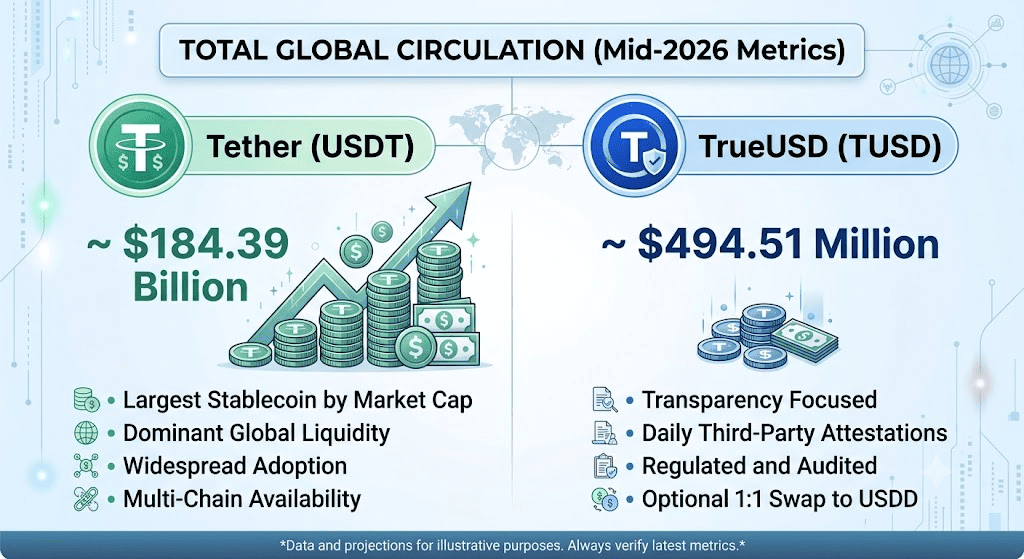
Key differences between Tether (USDT) and TrueUSD (TUSD) stablecoins
2. USDT vs. TUSD's Trading Pair Availability and Liquidity
When it comes to order book depth and market accessibility, the comparison is highly asymmetric.
USDT possesses an overwhelming liquidity advantage. It is the default base quote asset across more than 80% of all crypto trading volume, available across every tier-one exchange and decentralized liquidity pool globally.
TUSD has scaled back its broader exchange presence. While natively deployed or bridged across 10+ prominent networks, including Ethereum, TRON, and Avalanche, its open-market trading pairs are heavily concentrated on select international platforms and specialized DeFi ecosystems, yielding a lower 24-hour trading volume profile of roughly $31 million.
Read more: USDT Networks 2026: TRC20 vs ERC20 vs BEP20 vs Solana vs TON - Full Comparison
3. Legal Standing and GENIUS Act Compliance
Under the 2026 U.S. GENIUS Act, the compliance profiles of both issuers face distinct regulatory parameters.
Tether operates primarily as an international, non-U.S. entity, insulating its secondary market pools from direct domestic enforcement while remaining subject to global sanctions enforcement and secondary-market asset freezing orders.
TrueUSD maintains strict compliance frameworks for its primary accounts. To conform to the newly issued 2026 FinCEN joint rule under Section 4 of the GENIUS Act, Techteryx enforces mandatory onboarding, identity verification, and anti-money laundering (AML) controls for anyone directly utilizing their app terminal to mint or redeem fiat. This ensures that its institutional primary market workflows remain aligned with the Federal Reserve and OCC's structured guidelines.
Read more: What to Know About the U.S. GENIUS Act as Stablecoins Soar Above $260 Billion
How to Buy Tether (USDT) and TrueUSD (TUSD) on BingX
BingX offers an optimized, highly secure portal to purchase, trade, or automate your stablecoin positions using advanced market routing.
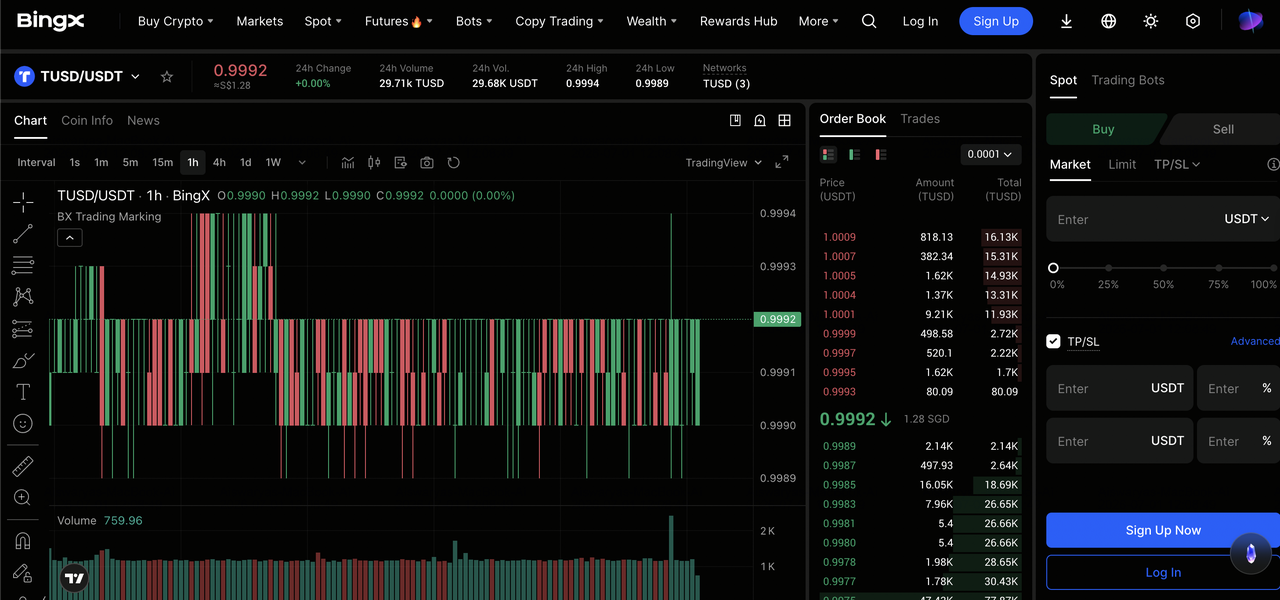
TUSD/USDT trading pair on BingX spot market
1. Access the Spot Trading Terminal
Log in to your BingX account. Hover over the Spot tab on the main top navigation menu and select Spot to initialize the live multi-chart exchange dashboard.
2. Select Your Asset Pair
Navigate to the search field located on the upper left section of the interface. Type in USDT or TUSD to populate the active market pairs, such as USDC/USDT or TUSD/USDT.
3. Configure Your Order Details
Go to the execution panel on the right side. Choose a Market Order if you want your purchase to fill instantaneously at current market pricing, or choose a Limit Order to specify a precise entry price threshold.
4. Execute and Confirm
Enter the total quantity of capital you wish to allocate. Review the nominal network processing parameters, click the green Buy button, and verify your new stablecoin allocation within your secure BingX Spot Wallet.
Key Considerations When Using TUSD and USDT Stablecoins
Before locking large capital reserves into either stablecoin, keep these critical market dynamics in mind:
- The USDD Migration Timeline: If you are holding TUSD, you must actively track official corporate updates regarding the TUSD-to-USDD transition. While existing TUSD remains fully functional and redeemable, maximizing long-term ecosystem rewards will require executing the optional 1:1 token migration.
- Geographic Listing Constraints: Due to the strict enforcement of MiCAR in the EU, ensure you are fully aware of your local jurisdiction's regulatory boundaries. Holding non-authorized stablecoins within European jurisdiction borders can expose users to sudden service restrictions on centralized platforms.
- Counterparty and Custodial Risk: Stablecoins are not equivalent to FDIC-insured bank deposits. The security of your asset relies entirely on the issuer's ongoing liquidity health, their choice of banking partners, and their vulnerability to sovereign regulatory actions.
Conclusion: TUSD or USDT, Which Stablecoin Is Better in 2026?
There is no definitive, one-size-fits-all answer to the Tether vs. TrueUSD question, as both digital assets serve entirely different roles within a modern crypto portfolio.
Tether (USDT) is the undisputed superior choice for active traders, derivatives market participants, and high-frequency liquidity providers. Its unparalleled market depth, infinite trading pairs, and deep global adoption ensure that you can enter or exit massive financial positions instantly with minimal slippage.
TrueUSD (TUSD) stands out as an intriguing niche choice for on-chain DeFi explorers and transparency-focused preservationists. If you prioritize automated, real-time cryptographic proof-of-reserves via Chainlink over traditional corporate quarterly disclosures, TUSD delivers a superior assurance model. Furthermore, for growth-oriented participants, its ongoing transition to the USDD architecture provides early access to unique multi-chain programmable utility incentives.
Most experienced market actors apply a diversified framework: utilizing USDT as their primary vehicle for rapid trading execution and exchange collateral, while carefully maintaining satellite allocations in specialized, highly auditable alternatives to mitigate centralized platform risks.
Related Reading
- USDC vs. USDT: Key Differences and Which Stablecoin to Choose in 2026?
- What Are the Best Stablecoins to Have in Your Portfolio in 2026?
- What Is USDT0 on Stable Chain and How Does It Differ From Traditional Stablecoins?
- What Is USDT in 2026? Complete Beginner's Guide to Tether's Stablecoin
- USDT Networks 2026: TRC20 vs ERC20 vs BEP20 vs Solana vs TON - Full Comparison
FAQs on Tether (USDT) vs. TrueUSD (TUSD)
1. What is the main difference between TrueUSD and Tether stablecoins?
The primary difference between TrueUSD and Tether lies in their transparency systems and liquidity scale. Tether is a massive global market leader relying on standard periodic accounting audits. TrueUSD is a smaller, specialized stablecoin that features automated, real-time daily attestations using Chainlink Proof of Reserve technology.
2. Can EU retail investors freely trade USDT and TUSD on centralized exchanges?
Following the full enforcement of MiCAR on July 1, 2026, stablecoins lacking explicit EMI licensing face heavy restrictions within the European Economic Area (EEA). Many primary exchanges have geofenced or restricted retail trading pairs for both USDT and TUSD within Europe, though both remain fully operational across global international corridors.
3. What is the TrueUSD to USDD transition?
The transition is a strategic initiative announced by TrueUSD to upgrade its core stablecoin architecture. It allows current TUSD holders to voluntarily swap their assets 1:1 into USDD, unlocking broader multi-chain compatibility and deeper integrated yield or reward participation frameworks without disrupting standard TUSD redemptions.
4. How do I instantly swap USDT for TUSD on BingX?
You can execute an instant capital rotation by navigating to the spot market to sell your asset for an intermediate base currency and purchasing your desired target token.
5. Are secondary market stablecoin holders impacted by the GENIUS Act KYC rules?
No. The joint rules proposed by FinCEN and U.S. banking agencies in June 2026 clarify that strict Customer Identification Program (CIP) mandates apply solely to the primary market for direct minting and redemption accounts with the issuer. Simply holding or transacting tokens across secondary smart contracts or P2P wallets does not establish an account under the Act.
