
The European Union’s Markets in Crypto-Assets (MiCA) regulation is officially fully operational, fundamentally reshaping how digital assets are issued, traded, and custodied across all 27 EU member states. July 1, 2026, marks the absolute final boundary of the framework's transitional "grandfathering" period. Any platform or issuer operating within the European Economic Area (EEA) without full authorization is now legally required to halt operations or face severe financial penalties.
For global traders and web3 enterprises, understanding MiCA is no longer a matter of future preparation but the current law of the land. By replacing a fractured network of 27 individual national regulatory systems with a single harmonized rulebook, MiCA provides unprecedented legal clarity, introduces rigid consumer protections, and introduces institutional-grade trust to a market representing more than 450 million consumers.
This guide delivers an authoritative breakdown of how MiCA functions, who it regulates, and what it means for your digital asset journey.
What Is the EU's MiCA Regulation and How Does It Work?
MiCA (Regulation (EU) 2023/1114) is the world's first comprehensive, unified legal framework designed specifically for digital assets. It operates by standardizing the legal perimeter of the crypto industry across the entire European single market, effectively bridging the gap between blockchain innovation and traditional financial oversight.
Instead of forcing companies to navigate 27 distinct national frameworks, MiCA introduces a centralized regulatory core supervised by national authorities alongside the European Securities and Markets Authority (ESMA) and the European Banking Authority (EBA).
Join BingX and claim 5,685+ USDT welcome gift
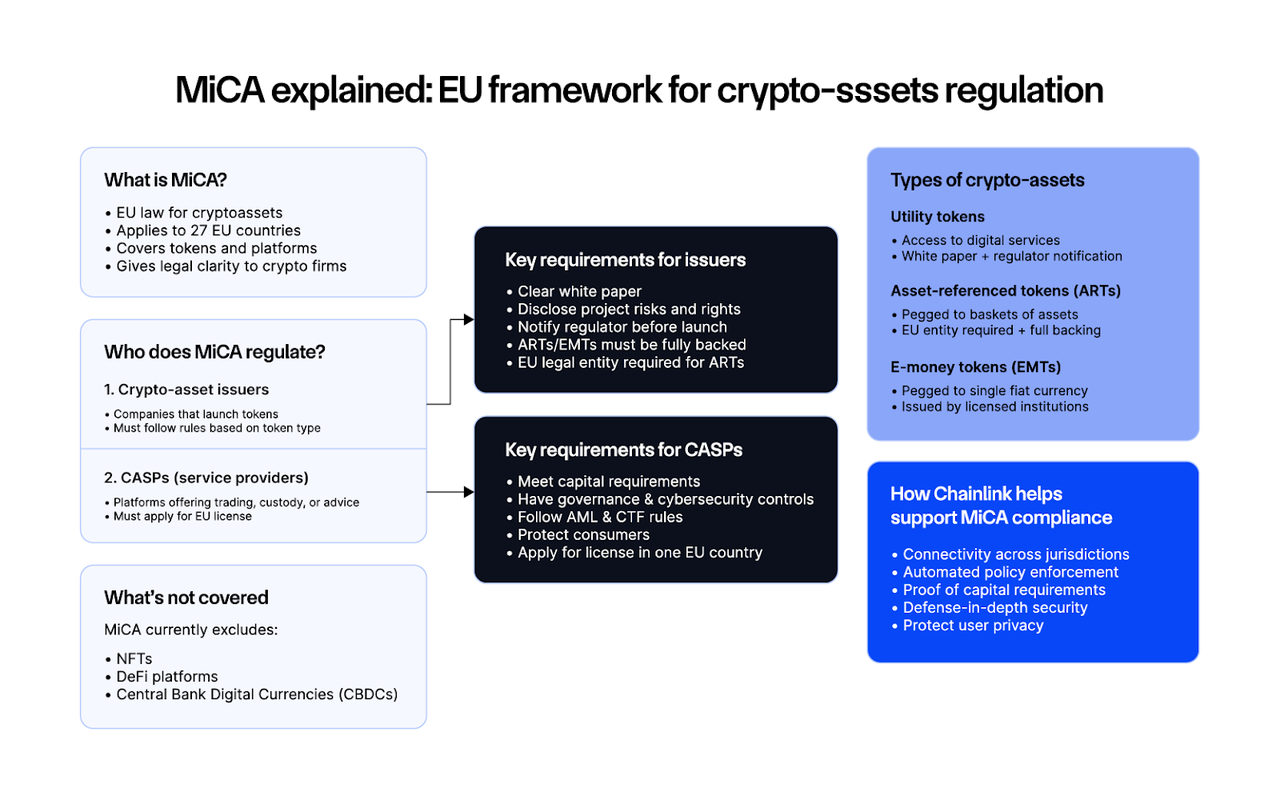
An overview of EU's MiCA regulation framework | Source: Chainlink
Key Highlights of the European Union MiCA Regulations
- The Passporting Engine: The single most powerful mechanism of MiCA is its passporting regime. Once a Crypto-Asset Service Provider (CASP) satisfies the licensing conditions of one single EU member state, such as France, Germany, or Malta, that single license grants them legal authorization to market and scale their services across all 27 EU nations without establishing separate local entities.
- Tiered Entry Requirements: To ensure market stability, MiCA imposes strict operational baselines. Standard retail service providers face capital adequacy minimums scaled directly to their operational risk:
- €150,000 minimum initial capital for platforms operating a crypto trading venue.
- €125,000 for custody services or standard exchange platforms.
- €50,000 for localized execution, reception/transmission, or crypto advisory services.
- Systemic Stablecoin Caps: To preserve the monetary sovereignty of the Eurozone, stablecoins are heavily managed. Issuers of stablecoins must hold mandatory asset reserves fully insulated from corporate balances. Furthermore, non-EU currency stablecoins, such as USD-denominated tokens, used as a widespread medium of exchange are restricted to a maximum threshold of 200 million Euros in daily payment transactions or 1 million daily transactions within the zone.
When Did MiCA Come Into Effect: The July 1, 2026 Compliance Cliff
As of July 1, 2026, the transitional window that allowed legacy Virtual Asset Service Providers (VASPs) to operate under older national registries has officially expired. Unlicensed firms are legally barred from onboarding new EU clients or marketing services within the bloc, and must execute an orderly wind-down of existing positions under strict European Securities and Markets Authority (ESMA) oversight.
The Great European Crypto Reset: MiCA License Count as of July 1, 2026
The absolute expiration of the transition window has triggered a massive consolidation wave across the European crypto landscape. The financial barriers, strict cybersecurity mandates, and rigorous auditing required by MiCA have completely altered the vendor landscape.
According to data compiled from the official ESMA Interim MiCA Register, the shift highlights a stark division in readiness:
- The Survival Rate: Out of more than 3,000 legacy providers that previously held lighter-touch national VASP registrations across the bloc, only about 213 to 244 entities successfully secured their full MiCA CASP authorization in time for the deadline.
- Mass Market Exit: This represents an approximate 80% to 90% contraction in the total number of individual operators allowed to legally face EU consumers. Lightweight operations have effectively been wiped out, concentrating market share into well-capitalized, highly compliant entities.
- Jurisdictional Hubs: Germany leads the regulatory leaderboard with over 55 authorized CASP entries heavily represented by banking institutions and domestic brokerages, followed by the Netherlands (26), France (19), and Malta (15), which remains a prime regulatory hub for global centralized exchanges.
- Stablecoin Scarcity: On the issuance side, the gatekeeping is even narrower. Only 17 E-Money Token (EMT) issuers have cleared the rigorous prudential bar enforced by the EBA, while zero pure Asset-Referenced Tokens (ARTs) hold active authorization.
Why MiCA Changed the Global Crypto Landscape
Before MiCA’s phased rollout began, crypto operations across Europe were highly fragmented. A Crypto-Asset Service Provider (CASP) could register in a lenient member state and attempt to offer services across the bloc, exploiting massive gaps in Anti-Money Laundering (AML) enforcement and consumer protection laws.
MiCA completely removes this regulatory arbitrage. Under its framework, any firm that achieves authorization from a single National Competent Authority (NCA), such as France's AMF, Germany's BaFin, or Malta's MFSA, receives passporting rights. This mechanism permits the company to scale its services seamlessly across all 27 EU countries under a single license. However, gaining that license requires meeting stringent structural criteria.
What Types of Crypto-Assets Does MiCA Regulate?
MiCA divides the digital asset ecosystem into three distinct categories, applying customized compliance rules based on the structural risk profile of the asset.
1. Asset-Referenced Tokens (ARTs)
ARTs are stablecoins that attempt to maintain a stable value by referencing a basket of multiple fiat currencies, commodities, cryptocurrencies, or other financial instruments. Issuers of ARTs must be incorporated as legal entities within the EU, publish a fully approved whitepaper, and maintain robust, independent reserve assets. Significant ARTs, e.g., those exceeding 10 million holders, fall under the direct, heightened supervision of the European Banking Authority (EBA).
2. E-Money Tokens (EMTs)
EMTs are stablecoins pegged 1:1 to a single fiat currency that is legal tender, such as a Euro-pegged token, e.g., Circle's EURC (Euro Coin) or a USD equivalent. MiCA mandates that EMTs can only be issued by authorized credit institutions or electronic money institutions. They must be backed 1:1 by liquid reserves, and holders retain a statutory right to redeem their tokens at par value at any time.
Read more: Top Euro‑Pegged Stablecoins to Know in 2026
3. Other Crypto-Assets Like Utility and Payment Tokens
This blanket category captures utility tokens that provide digital access to a specific application, service, or product. While the compliance requirements are lighter than those for stablecoins, issuers must still draft a comprehensive whitepaper, register with an NCA, and adhere to strict marketing transparency rules before presenting tokens to the public.
What Are the Key MiCA Compliance Requirements for CASPs in Europe?
To operate legally within the European market, any exchange, custodian, portfolio manager, or broker must achieve formal status as a licensed CASP. The compliance architecture rests on four pillars:
|
Requirement Pillar |
Core Mandate |
Target Outcome |
|
Capital Sufficiency |
Base capital buffers ranging from €50,000 to €150,000 (significantly higher for stablecoin reserve ratios). |
Ensures operational continuity and loss absorption. |
|
Asset Segregation |
Complete separation of customer funds from company operational capital. |
Protects user assets from corporate insolvency or misuse. |
|
The Travel Rule |
Full integration with the Transfer of Funds Regulation (TFR) to collect sender/receiver data on all transfers. |
Eliminates anonymous transaction gaps for robust AML compliance. |
|
DORA Cybersecurity |
Mandatory alignment with the Digital Operational Resilience Act (DORA) framework. |
Guards infrastructure against complex ICT and systemic cyber risks. |
What Is Excluded From MiCA's Current Scope?
MiCA was intentionally designed not to overlap with pre-existing traditional financial directives, leaving certain sectors out of scope:
- Financial Instruments: Any tokenized asset that qualifies as a security or financial instrument falls under the Markets in Financial Instruments Directive (MiFID II).
- Truly Decentralized Finance (DeFi): Protocols that function autonomously without an intermediary or identifiable legal operator are exempt. However, centralized front-ends, concentrated governance structures, or fee-extracting entities are actively scrutinized by regulators to determine if they trigger standard CASP obligations.
- Non-Fungible Tokens (NFTs): Unique digital art and collectibles are excluded. However, fractionalized NFTs or tokens issued in large, standardized series are reclassified as fungible crypto-assets under standard MiCA rules.
What Are the Penalties for MiCA Non-Compliance?
The enforcement powers granted to national regulators under MiCA are sweeping. Operating an unauthorized crypto enterprise targeting European residents carries severe administrative and financial consequences:
- Corporate Fines: Regulatory authorities can levy administrative fines up to €5,000,000 or between 3% and 12.5% of a company’s total annual turnover, depending on the severity of the infraction.
- Executive Liability: Individual directors, compliance officers, and executives face personal fines reaching up to €700,000 and can be barred from practicing in the financial sector across the EU.
- Public Registers: Non-compliant firms are logged into ESMA's public register of unauthorized entities, destroying market credibility and triggering instant banking off-ramp blockages.
How Does Europe's MiCA Differ From US's GENIUS Act and CLARITY Act?
As Europe's MiCA completely eliminates its transition window to enforce centralized bloc-wide compliance, the United States is taking a fundamentally different legislative path. Rather than introducing a single, overarching crypto rulebook, the US has fractured its digital asset strategy into specialized federal laws. The bedrock of this American approach relies on two massive pieces of legislation: the GENIUS Act, signed into law in July 2025, and the sweeping CLARITY Act, which cleared the Senate Banking Committee in May 2026.
While Europe opts for rigid, upfront prudential mandates that have forced an estimated 90% of lightweight startups out of the region, the US framework focuses heavily on division of agency labor and clear market structure definition. The GENIUS Act establishes strict, 100% cash-and-Treasury reserve standards for dollar-backed stablecoins, while the CLARITY Act attempts to end the regulation-by-enforcement era by establishing a mature blockchain test. This test permits digital assets to transition from strict SEC securities oversight to more flexible CFTC commodity regulation once a network achieves verifiable decentralization.
EU MiCA Regulations vs. US GENIUS and CLARITY Acts: Quick Comparison
|
Regulatory Feature |
Europe's MiCA |
US GENIUS Act & CLARITY Act |
|
Legislative Structure |
A single, comprehensive cross-border rulebook covering all asset types and service providers. |
Bifurcated: GENIUS Act handles payment stablecoins; CLARITY Act dictates general market structure. |
|
Jurisdictional Oversight |
Coordinated single licensing (Passporting) via national NCAs under ESMA and EBA guidance. |
Dual-agency framework dividing enforcement boundaries between the SEC and the CFTC. |
|
Stablecoin Reserve Limits |
Restricts non-EU stablecoins to €200M in daily payment transaction value; bans algorithmic structures. |
Mandates 1:1 backing in cash/Short-term US Treasurys; explicitly prohibits issuers from paying yield to holders. |
|
Token Classification |
Fixed categorization (ARTs, EMTs, and Utility Tokens) based on underlying asset-pegs. |
Fluid "Mature Blockchain Test," allowing tokens to shift from security status to commodity status as decentralization grows. |
Final Thoughts: How to Navigate the Regulated EU Crypto Market in 2026
MiCA represents a profound turning point for the global digital asset economy. While the structural compliance burden is heavy, particularly for smaller startups, the reward is a highly liquid, legally certain market spanning 27 nations. As the grandfathering safety net completely disappears, the divide between compliant, institution-friendly platforms and unregulated offshore entities is wider than ever. By choosing fully compliant channels and understanding these regulatory baselines, participants can confidently navigate the future of digital finance.
Risk Reminder: Digital asset prices are subject to high market risk and price volatility. Regulatory changes can shift local access parameters rapidly. Always verify the regulatory status of your chosen service providers and consult local compliance guidelines to safeguard your capital.
Related Reading
- The MiCA Cliff-Edge: $400M Liquidity Migration and Fast-Track Passports Upend European Crypto
- What to Know About the U.S. GENIUS Act as Stablecoins Soar Above $260 Billion
- What Is the Crypto CLARITY Act? Explore U.S. Digital Asset Regulation and Its Market Impact
- Virtual Asset Service Providers (VASPs) in Crypto: What Traders Need to Know (2026 Guide)
FAQs on the MiCA Regulation in European Union
1. Can a non-EU firm serve European clients under MiCA?
No. There is no third-country equivalence framework under MiCA. To legally serve EU residents, a foreign entity must establish a physical subsidiary within an EU member state, maintain an effective place of management with a local resident director, and secure a full CASP license. Relying on reverse solicitation, where the user initiates contact entirely on their own, is interpreted extraordinarily strictly by ESMA and is not a viable strategy for active market access.
2. How can I verify if a crypto platform is MiCA compliant?
You can query the official central registry maintained online by the European Securities and Markets Authority (ESMA). This database lists all authorized CASPs, approved asset whitepapers, and a registry of blacklisted, non-compliant entities.
3. Does MiCA ban stablecoins denominated in US dollars?
MiCA does not ban USD stablecoins, but it imposes severe structural limits. Non-EU currency stablecoins utilized as a medium of exchange face strict transaction caps of 1 million transactions or a daily trading volume limit of €200 million within the zone to protect the monetary sovereignty of the Euro.
