


The global energy network has entered its most transformative, multi-faceted structural realignment of the decade. By mid-2026, the historical wall separating traditional fossil fuel infrastructure from hyper-scale technology networks has completely dissolved. The modern market is handling two massive forces simultaneously: deep structural electricity demand from global artificial intelligence architectures, operating right alongside sharp cyclical asset price spikes from ongoing geopolitical blockades in the Middle East.
As major capital benchmarks like the XLE ETF surge with impressive year-to-date returns of nearly 34%, traditional capital allocation structures are moving onto public ledgers. The emergence of tokenized equities allows global investors to access real-world traditional energy assets via Web3 rails. By utilizing platforms like BingX TradFi, market participants can route crypto liquidity into U.S. stock futures using unified USDT margins, opening up direct fractional access to energy infrastructure giants without cross-border bottlenecks.
The Global Energy Market's Key Structural Drivers in 2026
The 2026 energy landscape is characterized by a unique collision between structural tech expansion and traditional fossil fuel constraints. Navigating this macro cycle requires breaking down four core structural realities:
1. The Data Center Power Crunch
While software optimizations continue to advance, the pure computational physical layer requires massive baseload electricity. According to BloombergNEF's New Energy Outlook 2026, global data center capacity has breached 84GW, with power consumption doubling to cross the 1,114 TWh threshold.
In the United States alone, data centers are projected to capture between 6.7% and 12% of total national electricity demand by 2028. This rapid acceleration has turned natural gas, nuclear power, and utility-scale solar-plus-storage frameworks into crucial systemic assets necessary to avoid regional electricity supply failures.
2. Geopolitics and the Strait of Hormuz Blockade
Ongoing Middle East conflicts have caused significant physical delivery interruptions throughout the first half of 2026. The continued operational closure of the Strait of Hormuz has taken roughly 100 critical fuel cargoes offline per month. This baseline disruption has pushed spot benchmarks for Brent crude past the $100–$130+/bbl threshold during peak delivery pinches. While diplomatic discussions occasionally trigger sharp short-term price pullbacks, the physical layout remains fundamentally tight, keeping forward risk premiums elevated.
3. The Long-Term Clean Energy Transition Alignment
High structural prices for traditional fuels are accelerating long-term capital deployments into low-carbon infrastructure. The global energy transition reached a record $2.3 trillion in investment allocations over the past year.
Driven by supply chain overcapacity and falling module costs, solar is on track to become the largest single source of global electricity generation by 2032. Concurrently, battery storage deployment is experiencing a massive 17-fold scale-up, projected to jump to 3.8 TW by 2035 to provide structural flexibility to expanding regional grids.
4. Rigorous Corporate Capital Discipline
Unlike previous historical commodity upcycles, large-cap integrated energy producers are avoiding aggressive, unhedged production growth. Upstream corporate boards are prioritizing free cash flow allocation toward stock buybacks, dividend distribution, and balance sheet protection. This strict corporate discipline keeps broad market supplies balanced, creating a high-yield floor for equity valuations even during temporary price pullbacks.
What Are the Best Energy Stocks and ETFs to Invest in 2026?
The following selected energy equity vehicles and benchmark instruments represent prime structural layers of the global energy value chain, well-positioned to navigate the current environment of geopolitical shifts and expanding power infrastructure.
1. Cheniere Energy (NYSE: LNG)
- 2026 Valuation Benchmark: $57.8 Billion Market Cap
- Consensus Rating: Strong Buy (Average Target: $295–$307)
- Core Role: Monopolistic Liquefied Natural Gas Processing & Export Infrastructure
Cheniere Energy stands as the dominant physical link connecting expanding U.S. shale production to supply-constrained global utility markets across Europe and Asia. Operating out of massive processing hubs at Sabine Pass and Corpus Christi, Cheniere runs a highly defensive toll road business model. The company processes raw natural gas into superchilled liquid under fixed-fee long-term contracts, completely shifting commodity price volatility onto the international buyer.
In its recent Q1 2026 operational disclosure, Cheniere reported record quarterly volumes of 187 exported cargoes, prompting management to raise full-year Consolidated Adjusted EBITDA guidance to a strong $7.25 billion – $7.75 billion range. The multi-year expansion of Corpus Christi Stage 3 has reached 96.5% engineering completion, with Train 6 poised to deliver commercial volumes ahead of schedule. Backed by solid average analyst price targets implying up to 25% near-term upside, Cheniere offers a powerful structural play on global natural gas demand.
Read more: Cheniere Energy (LNG) Price Prediction 2026: $330 Sovereign Boom or $210 Infrastructure Trap?
2. Exxon Mobil Corporation (NYSE: XOM)
- 2026 Valuation Benchmark: Supermajor Tier Integrated Moat
- Consensus Rating: Moderate Buy / Outperform (Top Targets: $182–$195)
- Core Role: Mega-Cap Integrated Oil and Gas Global Supermajor
Exxon Mobil provides a highly resilient, diversified asset base capable of navigating complex cyclical environments. Its upstream production profile is anchored by exceptionally low-cost extraction nodes, highlighted by a production milestone in Guyana that surpassed 900,000 gross barrels per day. This operational scale is paired with expanding alternative energy positioning, including the Golden Pass LNG joint venture's Train 1 launch, alongside carbon capture and direct lithium extraction projects.
While Exxon's recent Q1 GAAP net income of $4.2B was temporarily impacted by $3.9B in non-cash paper derivative adjustments from volatile forward price swings, its underlying cash generation remains robust. The company returned $9.2 billion straight to shareholders in Q1 alone, supported by an ultra-efficient cost optimization program that has removed $15.6 billion in structural corporate expenses since 2019. Wall Street price targets remain highly constructive, maintaining long-term outperformance configurations.
Read more: Exxon Mobil (XOM) Price Prediction 2026: $180 Energy Alpha or Geopolitical Value Trap?
3. Energy Select Sector SPDR ETF (NYSEARCA: XLE)
- Assets Under Management: $42.4 Billion as of May 2026
- Expense Ratio: 0.08% (Highly Liquid Institutional Core)
- Core Focus: Mega-Cap Liquid Energy Blue Chips (Market-Cap Weighted)
For investors looking to capture broad sector momentum without concentrated single-stock operational risks, the XLE ETF serves as the definitive institutional benchmark vehicle. The fund tracks the leading energy constituents of the S&P 500 index, operating with an exceptionally low expense ratio. The structural architecture of XLE is highly concentrated, allocating nearly half its total weight to three integrated titans: Exxon Mobil (22.2%), Chevron (16.6%), and ConocoPhillips (7.1%).
XLE has led broad equity market performance through the first half of 2026, delivering an impressive year-to-date return of around 33% and a trailing 1-year total return crossing 41%. The fund's heavy allocation toward integrated majors and midstream pipelines provides steady cash flow support through an attractive dividend yield of 2.5%–3.0%, making it a reliable foundational holding during times of macroeconomic volatility.
Read more: Energy Select Sector XLE ETF Prediction 2026: $65 Energy Supercycle or $40 Hormuz Hedge Exit?
4. SPDR S&P Oil & Gas Exploration & Production ETF (NYSEARCA: XOP)
- Beta Index Metric: 0.56 vs Standard Deviation of 27.31% (High Risk/Reward)
- Expense Ratio: 0.35%
- Core Focus: High-Beta Pure-Play Independent Exploration & Production (E&P)
The XOP ETF offers an alternative structural approach to sector exposure, employing an equal-weighted mechanism across the upstream oil and gas exploration and production segments. This framework shifts capital away from integrated downstream refining giants and routes it straight into smaller, independent upstream drillers, including top index holdings like APA Corp, Murphy Oil, SM Energy, and HF Sinclair.
Because its underlying businesses are highly sensitive to raw physical commodity pricing, XOP functions as a high-beta trading vehicle. Driven by geopolitical supply disruptions, XOP has rallied around 40% year-to-date, trading near multi-month highs. While its standard deviation metrics indicate a higher short-term risk profile, XOP provides unmatched upward momentum during bullish oil market cycles.
Read more: XOP S&P Oil & Gas ETF Prediction 2026: $210 Geopolitical Moonshot or $130 Hedge Trap?
5. Schlumberger N.V. (NYSE: SLB)
- 2026 Valuation Benchmark: $109.4 Billion Market Capitalization
- Consensus Rating: Strong Buy (Discount Value Anchor: $88.37 Cash Flow Estimate)
- Core Role: Global Oilfield Services & Subsea Technology Architecture
Schlumberger operates as the essential technology layer behind global extraction infrastructure, supplying specialized drilling, subsea hardware, and advanced reservoir modeling software to national and independent operators alike. As global production shifts toward complex international offshore reserves and deep-water developments, SLB captures a massive technological moat that isolates it from localized onshore declines.
In the first half of 2026, SLB achieved an impressive year-to-date share price surge of 41.5%, supported by robust international revenue streams and a targeted $4 billion shareholder capital return program. The strategic integration of ChampionX has unlocked substantial margin efficiencies, capturing $400 million in structural cost synergies across digital production platforms. While legacy discounted cash flow models point to an intrinsic value target near $88.37, SLB remains a premier oil services pick trading at an appealing structural discount.
Read more: SLB Stock Prediction 2026: $83 Digital AI Breakout or $48 Geopolitical Trap?
6. Occidental Petroleum Corporation (NYSE: OXY)
- 2026 Valuation Benchmark: $58 Billion Market Cap
- Consensus Rating: Zacks Rank #1 (Strong Buy) / Morgan Stanley Target: $74
- Core Role: Independent Exploration & Production (E&P) with Aggressive Deleveraging
Occidental Petroleum (OXY) represents a premier upstream asset experiencing a significant fundamental re-rating in 2026. Driven by a combination of elevated oil benchmarks and highly favorable earnings estimate revisions, OXY has surged more than 37%–48% YTD. The consensus EPS estimate for the current year has climbed 29.7% over the past month to $5.14 per share, indicating immense optimism regarding its Permian Basin core production.
The defining structural catalyst for OXY in 2026 is its massive debt reduction initiative. Management successfully repaid $7.1 billion in principal debt through early May, dropping total principal debt down to $13.3 billion as it charges toward a structural $10 billion milestone. Backed by an 8% dividend hike (yielding 1.7%) and anchoring confidence from Warren Buffett's Berkshire Hathaway, which holds an approximate 27% ownership stake, OXY is transforming into a lean, highly profitable cash generator.
Read more: Occidental Petroleum (OXY) Price Prediction 2026: $115 Net-Zero Alpha or $55 Commodity Trap?
Comparison of Leading Energy Stocks and ETFs in 2026
To help map out your portfolio allocation strategies for the second half of 2026, the structural differences across these leading energy assets are synthesized below:
|
Ticker |
Primary Category |
Core Structural Advantage |
2026 Catalysts & Financial Outlook |
|
LNG |
Gas Infrastructure |
Fixed toll-road fees via long-term supply contracts; isolates commodity price risk. |
Corpus Christi Stage 3 at 96.5% completion; full-year EBITDA raised to $7.25B–$7.75B. |
|
XOM |
Integrated Supermajor |
Extremely low-cost production footprint (Guyana >900k bpd) mixed with global downstream refining. |
Strong capital returns ($9.2B in Q1); $15.6B in structural savings; analyst targets up to $182–$195. |
|
OXY |
Upstream E&P Leader |
Aggressive balance sheet repair; massive asset backing by Berkshire Hathaway (27% stake). |
Repaid $7.1B debt YTD; Zacks #1 Strong Buy; current year EPS estimates revised up by 29.7%. |
|
XLE |
Blue-Chip ETF |
Highly concentrated large-cap exposure; very low 0.08% cost ratio; strong 2.5%–3.0% dividend yield. |
Up ~33% YTD; strong performance driven by large allocations to XOM and CVX. |
|
XOP |
Upstream E&P ETF |
Equal-weighted model; high beta leverage directly exposed to raw commodity pricing trends. |
Up ~40% YTD; strongly benefits from geopolitical supply shocks; higher short-term volatility. |
|
SLB |
Oilfield Technology |
Global market leader in offshore services, deep-water engineering, and digital infrastructure software. |
Up ~41.5% YTD; $4B earmarked for capital returns; $400M in synergies via the ChampionX integration. |
How to Trade Top Energy Stocks and ETFs on BingX
BingX offers global market participants advanced, crypto-native tools to gain price exposure to premier global energy assets. Traders can execute macro-driven strategies through two secure pathways tailored to individual allocation styles.
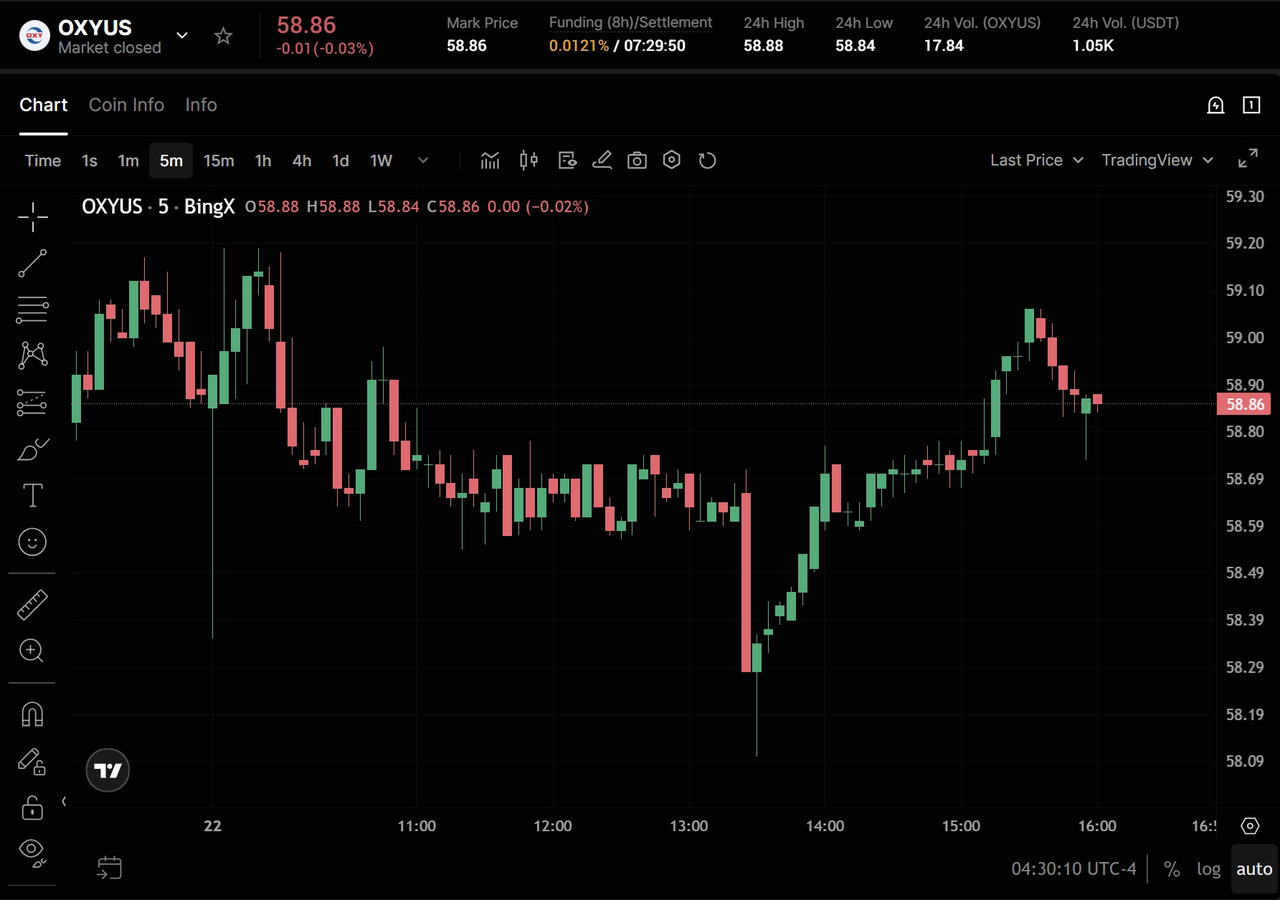
OXY/USDT perpetual contract on BingX futures market
Long or Short Energy Stocks and ETFs with USDT on BingX TradFi
For active traders looking to use leverage, implement short-term shorting capabilities, or hedge existing long-term structural portfolios, BingX TradFi provides highly liquid, USDT-settled equity perpetual contracts.
- Account Funding: Navigate to the TradFi portal and transfer your targeted USDT working margin from your primary Spot account into your Futures account.
- Select Contract: Select your targeted contract instrument from the directory of equity perpetual contracts, e.g., SLB-USDT, OXY-USDT, LNG-USDT, XLE-USDT, etc.
- Direction & Leverage: Determine your directional strategy: choose Open Long to capitalize on data center power demand and supply constraints, or choose Open Short to profit from potential geopolitical easing. Select your leverage parameters conservatively based on your personal risk threshold.
- Risk Mitigation & Execution: Input your exact position sizing. Always specify clear Take-Profit (TP) and Stop-Loss (SL) trigger targets within the execution layout to manage capital volatility before confirming your position.
Top Risks and Market Considerations for Energy Market Investors in 2026
While the structural macro trends backing the 2026 energy supercycle remain robust, market participants must manage capital allocation against significant systemic risks:
- Sudden Geopolitical De-escalation: A rapid diplomatic resolution to Middle East conflicts and a full reopening of the Strait of Hormuz could quickly remove existing supply risk premiums. This would expose unhedged upstream producers to sharp pricing corrections down toward the $50–$60/bbl consensus baseline.
- Macroeconomic and Chinese Demand Deceleration: If global industrial activity slows or broad recessionary pressures lower factory demand across major importing Asian economies, energy consumption will contract, creating a near-term oversupply of crude inventories.
- Grid Connection and Permitting Delays: Severe infrastructure bottlenecks in regional electricity grids, including transformer backlogs and extended permitting timelines, could delay data center expansions, capping near-term electricity demand growth.
- Tokenized Asset Governance Limits: Tokenized equity trading pairs function exclusively as price-tracking vehicles. They replicate 1:1 real-world economic performance using crypto rails but do not convey voting rights or physical share distribution.
Final Thoughts: Balancing the Energy Crossroads in 2026
The global energy landscape in 2026 represents a unique market crossroads. Traditional oil, gas, and infrastructure networks are generating substantial cash flows today, supported by persistent geopolitical premiums and tight global supplies. Simultaneously, the accelerating power demands of artificial intelligence and data center electrification are creating powerful, multi-year structural opportunities across utility grids and low-carbon tech layers.
Spreading capital across distinct, high-quality layers of this value chain, ranging from asset-insulated toll roads like Cheniere to integrated blue chips like Exxon Mobil or versatile benchmark ETFs, provides a balanced approach to navigating this high-yield environment. Utilizing the flexible tokenized spot structures and advanced futures contracts on BingX TradFi enables global capital to execute these macro strategies with speed and capital efficiency. However, because energy cycles are highly sensitive to fast-moving geopolitical shifts, traders should maintain strict risk management and treat these allocations as a focused, disciplined component of a diversified portfolio.
Related Reading
- Top AI Compute and GPU Stocks to Buy in 2026: The Shift to Inference and Custom Silicon
- Top 10 AI Infrastructure Stocks to Buy in 2026: Chip Manufacturing and Design Leaders
- Top AI Cloud Infrastructure Stocks to Buy in 2026 Amid Hyperscaler Capex and the Neocloud Boom
- Crude Oil Price Forecast 2026: $140 War Premium or $60 Surplus Baseline?
- Natural Gas Price Prediction 2026: $15 Global Energy Shock or U.S. Glut Trap?