

Investing in Sui (SUI) and Sei (SEI) represents a strategic choice between two deeply distinct philosophies of execution parallelization. While both networks are designed to break the sequential transaction bottlenecks that plague early state machines, they target entirely non-overlapping market niches.
Sui has solidified its footprint as a highly capitalized, versatile, asset-heavy general platform designed for consumer applications, gaming, and real-world asset (RWA) frameworks. Bolstered by institutional milestones like the Nasdaq listing of the 21Shares Spot SUI ETF (TSUI) in early 2026 and major remittance integrations with cross-border payment processors like Paga, Sui's native token SUI has established a resilient macro baseline around $0.73, with an active market cap of $2.957 billion.
Sei, conversely, has optimized its state machine around decentralized finance (DeFi) trading efficiency and high-frequency trading applications. Operating as an EVM-aligned, sector-specific powerhouse, Sei has faced a volatile capital cycle in 2026, marked by the recent structural shutdown of its native order-book DEX, Oxium, alongside the rollout of its highly anticipated Giga V2 upgrade. Trading near $0.048 with a market cap of $324.12 million, Sei focuses heavily on proving its thesis as an ultra-low-latency settlement hub for automated market makers, on-chain order books, and cross-border machine-to-machine commerce.
As market participants engage in a comprehensive Sui vs. Sei crypto comparison for the remainder of 2026, analyzing underlying technical designs, reviewing live network statistics, and knowing how to trade SEI and SUI on BingX are critical steps for managing risk.
Key Takeaways: Battle for Parallel Dominance Between Sui and Sei Blockchains
- Move Language Isolation vs. EVM Synergy: Sui leverages Sui Move to deliver structural safety and object-centric performance, but requires developers to learn a new language. Sei embraces full EVM compatibility, letting Ethereum projects migrate instantly via familiar Solidity code pipelines.
- Proven Speed Metrics: While both platforms offer zero-second finality, Sui leads real-world deployment in mid-2026, displaying 237 times higher live transaction throughput and an ultra-short 79ms block time.
- Liquidity vs. RWA Specialization: Sui retains deeper on-chain retail liquidity, holding over $421 million in DeFi TVL. Sei capitalizes on corporate compliance, carving out an impressive $272 million market cap in institutional real-world tokenization.
- Vesting vs. Circulating Dynamics: SEI features a healthier supply structure, with over 72% of its tokens circulating freely. SUI traders must account for regular monthly vesting releases, requiring sustained institutional demand to mitigate supply dilution.
Introduction: Understanding Sui and Sei
To accurately project which parallelized infrastructure offers the superior allocation or deployment runway for the remainder of 2026, market participants must look beyond theoretical whitepapers. Successful analysis requires evaluating real-time on-chain throughput, active ecosystem liquidity, and the structural market performance of both native tokens.
Sui (SUI), the Object-Centric Powerhouse
Sui entered the market in May 2023 under the direction of Mysten Labs, an elite engineering outfit founded by ex-Meta blockchain architecture veterans. Engineered from its inception to eliminate the scalability ceilings of legacy state machines, Sui replaces traditional account-based ledgers with a highly innovative, object-centric architecture. By treating every asset, token, and smart contract as an independent object, the network can run un-sequenced, parallel validation pipelines. This translates into a highly responsive user experience, featuring an ultra-low block time of just 79 milliseconds, a tested historical peak capacity of 926.5 transactions per second (TPS), and a theoretical ceiling exceeding 120,000 TPS.
From a market and adoption standpoint, Sui has captured immense institutional momentum throughout 2026. Backed by capital rails like the Nasdaq-listed 21Shares Spot SUI ETF (TSUI) and high-volume fintech integrations like Africa’s Paga payment network, the network has cemented its position as a heavyweight layer-1 ecosystem. SUI trades securely at a macro baseline of $0.73, commanding an active circulating market capitalization of $2.957 billion against a fully diluted valuation (FDV) of $7.297 billion. With a total value locked (TVL) comfortably exceeding $421 million and an average transaction fee held at an economically negligible $0.0001891, Sui stands out as a highly secure, well-capitalized, and battle-tested network tailored for mass-market consumer Web3, gaming, and enterprise applications.
Read more: What Is a Spot Sui ETF and When Could It Launch?
Sei (SEI), the High-Frequency Trading Hub
Sei launched in late May 2023 via the Cosmos SDK framework, purposefully built to solve a specific, high-friction problem: the structural latency and throughput limitations of decentralized financial exchanges (DEXs). Rather than trying to be a general-purpose ecosystem from day one, Sei optimized its core architecture directly around decentralized trading, order matching, and institutional capital efficiency. Following its monumental V2 upgrade, Sei became the world’s first production-grade parallelized Ethereum Virtual Machine (EVM), combining full, out-of-the-box Solidity developer compatibility with a multi-threaded execution engine, an optimized storage framework called SeiDB, and sub-250ms deterministic finality via its specialized Twin-Turbo and Autobahn consensus designs.
Financially, Sei represents an appealing, high-beta trading vehicle that offers a drastically different structural supply model compared to its competitors. Trading near $0.048 with an active market cap of $324.12 million, SEI features a robust Market Cap to FDV ratio of 72.18% (with a $481.37 million FDV), heavily protecting holders from the aggressive inflationary token-unlock pressures commonly seen across newer layer-1 blockchains. While Sei’s native DeFi TVL has experienced near-term pressure, stabilizing around $48.19 million following the shutdown of its flagship native order-book DEX, Oxium, the platform has successfully specialized in institutional RWA tokenization. Controlling a commanding $272 million active RWA market cap through strategic deployments with major asset managers, Sei serves as an ultra-fast, EVM-accessible sandbox engineered for programmatic finance and high-speed asset settlement.
Read more: Is Sei Network 2026's Fastest Layer-1 Blockchain?
Sui vs. Sei on Technical Architecture: Move vs. Parallel EVM
The primary differentiator between Sui and Sei lies within their storage models and execution environments. These core engineering choices determine how each network prevents data conflicts when thousands of transactions attempt to update the ledger at the exact same moment.
Sui: The Object-Centric Move VM
Sui completely abandons the legacy, account-based database design used by Ethereum and Solana. Instead, Sui’s state is built entirely around independent objects. On Sui, every token balance, NFT smart contract, or data point is treated as a unique, self-contained object with explicit ownership properties.
- Owned Objects: Transactions involving owned objects (such as a standard peer-to-peer token transfer) do not require global network consensus. Sui routes these through a Byzantine Consistent Broadcast mechanism, bypassing the main consensus engine entirely to achieve sub-second finality.
- Shared Objects: Transactions interacting with public smart contracts like a crowded automated market maker pool utilize Sui's specialized consensus engine (Narwhal and Mysticeti) to sequence actions.
This infrastructure is powered by Sui Move, a resource-oriented programming language designed by ex-Meta engineers. Sui Move prevents common smart contract exploits, such as reentrancy attacks, by treating tokens as strict mathematical resources that cannot be duplicated or dropped accidentally.
Sei: The Parallelized Ethereum Virtual Machine (EVM)
Sei approaches parallelization by re-engineering and optimizing a proven framework. Built atop the Cosmos SDK, Sei’s V2 upgrade introduces a Parallel EVM model, allowing Ethereum developers to deploy their existing Solidity code directly to Sei without rewriting a single line of infrastructure.
- Optimistic Concurrency Control (OCC): Instead of forcing developers to declare which data an application will touch beforehand, Sei runs transactions concurrently across multiple CPU cores. If the network detects that two separate transactions tried to modify the exact same ledger account at the exact same time, the system flag-checks the conflict, reverts the affected transaction, and re-runs it sequentially.
- SeiDB: To prevent database bloat, Sei utilizes an optimized storage layer that separates state commitment from state storage, significantly reducing disk read/write times and speeding up parallel processing pipelines.
Sui and Sei Ecosystem Statistics: TVL, Active Users as of July 2026
Capital retention and liquidity depth vary significantly across both environments in mid-2026, illustrating the distinct stages of ecosystem maturity between the two platforms.
|
Key Metric (Mid-2026) |
Sui ($SUI) |
Sei ($SEI) |
|
Total Value Locked (TVL) |
$421.83M (+2.43% 24h) |
$48.19M (-0.81% 24h) |
|
Real-World Asset (RWA) Mcap |
$22.88M |
$272.09M |
|
Daily App Revenue (24h) |
$23,888 |
$4,773 |
|
Daily App Fees (24h) |
$119,043 |
$43,572 |
|
Fully Diluted Valuation (FDV) |
$7.297B |
$481.37M |
|
Market Cap / FDV Ratio |
40.52% |
72.18% |
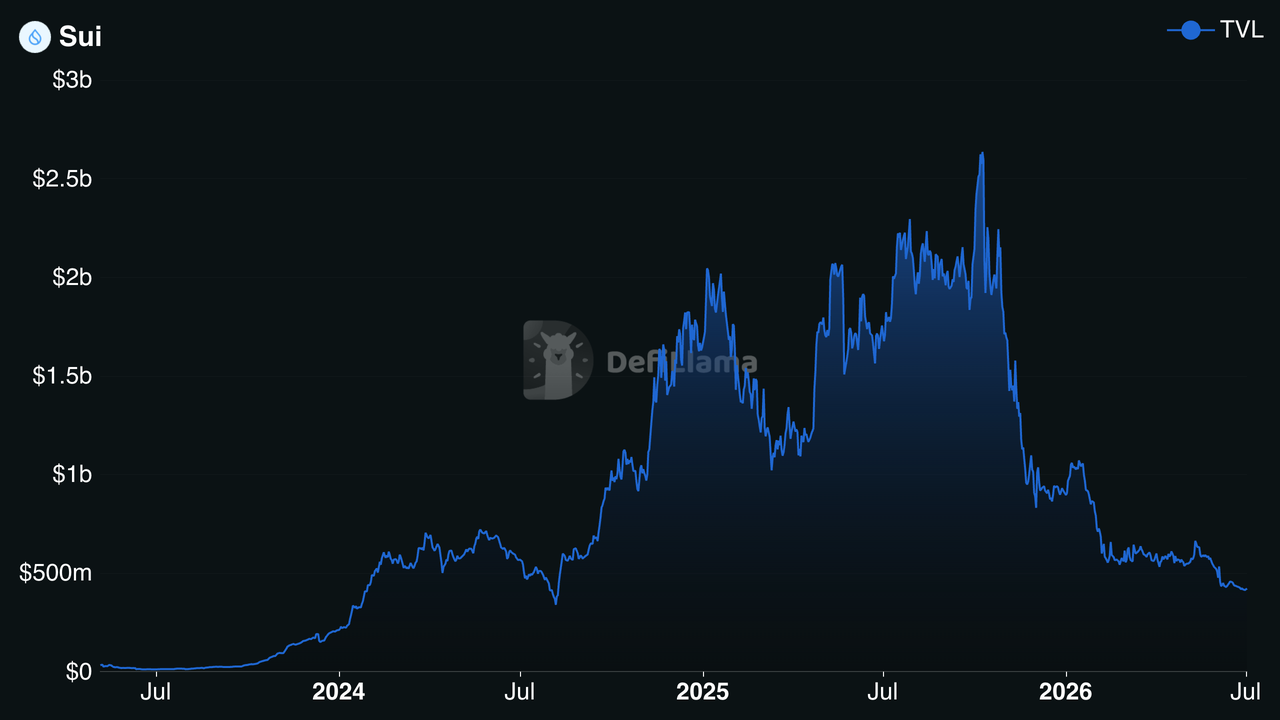
Sui's DeFi TVL | Source: DefiLlama
Sui maintains clear structural dominance in DeFi liquidity depth, supporting over $421 million in on-chain TVL. This deep liquidity is driven by steady stablecoin inflows, prominent DEXs, and the upcoming Deepbook v3 framework upgrade designed to introduce native margin trading.
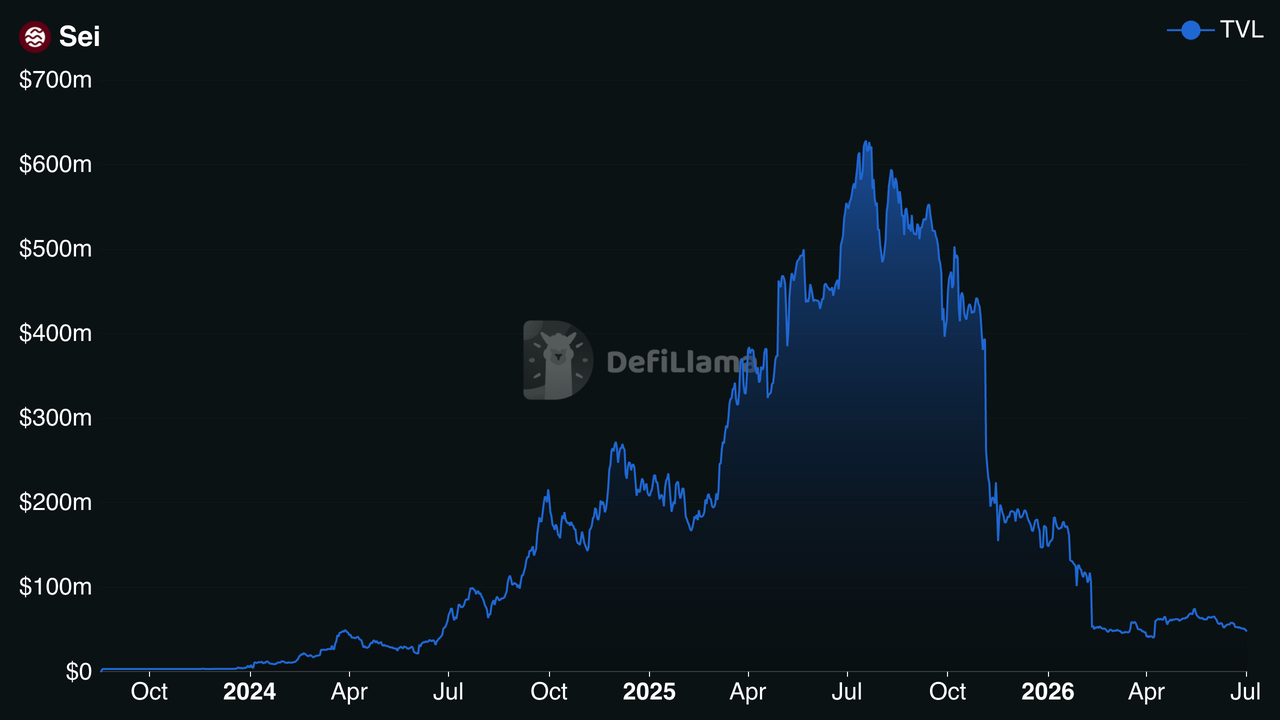
Sei DeFi TVL | Source: DefiLlama
Sei's DeFi TVL has experienced downward volatility, dipping to roughly $48 million following the closure of Oxium. However, Sei counters this deficit by leading heavily in institutional RWA tokenization, capturing an active RWA market cap of over $272 million. This is bolstered by ecosystem integrations with entities like Circle, Securitize, and a $30 million enterprise capital fund designed to deploy assets from managers like BlackRock on-chain.
Furthermore, Sei presents a more advantageous token unlock structure for the remainder of 2026: its Market Cap to FDV ratio sits at 72.18%, meaning the majority of supply is circulating. Sui faces a larger dilutive headwind, with a lower 40.52% Market Cap to FDV ratio that results in regular monthly token unlocks, which can create persistent supply overhead.
Which Is the Faster Blockchain, Sui or Sei: Finality and Throughput Comparison
When evaluating pure performance metrics under real-world conditions, the parallel execution advantages of both networks become clear.
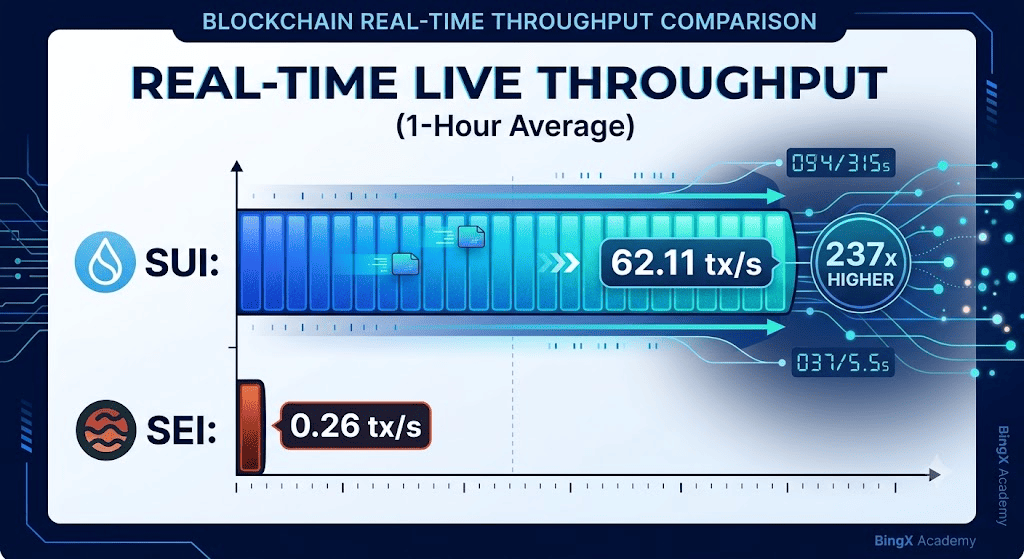
Throughput and Live Activity
While both networks post high theoretical benchmarks, live data from Chainspect reveals that Sui processes an average hourly throughput of 62.11 transactions per second (tx/s), which is 237 times higher than Sei's live average of 0.26 tx/s.
During high-congestion events, Sui's peak recorded historical throughput hits 926.5 tx/s, compared to Sei's maximum recorded metric of 255.7 tx/s. This gap indicates that Sui has captured more consistent organic consumer transaction volume, generating over 224,000 hourly transactions compared to Sei's 943 hourly actions.
Finality and Transaction Costs
- Block Time / Latency: Sui features an incredibly responsive execution loop, posting a block time of just 79 milliseconds, which is over 80% shorter than Sei's 435-millisecond block time.
- Time to Finality: Both networks achieve near-instantaneous, deterministic settlement, registering a true 0-second finality time where transactions are settled forever upon execution without risk of chain reorganization.
- Average Fees: Sui offers highly optimized economic scalability, keeping its average transaction fee at an ultra-low $0.0001891, roughly 82% cheaper than Sei's average base cost of $0.001104.
How to Trade SUI and SEI on BingX
The BingX platform offers advanced algorithmic systems, custom order routing, and specialized automated accumulation strategies to help you manage positions across both parallelized L1 tokens safely.
Buy and Sell SUI and SEI on the Spot Market
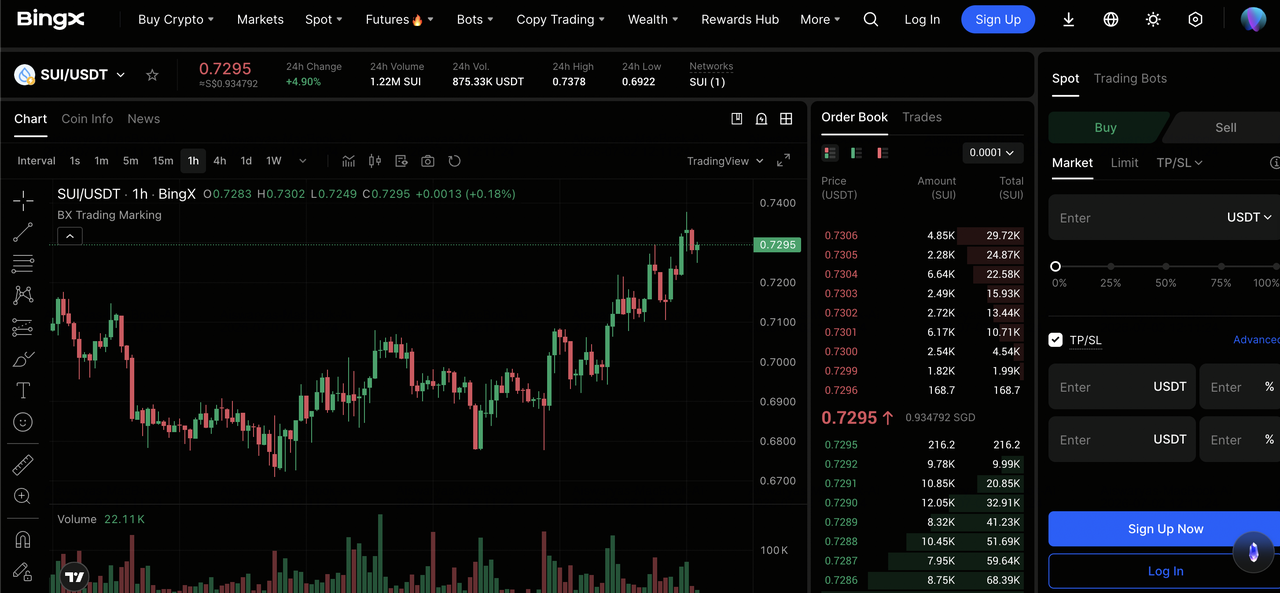
SUI/USDT trading pair on BingX spot market
- Log in to your verified BingX account and navigate to the top header menu, select Spot, and click Spot to load the main execution dashboard.
- Utilize the search module on the left panel to input SUI/USDT or SEI/USDT to access the live trading chart.
- Select a Market Order to fill your position immediately at the current global market rate, or set a Limit Order to specify your precise entry targets.
- Input your designated capital allocation size in USDT, click Buy SUI or Buy SEI, and track your tokens securely inside your asset wallet.
Read more: Where to Buy Sei Crypto: A Guide to the Best Exchanges in 2026
Long or Short SUI and SEI in the Futures Market
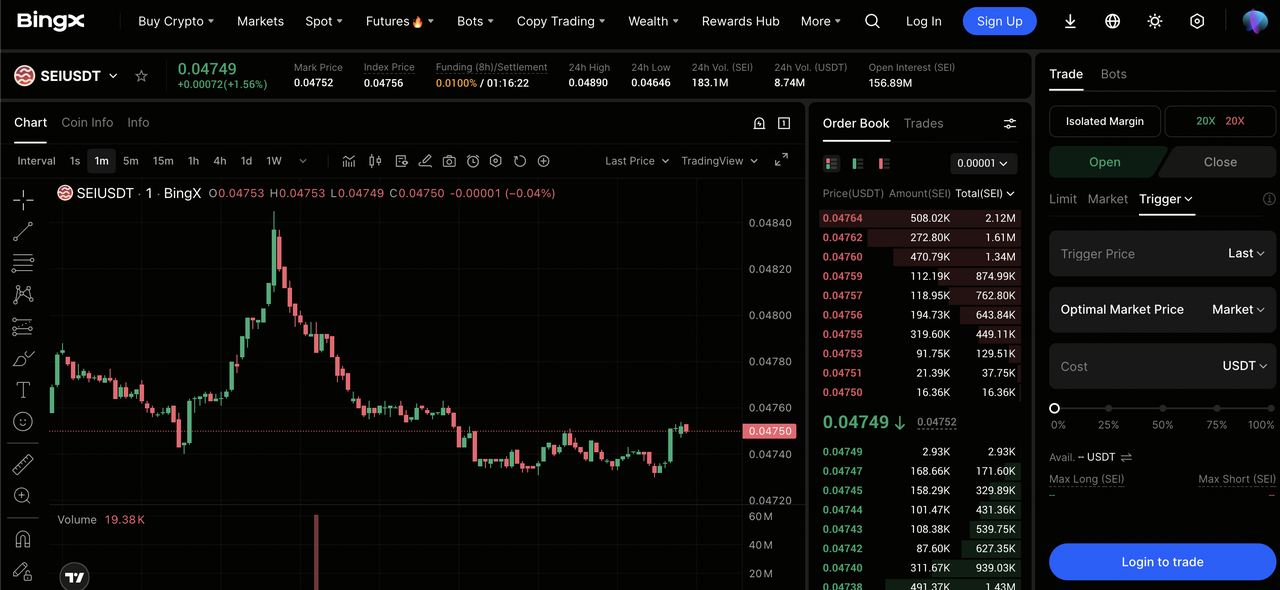
SEI/USDT perpetual contract on BingX futures market
- Navigate to the principal exchange dashboard, hover over Futures, and click Perpetual Futures to initialize high-liquidity derivative contracts.
- Select the asset asset dropdown menu in the upper-left chart corner and select the SUI/USDT Perpetual or SEI/USDT Perpetual contract pair.
- Select your preferred collateral risk structure: configure Isolated Margin to fence liability to an individual trade, or Cross Margin to share account collateral balances.
- Set your leverage scale using a disciplined parameters setting, such as 2x to 5x, to maintain healthy liquidation distance.
- Choose Long if your technical indicators forecast a resistance breakout, or choose Short to position for a macroeconomic correction down to support. Always specify your Take-Profit (TP) and Stop-Loss (SL) boundaries before clicking execution.
Accumulate SUI and SEI via BingX Recurring Buy (DCA)
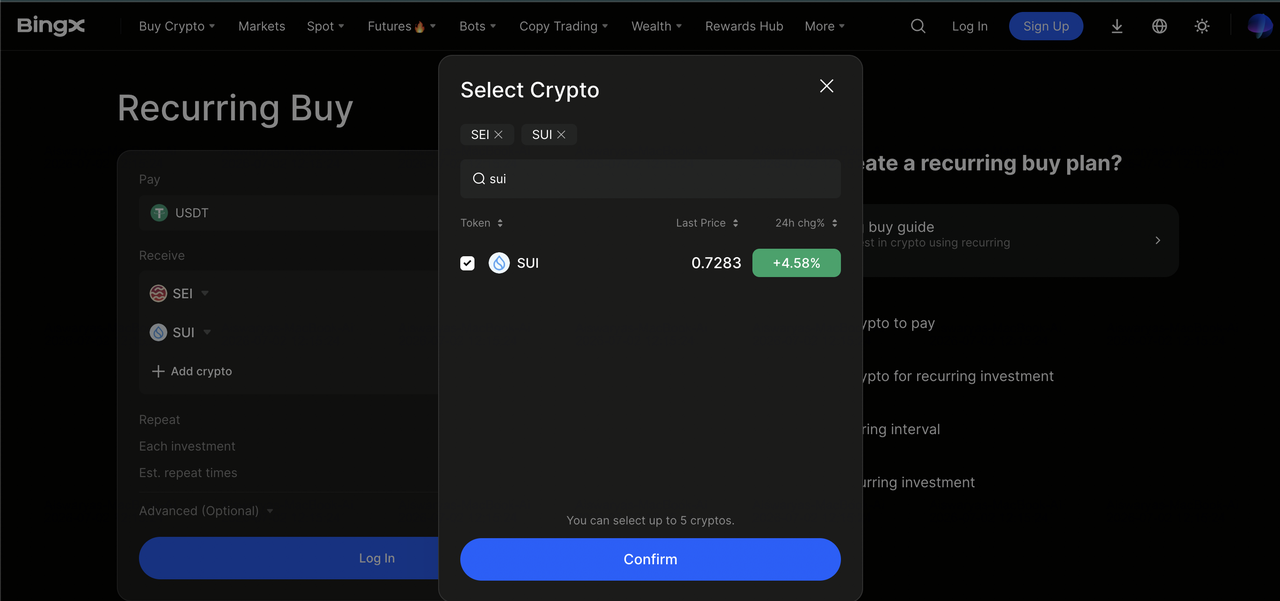
DCA SEI and SUI on BingX Recurring Buy
- Navigate directly to the Recurring Buy interface to establish automated portfolio expansion using programmatic Dollar-Cost Averaging (DCA).
- Choose to build a personalized, multi-asset basket strategy, allowing you to split capital across up to 5 individual assets like SUI and SEI simultaneously.
- Define your structural funding reserve token, such as USDT or USDC, and input your custom batch purchasing power, starting at 1 USDT.
- Adjust your automated buying frequency from the system checklist, selecting an execution schedule of Daily, Weekly, Bi-Weekly, or Monthly intervals.
- Review your scheduled averaging profile parameters, accept the system protocol terms, and click Create Plan to process automatic systemic purchases that eliminate emotional trading biases.
Top Risk to Consider When Investing in Sui and Sei Crypto
Investing in next-generation parallelized Layer-1 protocols carries structural risks that could impact capital allocation strategies throughout the remainder of 2026:
- Sui Supply Overhang: Over 40% of the total SUI supply remains locked in vesting smart contracts. The continuous influx of millions of dollars worth of unlocked tokens each month creates a mechanical supply dilution that requires sustained institutional inflow to absorb. Furthermore, past network stalls, such as the multi-hour outage in May 2026, show that the innovative Move VM is still maturing.
- Sei Ecosystem Concentration: While Sei boasts a favorable 72.18% circulating supply ratio, its specialized DeFi ecosystem faces near-term adoption strain. The complete structural shutdown of its primary native order-book DEX, Oxium, highlights the difficulty dApps face in maintaining profitability. Additionally, its aggressive Giga upgrade roadmap introduces high technical execution and smart contract risks before hitting mainnet.
Ultimately, you must never invest more than you can afford to lose. Ensure you utilize disciplined risk management tools, such as isolated margin modes, strict dollar-cost averaging cadences, and firm stop-losses, when adding these high-beta altcoins to your portfolio on BingX.
Final Thoughts: Sui or Sei, Which Layer-1 Blockchain to Choose in 2026?
Choosing which asset to weight or trade within your portfolio depends heavily on your risk tolerance, developer alignment, and macro thesis regarding parallelized ecosystems.
Sui is best suited for diversified, long-term investors seeking an ecosystem backed by institutional capital channels, expanding real-world corporate integrations, and a robust consumer application framework. If you prioritize absolute network stability, massive organic transactional volume, and programmatic security via the Move language, and possess the patience to absorb periodic volatility from monthly token unlocks, SUI serves as a strong core L1 holding.
Sei is best suited for high-risk, high-reward investors and active DeFi participants targeting maximum structural upside. By utilizing an EVM-aligned model, Sei serves as an ideal sandbox for rapid developer migration from Ethereum. If your investment focus centers on specialized high-frequency trading applications, on-chain order books, institutional RWA infrastructure, and automated machine-to-machine commerce, SEI presents a highly responsive vehicle with reduced long-term supply dilution.
Related Reading
- Is Sei Network 2026's Fastest Layer-1 Blockchain?
- Where to Buy Sei Crypto: A Guide to the Best Exchanges in 2026
- What Are the Top Crypto Projects and dApps in the Sui Ecosystem in 2026?
- Sui vs. Solana: The Ultimate 2026 Layer-1 Blockchain Architecture and Investment Analysis
- What Are the Best Sui Wallets of 2026?
FAQs on Sui (SUI) vs. Sei (SEI)
1. Are Sui and Sei part of the Cosmos ecosystem?
Sei was built using the Cosmos SDK and retains compatibility with certain Cosmos infrastructure components, though its V2 upgrade heavily emphasizes a parallelized EVM environment. Sui is completely independent of Cosmos, built from scratch with an object-centric architecture and a custom version of the Move Virtual Machine.
2. Can I use MetaMask to interact with both networks?
You can use MetaMask to interact directly with Sei due to its Parallel EVM compatibility and native EVM RPC support. You cannot use standard EVM wallets for Sui; interacting with the Sui network requires custom, Move-compatible applications like the Sui Wallet or Phantom.
3. How does Sui's zkLogin feature work?
Sui’s zkLogin simplifies Web3 user onboarding by utilizing zero-knowledge proofs to let individuals generate a blockchain wallet and sign on-chain transactions using existing credentials from Web2 providers like Google, Apple, or Facebook. This eliminates the necessity of securing or managing manual 12-word seed phrases.
4. What is the Giga upgrade on the Sei network?
The Giga upgrade is Sei’s premier technical roadmap milestone for 2026. It integrates the asynchronous Autobahn consensus engine and parallel execution protocols to target structural network limits of over 200,000 transactions per second with sub-400ms finality, alongside a private data layer Sedna designed to eliminate front-running and MEV.
5. Why do parallelized blockchains have low transaction fees?
Legacy networks execute transactions one after another, creating a processing bottleneck where users must outbid each other on gas fees to get confirmed. Parallel blockchains process thousands of independent transactions simultaneously across multiple computational cores, preventing the network from clogging and keeping base transaction fees low and predictable.
