

Bitcoin market sentiment remains fragile as signs of sustained U.S. demand have yet to fully return. One key indicator closely watched by traders is the BTC Premium Index, which tracks the price difference between Coinbase and other major exchanges and often signals institutional activity.
The Coinbase Bitcoin Premium Index has remained in negative territory for 40 consecutive trading days, the longest stretch since 2023, with the latest reading near -0.05%. This indicates that U.S. demand remains weak, while Bitcoin continues to trade at a discount on Coinbase relative to global exchanges. Although BTC has rebounded about 15% from its February low, the premium has not yet turned positive, suggesting that the recovery has been driven more by non-U.S. markets than by renewed American buying.
This weakness is also reflected in spot Bitcoin ETF flows. Over the past 30 days, spot BTC ETFs recorded approximately $6.4 billion in net outflows, marking the largest monthly redemption period on record, while total ETF assets fell from $104.2 billion to around $80.4 billion. At the same time, the Crypto Fear & Greed Index briefly dropped to 5, a level comparable to the 2022 bear-market bottom, while U.S. search interest for "Bitcoin zero" surged. The divergence between price recovery and still-negative premium suggests that the market remains in a clearing phase, and a sustained move back above zero will be the key signal to watch for renewed U.S. capital inflows.
What Is the Coinbase Bitcoin Premium Index?
The Coinbase Bitcoin Premium Index measures the percentage difference between Bitcoin's price on Coinbase, a major regulated U.S. exchange, and the global average BTC price across leading international platforms.
Because Coinbase primarily serves U.S. retail investors, institutions, and compliance-focused capital, movements in this index act as a real-time indicator of U.S. market sentiment and institutional flows.
- Positive premium (Coinbase price above global average): Indicates stronger U.S. buying pressure and potential institutional inflows.
- Negative premium (Coinbase price below global average): Suggests stronger selling pressure from U.S. markets and weaker risk appetite.
This makes the Coinbase Premium Index one of the clearest market indicators for tracking whether institutional capital may be entering or exiting the Bitcoin market.
Coinbase Bitcoin Premium Index Stays Negative for 40 Days, Signaling Continued U.S. Selling Pressure
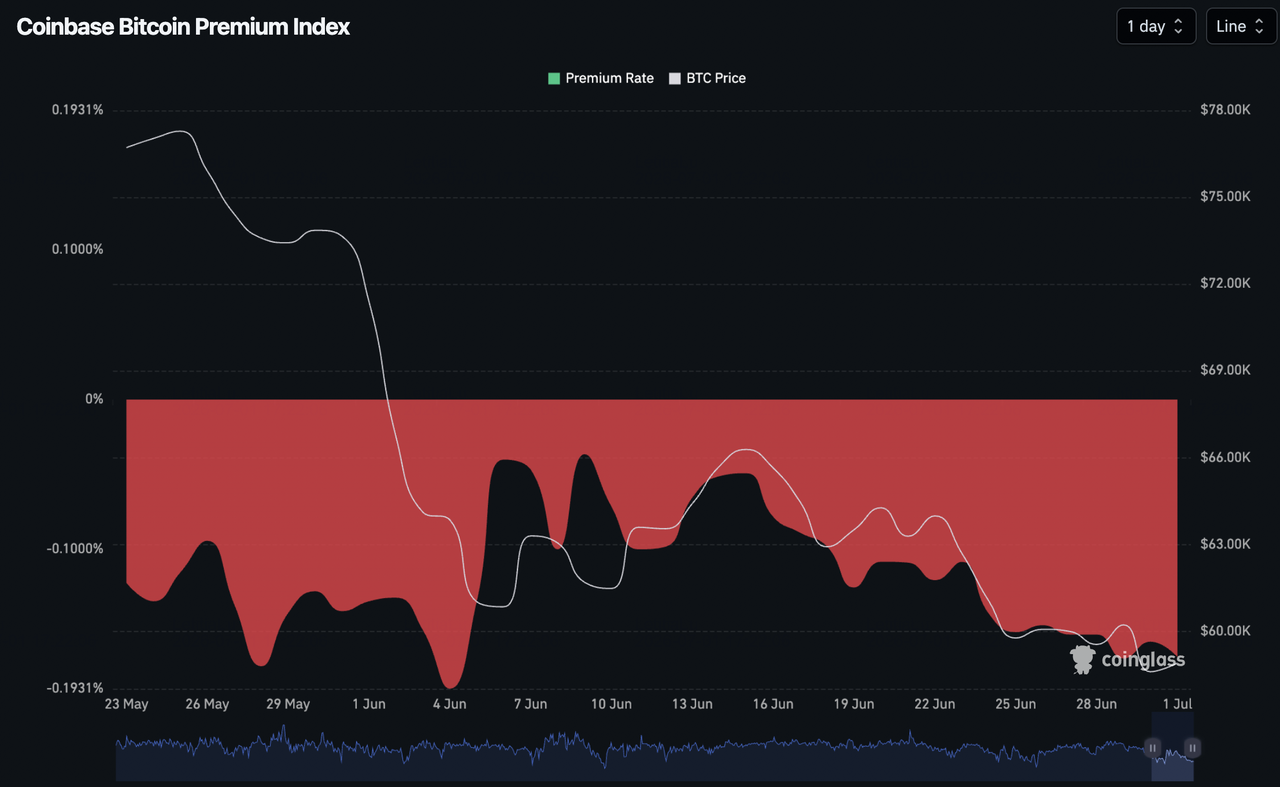
Image source: Coinglass
The Coinbase Bitcoin Premium Index has moved through an extended discount phase, remaining in negative territory for 40 consecutive trading days, the longest negative stretch since 2023. During this period, Bitcoin has continued to trade at a discount on Coinbase relative to global exchanges, reflecting persistent U.S. selling pressure and weak local buying demand. The latest reading stands near -0.05%, showing that the discount has narrowed from deeper negative levels but has not yet turned into a confirmed positive premium.
This divergence is important because Bitcoin has rebounded about 15% from its February low, while the Coinbase premium has failed to turn positive alongside the price recovery. That suggests the rebound has been driven more by non-U.S. markets, while U.S.-based demand has not clearly returned. Spot Bitcoin ETF flows also point in the same direction, with recent outflows showing that U.S. compliant capital remains cautious rather than actively re-entering the market.
For traders, the key signal remains whether the Coinbase Bitcoin Premium Index can break above zero and stay positive. A move back into positive territory would be a clearer sign that U.S. buying demand is recovering. Until then, the index is better viewed as a sign that selling pressure may be easing at the margin, rather than a confirmed signal that institutional or compliant capital has returned to the market.
What the Coinbase Bitcoin Premium Index Discount Means for Bitcoin
A prolonged period of negative readings reflects a cautious market structure where U.S. demand remains weaker than global demand. In the current context, the signal is still not a confirmed recovery, because the Coinbase premium has remained below zero even as Bitcoin rebounded from its February low. The narrower discount suggests that U.S. selling pressure may be easing, but a more durable demand recovery has not yet been confirmed.
|
Signal |
What It Means |
|
40-day negative premium streak |
Longest discount stretch since 2023, showing weak U.S. demand |
|
Latest reading near -0.05% |
Selling pressure is easing, but the premium has not turned positive |
|
BTC rebound of about 15% |
Price recovery is likely driven more by non-U.S. markets |
|
Spot BTC ETF outflows of about $6.4B |
U.S. compliant capital remains cautious |
|
Fear & Greed Index briefly fell to 5 |
Sentiment is near 2022 bear-market bottom levels |
- 40 Days of Negative Premium Shows Persistent U.S. Weakness: For 40 consecutive trading days, the Coinbase Bitcoin Premium Index remained negative, marking its longest negative stretch since 2023. During this period, Bitcoin consistently traded at a discount on Coinbase relative to global exchanges, reflecting weak U.S. demand and continued selling pressure from American market participants.
- Narrowing Discount Suggests Selling Pressure Is Easing: The index remains below zero, with the latest reading near -0.05%. Compared with deeper negative levels earlier in the discount phase, the narrower gap suggests that selling pressure may be easing at the margin. However, the index has not yet turned positive, meaning the current signal should not be read as a clear return of U.S. buying demand.
- ETF Outflows and Extreme Fear Show U.S. Capital Remains Cautious: The same weakness is also reflected in spot Bitcoin ETF flows. Over the past 30 days, spot BTC ETFs recorded approximately $6.4 billion in net outflows, marking the largest monthly redemption period on record, while total ETF assets fell from $104.2 billion to around $80.4 billion. At the same time, the Crypto Fear & Greed Index briefly dropped to 5, a level comparable to the 2022 bear-market bottom, while U.S. search interest for “Bitcoin zero” surged. Together, these signals suggest that U.S. compliant capital and broader market sentiment remain cautious, even as Bitcoin prices have rebounded.
How Traders Are Interpreting the Negative Coinbase Bitcoin Premium Signal
- Short-term outlook: With the index still holding in negative territory, the near-term setup remains cautious. The latest reading near -0.05% suggests that U.S. selling pressure has eased from deeper negative levels, but demand has not returned strongly enough to push Coinbase prices above global averages. Rather than a confirmed recovery phase, the current structure points to selling pressure weakening while buyers remain selective.
- What to watch: The key confirmation signal is whether the Coinbase Bitcoin Premium Index can break above zero and remain positive. A sustained move back into positive territory would be a clearer sign that U.S. buying demand is recovering. Until then, the current signal is better viewed as a transition from stronger selling pressure toward stabilization, rather than proof that institutional or compliant capital has fully returned.
How to Trade Bitcoin Perpetual Futures on BingX
Bitcoin can be traded on BingX through the BTC/USDT perpetual futures market, allowing traders to take both long and short positions depending on market conditions. Unlike traditional futures, perpetual contracts do not have an expiration date, making them suitable for traders who want to actively trade Bitcoin price movements.
BingX AI also provides real-time market analysis and trend indicators to help traders evaluate momentum and manage volatility.
Steps to Trade BTC Perpetual Futures
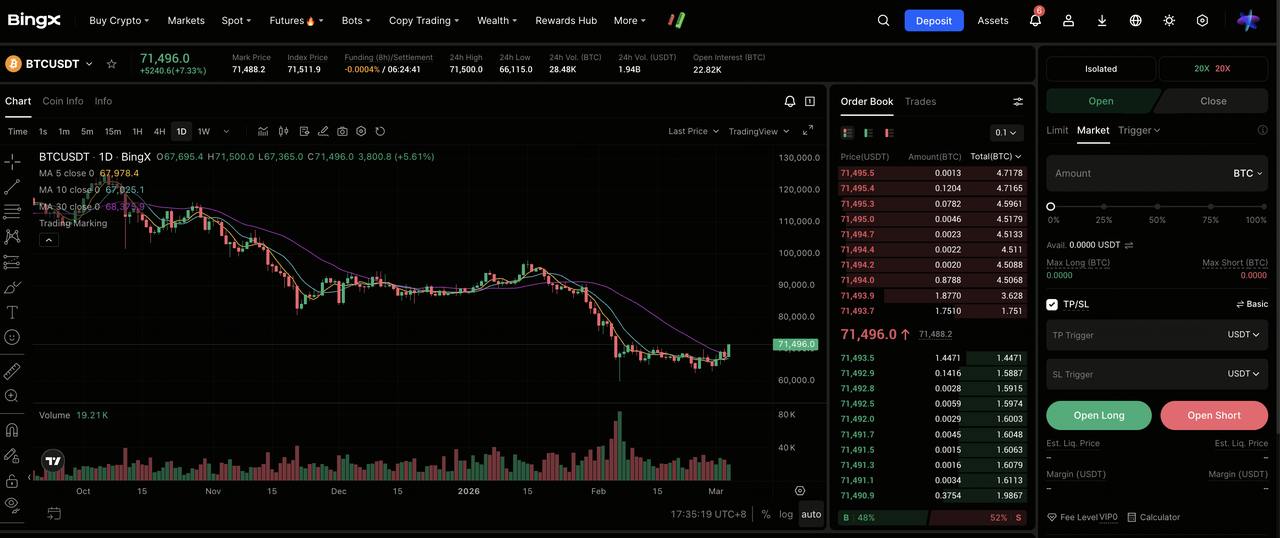
- Open the BTC/USDT Perpetual Futures market: Log in to your BingX account and navigate to the BTC/USDT Perpetual Futures trading page.
- Choose your position direction: Select Long if you expect Bitcoin’s price to rise, or Short if you expect the price to decline.
- Set order type and position size: Choose a market order for immediate execution or a limit order to enter at a specific price. Then specify the position size and leverage level.
- Manage risk before opening the trade: Set stop-loss and take-profit levels to control downside risk and lock in gains if the market moves in your favor.
- Monitor the position using BingX AI insights: Track market momentum, RSI divergence, and volatility signals with BingX AI tools to adjust your position if conditions change.
Leverage can amplify potential returns but also increases risk, so careful position sizing and risk management are essential when trading Bitcoin perpetual futures.
Final Thoughts
The Coinbase Bitcoin Premium Index remaining negative for 40 consecutive trading days suggests that U.S. selling pressure has not fully cleared. Although the discount has narrowed to around -0.05%, the index has not yet moved back above zero, meaning U.S. buying demand has not clearly returned. This is important because Bitcoin has rebounded about 15% from its February low, but the premium has failed to confirm the same recovery on the U.S. side.
Spot Bitcoin ETF data points in the same direction. With approximately $6.4 billion in net outflows over the past 30 days and total ETF assets falling from $104.2 billion to around $80.4 billion, U.S. compliant capital still appears cautious. At the same time, the Crypto Fear & Greed Index briefly dropped to extreme levels, while U.S. search interest for “Bitcoin zero” surged, showing that sentiment remains fragile.
For now, the Coinbase BTC Premium Index is better viewed as a sign that selling pressure may be easing, rather than a confirmed signal that U.S. demand has recovered. Whether the index can break above zero and stay positive will be the key signal to watch for the next stage of Bitcoin’s market structure.
