

The evolution of automated market makers (AMMs) has reached a critical structural milestone. When Uniswap V3 introduced concentrated liquidity in 2021, it revolutionized capital efficiency by allowing liquidity providers (LPs) to allocate capital within specific price ranges. However, this optimization came at the expense of extensibility; developers could not add custom functionalities, like dynamic fees, time-weighted average market makers (TWAMMs), or limit orders, without entirely duplicating and deploying a new protocol codebase.
In the 2026 decentralized finance (DeFi) ecosystem, Uniswap V4 completely shifts this paradigm. Officially launched on mainnet on January 31, 2025, after nine independent audits and an industry-record $15.5 million bug bounty program, V4 transitions Uniswap from a rigid decentralized exchange into an open, highly programmable liquidity platform. As of mid-2026, V4 handles massive trading volumes across more than 18 mainnet networks, including Ethereum, Base, Arbitrum, BNB Chain, and Uniswap's proprietary app-chain, Unichain.
By substituting the traditional multi-contract factory model with a unified architectural framework, V4 provides developers with unparalleled creative liberty while slashing operational costs for traders. This guide details the core design pillars of Uniswap V4, contrasts its architecture with previous versions, and explains how to successfully navigate this modular liquidity frontier.
Uniswap's Evolution from V3 to V4: Breaking the Rigid Framework
While Uniswap V3 introduced the highly efficient concentrated liquidity engine, it operated as a rigid, closed-box system. If a developer wanted to build an automated yield compounding strategy, an advanced on-chain oracle, or a dynamic fee model that adjusted for volatility, they had no choice but to write an entirely new peripheral smart contract or fork the core Uniswap V3 protocol altogether. This created massive fragmentation across DeFi liquidity.
Uniswap V4 preserves the underlying capital efficiency gains of V3, where LPs bound their tokens to specific price ticks, but abstracts the surrounding execution layer. Instead of treating a liquidity pool as a fixed financial product, V4 evolves the pool into a highly customizable platform. It solves V3's primary limitations by eliminating hardcoded fee tiers, removing the necessity of wrapped tokens, and turning the exchange itself into an extensible infrastructure layer that any developer can build plug-ins for.
Read more: What Is Uniswap? A Complete Guide to UNI Token, Fee Switch, and V1-V4 Features
What Are Hooks and Singleton Architecture on Uniswap V4?
The structural transformation of Uniswap V4 relies on two core design innovations that fundamentally alter how data is processed on the blockchain.
PoolManager Singleton Architecture
In previous iterations of Uniswap, deploying a new token pair required deploying an entirely new, independent smart contract instance via a factory pattern. This method was intensely gas-heavy due to bytecode serialization constraints.
Uniswap V4 introduces the Singleton design pattern, housing every single liquidity pool inside one single smart contract known as the PoolManager.sol. Pools are no longer isolated contracts; they are simply distinct state entries within a centralized registry. This single structural change renders pool creation 99.99% cheaper, lowering an operation that used to cost millions of gas down to a basic state update. Furthermore, multi-hop swaps across multiple token pairs can execute entirely within the same contract context, eliminating the need to read and write state across disparate addresses.
Custom Action Hooks
Hooks are the defining innovation of Uniswap V4. A hook is an externally deployed smart contract that injects developer-defined Solidity logic at ten specific lifecycles of a pool's execution.
When a new pool is initialized, its immutable PoolKey binds it to a specific hook contract. The contract's execution pathways are governed by strict address flags that dictate exactly when the PoolManagercalls out to the hook:
- beforeInitilize / afterInitialize
- beforeAddLiquidity / afterAddLiquidity
- beforeRemoveLiquidity / afterRemoveLiquidity
- beforeSwap / afterSwap
- beforeDonate / afterDonate
Through these hooks, developers can build complex financial instruments natively on top of Uniswap's core liquidity without altering the secure base layer. Prominent 2026 application use cases include automated Volatility-Shifting Dynamic Fees, On-Chain Limit Orders that trigger at specified tick prices, and MEV (Maximal Extractable Value) internalization mechanisms that capture arbitrage profits and distribute them back to passive LPs.
How Does Uniswap V4 Reduce Gas Costs for LPs and Traders?
Operational efficiency was a primary focus for the engineers of Uniswap V4. By pairing the singleton architecture with native EVM changes, V4 delivers dramatic gas savings for both market participants and liquidity providers.
Flash Accounting and Transient Storage (EIP-1153)
Historically, every individual step of a trade or liquidity modification required physical token transfers via ERC-20 transfer() or transferFrom() calls to maintain solvency records. For multi-hop routes, this caused massive gas overhead.
Uniswap V4 introduces Flash Accounting or deferred balance accounting. When an external router contract unlocks the PoolManager, it can execute an infinite sequence of actions, such as multiple swaps, pool rebalancings, and position modifications. Instead of moving tokens instantly, the PoolManager modifies an internal net balance tracking field called a BalanceDelta.
The protocol enforces strict solvency: the transaction will atomically revert unless all positive and negative deltas are completely cleared, or zeroed out, by the time control is handed back to the PoolManager. This mechanism is made economically viable by EIP-1153 transient storage opcodes, which clear the transaction-level data out of Ethereum's storage at the end of the block, preventing expensive serialization fees.
How Much Gas Can You Save Trading on Uniswap V4?
- For Traders Performing Multi-Hop Swaps: Because flash accounting keeps intermediate steps strictly inside transient storage, a trade bouncing across three or four different internal pools only triggers token transfers at the absolute beginning and end of the route. This slashes multi-hop gas costs significantly.
- For LPs on Position Management: V4 introduces native support for ERC-6909, a minimalistic multi-token standard. LPs who frequently modify their positions can claim their earned yields or pulled assets as internal ledger credits rather than demanding standard ERC-20 token transfers. Furthermore, the base pools forgo the protocol-enshrined price oracle included in V2 and V3, saving roughly 15,000 gas on the first swap of a pool in each block.
- Native ETH Support: V4 pools support direct native Ethers. Traders no longer need to pay the additional gas required to wrap ETH into WETH or unwrap it afterward, dropping transfer overhead from roughly 40,000 gas down to the native 21,000 gas minimum.
Uniswap V4 vs. V3 vs. V2: Key Technical Differences
|
Feature |
Uniswap V2 |
Uniswap V3 |
Uniswap V4 (Current 2026 Standard) |
|
Liquidity Distribution |
Full-Range (x⋅y=k) |
Concentrated (Specific Price Ticks) |
Concentrated + Custom Curve Capability |
|
Contract Pattern |
Factory + Unique Per-Pool Contracts |
Factory + Unique Per-Pool Contracts |
Singleton Contract (PoolManager) |
|
Extensibility |
Minimal (Immutable Core) |
Low (Static Fee Tiers) |
Very High via Arbitrary Code Hooks |
|
Fee Structure |
Fixed 0.30% |
Static Tiers (0.05%, 0.30%, 1.00%) |
Dynamic & Hook-Managed Per Swap |
|
Native ETH Support |
No (Requires WETH Wrapping) |
No (Requires WETH Wrapping) |
Yes (Direct Native Token Pairs) |
|
Accounting Method |
Immediate Token Transfers |
Immediate Token Transfers |
Flash Accounting via Transient Storage |
|
Position Representation |
ERC-20 Liquidity Tokens |
ERC-721 Non-Fungible Tokens (NFTs) |
ERC-6909 Multi-Token Accounting / Subscriptions |
The fundamental shift from Uniswap V2 and V3 to V4 is a transition from rigid, isolated smart contracts into a highly programmable, unified liquidity network. Uniswap V2 relied on a simple, full-range AMM curve (x⋅y = k) where capital was spread inefficiently from zero to infinity. V3 solved this by introducing concentrated liquidity, letting LPs lock capital within precise price ticks for up to 4000x greater capital efficiency, but it locked the system into a strict factory model with pre-set fee tiers (0.05%, 0.30%, 1.00%) and required external wrapping for native ETH. Uniswap V4 preserves V3's raw mathematical tick efficiency but introduces a PoolManager Singleton design that stores every single liquidity pool in a centralized registry. By breaking the isolated pool mold, V4 drops pool deployment gas costs by 99.99%, transforming them from expensive contract deployments into cheap state updates, while natively restoring native ETH pairs to slash transaction wrapping overhead.
Practically and operationally, V4 re-engineers data settlement and customization through the introduction of Arbitrary Code Hooks and Flash Accounting via EIP-1153. While V2 and V3 forced immediate ERC-20 token transfers after every isolated swap or hop, V4 tracks intermediate multi-hop routing step metrics as internal balances called BalanceDeltas.
By utilizing Ethereum's transient storage opcodes, the protocol defers actual external asset transfers until the very end of the execution block, providing compounding gas discounts to traders on multi-hop routes. For LPs and developers, V4 replaces rigid V3 configurations with programmable flexibility: hooks act as core protocol plugins that allow anyone to implement dynamic volatility-adjusted fees, native on-chain limit orders, and automatic fee compounding. This architectural evolution effectively transforms Uniswap from a standard decentralized application into a modular execution engine for customized financial primitives.
Read more: Uniswap V1 vs V2 vs V3 vs V4: Full Guide to Uniswap Features and Key Version Differences
Getting Started with Uniswap V4: A Beginner’s Guide
Navigating the upgraded Uniswap V4 modular ecosystem requires a shift from standard decentralized app interactions to handling integrated peripheral routers and permissionless hook pools.
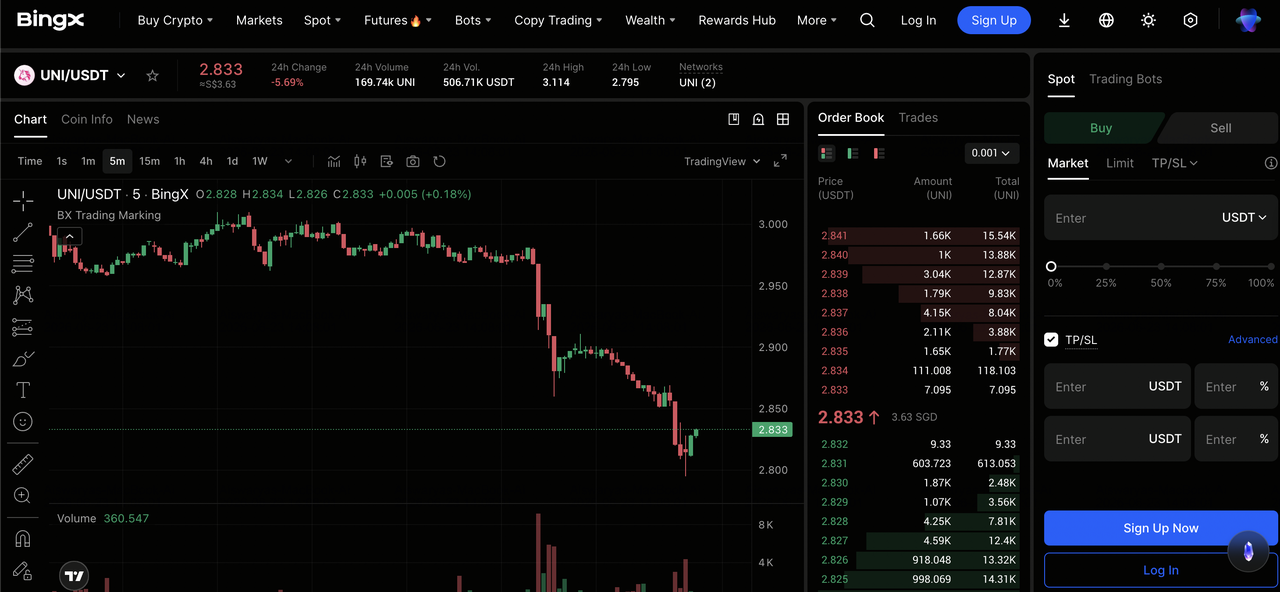
UNI/USDT trading pair on BingX spot market
- Acquire Base Capital on BingX: Log into your BingX account, navigate to the Spot Trading interface, search for the UNI/USDT or ETH/USDT trading pairs, and purchase your core assets using high-speed liquidity rails.
- Set Up a Non-Custodial Web3 Wallet: Download a modern EVM-compatible decentralized wallet engine like MetaMask, Base App, or the native Uniswap Wallet, ensuring your offline seed phrases are completely secure.
- Fund Native Network Gas Fee Balances: Withdraw your native ETH or ERC-20 tokens from BingX straight to your on-chain Web3 wallet address, ensuring you select the appropriate target chain, such as Ethereum Mainnet, Base, or Unichain.
- Connect to the Universal Router Aggregator: Navigate to the official Uniswap Web App or integrated multi-chain interface, click Connect Wallet, and sign the prompt to safely expose your non-custodial address to the frontend.
- Route Transactions Through Permit2: When prompted by the app interface to swap or provide liquidity, sign the signature-based Permit2 token authorization - this gas-optimized manager grants the core PoolManager safe, time-bounded allowance parameters.
- Deploy Capital to Hook-Enabled Pools: Choose whether to swap assets instantly using optimized multi-hop flash accounting routes or enter the Pools registry dashboard to select custom hook-enabled price ticks, such as dynamic fee or TWAMM pools, to lock in automated liquidity configurations.
Read more: How to Connect Uniswap (UNI) to MetaMask
Is Uniswap V4 the Future of Customizable Liquidity in the Modular DEX Era?
Uniswap V4 represents a paradigm shift where liquidity is no longer a static commodity but a programmable primitive. In this new era, the lines between market makers, lending protocols, and structural asset management are permanently blurred.
With custom accounting capabilities, developers can use the PoolManager strictly as a settlement layer while designing entirely unique pricing curves. This allows for experimentation with Asymmetric Fee Curves that penalize toxic order flow, Dynamic Impermanent Loss Hedging Pools that rebalance themselves via external oracle triggers, and Time-Dependent Liquidity Controls for token launches.
Furthermore, the introduction of position Subscribers allows external contracts to be natively notified whenever an LP adds, removes, or moves liquidity. This completely transforms liquidity mining; protocols can now offer real-time staking rewards and yield-boosting incentives without forcing users to transfer their underlying ERC-721 position tokens into an external vault, eliminating a massive smart contract risk vector that plagued previous DeFi generations.
Tracking Uniswap V4's 2026 Adoption Landscape and Unichain
As of mid-2026, Uniswap V4's multi-chain deployment footprint spans 18 mainnet layers. A massive driver of this liquidity expansion is Unichain, Uniswap's dedicated Layer 2 network built on the Optimism Superchain. Deployed in early 2025, Unichain serves as a high-speed settlement hub tailored specifically to optimize V4's structural parameters.
Furthermore, the integration of Continuous Clearing Auctions (CCA) directly into the frontend interface has streamlined price discovery for newly launched assets, utilizing smart contracts to resolve initial capital drops without exposure to predatory front-running.
Another massive evolution is UNIfication, a milestone governance proposal that passed in December 2025. This protocol shift officially activated the fee switch, directing a percentage of transaction fees from older V2 and V3 pools toward buying and burning UNI tokens. While V4 pools are currently exempt from protocol fees to maximize early developer experimentation, the underlying value capture of the UNI token ecosystem has transitioned firmly into a yield and deflationary cash-flow asset.
Uniswap V4's Security Considerations: Hook Vulnerabilities, Auditing Requirements
While the core codebase of Uniswap V4 is structurally immutable and heavily audited, the primary risk vector shifts directly to third-party hook implementations.
- Missing Access Controls: If a custom hook lacks an explicit onlyPoolManager modifier or proper authentication on its callback execution pathways, malicious actors can bypass standard swap routing and call the hook directly with arbitrary parameters to manipulate reserves or forge fake deposits.
- Reentrancy Vectors in Transient Storage: Because flash accounting tracks state using EIP-1153 transient storage, hooks that trigger external untrusted calls before or after a lifecycle action can expose the pool to complex cross-function reentrancy attacks before the net balances are zeroed out and validated by the PoolManager.
- Permanent Denial of Service (DoS): If a hook contract contains unhandled revert triggers or hardcoded math exceptions within its beforeRemoveLiquidity or afterRemoveLiquidity logic, malicious or poorly programmed hooks can permanently trap liquidity provider capital inside the pool registry.
- Malicious Pool Cloning: Uniswap V4 does not restrict who can initialize a pool or which hook address it can map to. Attackers can deploy clones of reputable hooks paired with malicious, unverified token contracts that hijack control flows during swap routing to compromise adjacent systems.
- Token Standard Incompatibilities: Hooks that manage structural accounting variables often suffer catastrophic precision failures or mathematical balance bugs when paired with non-standard assets, such as fee-on-transfer tokens, elastic-supply rebasing tokens, or tokens with unusual decimals.
- Centralization and Upgradeability Proxies: Many developers build upgradeable hooks using standard proxy patterns. If the administrative keys or multi-signature setups governing those upgrades are compromised, a historically secure pool can be altered instantly to route funds to an attacker.
Final Thoughts: How to Navigate the Uniswap V4 Multi-Engine Ecosystem
Uniswap V4 completes the transition of decentralized exchanges from rigid transactional applications into modular protocol layers. For institutional market makers, the flexibility of custom dynamic fees and programmatic impermanent loss hedging tools provides an institutional-grade playground for risk management. For retail swappers, the combination of V4's underlying gas reductions and aggregate routing frameworks like UniswapX means trades are automatically optimized for the absolute best price routing across multiple chains behind the scenes.
As the industry moves forward through 2026, the distinction between separate DeFi platforms continues to blur. Through its open hook framework, Uniswap V4 is no longer just a destination for capital but also the underlying infrastructure upon which the next generation of financial primitives are built.
Risk Reminder: Modern DeFi interactions carry inherent smart contract vulnerabilities, market volatility, and protocol execution risks. While the core Uniswap V4 engine is exceptionally secure, third-party hooks can introduce unpredictable logic flaws. Always execute extensive research, manage position sizes carefully, and audit the exact hook parameters before committing significant capital to an active V4 pool.
Related Reading
- What Is Uniswap? A Complete Guide to UNI Token, Fee Switch, and V1-V4 Features
- Maximizing Yield in 2026: The Ultimate Uniswap Pools Guide
- Uniswap V1 vs V2 vs V3 vs V4: Full Guide to Uniswap Features and Key Version Differences
- How to Connect Uniswap (UNI) to MetaMask
- Uniswap vs. PancakeSwap vs. SushiSwap: Which one is the Better DEX in 2026?
FAQs on Uniswap V4
1. Does Uniswap V4 fully replace Uniswap V3?
No. Uniswap V3 and V4 run concurrently across mainnet networks. Because massive blue-chip liquidity positions remain established inside mature V3 pools, aggregators route capital through both versions seamlessly based on real-time execution pricing and localized pool depth.
2. Can custom hooks steal funds from an active pool?
The core PoolManager contract enforces strict math invariants, meaning a hook cannot directly alter the global solvency ledger of the core exchange. However, if a hook implements faulty custom accounting or flawed withdrawal fee logic, it can create localized vector exploits that put that specific pool's assets at risk.
3. How do dynamic fees differ in V4 compared to older versions?
In Uniswap V3, pools were strictly limited to rigid, pre-defined fee tiers (e.g., 0.05%, 0.30%). In V4, pools utilizing dynamic hooks can adjust fees dynamically on a per-swap or per-block basis according to real-time asset volatility, trading volume, or external price oracles.
