

Teller (DEBIT) is presented through Debit, an AI-powered finance application built on Teller’s lending stack. The platform combines a conversational agent with onchain borrowing, swapping, bridging, lending, shorting, looping, yield, and transfer workflows. Debit currently documents support for more than 100 assets, while the DEBIT token has a fixed supply of 100 million tokens and is designed to support AI usage credits, staking, discounts, governance, and ecosystem incentives.
Debit is the consumer-facing application layered on top of Teller’s lending infrastructure. Its borrowing model includes lender-matched no-collateral pre-qualification alongside asset-backed USDC loans, giving users access to different credit paths from the same interface. This guide explains what Teller is, how Debit works, how DEBIT tokenomics function, the main risks to consider, and how to trade DEBIT on BingX.
What Is Teller (DEBIT)?
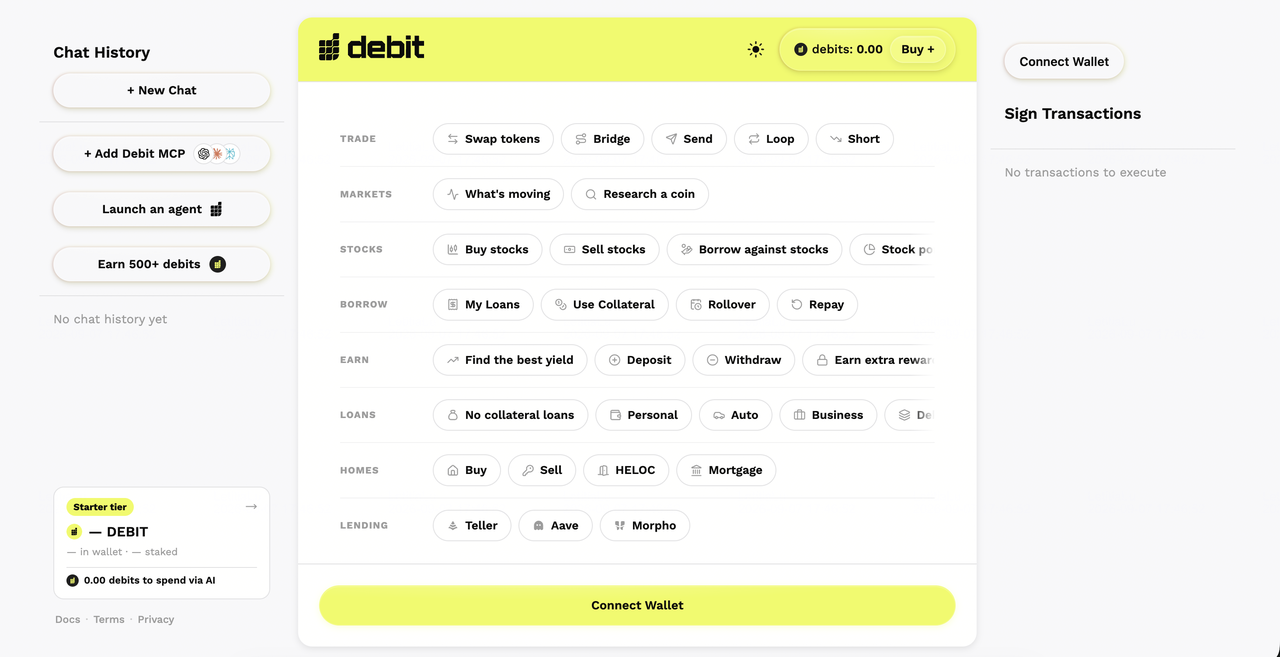
Teller (DEBIT), through the Debit application, is an AI-powered onchain finance platform designed to make borrowing, lending, swapping, and other multi-step crypto transactions easier to use. Its conversational AI agent turns plain-language requests into transaction plans that users can review before execution. Underneath the interface, Teller provides the lending infrastructure, including lender matching, asset-backed borrowing, isolated markets, and other credit mechanisms.
DEBIT is the utility and governance token for the Debit ecosystem. It is designed for AI usage credits, staking, eligible service discounts, governance, and ecosystem incentives, linking token demand to platform activity. The broader strategy is to combine an AI-led user experience with Teller’s lending stack so users can access borrowing, swapping, bridging, shorting, looping, yield, and transfers from one interface rather than navigating multiple DeFi applications.
Key components of the Teller ecosystem include:
- Debit AI agent: Converts natural-language requests into onchain transaction plans for review.
- Borrowing paths: Supports both lender-matched no-collateral pre-qualification and asset-backed USDC borrowing.
- Teller lending stack: Provides lending pools, isolated markets, repayment processes, and liquidity infrastructure.
- DEBIT access layer: Connects AI credits, staking, discounts, governance, and ecosystem incentives.
How Does Teller Work?
Teller works through Debit, an AI-led finance interface that turns user requests into onchain transaction plans. The Debit agent coordinates borrowing, lending, swapping, and other actions through the Teller lending stack, while the Debit Score and DEBIT token support credit access, platform usage, and incentives.
- Natural-language requests become transaction plans: Users can describe what they want to do in plain language, and the Debit agent prepares the underlying onchain actions for review before execution.
- Two borrowing routes serve different needs: Teller supports lender-matched no-collateral pre-qualification as well as asset-backed USDC borrowing against crypto or tokenized stocks.
- Lending pools provide the credit layer: Teller’s infrastructure includes isolated lending markets, preset loan terms, repayment and rollover processes, and liquidation auctions for defaults.
- The AI agent connects multiple onchain strategies: Users can access swapping, bridging, shorting, looping, lending, yield, rewards, and transfers through the same conversational interface.
- DEBIT powers platform access and incentives: The token is designed for AI usage credits, staking, service discounts, governance, and ecosystem rewards. Loans and swaps themselves are still denominated in the underlying assets rather than DEBIT.
Read More: What Are the Top 10 DeFi Lending Protocols to Watch in 2026?
Teller vs. Aave: What Are the Key Differences Between the Onchain Lending Platforms?
Teller and Aave both support onchain borrowing, but they approach it differently. Teller, through Debit, focuses on an AI-led interface that can prepare multi-step finance actions and includes both lender-matched credit and asset-backed borrowing. Aave is built around permissionless liquidity pools where users supply assets or borrow against collateral.
|
Comparison |
Teller |
Aave |
|
Core model |
AI-led finance app built on a lending stack |
Permissionless onchain liquidity protocol |
|
Main users |
Users seeking guided borrowing and multi-step finance actions |
Onchain lenders and collateralized borrowers |
|
Borrowing model |
Lender-matched pre-qualification plus asset-backed borrowing |
Primarily overcollateralized borrowing from liquidity pools |
|
Token utility |
AI credits, staking, discounts, governance, and incentives |
Governance and protocol-security participation |
|
Main advantage |
Combines credit and multiple onchain workflows in one interface |
Mature liquidity markets with transparent pool mechanics |
|
Main tradeoff |
Newer platform with execution and adoption risk |
Less focused on conversational workflows or consumer-credit matching |
Teller is designed for users who want AI-assisted access to borrowing, swapping, bridging, lending, shorting, looping, yield, and transfers from one interface. Aave offers a more established money-market model centered on supplying liquidity and collateralized borrowing. The choice mainly depends on whether users prefer a guided AI finance experience or direct access to permissionless lending markets.
Read More: What Is Aave DeFi Lending Protocol and How Does it Work?
What Are the Teller (DEBIT) Tokenomics?
DEBIT has a fixed maximum supply of 100 million tokens, with allocations distributed across investors, the team, ecosystem programs, liquidity, and other categories under different vesting schedules. The published unlock structure extends over four years, after which the full token supply is scheduled to be unlocked. The largest standalone allocation is assigned to investors at 25.21%.
DEBIT Token Utility and Supply Mechanisms
- AI usage credits: DEBIT is used to access AI-powered finance features, with more advanced workflows consuming more platform credits.
- Staking: Users can lock DEBIT through fixed-term staking to participate in ecosystem programs and governance while reducing immediately circulating supply.
- Service discounts: Holding or staking DEBIT can qualify users for discounts on eligible platform services, depending on the applicable tier and platform rules.
- Governance: DEBIT holders can participate in governance covering areas such as treasury use, platform fees, AI credits, product priorities, and ecosystem incentives.
- Ecosystem incentives: DEBIT can support rewards and participation programs across the Debit ecosystem. Any revenue-linked incentives remain subject to program terms and governance rather than functioning as guaranteed distributions.
DEBIT Token Allocation
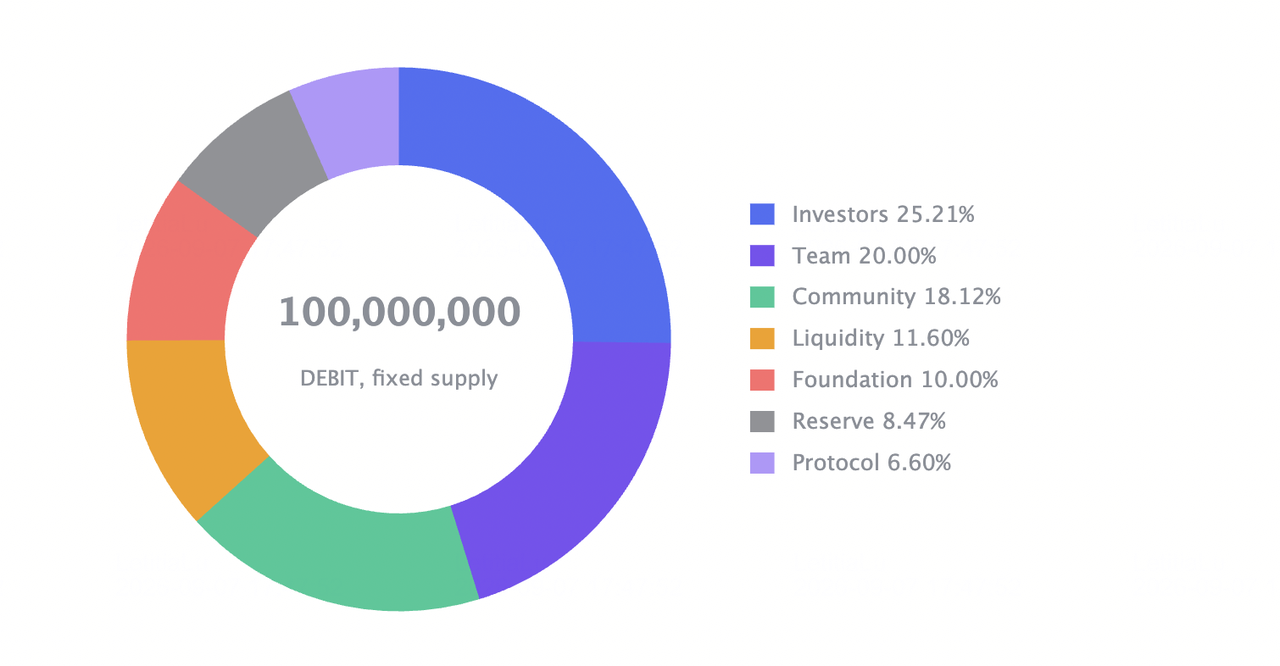
DEBIT has a fixed supply of 100 million tokens, distributed across investors, the team, community, liquidity, foundation and reserve, and protocol allocations. Each category follows a different unlock schedule, making vesting an important factor in future circulating supply.
- Investors and Team: 45.21%, or 45.21M DEBIT. Investors receive 25.21M DEBIT with a 12-month cliff followed by 12-month linear vesting. The team receives 20M DEBIT with a 12-month cliff followed by 36-month linear vesting.
- Community: 18.12%, or 18.12M DEBIT. 48% unlocks at TGE, with the remaining allocation vesting linearly over 36 months.
- Foundation and Reserve: 18.47%, or 18.47M DEBIT. Foundation tokens begin with a 2% TGE unlock followed by 36-month linear vesting, while reserve tokens remain locked for six months before releasing through month 15.
- Liquidity: 11.60%, or 11.6M DEBIT. 69% unlocks at TGE, with the remainder released during months one through three.
- Protocol: 6.60%, or 6.6M DEBIT. 4.5% unlocks at TGE, with the remaining tokens vesting linearly over 36 months.
DEBIT’s supply pressure therefore changes significantly over time. Liquidity and part of the community allocation enter circulation early, while investor and team tokens remain more heavily delayed. Investors should monitor the vesting calendar alongside demand from AI credits, staking, governance, and other platform uses when assessing future circulating supply.
How to Trade Teller (DEBIT) on BingX
BingX offers DEBIT through its perpetual futures market, allowing active traders to take long or short exposure to DEBIT price movements without holding the underlying token. Users seeking direct ownership should independently verify the official contract and available spot liquidity before using a supported decentralized exchange.
Futures Trading: Trade DEBIT Price Movements
BingX lists a USDT-margined DEBIT perpetual. Because leverage can amplify both gains and losses, futures are intended for traders who understand liquidation and have a defined risk plan.
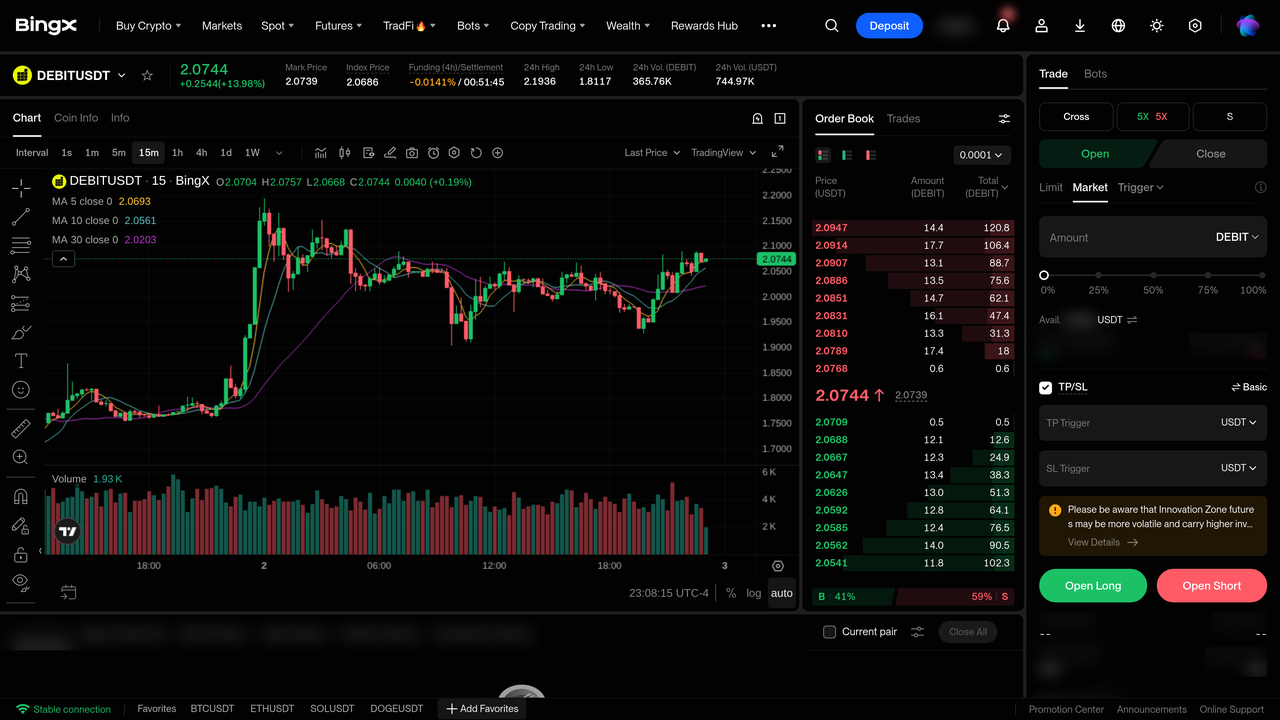
Step 1: Account setup and security.Sign up and log into BingX, complete the identity verification (KYC) required in your region, and enable two-factor authentication.
Step 2: Transfer collateral. Move USDT from the spot account to the futures account, where it is used as margin.
Step 3: Select the contract. Open the DEBIT-USDT perpetual.
Step 4: Set direction and leverage.Open long or short based on the trading thesis. Select leverage and position size within the defined risk limit.
Step 5: Execute the trade. Enter the order amount and use a market or limit order according to the trading plan.
Step 6: Manage risk. Set stop-loss and take-profit controls before or immediately after entry. Profit and loss settle dynamically in USDT.
Risks and Considerations Before Investing in Teller (DEBIT)
Teller’s outlook depends on whether the Debit AI agent can turn its lending, trading, and access features into sustained usage before additional token unlocks increase circulating supply.
- Execution and integration risk: Debit relies on accurate AI-agent behavior, transaction review, credit integrations, and underlying onchain protocols. Failures in any layer could reduce trust or interrupt user activity.
- Credit and collateral risk: Lender-matched credit, asset-backed loans, and liquidation mechanisms expose users to different underwriting, counterparty, smart-contract, and collateral risks.
- Token unlocks could increase selling pressure: Only 17.22% of DEBIT supply is stated as unlocked at launch, with the remainder released over time. Faster supply growth without matching demand could pressure the token.
- Token utility may not generate enough demand: AI credits, staking, service discounts, governance, and incentives only support DEBIT if users actively adopt those features and continue using the platform.
- Perpetual futures add leverage and liquidation risk: DEBIT futures can move sharply, and leverage magnifies both gains and losses. Rapid price swings can trigger liquidation even when the longer-term platform thesis remains unchanged.
Final Thoughts: Should You Invest in Teller (DEBIT) in 2026?
Teller, through the Debit application, combines an AI-led finance interface with onchain lending, borrowing, and multi-step transaction workflows. Its 2026 investment case depends on whether that interface can turn user activity into sustained DEBIT demand through AI credits, staking, governance, service benefits, and other platform utilities. The dual borrowing model also gives Teller a broader user proposition than a standard collateral-only DeFi money market.
The key factors to watch are AI-credit usage, lending activity, token unlocks, staking participation, governance changes, and available liquidity. Teller’s integrated interface and lender-matched plus asset-backed borrowing paths help differentiate the platform, but DEBIT still carries execution, credit, supply-unlock, smart-contract, and market-volatility risks. For investors, the strongest confirmation would be rising platform usage and token utility that grows fast enough to absorb new circulating supply over time.
Related Reading
- What Is DeFi (Decentralized Finance)? 8 Types of DeFi Protocols to Know
- What Is Aave (AAVE) Crypto Lending: All You Need to Know in 2026
- What Are the Top 10 DeFi Lending Protocols to Watch in 2026?
- What Are the Top 10 AI Agent Crypto Projects of 2026?
- How to Get Started with Perpetual Futures Trading on BingX: A 2026 Beginner's Guide
FAQs About Teller (DEBIT)
1. What makes Teller different from other DeFi lending projects?
Teller is presented through Debit as an AI-led finance application rather than only a lending-pool interface. It combines lender-matched no-collateral pre-qualification with asset-backed borrowing, while the AI agent can also prepare multi-step onchain workflows such as swapping, bridging, lending, shorting, and yield strategies.
2. What blockchain is DEBIT on?
DEBIT is documented on both BNB Smart Chain and Ethereum using the same published contract address. Users should still verify the official contract address and selected network before transferring tokens.
3. Is DEBIT’s supply publicly disclosed?
Yes. The Debit tokenomics documentation states a fixed supply of 100 million DEBIT and publishes allocation and vesting schedules for investors, the team, community, liquidity, foundation and reserve, and protocol allocations.
4. Which wallets support DEBIT?
DEBIT can be stored in self-custody wallets that support Ethereum and BNB Smart Chain, such as MetaMask, Trust Wallet, and Rabby Wallet. Users may need to add DEBIT manually using the official token contract address, and should confirm both the contract and selected network before transferring funds.
5. Is Teller the same as the legacy Teller Protocol documentation?
No. This article focuses on Teller as presented through the Debit application and DEBIT ecosystem at debitai.xyz and debit.debitai.xyz. The older Teller Protocol documentation at docs.teller.org represents a separate legacy documentation set and should not be treated as the primary source for the current Debit platform.
