

DeXe (DEXE) is the native token of DeXe Protocol, a decentralized governance infrastructure platform for creating and managing DAOs. DeXe provides a no-code DAO constructor, modular smart contracts, expert delegation, validator review, treasury controls, staking, and configurable voting models.
DeXe aims to solve common DAO governance problems, including low participation, whale-dominated votes, and off-chain execution through multisig wallets. By moving more governance processes on-chain and adding validator review before execution, DeXe tries to make DAO decisions more transparent and harder to manipulate.
By 2026, DeXe's TVL had grown from about $500 million at the end of 2024 to around $1.7 billion in early Q2 2026. The key question is whether this growth reflects broad adoption or remains concentrated in a smaller number of large DAOs and wallets. This guide explains what DeXe is, how it works, DEXE tokenomics, key risks, and how users can buy USDT on BingX before trading DEXE on supported decentralized exchanges.
What Is DeXe (DEXE)?
DeXe (DEXE) is the native governance token of DeXe Protocol, a DAO infrastructure platform initially built on Ethereum, with support for BNB Chain and planned expansion to Solana, Polygon, and Arbitrum. A DAO, or decentralized autonomous organization, is a blockchain-based community that uses smart contracts and token-based voting to make decisions without a traditional centralized management structure.
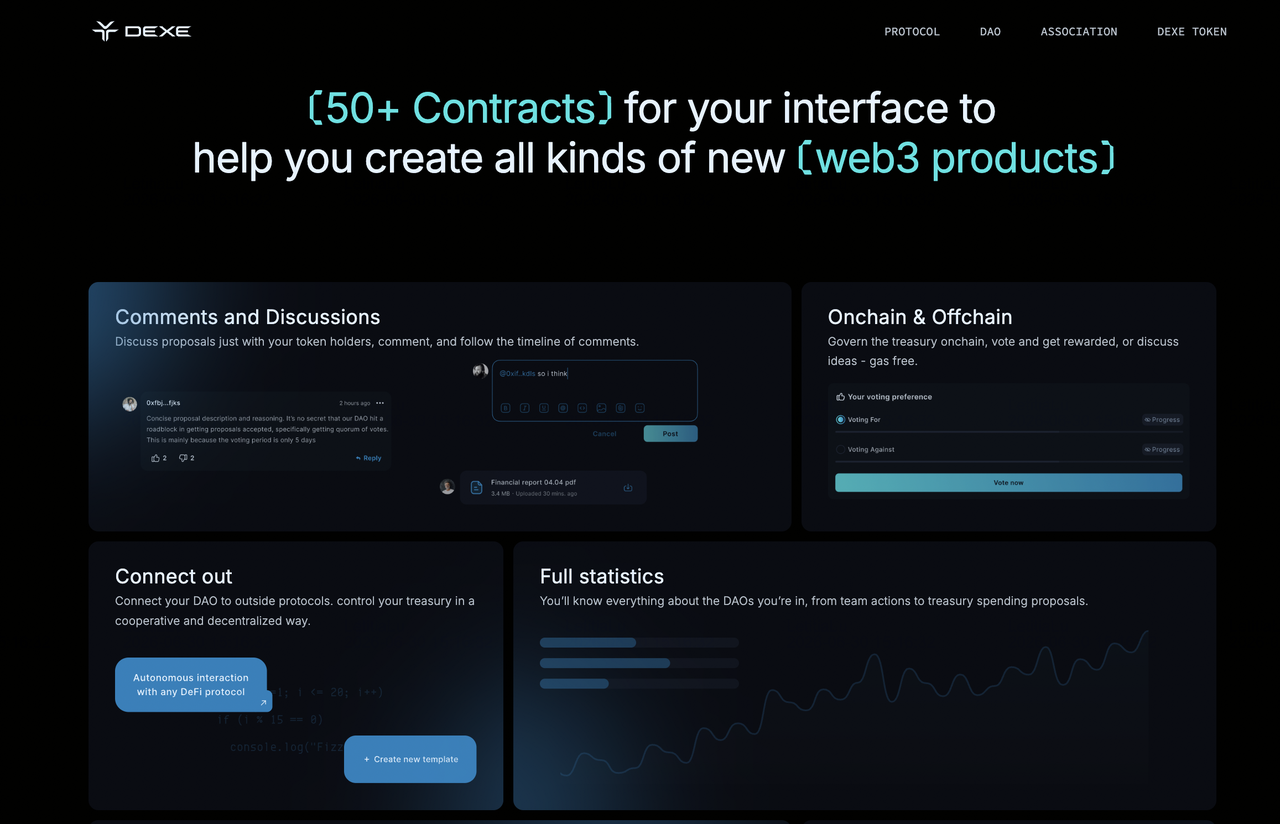
DeXe Protocol helps projects launch fully on-chain DAOs without custom smart contract development. Its no-code DAO studio is built on a library of more than 60 modular smart contracts covering proposal creation, voting logic, treasury management, staking, reward distribution, validator lists, user registries, and DAO-specific governance settings.
DEXE is used for protocol governance, staking, and fee capture, while the DeXe DAO governs the protocol itself using DeXe's own infrastructure. The main difference between DeXe and simpler DAO tooling platforms is its validator layer: after a community vote passes, approved validators can review the outcome before execution. This adds a second checkpoint against malicious proposals, whale-driven votes, or treasury-draining attacks.
DEXE Token vs. DeXe Protocol vs. DeXe DAO: Key Differences
|
Component |
What It Means |
Main Role |
|
DEXE token |
Native ERC-20 token of the DeXe ecosystem |
Governance, staking, fee capture, and treasury participation |
|
DeXe Protocol |
Open-source DAO infrastructure layer |
No-code DAO creation, modular governance contracts, validator review, and delegation |
|
DeXe DAO |
The protocol's own governing DAO |
Controls treasury allocation, fee structures, council members, sub-DAOs, and upgrades |
|
Validators and experts |
Specialized governance participants |
Review proposal outcomes, support informed voting, and reduce governance attack risk |
How Does DeXe Protocol Work?
Source: DeXe Protocol
DeXe Protocol works through a layered governance system that combines no-code DAO deployment, flexible voting models, expert delegation, and validator review.
- No-code DAO constructor: DeXe lets teams launch DAOs without writing custom smart contract code. Projects can create governance structures, configure voting rules, manage treasuries, set staking programs, and define reward logic through DeXe's modular contract library.
- Multiple voting models: DeXe does not force every DAO into a simple one-token-one-vote structure. DAOs can configure different proposal types, quorum thresholds, voting durations, and decision-making rules based on the needs of the community.
- Expert sub-DAOs: Projects can create specialist groups for areas such as treasury management, technical upgrades, marketing, or community operations. This allows broad community participation while giving complex decisions to more informed contributors.
- Delegation to experts: Passive holders can delegate voting power to active participants. DeXe's model can reward both the delegate and the original token holder, creating stronger incentives for informed participation.
- Validator review layer: After a proposal passes, validators review the result before execution. This is designed to reduce the risk of whale manipulation, coordinated attacks, or malicious treasury proposals that pass through simple token voting.
Why DeXe Matters: The DAO Governance Problem
Most DAO governance systems still rely on simple token-weighted voting. This creates several recurring problems: low voter turnout, whale-dominated decisions, passive holders who do not participate, and proposal execution that may still depend on multisig signers.
DeXe's approach is to treat governance as infrastructure rather than as a small feature attached to a token. The protocol gives DAOs more ways to structure voting, delegate authority, assign expert roles, and review passed proposals before execution.This makes DeXe more relevant to projects that want stronger on-chain governance but do not want to build governance contracts from scratch.
DeXe Protocol vs. Other DAO Governance Platforms
|
Platform |
Category |
Main Role |
Key Difference |
|
Snapshot |
Off-chain voting tool |
Gas-free signaling votes |
Simple and widely adopted, but votes are not automatically executed on-chain |
|
Aragon |
DAO creation framework |
Modular DAO deployment |
Strong DAO tooling, but less focused on validator review and expert delegation rewards |
|
Compound Governor / OpenZeppelin Governor |
Governance contract standard |
On-chain voting for DeFi protocols |
Battle-tested, but usually limited to one governance model per deployment |
|
DeXe Protocol |
Full-stack DAO infrastructure |
No-code DAO creation, validator review, expert delegation, and staking |
Combines configurable DAO deployment with a dedicated verification layer before execution |
DeXe sits between simple DAO voting tools and fully custom governance frameworks. Its main advantage is that it packages DAO creation, voting, delegation, validator checks, and treasury logic into one infrastructure layer. This makes it more comprehensive than off-chain voting tools, while still being easier to deploy than custom governance contracts.
What Are the DeXe (DEXE) Tokenomics?
DEXE tokenomics are shaped by fixed supply, early deflationary burns, staking, governance utility, and fee capture from DAO activity.
DEXE Token Utitilies and Mechanisms
Source: DeXe Protocol
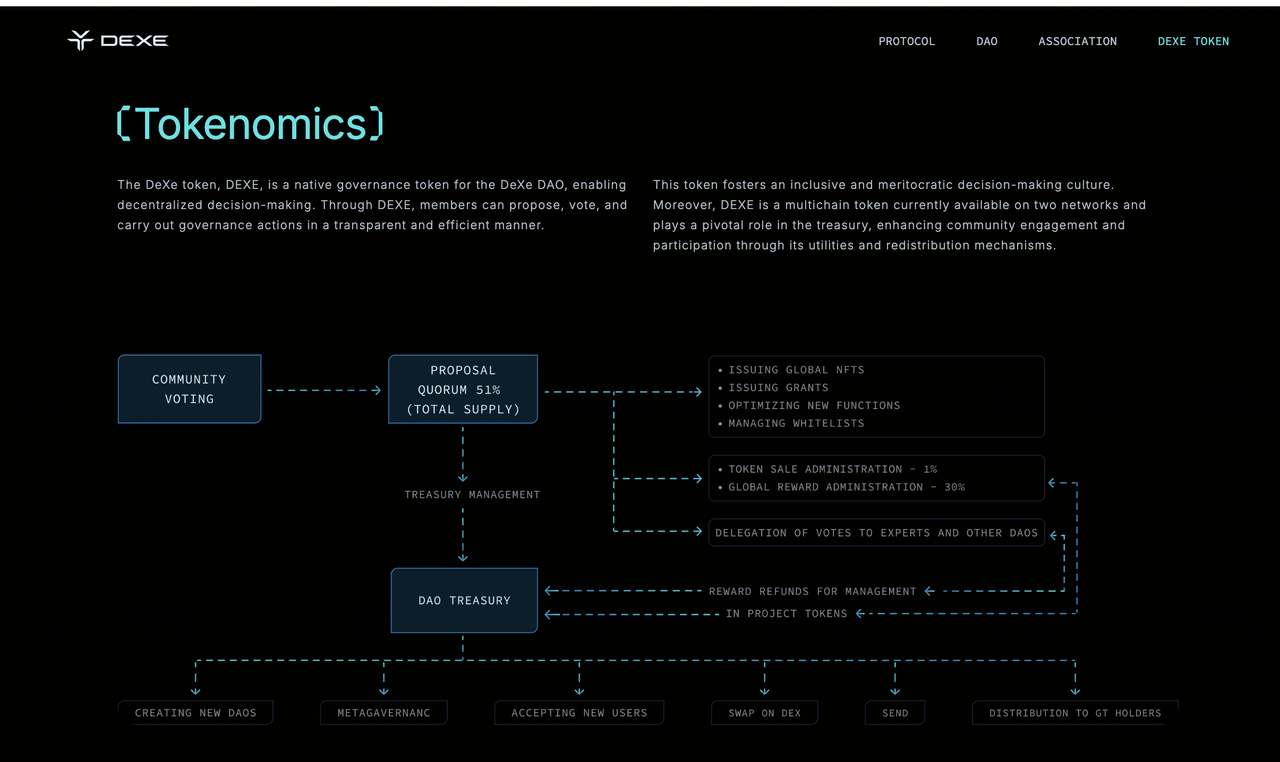
- Governance voting: DEXE holders vote on DeXe DAO decisions, including treasury allocation, fee structures, council members, and protocol upgrades.
- Fee capture: DAOs built on DeXe can generate platform fees, with a portion flowing back to the DeXe Protocol treasury. This links protocol value to real DAO usage rather than only token emissions.
- Staking rewards: DEXE holders can lock tokens across 1-month, 3-month, 6-month, 12-month, and 24-month tiers. Longer lockups generally create stronger incentives for long-term participation.
- Deflationary burns: Around 3.5 million tokens have already been permanently burned. Future burns can be proposed through DAO governance.
- Fixed total supply: DEXE has a maximum supply of about 96.5 million tokens, with roughly 83.7 million circulating as of mid-2026. The supply can decrease through burns, but does not rely on ongoing inflationary emissions.
DEXE Token Allocation
|
Holder Category |
Approximate Status |
Description |
|
Public circulating supply |
~83.7M tokens |
Available to holders, traders, stakers, and governance participants |
|
DeXe Protocol treasury |
Governance-controlled allocation |
Used for ecosystem growth, grants, rewards, and treasury decisions |
|
Locked / non-circulating supply |
~13M tokens |
Subject to vesting, future unlocks, or governance-controlled release |
|
Permanently burned supply |
~3.5M tokens |
Removed from supply through early burns |
DEXE's tight circulating supply can amplify volatility. It can support strong upside when demand increases, but upcoming unlocks or large holder selling can also create sharp downside pressure.
How to Trade DeXe (DEXE) on BingX
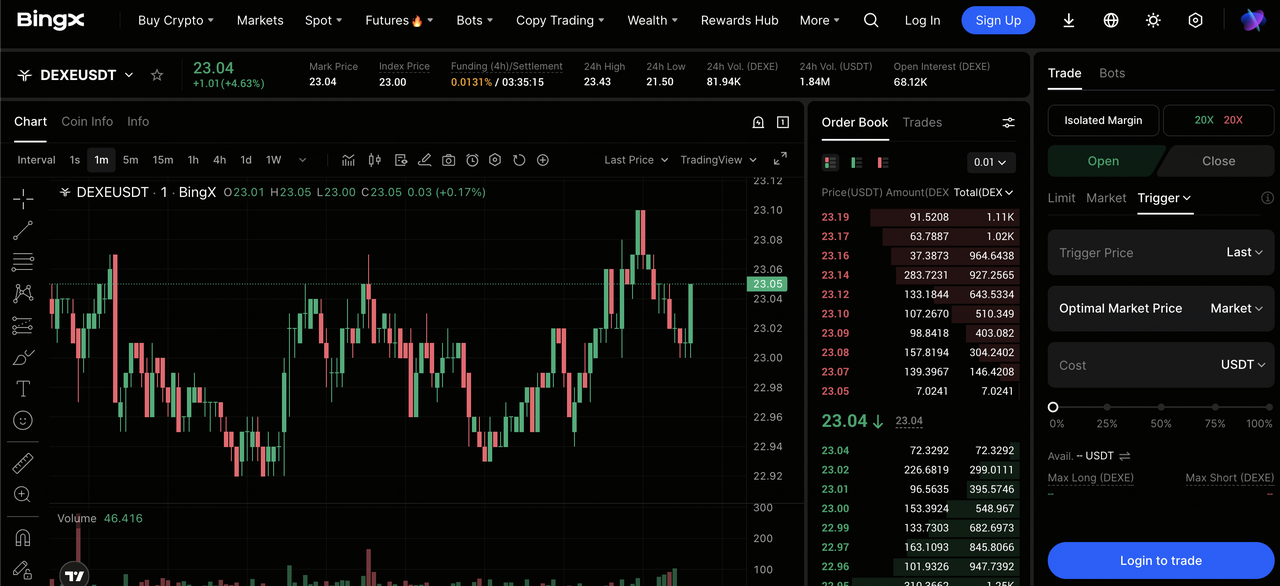
DEXE/USDT perpetual contract on BingX futures market
Active traders can effortlessly navigate the highly volatile DEXE derivatives market by leveraging BingX AI to receive real-time trend analysis and automated contract execution strategy suggestions.
- Select the Futures dropdown menu on the main dashboard and click Perpetual Futures.
- Search for the DEXE/USDT perpetual contract interface using the top-left asset look-up bar.
- Choose your preferred Margin Mode: select Isolated Margin to lock risk to an individual position, or Cross Margin to utilize your unified account balance as collateral.
- Set your target Leverage level, keeping settings conservative (e.g., 2x–5x) to safely insulate your capital from sudden market-wide sweeps.
- Define your execution criteria (Limit or Market order) and establish mandatory Take-Profit (TP) and Stop-Loss (SL) trigger thresholds before opening your trade.
- Click Open Long if your indicators signal an upward breakout, or click Open Short to capitalize on a downward momentum shift.
Risks and Considerations Before Investing in DeXe (DEXE)
DeXe has shipped real governance infrastructure, but DEXE still carries risks tied to concentration, token unlocks, competition, multichain execution, and high volatility.
- TVL growth has outpaced holder growth: DeXe's TVL reached about $1.7 billion, but holder growth has been slower. If capital is concentrated in a small number of DAOs or wallets, the network may be less decentralized than the TVL number suggests.
- Token unlocks could create sell pressure: DEXE's circulating supply is relatively tight, which can support price momentum. However, future unlock events could introduce new supply and weigh on price, especially if market sentiment weakens.
- DAO tooling is a competitive market: DeXe competes with Snapshot, Aragon, OpenZeppelin Governor-based systems, and other governance infrastructure projects. Its validator layer is a real differentiator, but competitors could adopt similar features over time.
- Multichain expansion remains unfinished: DeXe has plans to expand beyond Ethereum and BNB Chain, but the timeline is not fully defined. Until then, its addressable market remains more concentrated in existing EVM ecosystems.
- DEXE can be highly volatile: DEXE has shown large monthly and single-day moves. Tight circulating supply, momentum-driven trading, token unlock concerns, and broader altcoin cycles can all amplify price swings.
- Governance execution risk still exists: Validators and expert sub-DAOs reduce governance risk, but they do not eliminate it. If validator selection becomes too concentrated or expert groups fail to act independently, DeXe could face the same governance problems it is designed to solve.
Final Thoughts: Should You Invest in DeXe in 2026?
DeXe is one of the more credible DAO infrastructure projects to emerge from the 2021 governance-token cycle. Its no-code DAO constructor, validator review layer, expert delegation system, staking module, and $1.7 billion in TVL give it a stronger usage story than many earlier DAO tooling projects.
The main question for 2026 is whether DeXe can turn TVL and DAO-count growth into broader, more decentralized adoption. Holder growth, DAO diversity, token unlocks, and multichain execution will matter as much as headline TVL. For long-term investors, DEXE offers exposure to on-chain governance infrastructure. For active traders, DEXE futures on BingX provide a way to trade around momentum, unlocks, and DAO adoption catalysts. In both cases, the key is understanding the gap between platform-level growth and token distribution before taking a position.
Related Reading
- What Is DeFi (Decentralized Finance)? 8 Types of DeFi Protocols to Know
- What Is Quack AI (Q) AI-Powered DAO Governance and How to Trade It On BingX?
- What Is Ethereum (ETH)? A Beginner’s Guide to How Ethereum Works (2026)
- What Is Internet Computer (ICP)? A Beginner's Guide to How ICP Works (2026)
- What Is Render (RENDER)? A Beginner’s Guide to Render Network, AI, and GPU Compute in 2026
FAQs About DeXe (DEXE)
1. What Is a DAO in Crypto?
A DAO, or decentralized autonomous organization, is a blockchain-based community that uses smart contracts and token voting to make decisions. Instead of relying on a traditional company structure, DAO members can vote on proposals related to treasury spending, protocol upgrades, governance rules, and ecosystem development.
2. Which Blockchain Is DeXe (DEXE) On?
DEXE is available on Ethereum as an ERC-20 token and on BNB Smart Chain as a BEP-20 token. DeXe Protocol also supports Ethereum and BNB Chain, with planned expansion to other networks such as Solana, Polygon, and Arbitrum.
3. Which Wallets Support DeXe (DEXE)?
DEXE can be stored in wallets that support Ethereum and BNB Smart Chain tokens, such as MetaMask, Trust Wallet, and other WalletConnect-compatible wallets. Before sending funds, users should always confirm the correct DEXE contract address and make sure the wallet network matches the chain they are using.
