


Blockchain scaling has entered a high-stakes operational phase, prompting an unprecedented shift toward modular network design. By mid-2026, the primary constraint throttling the throughput of next-generation Layer 2 (L2) rollups and decentralized applications (dApps) is no longer raw transaction execution or consensus speed, but the acute economic and technical constraint of Data Availability (DA).
To post transaction records back to secure base layers without encountering massive latency bottlenecks, rollups are driving transaction data volumes past multiple terabytes per month. Because traditional monolithic architectures require every full node to download 100% of the transaction data, a massive capacity scramble has broken out. Data availability costs have historically commanded up to 95% of the total operating expenses paid by rollups, making DA efficiency the ultimate metric for Web3 monetization.
As the modular infrastructure sector commands an increasingly vital share of the crypto industry's total valuation, market access frameworks are evolving. Global market participants can access exposure to the foundational protocols powering this modular scaling era 24/7 via BingX spot and futures markets. This framework bridges digital asset liquidity directly into the core data layer of the decentralized economy.
What Is Data Availability (DA) and How Does It Work?
Data Availability (DA) is the cryptographic guarantee that all transaction data for a newly proposed blockchain block or rollup batch has been successfully published to the network and remains downloadable by any participant.
It directly addresses the "data withholding attack," where a malicious block producer publishes a valid-looking block header but hides the underlying transaction details, preventing other nodes from verifying state transitions. DA does not imply permanent archival storage; rather, it ensures a public verification window, typically 14 to 18 days, during which nodes can download the raw data to independently reconstruct balances and audit network rules.
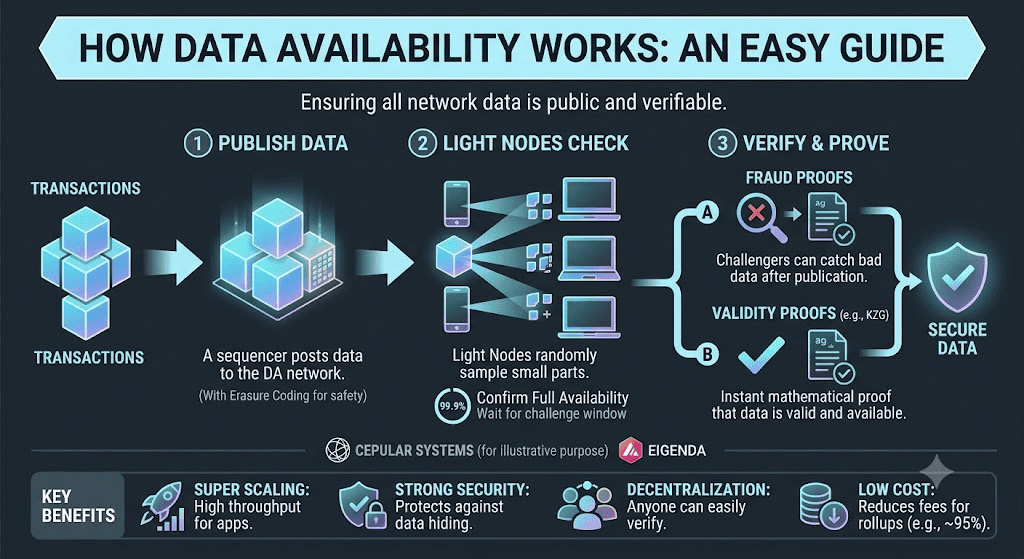
How data availability works
The mechanics of modern DA rely heavily on Data Availability Sampling (DAS) and erasure coding to break the data download bottleneck. Instead of forcing every node to download a block in its entirety, erasure coding mathematically expands the block data with redundant information using polynomial functions. This ensures that if even a fraction of the block is missing, the entire original dataset can be reconstructed.
Consequently, lightweight nodes can achieve a 99.999% probabilistic guarantee of full availability within seconds by randomly downloading tiny, fractional data fragments (samples). Advanced layers further secure this process using either KZG polynomial commitments for instant mathematical proof (validity proofs) or cryptographic fraud proofs to catch bad actors during the challenge window.
The Global Data Availability Landscape in 2026: Key Structural Trends
The Web3 infrastructure market has evolved from a historically bundle-everything monolithic design into a highly optimized, specialized modular paradigm. The mid-2026 DA landscape is defined by four foundational structural trends:
1. The Migration of the Blockchain Bottleneck
Throughout 2024 and 2025, transaction execution and high gas fees on Layer 1 blockchains were the primary chokepoints for decentralized scaling. In mid-2026, execution constraints are steadily easing due to advanced virtual machines (VMs) and zero-knowledge (ZK) environments. The bottleneck has officially migrated to data publishing. Next-generation rollups demand massive throughput to support fully-onchain applications, like real-time Web3 games and generative AI mints, turning raw data storage and verifiability into prime digital commodities.
2. The Dominance of Alternative DA Layers (Alt-DA)
While Ethereum's Dencun upgrade introduced EIP-4844 blobs to temporarily lower L2 storage fees, massive transactional demand has driven protocols toward dedicated Alternative Data Availability (Alt-DA) networks. These purpose-built layers decouple data publication from transaction execution entirely, reducing blob submission costs by roughly 95% compared to native L1 execution paths and handing developers unprecedented operating margins.
3. Shift from Data Storage to Data Availability
A common point of confusion is equating data availability with long-term data retrievability or archival storage. In 2026, the industry clearly delineates the two. DA protocols guarantee that transaction data is publicly broadcast and accessible for a temporary, fixed window, typically 14 to 18 days, so that independent nodes can download it to reconstruct and verify the state of the network. Once this verification window closes, long-term archival retrievability is offloaded to decentralized storage networks like KYVE or Filecoin, allowing DA layers to maintain ultra-high high-speed throughput.
4. Advanced Verification with DAS and Erasure Coding
Technological roadmaps have scaled rapidly to solve the data withholding attack, a vulnerability where a malicious sequencer publishes a block header but hides the underlying transactions. Modern DA networks deploy Data Availability Sampling (DAS) and erasure coding. Erasure coding expands datasets with mathematical redundancy, meaning that if even 50% of the data is withheld, the full set can be completely reconstructed. This allows lightweight nodes to verify that data is 100% available by randomly sampling tiny, fractional snippets of code without downloading entire blocks.
What Are the Best Data Availability (DA) Protocols to Watch in 2026?
The following directory highlights the pioneering modular networks and specialized infrastructure protocols dominating the global data availability layer in the second half of 2026.
1. Celestia (TIA)
- 2026 Valuation Benchmark: $500 Million Circulating Market Cap
- Core Role: The Pioneer of Dedicated Modular DA Layers
Celestia stands as the world’s first purpose-built modular DA blockchain. Rather than managing complex smart contract execution environments, Celestia’s architecture focuses exclusively on ordering transactions and guaranteeing their data availability via its native utility asset, TIA.
Technologically, Celestia’s mid-2026 baseline is anchored by its major Matcha upgrade, which successfully increased block capacity up to 128MB. Celestia utilizes a unique combination of DAS and Namespaced Merkle Trees (NMTs), which allow rollups to query only the specific data streams relevant to their application.() Backed by key capital injections from top-tier ventures, Celestia processes nearly 40% of the modular rollup data tail, making it a cornerstone asset for investors tracking pure-play infrastructure utility.
2. Avail (AVAIL)
- 2026 Valuation Benchmark: High-Growth Web3 Core Infrastructure
- Core Role: Multichain Modular DA Powered by Validity Proofs
Avail is an institutional-grade, modular DA layer designed specifically to support next-generation rollups, validiums, and trust-minimized application clusters. Originating from advanced infrastructure research inside the Polygon ecosystem before spinning out as a standalone network, Avail approaches data verification through a highly mathematically rigorous framework.
Unlike networks that rely on optimistic fraud-proof assumptions, Avail deploys KZG polynomial commitments and validity proofs. This technical architecture ensures that data availability can be verified immediately upon block finalization without waiting for a challenge window. Avail’s core value proposition lies in its cross-chain interoperability design, providing unified interfaces across multiple separate rollup frameworks, positioning it as a primary infrastructure target for complex multi-chain ecosystems.
3. EigenDA
- Core Role: Ethereum-Aligned Hyper-Throughput DA Layer Via Restaking
EigenDA represents a fundamentally different operational model by integrating directly into the pre-existing economic security layer of Ethereum. Developed by EigenLayer, EigenDA does not exist as an independent sovereign blockchain; instead, it operates as an Actively Validated Service (AVS) secured by restaked ETH and native Eigen ecosystem assets.
This unique architecture allows Ethereum Layer 2 networks to inherit a multi-billion-dollar pool of decentralized economic security without leaving the Ethereum ecosystem rails. EigenDA utilizes a high-performance decentralized committee model to distribute and verify data slices across thousands of Ethereum validation nodes. Because it bypasses the need to bootstrap an independent consensus mechanism from scratch, EigenDA offers massive data throughput capacity at ultra-low costs, making it the preferred DA choice for enterprise-grade, high-volume Ethereum L2 rollups.
Read more: What Is Restaking on EigenLayer, Explained?
Comparison of Leading Data Availability (DA) Platforms
Based on updated mid-2026 network architectures, implementation metrics, and structural positions, here is a scannable cross-reference of the top DA ecosystem plays:
|
Protocol |
Security Model |
Primary Verification Catalyst |
Core Structural Use Case |
Decentralization Strategy |
|
Celestia (TIA) |
Sovereign Proof-of-Stake Consensus |
Data Availability Sampling (DAS) & NMTs |
Sovereign rollups, appchains, and independent modular stacks |
Highest: Mass adoption of light node samplers scales block size linearly. |
|
Avail (AVAIL) |
Independent Validated Network |
KZG Commitments & Validity Proofs |
Multichain scaling clusters, hybrid rollups, and AggLayer apps |
High: Instant mathematical finality without fraud-proof challenge windows. |
|
EigenDA |
Shared Economic Security (Ethereum Restaking) |
Decentralized Node Committee Model |
High-throughput Ethereum L2 networks and enterprise validiums |
High (Restaked): Leverages established Ethereum validator base infrastructure. |
How to Trade Data Availability Projects on BingX
Global market participants can gain optimized, institutional-grade price exposure to the booming data availability and modular infrastructure ecosystem using unified, crypto-native rails on BingX.
Trade DA Token Spot and Futures with USDT on BingX
For active participants looking to build long-term structural portfolios, execute short-term momentum trades, or deploy capital efficiency through leverage, the BingX portal provides deep liquidity across premier Web3 infrastructure tokens:
- Navigate to the BingX Futures or Spot portal and access the markets list.
- Transfer your desired volume of working capital from your standard funding account over to your Futures or Spot Account in USDT.
- Select your desired asset ticker from the robust directory of infrastructure pairs, such as TIA/USDT or EIGEN/USDT.
- Formulate your macro direction: execute Open Long to capitalize on the multi-year modular rollup adoption trends, or Open Short to trade near-term infrastructure sector pullbacks. Set your leverage parameters defensively in alignment with your risk management rules.
- Set up precise Take-Profit (TP) and Stop-Loss (SL) boundary orders to insulate your account against sudden crypto market intraday volatility. Confirm and execute the transaction; real-time PnL will adjust dynamically inside your wallet.
Risks and Key Considerations When Evaluating DA Networks
While the modular blockchain supercycle presents an extraordinary macro tailwind, market participants must manage capital against several critical risk vectors:
- Sovereign vs. Shared Security Economics: Sovereign networks like Celestia require ongoing utility token demand to incentivize validators and maintain network security. If token valuations face macro downward pressure, the economic cost to attack the consensus layer drops. Conversely, protocols like EigenDA mitigate this by leveraging Ethereum's pre-established multi-billion-dollar security base.
- Aggressive Ethereum Native Subsidization: The core Ethereum protocol continues to aggressively develop its internal DA roadmap via PeerDAS (EIP-7594) inside the upcoming Fusaka upgrade. If native Ethereum blobs become cheap and abundant enough to handle all enterprise L2 data loads permanently, the economic incentive for rollups to offload storage to Alt-DA layers could narrow.
- Technological Upstream Disruptions: The software landscape moves faster than physical infrastructure. Advanced zero-knowledge state compression algorithms can significantly reduce the raw byte size of transaction summaries before they hit the base network. A structural breakthrough in off-chain data compression could cut total byte demand, impacting the fee generation metrics of raw volume-driven DA layers.
- Asset Release and Token Overhangs: Many modular infrastructure projects launched their mainnets within the last few years, meaning that substantial chunks of early team, investor, and ecosystem allocations remain bound under strict vesting schedules through late 2026. Market participants must map out cliff unlock dates, as sudden token supply expansions can dilute circulating valuations regardless of protocol performance.
Final Thoughts: Should You Invest in the Data Availability Modular Scaling Sector?
The mid-2026 technology landscape features an undeniable reality: while monolithic networks provide simple, all-in-one execution frameworks, the high-throughput, low-fee future belongs to modular design patterns. Data Availability layers serve as the foundational bedrock of this shift, turning raw blockchain storage into a highly scalable, cryptographically verifiable asset.
Strategic capital allocation across distinct architectures of the DA sector, ranging from sovereign sampling champions like Celestia to validity-proof innovators like Avail and restaked powerhouses like EigenDA, offers a clear blueprint for capturing the multi-year Web3 infrastructure expansion. Utilizing the secure, flexible trading rails on BingX allows global investors to navigate these structural infrastructure trends seamlessly using unified capital.
However, trading high-beta blockchain infrastructure assets demands absolute portfolio discipline. Investors must implement stringent risk mitigation protocols, track ongoing rollup integration metrics, and approach the modular data availability supercycle as a volatile, high-growth component within a globally diversified digital asset strategy.
Related Reading
- What Is Restaking on EigenLayer, Explained?
- Top 8 Restaking Crypto Projects to Know in 2026
- What Is LayerZero (ZRO) Omnichain Interoperability Protocol and How Does It Work?
- What Is Chainlink: the Oracle Network Powering DeFi, RWAs, and the Future of Finance?
- What Are the Top Zero-Knowledge (ZK) Crypto Projects of 2026?
