
The global capital markets in mid-2026 are closely analyzing the commercial space flight industry as pioneers transition from boutique, low-cadence tourism runs to high-frequency suborbital business models. Virgin Galactic Holdings, Inc. (NYSE: SPCE) serves as a highly watched vehicle for global investors aiming to capture this capital-intensive aerospace pivot. By shifting its core engineering focus from its legacy flight systems toward its next-generation Delta-class spaceship fleet, the California-headquartered corporation presents a highly speculative, high-beta tactical profile for the current macroeconomic climate.
As space flight operators burn through initial public market cash cushions to fund complex aerospace manufacturing setups, Wall Street analysts are aggressively recalculating the company's long-term survival runway. The transition away from the historic VSS Unity architecture toward modular, multi-ship assembly frameworks is creating extreme short-term volatility on the trading floor. For international traders monitoring secular shifts in commercial space tourism, keeping a close eye on SPCE's underlying financial metrics has become a major strategic priority. You will also discover how to trade Virgin Galactic Holdings, Inc. (NYSE: SPCE) futures on BingX TradFi with USDT collateral.
Read more: SpaceX (SPCX) Price Prediction 2026: $227 Street-High AI Fusion or Trillion-Dollar Valuation Bubble?
Key Highlights: Top 5 Things for Tech Investors to Know in 2026
- The Delta-Class Strategic Re-allocation: Following the retirement of the historic VSS Unity spaceship after its final Galactic 07 flight, Virgin Galactic has concentrated its entire engineering capacity on developing and testing its Delta-class vehicles. These ships are designed to achieve a far higher launch cadence and optimize profit margins.
- Aggressive Premium Ticket Repricing: Reflecting the intense engineering demands and high costs of suborbital spaceflight, ticket structures have surged over time. Initial reservations priced at $200,000 grew to $450,000 and $600,000 in recent years, culminating in a 2026 booking re-opening at $750,000 per seat.
- Balance Sheet Management and Dilution: Operating with deep net losses, Virgin Galactic relies heavily on capital restructuring. The company continues to utilize common stock issuances to settle legacy liabilities and fund its multi-year capital expenditure requirements.
- Resolution of Legacy Legal Headwinds: The company has begun clearing regulatory and legal overhangs, recently reaching a preliminary $2.75 million settlement regarding long-standing shareholder derivative litigation.
- Unique Air-Launched Operational Framework: Unlike vertical-launch rocket providers, Virgin Galactic preserves a distinct operational model using its White Knight Two (Mothership Eve) carrier aircraft to release suborbital vehicles at 44,000+ feet, insulating its flight profile from standard pad constraints.
What Is Virgin Galactic Holdings, Inc. (NYSE: SPCE)?
Source: Google
Virgin Galactic Holdings, Inc. is an American aerospace company pioneering commercial human spaceflight for private individuals and scientific researchers. Founded in 2004 by British entrepreneur Sir Richard Branson and the Virgin Group conglomerate, the company established itself as an early titan of the private space sector by capturing the legacy tech of the Ansari X Prize-winning SpaceShipOne prototype. On October 28, 2019, Virgin Galactic made history by listing on the New York Stock Exchange under the ticker SPCE via a high-profile SPAC merger, becoming the world's first publicly traded space tourism operator. The company's unique flight architecture operates through an air-launched, multi-stage vehicle ecosystem:
- The Mothership (White Knight Two / VMS Eve): A custom-engineered, twin-fuselage jet aircraft designed to carry the suborbital spacecraft to high altitudes before release.
- The Spaceplane (SpaceShipTwo / Delta-Class): A crewed, rocket-powered vehicle that detaches from the mothership, fires its internal hybrid rocket motor to break the sound barrier, and climbs past 50 miles altitude to deliver several minutes of weightlessness before utilizing a unique "feathering" tail structure for aerodynamic atmospheric re-entry.
Headquartered in California with primary launch facilities located at the state-funded Spaceport America complex in New Mexico, Virgin Galactic has evolved from a pure marketing and development venture into an active flight operator. Following years of testing, structural crashes, and design adjustments, the modern company is entirely focused on scaling its manufacturing footprint to make high-net-worth space exploration repeatable and commercially viable.
Read More: Nvidia (NVDA) Stock Price Outlook for 2026: Can Blackwell and Vera Rubin Take NVDA Back to $300?
Key Details and Stock Metrics for SPCE
- Exchange / Index Position: New York Stock Exchange (NYSE) / Independent Aerospace Constituent
- Inception Year: Founded in 2004 (Listed publicly via SPAC in October 2019)
- Global Corporate Headcount: Streamlined around core Delta assembly hubs
- Primary Spaceport Facility: Spaceport America (Anchor Tenant), New Mexico, United States
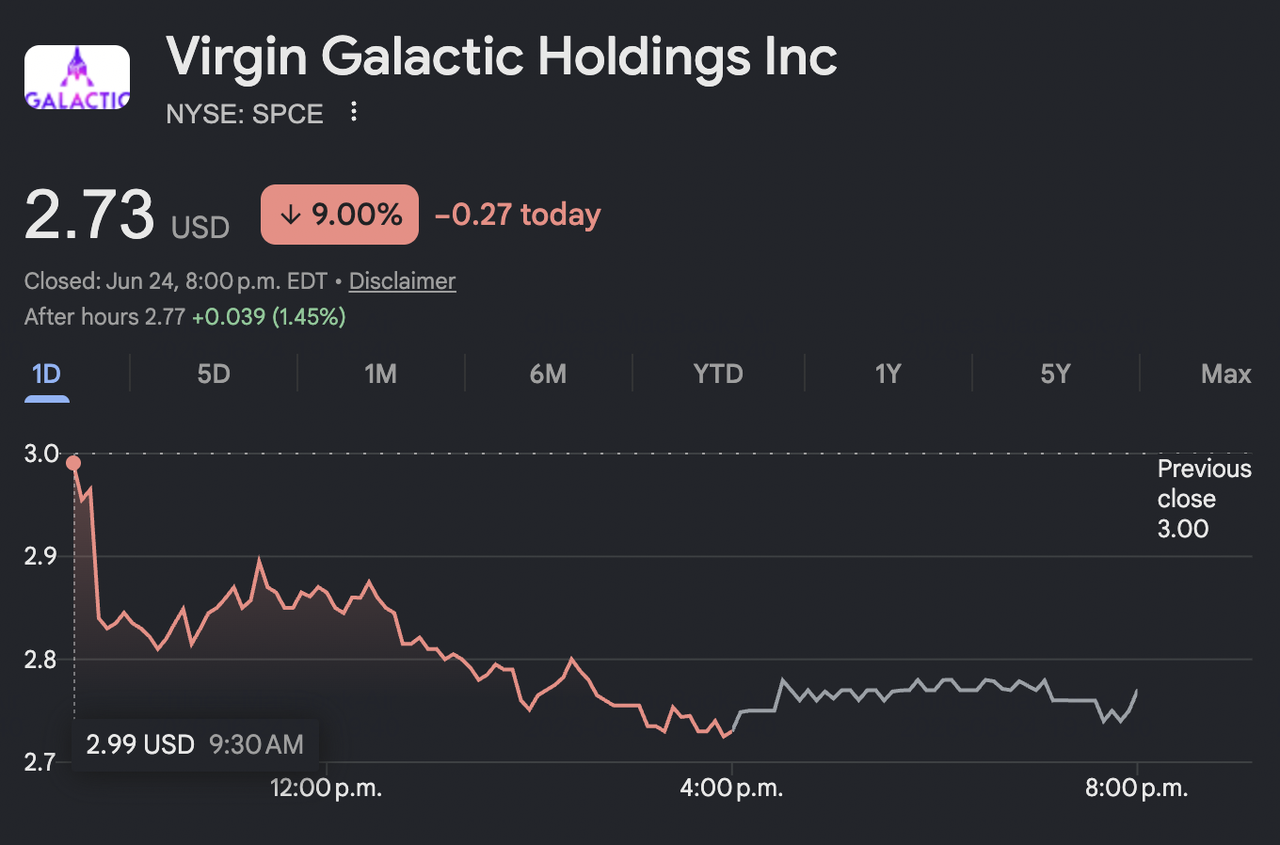
- Financial Tracking Parameters: As of the June 24, 2026 market close, SPCE finished trading at $2.73 USD per share, representing a 9.00% daily drop.
Read More: Intel (INTC) Stock Forecast 2026: Foundry Breakthrough to $89 or Value Trap?
Virgin Galactic's Financial and Operational Metrics
The fundamental data tracking Virgin Galactic's public equity structure highlights the core challenges facing the company's valuation layer:
|
Financial Metric Category |
2026 Stated Value Status |
|
Current Stock Price |
$2.73 USD |
|
Estimated Market Capitalization |
Approx. $293.25 Million |
|
52-Week Trading Range |
$2.13 – $8.90 USD |
|
Average Daily Trading Volume |
~23.58 Million Shares |
|
Trailing Earnings Per Share (EPS) |
-$4.35 USD |
|
Next Estimated Earnings Date |
Estimated August 5, 2026 |
2026 Tech Sector Investment Comparison
The table below contrasts the financial parameters, underlying operational models, and structural tailwinds defining the prime aerospace and technology exposure channels in the 2026 market cycle.
|
Asset Class / Strategy |
Implied Focus Sector |
Primary Vehicle / Architecture |
Primary Growth Tailwinds |
Structural Risks and Roadblocks |
|
Virgin Galactic Equity (NYSE: SPCE) |
Suborbital Commercial Space Tourism |
Air-Launched Rocket Gliders (Delta-Class / Eve) |
Substantial price-per-ticket scaling ($750k); high-frequency multi-ship launch target. |
Severe cash burn rates; persistent shareholder dilution; absolute dependency on single-site logistics. |
|
Broad Aerospace and Defense Benchmarks |
Orbital Defense and Heavy Launch Cargo Systems |
Vertical Multistage Multi-Engine Rockets |
Massive long-term defense communication contracts; global constellation scaling. |
Heavy capital expenditure requirements; intense regulatory overhead; rigid sovereign procurement bottlenecks. |
|
iShares Expanded Tech-Software ETF (IGV) |
Enterprise Application and Systems Cloud Layers |
Digital Software / AI Models |
Pure recurring SaaS revenue models; exceptional operating cash margins; minimal physical overhead. |
Vulnerable to broader valuation multiple compression; zero protection against digital market shocks. |
Recent Corporate Developments and Strategy for Virgin Galactic
Rather than executing active customer flights, Virgin Galactic's 2026 strategy centers heavily on cost management, capital conservation, and manufacturing execution.
1. Debt Restructuring and Common Stock Dilution
Faced with high capital spending requirements to get the Delta fleet onto the test track, Virgin Galactic has initiated an aggressive debt reduction plan. The company filed to redeem up to $30.5 million of its outstanding 9.80% First Lien Notes. To preserve cash, this redemption is being executed through the programmatic issuance of new common stock, directly addressing near-term debt obligations but increasing the total floating share count.
2. Flight Testing Operations Resumption
To keep its mission control teams sharp and prepare the logistical infrastructure for new ship arrivals, the company has resumed localized flight operations using its carrier aircraft, Mothership Eve, at Spaceport America. These sorties collect essential environmental data to de-risk the future integration of the new spaceship components.
The SPCE Investment Thesis for 2026: 5 Pillars of Market Valuation
Source: MarketBeat
1. The Economics of the $750,000 Ticket Structure
By raising reservation prices to $750,000 per seat, Virgin Galactic is attempting to profoundly transform its unit economics. If the upcoming Delta-class spaceships successfully carry six passengers per flight, gross revenue per launch scales to $4.5 million, dramatically shortening the path to operating profitability.
2. Transition to High-Cadence Delta-Class Fleet
Unlike the legacy VSS Unity, which requires extensive maintenance cycles between flights, the Delta-class ships are built with modular components engineered for rapid turnarounds. This architecture aims to shift the company from a sporadic launch schedule to a predictable, revenue-generating fleet model.
3. Strategic Anchor Tenancy at Spaceport America
As the anchor tenant of the $200 million state-funded Spaceport America facility in New Mexico, Virgin Galactic enjoys deep local structural support. This specialized site provides protected, low-congestion airspace that is absolutely vital for conducting regular supersonic commercial test operations.
4. Intellectual Property and Custom Composite Monopolies
Through its deep history of composite design manufacturing, originally anchored by the full acquisition of The Spaceship Company, Virgin Galactic retains exclusive rights to unique high-altitude feathering structures. This proprietary technology solves extreme thermal atmospheric re-entry issues without requiring heavy ceramic shielding.
5. Capturing Untapped Scientific Research Budgets
Beyond multi-millionaire space tourists, the company is positioning its suborbital fleet as an efficient laboratory environment for space science missions. Offering global universities and sovereign research institutes cheap microgravity testing slots provides a reliable alternative source of non-consumer revenue.
SPCE Valuation and Performance Forecasts for 2026: Bull vs. Bear Outlook
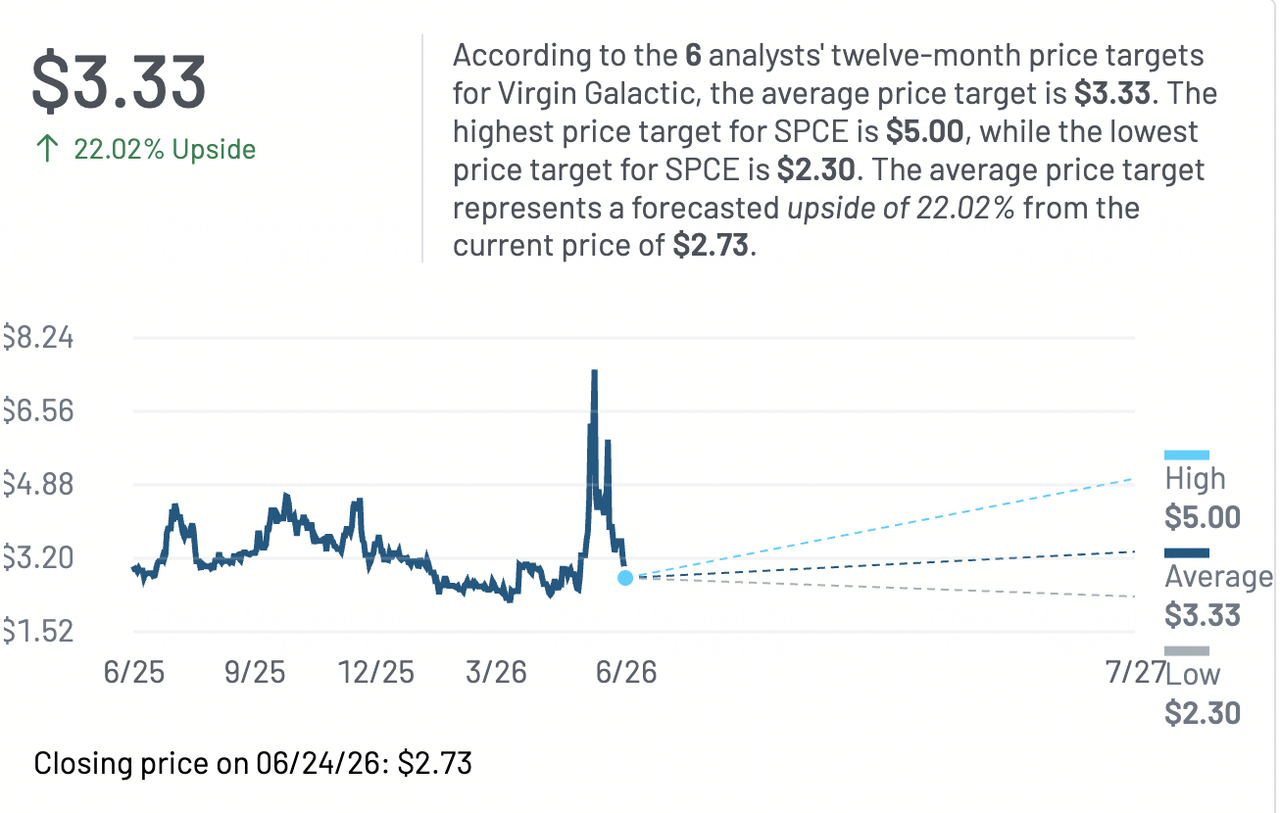
Institutional research desks maintain a highly polarized stance on Virgin Galactic equity, balancing the massive addressable market of wealthy thrill-seekers against near-term liquidity constraints.
|
Institution / Analyst Desk |
2026 Target Implied Range |
Market Outlook / Stance |
|
Canaccord Genuity |
$4.50 – $6.00 |
Speculative Buy: Optimistic on the factory buildout timeline for the Delta fleet and the higher ticket pricing power. |
|
Cowen and Company Aerospace |
$3.00 – $4.50 |
Market Perform: Neutral stance pending the first physical flight tests of the new Delta prototypes. |
|
Truist Securities |
$2.00 – $3.00 |
Hold / Neutral: Acknowledges reduced near-term debt, but remains concerned about ongoing equity dilution. |
|
Market Consensus (Aggregated) |
$1.50 – $2.50 |
Underperform: Cautious due to the extended revenue pause during the current fleet swap. |
|
Morgan Stanley Equity Desk |
$1.00 – $1.80 |
Underweight: Focused on the ongoing cash burn and the long delay before regular commercial operations resume. |
The Bull Case: Swift Factory Milestones Trigger Short Covers
Bulls argue that because the stock trades at a depressed market capitalization of ~$293.25 million, any positive surprise, such as beating timelines for the rollout of the first Delta vehicle, could trigger an explosive short-squeeze. If the company proves its production model works without requiring more debt, the stock could quickly retest the upper limits of its 52-week range ($8.90).
The Bear Case: Fleet Upgrades Stall as Liquidity Thins Out
Bears point out that with a trailing EPS of -$4.35, the company's financial runway is under constant pressure. If flight testing for the Delta-class encounters technical delays or design changes, the revenue pause could stretch deep into future cycles, forcing further common stock dilution and dragging share prices down toward all-time lows ($2.13).
Read more: How to Trade Forex, Commodities, Stocks, and Indices With BingX TradFi: A Beginner's Guide (2026)
Competitive Risks and Sector Pressures for SPCE Investors to Know
Even with its early-mover brand advantage, Virgin Galactic's leadership team faces a challenging path forward through several significant headwinds:
- Prolonged Revenue Intermission: Having retired VSS Unity to preserve capital for the Delta program, the company faces a protracted period with minimal flight revenue. This leaves it completely dependent on macro capital markets for funding.
- Extreme Human Capital and Operational Safety Constraints: The suborbital space flight environment allows no margin for error. As seen in the historic 2014 VSS Enterprise test disaster, any technical failure can result in catastrophic asset loss, severe regulatory groundings, and irreversible brand damage.
- Execution Risk in Automated Assembly Scaling: Shifting from handmade, artisan aerospace builds to an assembly line framework is notoriously difficult. Any delays in component sourcing or automated software calibrations will delay the start of regular commercial services.
How to Trade Virgin Galactic Holdings, Inc. (NYSE: SPCE) Futures on BingX TradFi
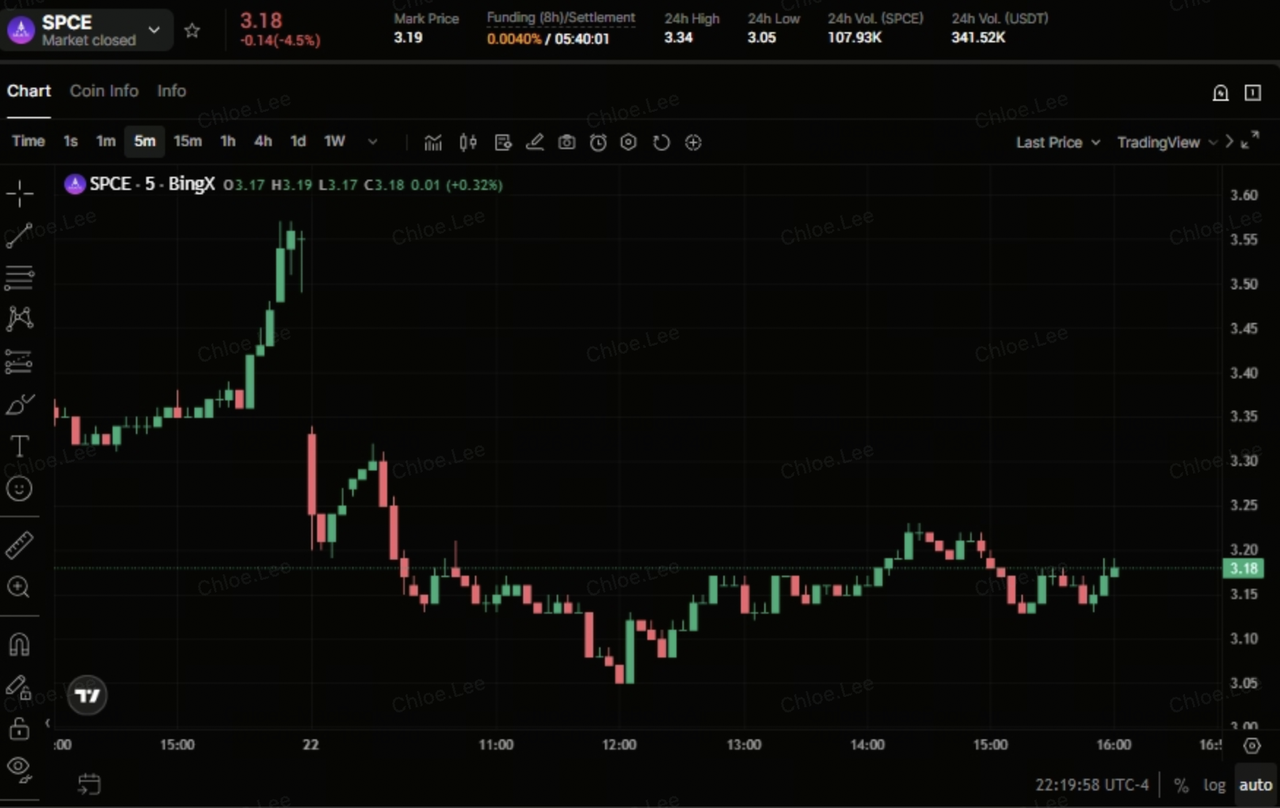
For global market participants looking to take advantage of the volatility surrounding aerospace manufacturing timelines, trading SPCE derivative contracts offers a highly flexible, capital-efficient alternative to physical stock ownership. This approach allows active traders to hedge their positions or express directional views around key technical milestones and earnings calls, much like how tech traders use digital ecosystems to track core innovations across traditional finance (TradFi), semiconductor giants like NVIDIA, or core digital assets like Bitcoin.
- Go to the BingX TradFi section and select Stock Futures.
- Search for the SPCE/USDT perpetual contract.
- Check the trading session before placing your order. Liquidity is typically lower during extended sessions, which can result in wider spreads and higher volatility.
- Select your Margin Mode (Isolated or Cross) and set your leverage.
- Choose Open Long if you expect momentum, strong chip architecture updates, or positive analog cycle inventory recovery. Choose Open Short if you anticipate margin pressures from heavy CapEx spending, factory execution delays, or valuation pullbacks.
- Set Take-Profit (TP) and Stop-Loss (SL) levels immediately to manage risk against SPCE's price swings driven by earnings, news, or global semiconductor production milestones.
Read More: Arm Holdings (ARM) Stock Outlook 2026: AI Licensing and the $200+ Price Target
Conclusion: Navigating the Space Fleet Swap in 2026
The private space flight sector in 2026 has reached a definitive crossroad. The era of proving that suborbital space tourism is possible has passed; the new challenge is proving that it can scale into a highly profitable, high-frequency commercial business. Virgin Galactic's choice to pause its flight operations and focus entirely on building its Delta-class fleet represents a bold, make-or-break bet on its manufacturing future.
While investors must carefully weigh the real risks of ongoing share dilution and a prolonged revenue pause against current targets, the company's improved $750,000 ticket pricing and reduced debt profile provide a foundational path forward. For short-term derivatives traders and speculative long-term investors alike, tracking the SPCE ecosystem offers a direct way to trade the high-velocity shifts of the private space race as it attempts to make commercial suborbital spaceflight routine.
Risk Reminder: Trading high-growth technology and aerospace equities involves immense capital risk due to extreme valuation multiples, capital-intensive deployment timelines, and concentrated corporate governance. Always implement strict risk management, appropriate position sizing, and automated stop-loss protocols.
Related Reading
- The Passive Inflow Wave: Decoding the $32.5B Structural Squeeze and Liquidity Shock Facing SpaceX (SPCX)
- Top 10 Things to Know About the SpaceX IPO: Pricing, Valuation, and How to Trade It
- What Is SpaceX Tokenized Stock (SPCXB) and How to Buy It?
- Top Space Stocks to Buy Ahead of SpaceX IPO
- SpaceX (SPCX) Price Prediction 2026: $227 Street-High AI Fusion or Trillion-Dollar Valuation Bubble?
