

Artificial intelligence (AI) infrastructure has entered an explosive growth phase in mid-2026, driven by a monumental infrastructure buildout. Major cloud hyperscalers, including Microsoft, Amazon, Alphabet, Meta, and Oracle, are projecting a combined capital expenditure (capex) of $600 billion to $750 billion this year, with up to 75% directed entirely toward AI servers, accelerators, network fabrics, and physical data center buildouts.
As the broader semiconductor market approaches an unprecedented $1.3 trillion valuation according to Gartner, the core hardware bottleneck is evolving. While the industry scrambled for pure raw computing power in 2024 and 2025, the rise of agentic AI workflows and sequential reasoning in 2026 has transformed architectural demands. The hardware layer now requires a highly synchronized interplay between processing graphics units (GPUs), high-performance central processing units (CPUs), ultra-dense High-Bandwidth Memory (HBM), advanced optical networking transceivers, and extreme ultraviolet (EUV) lithography systems.
Through tokenized stocks, digital assets that mirror real-world equities 1:1 on public blockchains, and USDT-collateralized stock futures on BingX TradFi, crypto-native investors can access fractional exposure to these global technology giants 24/7. This decentralized framework bridges digital asset liquidity directly into the core hardware layer powering the global AI economy.
Key Trends in the Global AI Hardware Market in 2026
The AI hardware sector has graduated from speculative, early-stage testing into a highly visible, cash-flow-rich secular cycle. The mid-2026 landscape is defined by three fundamental themes:
1. The Rise of Agentic AI and the GPU-to-CPU Shift
In traditional large language model (LLM) training workloads, data center hardware configurations favored an asymmetric 8:1 ratio of GPUs to CPUs. However, the commercial proliferation of AI agents capable of multi-step automation has significantly altered inference environments. Agentic AI demands intense sequential reasoning and continuous tool-interaction protocols. Consequently, data centers are shifting toward a 1:1 GPU-to-CPU ratio, driving an unprecedented demand surge for high-performance server CPUs alongside specialized accelerators.
2. Custom ASICs vs. Off-the-Shelf Accelerators
While off-the-shelf accelerators remain the dominant backbone for foundational model training, hyperscalers are aggressively executing custom Application-Specific Integrated Circuit (ASIC) roadmaps to mitigate component concentration and reduce long-term operational costs. This dual-track deployment creates a highly profitable environment for both pure-play chip designers and specialized custom silicon design enablers.
3. Memory Sub-Cycles and Hardware 'Memflation'
Advanced AI accelerators remain heavily gated by physical memory constraints. High-Bandwidth Memory (HBM) capacity is a primary structural bottleneck across the semiconductor industry. Memory manufacturers have completely pre-sold their entire 2026 HBM allocations under rigid long-term contracts. This structural supply deficit has triggered a memory inflation or 'memflation' wave, driving record gross margins for firms commanding advanced node memory fabrication.
What Are the 10 Best AI Hardware Stocks to Buy in 2026?
The following directory analyzes the premier semiconductor foundries, chip designers, equipment manufacturers, and optical networking leaders defining the global artificial intelligence infrastructure footprint in the second half of 2026.
1. Nvidia (NVDA)
- 2026 Valuation Benchmark: $5.05 Trillion Market Cap
- Core Supply Role: Undisputed Global AI Accelerator and Full-Stack Ecosystem Leader
Nvidia remains the foundational anchor of the global AI computing landscape, commanding over 80% market share in data center accelerators. In mid-2026, Nvidia's financial performance continues to break records, printing a historic Q1 FY2027 revenue of $81.6 billion, up 85% year-over-year, bolstered by an $80 billion additional share repurchase authorization.
While its flagship Blackwell platform scales across tier-1 cloud providers, Nvidia is aggressively executing its next-generation Vera Rubin architecture. Purpose-built for agentic AI and physical reasoning, the Rubin platform integrates advanced Vera CPUs with Rubin GPUs and ultra-dense HBM4 memory, promising up to a 10x reduction in inference cost per token. Combined with its impenetrable CUDA software moat, Nvidia represents the premium benchmark for pure-play AI infrastructure exposure.
Read more: Nvidia (NVDA) Stock Price Outlook for 2026: Can Blackwell and Vera Rubin Take NVDA Back to $300?
2. Broadcom (AVGO)
- 2026 Valuation Benchmark: $1.88 Trillion Market Cap
- Core Supply Role: Premier Custom AI ASIC and High-Speed Networking Chip Pioneer
Broadcom has solidified its position as the premier secondary play to Nvidia, acting as the primary engineering engine behind custom AI accelerators for hyperscalers like Google and Meta. The firm's AI-linked semiconductor segments are experiencing triple-digit growth, with management reaffirming a massive $100 billion AI revenue target for FY2027.
Beyond custom silicon, Broadcom dictates the global standard for data center switching and routing fabrics, which are vital for scaling massive, multi-node AI clusters. Despite experiencing near-term stock volatility due to traditional enterprise software segments, Broadcom's hardware bookings exceed $30 billion, making it an indispensable infrastructure component for multi-year AI capital allocation plans.
Read more: Broadcom (AVGO) Stock Outlook for 2026: AI Infrastructure King or Margin Victim?
3. Taiwan Semiconductor Manufacturing Company (TSM)
- 2026 Valuation Benchmark: $2.20 Trillion Market Cap
- Core Supply Role: Critical Advanced-Node Foundry and Packaging Monopolist
Taiwan Semiconductor Manufacturing Company (TSMC) is the foundational 'picks and shovels' provider for the entire AI economy, acting as the exclusive fabrication foundry for Nvidia, AMD, Broadcom, and Apple. Leveraging its advanced 3nm and next-generation 2nm processing nodes, TSMC has guided full-year 2026 revenue growth above 30% in USD terms, with capital expenditure tracking at the absolute high end of its $52 billion to $56 billion range.
TSMC’s structural competitive advantage resides in its market-dominant Chip-on-Wafer-on-Substrate (CoWoS) advanced packaging capacity. With CEO C.C. Wei highlighting insatiable demand that could take years to fully satisfy, TSMC maintains extraordinary pricing power and robust gross margins of roughly 66%, insulating it from direct chip-design competition.
Read more: TSMC (TSM) Price Prediction 2026: AI Monopoly or Geopolitical Trap at $480?
4. Advanced Micro Devices (AMD)
- 2026 Valuation Benchmark: $800 Billion Market Cap
- Core Supply Role: Primary Challenger in AI GPUs and Data Center CPU Computing
Advanced Micro Devices (AMD) has emerged as the leading alternative to Nvidia's accelerator monopoly, driven by strong data center momentum for its Instinct MI350 series GPUs. In Q1 2026, AMD posted a record $5.8 billion in data center revenue, capturing notable commitments from enterprise operators like OpenAI and Meta for scaled inference workloads.
Critically, AMD is a primary beneficiary of the agentic AI structural shift. Its latest high-performance data center CPUs, built on TSMC’s 2nm node and featuring a 256-core configuration with high memory bandwidth, are designed to absorb intense sequential reasoning workloads. With management expanding its server CPU total addressable market (TAM) projections past $120 billion by 2030, AMD represents a high-beta challenger with deep structural upside.
Read more: AMD Price Prediction 2026: $525 AI Sovereignty or $300 Valuation Trap?
5. Micron Technology (MU)
- 2026 Valuation Benchmark: $1.00 Trillion Market Cap
- Core Supply Role: Elite US-Based Pure-Play High-Bandwidth Memory (HBM) Producer
Micron Technology has executed a historic structural transformation, crossing the $1 trillion market cap threshold in 2026 on the back of an unprecedented AI memory supercycle. The company's ultra-efficient 24GB and 36GB HBM3E configurations consume 30% less power than legacy alternatives, positioning them as standard components in premier AI data center architectures.
Benefiting from domestic US CHIPS Act funding and rapid execution on its advanced 1-gamma DRAM nodes, Micron reported a massive gross margin of 74.9% in its recent fiscal disclosure. With its entire 2026 HBM production capacity completely sold out, Micron remains a direct pure-play beneficiary of ongoing hardware capacity constraints.
Read more: Micron (MU) Stock Price Forecast 2026: Can AI Memory and DRAM Demand Push MU to $500?
6. ASML Holding (ASML)
- 2026 Valuation Benchmark: $675 Billion Market Cap
- Core Supply Role: Monopoly Supplier of Cutting-Edge Photolithography Systems
Headquartered in the Netherlands, ASML holds an absolute monopoly on the Extreme Ultraviolet (EUV) and High-NA (High Numerical Aperture) lithography machines required to print semiconductor nodes below 5nm. Without ASML's hardware, fabrication plants cannot manufacture advanced AI accelerators or next-generation mobile chips.
Reflecting intense demand for leading-edge foundry expansions, ASML raised its full-year 2026 revenue guidance to a range of €36 billion to €40 billion, maintaining high gross margins above 51%. Despite complex geopolitical export landscapes, ASML's deep order backlog and unique positioning make it a highly resilient long-term infrastructure asset.
Read more: ASML Holding (ASML) Stock Price Forecast 2026: AI Infrastructure King or Geopolitical Target?
7. Applied Materials (AMAT)
- 2026 Valuation Benchmark: $400 Billion+ Market Cap
- Core Supply Role: Global Leader in Semiconductor Materials Engineering and Equipment
Applied Materials supplies the highly specialized deposition, etching, and materials modification equipment required by advanced foundries to execute Gate-All-Around (GAA) transistor designs and complex chiplet/superchip architectures. The company delivered a record Q2 FY2026 revenue of $7.91 billion, pushing its non-GAAP gross margin past the 50% milestone for the first time in over 25 years.
Driven by the complex integration of HBM and advanced packaging across modern fabrication lines, Applied Materials raised its 2026 outlook, projecting its advanced packaging segment to grow by more than 50%. As cleanrooms scale globally across the US, Europe, and Asia, AMAT offers broad, diversified exposure to structural wafer fab equipment expansions.
8. Applied Optoelectronics (AAOI)
- 2026 Valuation Benchmark: $15.8 Billion Market Cap
- Core Supply Role: High-Beta Provider of Next-Gen Optical Interconnects and Transceivers
Applied Optoelectronics (AAOI) operates as a highly volatile, specialized infrastructure play levered to the rapid scale-up of back-end data center fabrics. As hyperscalers expand AI computing clusters, traditional copper cabling introduces severe latency and thermal limitations, forcing a massive architectural pivot toward high-speed optical transceivers.
AAOI is currently scaling its 800G optical transceivers toward a baseline capacity of 100,000 units per month, while showcasing next-generation 1.6T on-board optics solutions for massive AI workloads. Backed by extensive order backlogs from prominent hyperscalers and a new $300 million manufacturing expansion in Sugar Land, Texas, AAOI is projecting a triple-digit revenue acceleration for full-year 2026, making it a favorite for high-momentum traders.
Read more: AAOI Stock Prediction 2026: $260 Photonics Boom or Dilution Trap?
9. Marvell Technology (MRVL)
- 2026 Valuation Benchmark: $255 Billion Market Cap
- Core Supply Role: High-Growth Leader in Electro-Optics and Data Center Networking Fabrics
Marvell Technology has emerged as a premier AI infrastructure powerhouse, with data center architectures driving roughly 76% of its total corporate revenue. The firm recently launched the Teralynx T100, the semiconductor industry's first 102.4 Tbps AI-optimized switching platform built on an advanced 3nm node, engineered specifically to eliminate communication bottlenecks within massive neural network configurations.
Marvell's structural outlook was significantly boosted at Computex 2026, where its critical role in AI electro-optics and custom silicon integration received high-profile industry validation. Following strong booking trends and its upcoming inclusion in the S&P 500 index, Marvell raised its long-term financial guidance, projecting aggressive revenue growth approaching $11.5 billion for FY2027.
Read more: Marvell (MRVL) 2026 Outlook: Can AI & Silicon Momentum Drive Stock to $150?
10. IBM (IBM)
- 2026 Valuation Benchmark: $264 Billion Market Cap
- Core Supply Role: Enterprise AI Integration Giant with Dominant Quantum Compute Foundations
International Business Machines (IBM) offers a highly stable, cash-flow-resilient entry point into the institutional enterprise landscape. Rather than competing in consumer hardware, IBM focuses on enterprise AI operating models through its watsonx platform, with generative AI contracts now representing roughly 30% of its total operational backlog.
On the infrastructure frontier, IBM shocked the technology sector by announcing a massive $10+ billion investment over the next five years to build out its advanced hardware pipeline, targeting the deployment of the world's first large-scale, fault-tolerant quantum computer, the IBM Quantum Starling, by 2029. Backed by record-setting free cash flow growth and a robust dividend yield, IBM serves as an exceptional defensive asset in a volatile tech market.
Read more: IBM (IBM) Stock Outlook for 2026: Quantum Leader or Legacy Victim?
Comparison of Leading AI Hardware Companies to Invest in
Based on updated mid-2026 market data, official financial disclosures, and structural supply chain positioning, here is a scannable cross-reference of the top AI hardware ecosystem plays:
|
Ticker / Symbol |
Primary Infrastructure Role |
Core Architectural Catalyst |
2026 Financial & Structural Outlook |
|
Nvidia (NVDA) |
Data Center Accelerator Leader |
Blackwell & Vera Rubin Nodes |
Q1 Data Center revenue hits $75.2B; record cash flows; unmatched CUDA software moat. |
|
Broadcom (AVGO) |
Custom ASIC & Switching Fabric |
Hyperscaler custom silicon |
Reaffirmed $100B AI revenue target for FY2027; custom silicon demand soaring. |
|
TSMC (TSM) |
Advanced-Node Semiconductor Foundry |
3nm / 2nm node domination |
Gross margins holding at 66%; 2026 revenue guidance raised past 30% growth. |
|
AMD (AMD) |
Accelerator & Server CPU Designer |
Instinct MI350/MI400; Venice CPU |
Data center sales up 57% YoY; capitalizing heavily on agentic AI CPU configurations. |
|
Micron (MU) |
High-Bandwidth Memory Producer |
High-efficiency 24GB/36GB HBM3E |
Revenue nearly tripled YoY; 2026 production completely pre-sold under rigid allocation. |
|
ASML (ASML) |
Photolithography Equipment |
EUV & High-NA Lithography |
Raised 2026 revenue guidance to €36B–€40B; total monopoly on leading-edge equipment. |
|
AMAT (AMAT) |
Materials Engineering Equipment |
Transistor design & advanced packaging |
Packaging revenue up 50%; gross margins cross 50% for the first time in 25 years. |
|
AAOI (AAOI) |
High-Speed Optical transceivers |
800G & 1.6T network scaling |
Building new $300M Texas facility; projecting 103%+ full-year revenue acceleration. |
|
Marvell (MRVL) |
High-Speed Data Center Networking |
Teralynx T100 102.4 Tbps Switch |
Data center drives 76% of revenue; upcoming S&P 500 inclusion; strong industry backing. |
|
IBM (IBM) |
Enterprise AI & Quantum Compute |
watsonx platform; Quantum Starling |
Initiating $10B quantum buildout; high free cash flow conversion; stable dividend profile. |
How to Trade AI Hardware Stocks on BingX TradFi
BingX provides global market participants with highly optimized, institutional-grade tools to capture price exposure across the entire semiconductor and AI hardware ecosystem using unified, crypto-native rails.
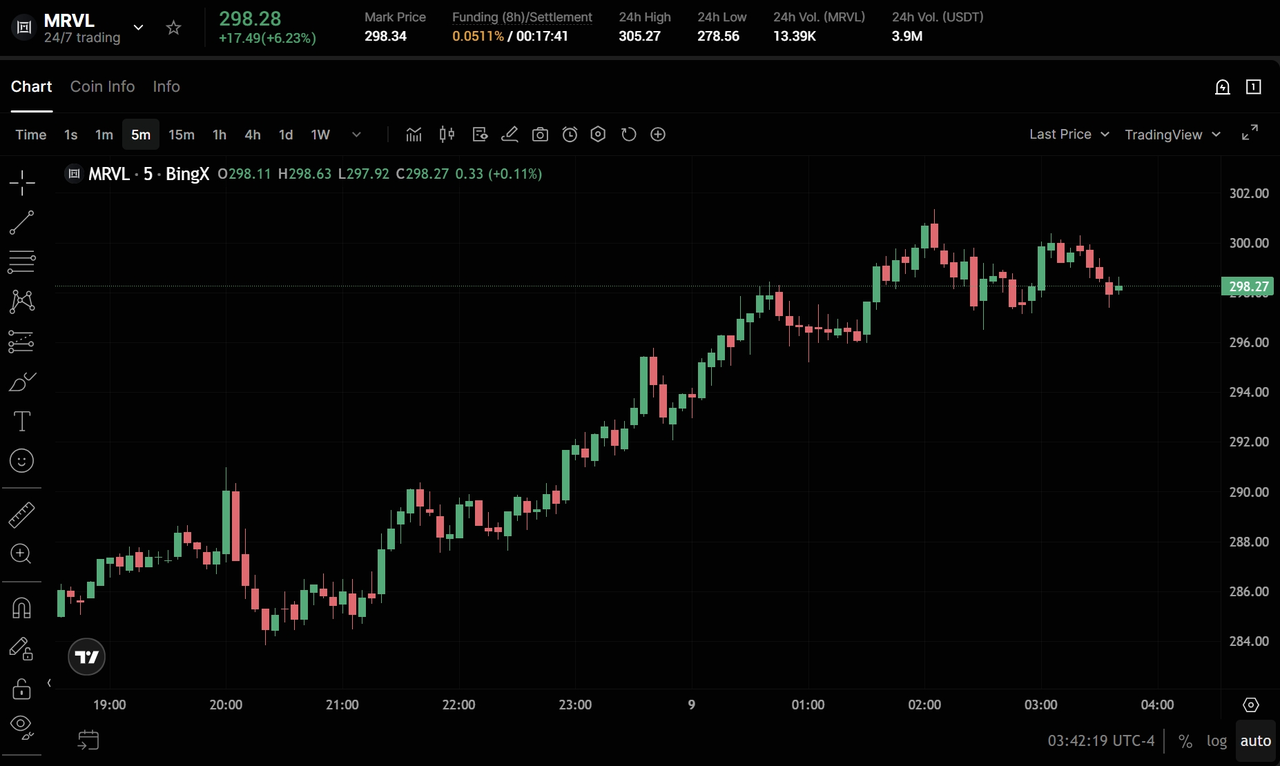
MRVL/USDT perpetuals on BingX futures market
Trade AI Hardware Stock Futures with USDT on BingX TradFi
For active market participants looking to hedge spot technology portfolios, execute tactical short strategies, or deploy capital efficiency through leverage, the BingX TradFi portal offers deep liquidity via USDT-settled perpetual contracts mirroring premier global equities.
- Navigate to the BingX TradFi web or mobile interface and select the Stocks list.
- Transfer your desired volume of working capital from your standard Spot Account over to your Futures Account in USDT.
- Select your desired asset contract from a robust directory of technology pairs, such as NVDA-USDT, AVGO-USDT, TSM-USDT, or MRVL-USDT.
- Formulate your macro direction: execute Open Long to capitalize on secular data center buildout trends, or Open Short to trade near-term macroeconomic pullbacks.
- Set your leverage parameters defensively in strict alignment with your capital preservation rules.
- Configure precise Take-Profit (TP) and Stop-Loss (SL) boundary orders to insulate your account against unexpected intraday volatility. Confirm and execute the contract; real-time PnL will track dynamically inside your futures wallet.
Top 5 Risks and Key Considerations When Trading AI Hardware Stocks
While the AI infrastructure expansion presents an extraordinary macro tailwind, market participants must manage risk against several critical vectors:
- Valuation Compression vs. Capex Digestion Pauses: With premier hardware leaders trading at elevated sector averages, with average and median P/E ratios at 50x and 32x respectively, valuations are highly sensitive to spending fluctuations. Traders must monitor the combined $600 billion – $750 billion hyperscaler capex bucket; if enterprise CIOs experience a 'Trough of Disillusionment' freeze due to lagging software ROI, even a minor 5% deceleration in infrastructure spending can trigger severe, multi-point valuation contractions.
- HBM Capacity Bottlenecks and Memflation Squeezes: Raw computing power is strictly gated by physical memory constraints, with HBM capacity serving as the primary industry bottleneck for 2026 accelerators. Because advanced memory lines are completely pre-sold into 2027, any manufacturing yield issue or raw wafer supply crunch will immediately compress downstream hardware margins, making the trailing gross margins of memory fabricators a critical metric to watch.
- Accelerated 12-to-18 Month Architectural Obsolescence: The hardware layer moves at a relentless, high-stakes pace where a dominant chip architecture can face structural margin erosion in under 18 months. Market participants must dynamically track compressed deployment roadmaps, such as Nvidia’s rapid shift from Blackwell to the Vera Rubin platform, to avoid holding legacy hardware assets during next-gen node transitions.
- Geopolitical and Supply Chain Concentration Risks: Advanced semiconductor fabrication remains heavily concentrated within specific geographic corridors, leaving the entire AI economy exposed to single-point-of-failure vulnerabilities. Traders must evaluate cross-border operations and local tax reporting, such as DIRPF or regional derivatives legislation, to hedge portfolios against sudden supply chain disruptions, packaging material shortages, or regional energy grid constraints.
- Tokenized Equity Liquidity and Governance Disconnect: Tokenized asset pairs on TradFi platforms function exclusively as precise, 1:1 price-tracking vehicles engineered for global capital efficiency. While they offer fractional 24/7 exposure to high-value tech stocks, traders must understand that these decentralized instruments do not convey real-world corporate voting rights or traditional shareholder legal protections, requiring strict account-level risk boundaries.
Final Thoughts: Navigate the 2026 AI Infrastructure Cycle with BingX
The mid-2026 technology landscape features an undeniable reality: while traditional consumer electronics segments navigate macro cyclicality, the foundational infrastructure layer supplying the artificial intelligence revolution is generating massive, highly visible cash flows today.
Strategic capital allocation across distinct layers of the hardware ecosystem, ranging from foundational foundries like TSMC and accelerator titans like Nvidia to custom silicon enablers like Broadcom and networking innovators like Marvell, offers a robust blueprint for capturing this multi-year technology boom.
Utilizing the secure, flexible tokenized spot and futures rails on BingX TradFi allows global traders to execute these structural trends seamlessly using unified, stablecoin-driven capital. However, trading high-beta semiconductor assets demands absolute portfolio discipline. Investors must implement stringent risk mitigation protocols, monitor quarterly corporate earnings, and approach the AI hardware supercycle as a volatile, high-growth component within a broader, globally diversified trading strategy.
Disclaimer: This article is provided for informational purposes only and does not constitute financial or investment advice. AI hardware and semiconductor stocks are subject to high market volatility, rapid technological shifts, and macroeconomic risks. Always conduct your own thorough research or consult with a licensed financial advisor before making any investment decisions. BingX does not guarantee the performance of any asset or derivative contract discussed herein.
Related Reading
- Top AI Hyperscaler Stocks to Watch in 2026: The $700 Billion Cloud Infrastructure Race
- Top AI Semiconductor Stocks to Buy in 2026: AI Chips and Supply Chain Complete Guide
- Top AI Data Center Stocks to Buy in 2026: Cloud, Servers, and AI Compute Infrastructure
- Top AI Compute and GPU Stocks to Buy in 2026: The Shift to Inference and Custom Silicon
- What Is the U.S. CHIPS and Science Act? Its Impact on Semiconductors, Technology, and Crypto in 2026
