
The Roundhill Memory ETF (DRAM) is an actively managed fund focused on global companies producing high-bandwidth memory, DRAM, NAND, solid-state drives and related storage technology. Micron, Samsung Electronics, SK hynix, SanDisk and Kioxia are among its leading exposures. This concentrated design provides direct participation in AI memory demand, but also magnifies memory pricing, geographic and single-industry risk.
The fund has no quarterly earnings of its own, so the investment test rests on portfolio composition and market performance. DRAM launched on April 2, charges a 0.65% expense ratio and closed September 24 at $60.72, up 118.73% from the launch reference. Its $26.14 to $81.60 range shows how quickly AI-memory expectations and cyclical concerns can reprice the basket.
The DRAM stock forecast for 2026 now centers on two competing views:
- The HBM constraint and AI-infrastructure case: hyperscaler spending keeps advanced memory supply tight, supporting pricing, margins and earnings upgrades across Micron, Samsung and SK hynix.
- The cycle reversal and concentration case: new capacity, softer conventional-memory demand or weaker AI spending lowers pricing across the same small group of holdings and accelerates the ETF's downside.
This guide breaks down the DRAM stock forecast, 2026 price scenarios, key risks and market outlooks, drawing on Roundhill's fund documents, holdings information and market data through September 24, plus how to trade DRAM stock futures on BingX TradFi with USDT collateral.
Top 5 Things for Roundhill Memory ETF Investors to Know in September 2026
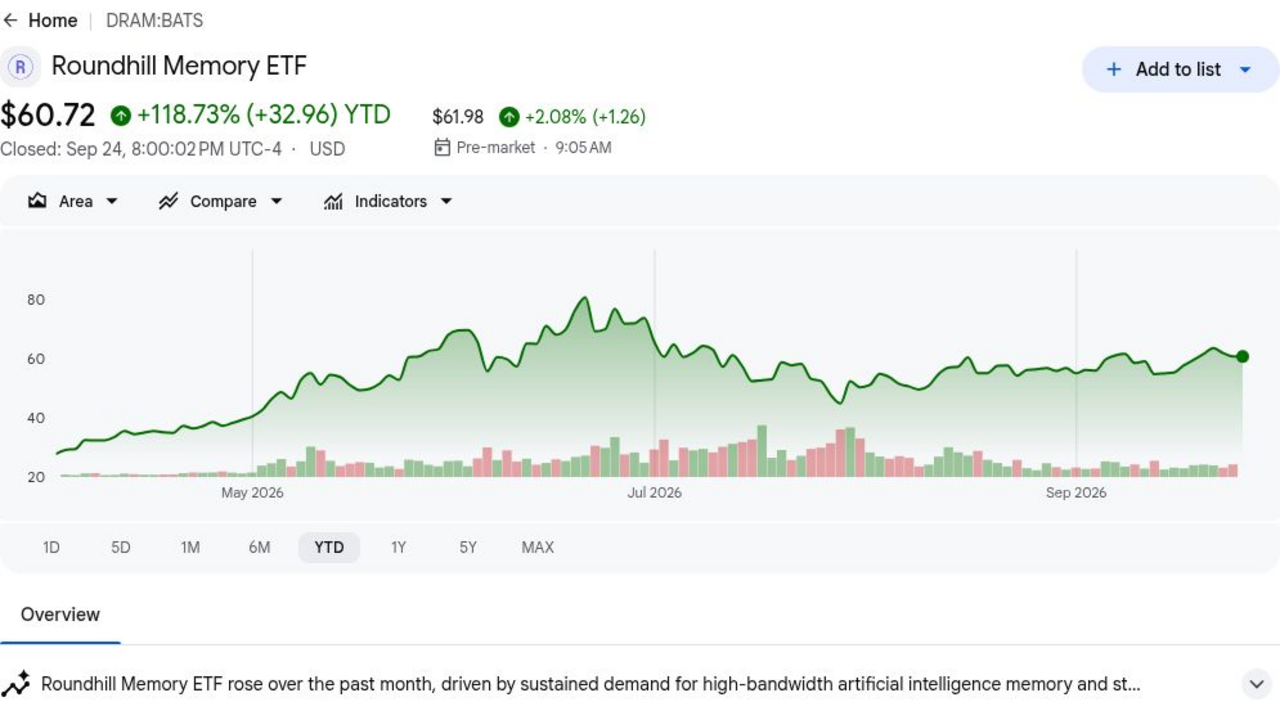
- $60.72 close left DRAM up 118.73% since launch: The fund more than doubled from its April 2 reference of $27.76, even after falling 1.91% on September 24. That performance shows powerful AI-memory momentum and raises the valuation sensitivity of the concentrated portfolio.
- More than $6 billion of AUM arrived within five weeks: Reuters reported that DRAM reached its first $1 billion after only 10 trading days. Rapid inflows improved liquidity and market visibility, but they also show how much thematic enthusiasm became embedded early.
- 0.65% is the fund's annual gross expense ratio: DRAM is actively managed and generally expects limited turnover outside quarterly rebalancing. The fee buys targeted global access and portfolio oversight, including companies that are harder for U.S. investors to reach directly.
- Three major memory producers anchor portfolio outcomes: Micron, Samsung and SK hynix were the dominant launch exposures, with SanDisk and Kioxia adding NAND and storage participation. This concentrated structure makes HBM and memory pricing more important than broad semiconductor-index performance.
- $26.14 to $81.60 is the observed trading range: The $55.46 spread is almost twice the launch price. A thematic ETF with limited history can move far faster than a diversified index when supply estimates, AI capital spending or regional risk changes.
What Is the Roundhill Memory ETF (DRAM)?
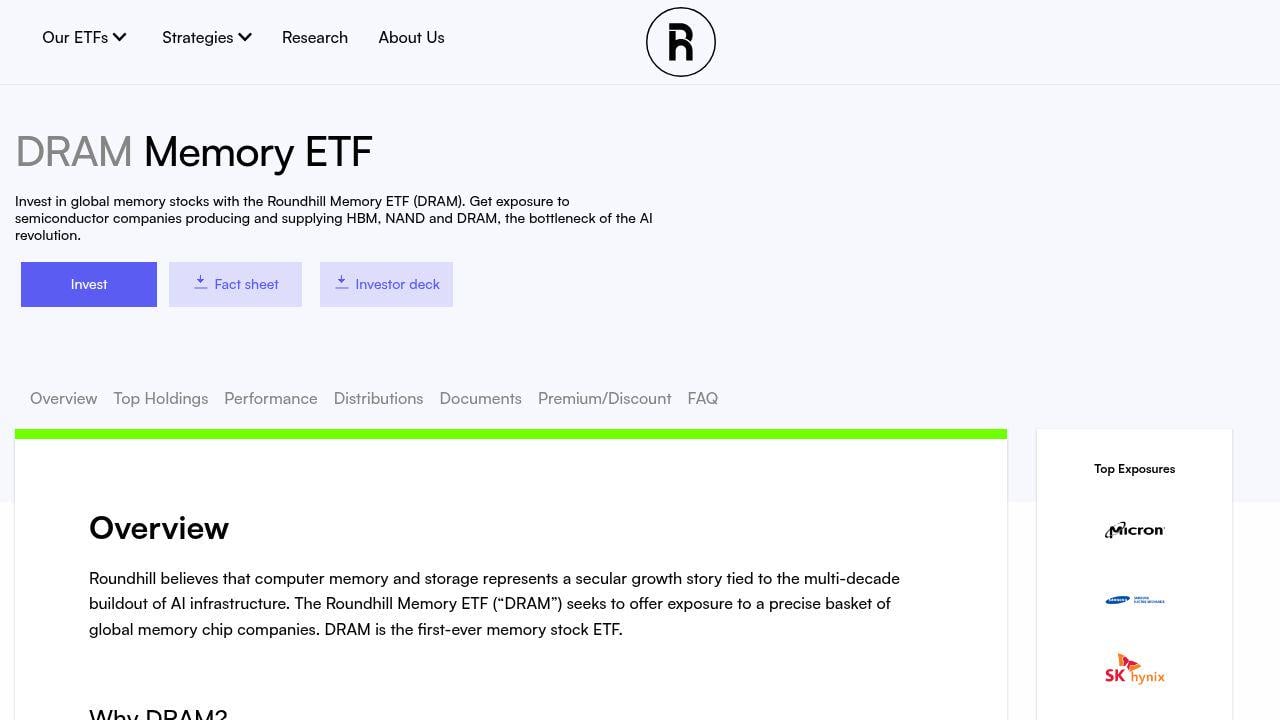
DRAM is the first U.S.-listed ETF designed specifically around global memory and storage companies. Eligible businesses generally derive at least half of revenue or profit from HBM, DRAM, NAND, NOR, SSD, HDD or specialty memory. Roundhill combines listed shares and total-return swaps to create access across U.S., South Korean, Japanese and other markets. Shares trade on Cboe BZX, options are available, and the fund charges a 0.65% annual gross expense ratio.
The long-term strategy is to capture memory's role as a physical bottleneck for AI training, inference and data-center expansion. Micron, Samsung Electronics and SK hynix supply leading-edge HBM and conventional DRAM, while SanDisk and Kioxia extend the basket into NAND flash. Roundhill may rebalance as product leadership, revenue exposure and investability change. The swap structure also helps the fund maintain regulated-investment-company diversification while accessing foreign issuers that do not have ordinary U.S. listings.
Read More: Top High-Bandwidth Memory (HBM) Stocks to Buy in the 2026 Memory Supercycle
DRAM ETF Top Holdings 2026: Samsung, SK hynix, Micron, Kioxia, and More
Roundhill Memory ETF (DRAM) is a concentrated memory-sector ETF focused on companies producing DRAM, NAND, HBM, and storage products. The fund holds just nine stocks, with Samsung Electronics, SK hynix, and Micron accounting for roughly 73% of the portfolio, making HBM pricing, AI-server demand, and the broader memory cycle the biggest drivers of performance.
Beyond the three largest positions, DRAM also holds Kioxia, Sandisk, Western Digital, Seagate, Nanya Technology, and Winbond Electronics. The fund is actively managed, with a 0.65% expense ratio, and its geographic exposure is also concentrated, with South Korean and U.S. companies making up most of the portfolio.
- Launch date: April 2, 2026
- Expense ratio: 0.65%
- Number of holdings: 9
- Management style: Active
- Main exposure: DRAM, NAND, HBM, and data storage
|
Company |
Ticker |
Country |
Weight |
Main Exposure |
|
Samsung Electronics |
5930 |
South Korea |
24.99% |
DRAM, NAND, HBM |
|
SK hynix |
660 |
South Korea |
24.22% |
HBM, DRAM, NAND |
|
Micron Technology |
MU |
United States |
23.83% |
HBM, DRAM, NAND |
|
Kioxia Holdings |
285A |
Japan |
4.87% |
NAND flash memory |
|
Sandisk |
SNDK |
United States |
4.66% |
NAND and flash storage |
|
Western Digital |
WDC |
United States |
4.64% |
Data storage |
|
Seagate Technology |
STX |
United States |
4.49% |
Hard drives and data storage |
|
Nanya Technology |
2408 |
Taiwan |
3.95% |
DRAM |
|
Winbond Electronics |
2344 |
Taiwan |
2.35% |
Specialty memory |
Roundhill Memory ETF (DRAM) 2026 Performance Overview: 118.73% Return and Strong AI Memory Demand
Roundhill Memory ETF (DRAM) launched on April 2 at a $27.76 reference price and closed at $60.72 on September 24, delivering a 118.73% return during the period. The ETF traded between a $26.14 low and an $81.60 high, reflecting strong demand but significant volatility. With a 0.65% expense ratio and active management structure, DRAM provides concentrated exposure to memory companies benefiting from AI infrastructure demand. Reuters reported that assets under management surpassed $6 billion after five weeks and reached $1 billion within the first 10 trading days, highlighting strong investor interest alongside elevated concentration risk.
|
Financial Metric |
Guidance / Consensus |
Reported / Actual |
Surprise |
|
Launch date |
— |
April 2, 2026 |
Established. First U.S.-listed memory-focused ETF. |
|
September 24 market price |
$61.90 prior close |
$60.72 |
Declined. Down $1.18, or 1.91%, for the session. |
|
Return since launch |
$27.76 launch reference |
1.1873 |
Expanded. More than doubled in under six months. |
|
52-week range |
— |
26.14–81.60 |
Volatile. Wide range reflects thematic concentration. |
|
Gross expense ratio |
— |
0.65% |
Disclosed. Annual fee supports active management. |
|
Management style |
— |
Active |
Flexible. Holdings are generally rebalanced quarterly. |
|
Five-week AUM milestone |
$1B after 10 sessions |
More than $6B |
Accelerated. Reuters called it the fastest-growing ETF launch. |
- 118.73% since launch shows extraordinary thematic momentum: DRAM moved from $27.76 to $60.72 in less than six months. The gain reflects both stronger earnings expectations for memory producers and the effect of concentrated fund inflows on a narrow investment theme.
- $6 billion after five weeks confirmed exceptional investor demand: The first $1 billion arrived within 10 trading days. Scale can improve spreads and liquidity, although rapid asset growth does not protect the portfolio when the underlying memory producers decline together.
- 0.65% is the annual cost of active memory exposure: The fund offers access across several countries and may use swaps for foreign issuers. The recurring fee must be weighed against the convenience of holding one U.S.-listed instrument instead of multiple overseas securities.
- $81.60 and $26.14 define a wide observed range: The high stood 34% above the September 24 close, while the low was 57% below it. That asymmetry shows why entry price and risk controls matter even when the long-term AI-memory thesis remains intact.
- Five named global producers dominate the economic thesis: Micron, Samsung, SK hynix, SanDisk and Kioxia connect DRAM to HBM, conventional DRAM and NAND. Even strong diversification by geography does not eliminate common exposure to the same pricing cycle. Their earnings revisions can therefore move the fund together.
Read More: Top AI Memory Stocks to Buy in 2026: DRAM, HBM, and AI Storage Demand Explained
Roundhill Memory ETF (DRAM) 2026 Investment Outlook: $75 Bull Case vs. $42 Bear Case
DRAM's 2026 outlook depends on whether AI-driven memory demand can keep HBM and advanced DRAM supply tight enough to support pricing and earnings across its largest holdings. The upside comes from sustained hyperscaler spending and stronger memory margins, while new capacity, weaker conventional memory pricing, and a broader semiconductor slowdown remain the main risks.
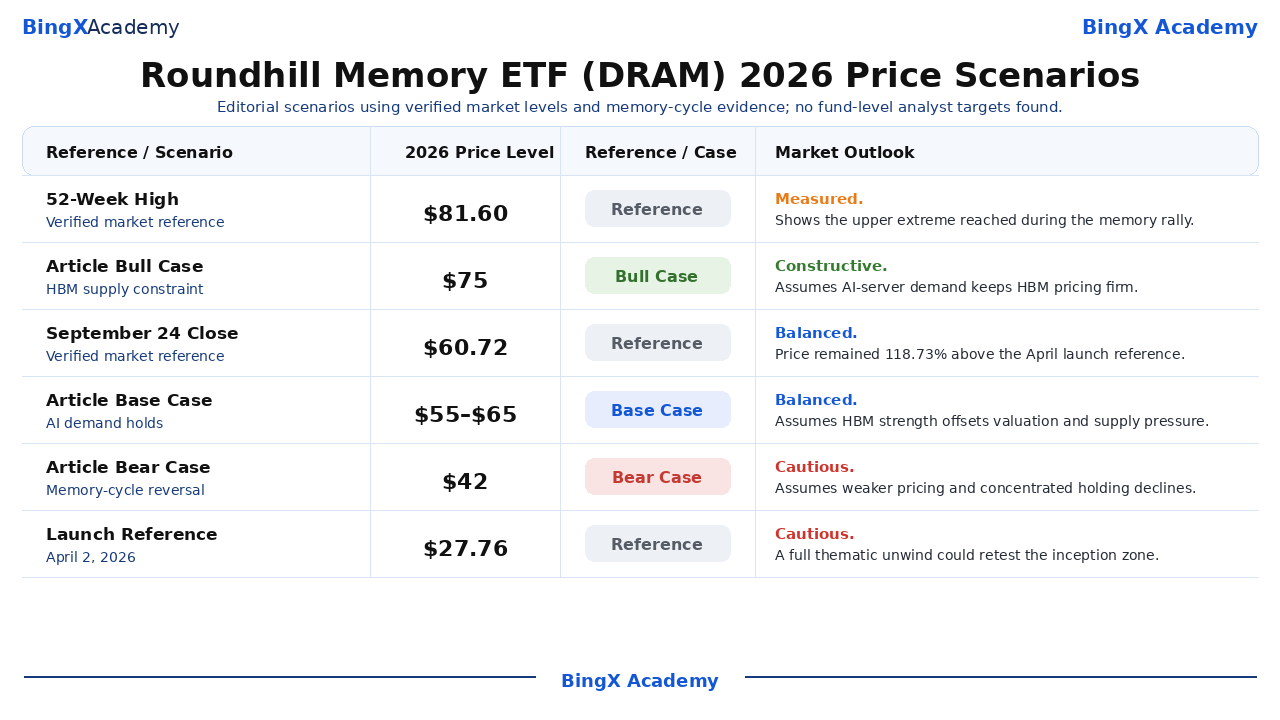
The Bull Case: HBM Constraints Push DRAM Toward $75
The Bull Case assumes AI-server deployments sustain demand for HBM and leading-edge DRAM, keeping utilization, pricing and margins high across the largest holdings. DRAM already reached an $81.60 high, so $75 represents a retest below the observed extreme rather than an unprecedented level.
A move toward $75 requires hyperscaler capital spending to remain firm and new capacity to trail demand through year-end. Earnings upgrades from Micron, Samsung or SK hynix would confirm the case, while falling HBM contract prices or delayed AI clusters would weaken it.
The Base Case: Strong AI Demand Keeps DRAM Between $55 and $65
The Base Case assumes HBM remains tight while conventional memory normalizes and investors digest the 118.73% post-launch return. Strength among the top producers is partly offset by profit taking, the 0.65% fee and concern that future supply additions reduce pricing power.
DRAM could trade mainly between $55 and $65 under this scenario. Stable portfolio weights, continued fund liquidity and memory-producer guidance would support the range. A sustained break below $55 would signal that the market is pricing a sharper cyclical slowdown.
The Bear Case: A Memory-Cycle Reversal Pulls DRAM Toward $42
The Bear Case assumes capacity growth catches demand, conventional DRAM or NAND prices weaken and AI capital spending expectations flatten. Because the portfolio is concentrated in producers exposed to the same cycle, declines can occur simultaneously rather than offset one another.
A move toward $42 becomes more likely if the largest holdings cut guidance or memory contract pricing rolls over. The level remains above the $27.76 launch reference, but would erase roughly 31% from the September 24 close and sharply compress the post-launch premium.
DRAM Stock Price Forecasts and Market Reference Levels for 2026
No verifiable named fund-level analyst price targets were available as of September 24. The table therefore separates observed prices from BingX Academy editorial scenarios based on portfolio concentration, memory-cycle evidence and the fund's limited trading history. None of these levels is a forecast issued by Roundhill or Wall Street.
|
Institution / Scenario |
2026 Price Target |
Rating / Case |
Market Outlook |
|
52-Week High |
$81.60 |
Market Reference |
Measured. Verified upper extreme reached during the 2026 memory rally. |
|
Article Bull Case |
$75 |
Bull Case |
Constructive. Assumes AI-server demand keeps HBM pricing and producer earnings firm. |
|
September 24 Close |
$60.72 |
Market Reference |
Balanced. Verified close remained 118.73% above the April launch reference. |
|
Article Base Case |
55–65 |
Base Case |
Balanced. Assumes HBM strength is partly offset by valuation and supply normalization. |
|
Article Bear Case |
$42 |
Bear Case |
Cautious. Assumes weaker memory pricing and concentrated holding declines compress the ETF. |
|
Launch Reference |
$27.76 |
Market Reference |
Cautious. A full thematic unwind could retest the April inception zone. |
How to Trade Roundhill Memory ETF (DRAM) on BingX
Trade DRAM's AI-memory, HBM-pricing and cyclical-supply outlook using BingX TradFi and BingX AI tools. Because the fund can move sharply with its concentrated holdings, traders should define both the catalyst and risk limits before entering a position.
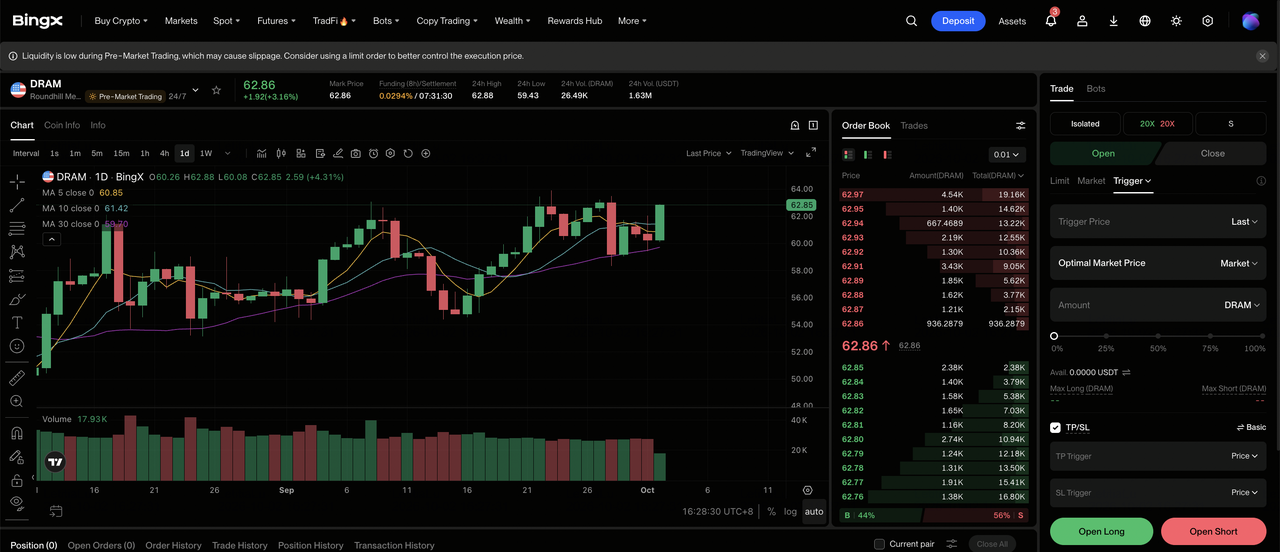
Step 1: Access BingX TradFi. Sign up and navigate to the specialized TradFi section on the BingX exchange dashboard.
Step 2: Select Roundhill Memory ETF (DRAM). Search for and select the DRAM-USDT perpetual futures contract.
Step 3: Choose your direction. Select Open Long if HBM pricing and AI spending remain firm. Select Open Short if supply growth or weaker demand pressures memory producers.
Step 4: Select leverage and margin mode. Choose Isolated or Cross-Margin based on your risk tolerance. The $26.14 to $81.60 range shows why conservative leverage and clear position sizing are important.
Step 5: Execute strict risk protocols. Set Take-Profit and Stop-Loss (TP/SL) levels before or immediately after entering the trade. DRAM can react quickly to memory pricing, producer guidance, AI spending and portfolio flows.
Top 5 Risks to Watch for DRAM Investors in 2026
DRAM concentrates exposure to one cyclical industry through a new fund structure. Each risk can affect several holdings simultaneously and increase price volatility.
- Memory pricing can reverse before demand visibly slows: Producers and customers manage inventories ahead of reported shipments. A change in contract prices can reduce earnings estimates across several holdings at once and pull the ETF lower rapidly.
- Issuer concentration limits diversification: A small group of memory producers drives most portfolio behavior. Even with exposure across countries, the holdings share demand, capacity and pricing cycles, so simultaneous portfolio losses are possible across the fund.
- South Korea exposure adds geopolitical and currency risk: Samsung and SK hynix connect DRAM to Korean markets and regional security conditions. Exchange-rate moves, trade restrictions or geopolitical tension can affect U.S.-dollar returns separately from operating performance.
- Total-return swaps add counterparty complexity: Roundhill uses derivatives to access certain exposures and manage diversification tests. Swaps introduce counterparty, liquidity and valuation risks that direct common-stock ownership does not create in exactly the same form.
- A new fund has limited stress history: DRAM launched in April and has traded between $26.14 and $81.60. The short record makes it harder to estimate behavior during a full memory downturn, prolonged outflows or severe market dislocation.
Final Thoughts: Should You Invest in DRAM in 2026?
DRAM offers concentrated exposure to the memory layer behind AI infrastructure, with major holdings tied to HBM, DRAM, NAND, and storage demand. Its 118.73% post-launch return, more than $6 billion of early AUM, and $81.60 high show how strongly investors embraced the theme, but the same momentum also increases sensitivity to any reversal in memory pricing or AI spending.
The Bull Case toward $75 depends on durable HBM demand, firm hyperscaler spending, and further earnings upgrades from major memory producers. The Bear Case toward $42 reflects weaker pricing and synchronized declines across a concentrated portfolio. Investors can track HBM contract prices, producer guidance, hyperscaler capex, fund flows, and the $55 lower end of the Base Case for signs of which scenario is developing.
Risk Reminder: Trading thematic ETFs and perpetual futures involves a risk of capital loss. Concentration, leverage, and memory-cycle volatility can produce rapid losses. Conduct independent research before allocating capital.
Related Reading
- Top High-Bandwidth Memory (HBM) Stocks to Buy in the 2026 Memory Supercycle
- Top AI Memory Stocks to Buy in 2026: DRAM, HBM, and AI Storage Demand Explained
- Top AI Server Stocks to Buy in 2026: Rack-Scale Systems, GPU Servers, and AI Servers Infrastructure
- iShares Semiconductor ETF (SOXX) Price Prediction 2026: Can AI Chip Demand Drive SOXX to $650?
- Micron Stock Price Prediction 2026: $1,500 AI Supercycle or Peak Margin Cyclical Trap?
- Samsung Stock Price Prediction 2026: ₩480,000 Street-High Memory Supercycle or Strike Crisis Trap?
- SK Hynix (SKHYNIX) Stock Price Prediction 2026: Can AI Memory Leader SKHYNIX Break $1,300?
