


Red Cat Holdings (RCAT) develops American-made drones and autonomous systems for defense, national security and public-safety customers. Teal Drones and FlightWave Aerospace supply tactical aircraft led by Black Widow and Edge 130, while Blue Ops extends the platform into uncrewed surface vessels. This all-domain strategy widens the addressable market, but leaves RCAT sensitive to government award timing, manufacturing execution and operating losses.
RCAT Q2 showed rapid growth from a small base with profitability still unsettled. Revenue reached $20.19 million, up 527% year over year but $2.39 million below consensus, while gross margin improved to 16.1% from 11.6%. Management reaffirmed $150 million to $180 million of 2026 revenue, meaning the second-half shipment ramp must be much larger than the first.
The RCAT stock forecast for 2026 now centers on two competing views:
- The program conversion and production-scale case: Black Widow deliveries, allied demand and maritime awards convert the backlog into shipments while higher factory utilization moves gross margin toward the 25% to 30% range.
- The award-delay and financing case: procurement decisions shift right, production costs remain high and operating losses consume cash before annual revenue reaches the $150 million to $180 million target.
This guide breaks down the RCAT stock forecast, 2026 price scenarios, key risks and analyst outlooks, drawing on Red Cat's August 6, 2026 Q2 release, quarterly filing and market data through September 24.
Top 5 Things for Red Cat Investors to Know in September 2026
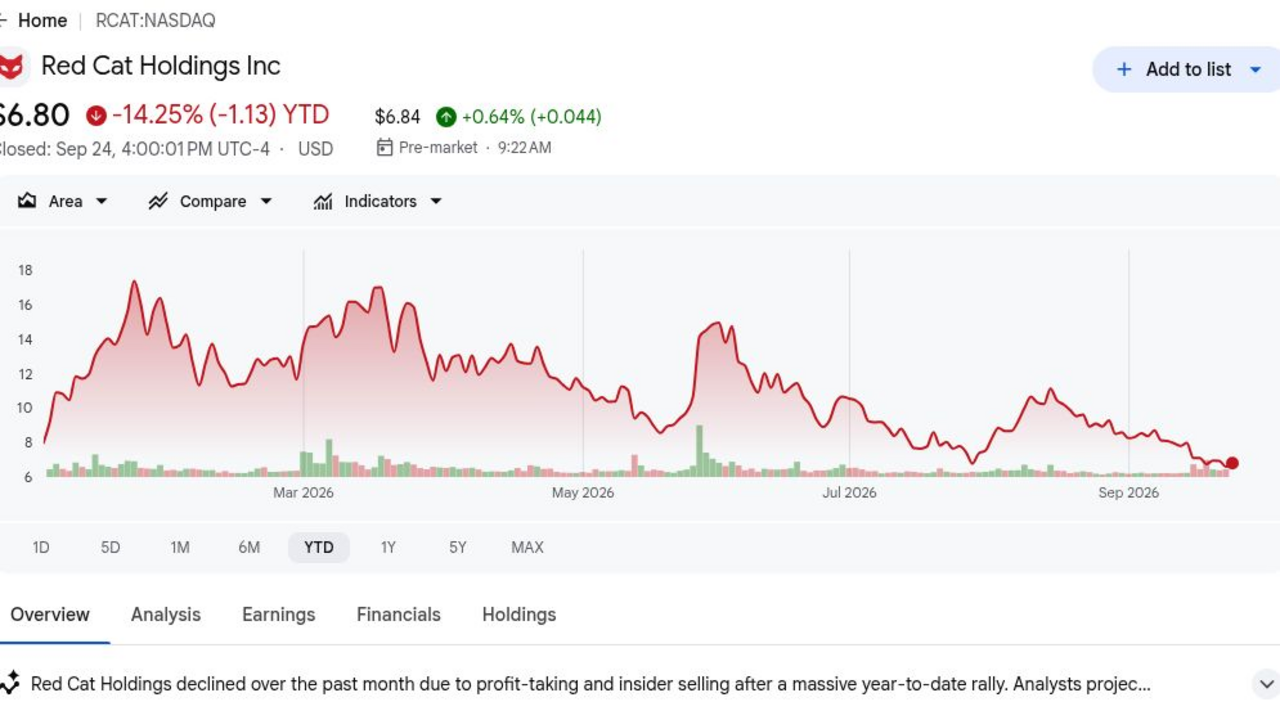
- $6.80 close left RCAT down 14.25% YTD: The September 24 reference price sat 64% below the $18.78 52-week high. The drawdown shows that investors have discounted slower award conversion even though the $16.50 consensus target remained more than twice the close.
- $20.19 million of Q2 revenue increased 527%: Sales rose from $3.2 million a year earlier, but missed the $22.58 million consensus by $2.39 million. The combination confirms strong scaling and shows why shipment timing still matters to quarterly results.
- 16.1% gross margin improved by 4.5 percentage points: Gross profit reached $3.3 million versus $0.4 million a year earlier, and margin rose from 12.7% in Q1. Better overhead absorption supports the model, though the level remains below mature defense suppliers.
- $150 million to $180 million of annual revenue remains the target: Consensus stood near $155.05 million, inside management's range. Reaching even the low end requires a steep second-half ramp, making Black Widow production and maritime shipments the central execution test.
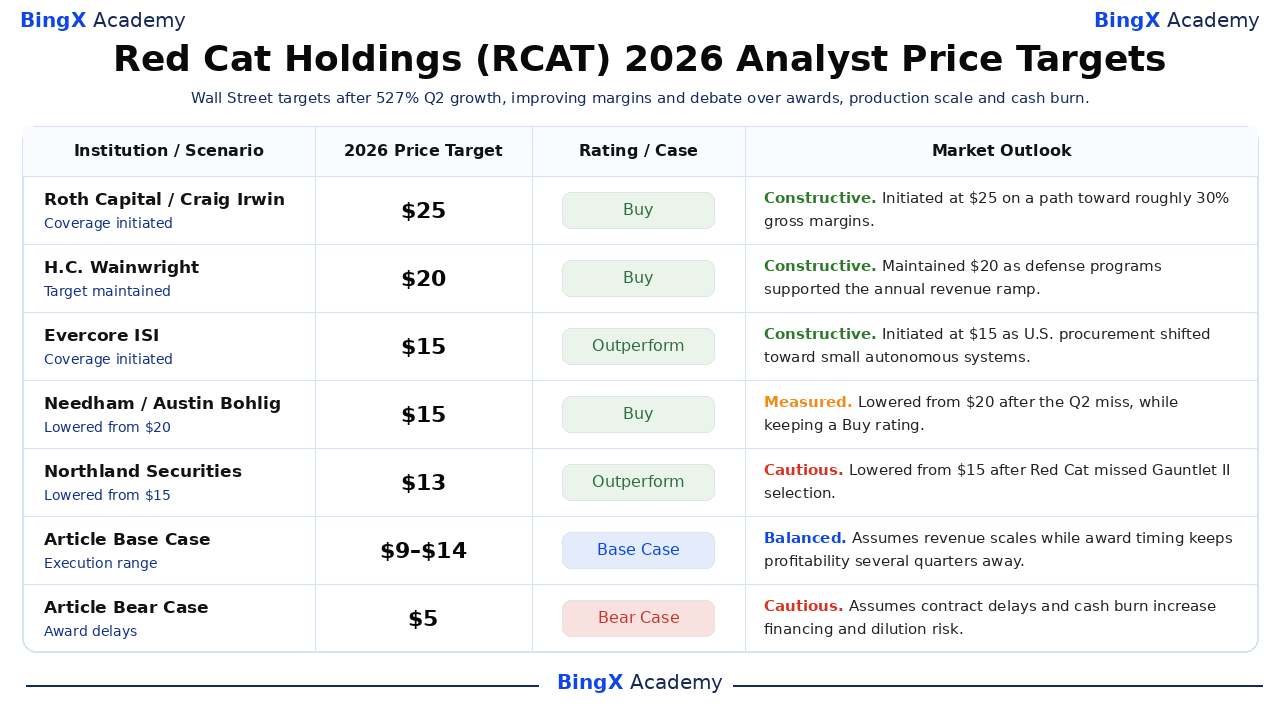
- $25 to $9 analyst targets show unusually wide disagreement: Roth Capital's $25 target assumes a path toward 30% gross margins, while Piper Sandler's $9 target waits for more validated awards. The $16 gap captures how procurement outcomes can change both estimates and valuation quickly.
What Is Red Cat Holdings (RCAT)?
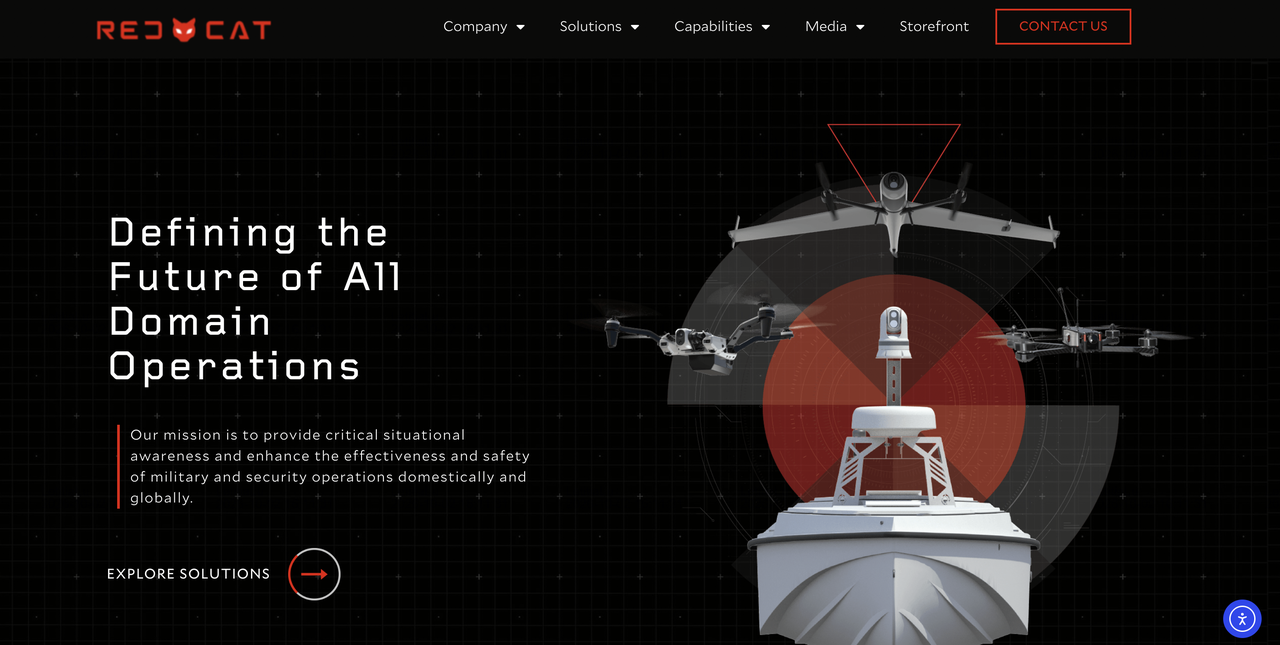
Red Cat is a U.S.-based defense technology company focused on small unmanned aircraft and autonomous robotic systems. Teal Drones manufactures Black Widow and Teal 2 quadcopters, FlightWave Aerospace adds the long-endurance Edge 130 VTOL platform, and the FANG line addresses first-person-view missions. Revenue comes primarily from hardware, software, accessories and government program deliveries. The customer base includes U.S. military branches, federal agencies, public-safety organizations and allied defense buyers.
The long-term plan is to build a connected Family of Systems across air, land and sea rather than rely on one aircraft. Black Widow anchors the U.S. Army Short Range Reconnaissance program, while Edge 130 broadens endurance and payload choices. Blue Ops and its Havoc partnership extend collaborative autonomy into uncrewed surface vessels. Red Cat is also expanding domestic production, integrating acquisitions and pursuing in-country manufacturing relationships for international customers, which can increase addressable demand if programs convert into funded orders.
Read More: Top Defense Stocks to Buy in 2026: Primes, Missiles, Drones, Space, and AI-Enabled Warfare
Red Cat Holdings (RCAT) Q2 2026 Earnings Overview: Revenue Growth and Margin Improvement Highlight Execution Challenge
Red Cat reported $20.19 million of revenue versus $22.58 million expected, a GAAP loss of $0.26 per share versus a $0.17 loss consensus, and $3.3 million of gross profit. Revenue increased 527%, gross margin reached 16.1% from 11.6% a year earlier and cash plus marketable securities totaled $131.9 million. Management reaffirmed $150 million to $180 million of 2026 revenue, leaving execution concentrated in the second half.
|
Financial Metric |
Guidance / Consensus |
Reported / Actual |
Surprise |
|
Q2 2026 revenue |
$22.58M consensus |
$20.19M |
Missed. $2.39M below consensus; up 527% YoY. |
|
Q2 GAAP diluted EPS |
-$0.17 consensus |
-$0.26 |
Missed. Loss was $0.09 wider than consensus. |
|
Q2 gross profit |
$0.4M a year earlier |
$3.3M |
Improved. Increased by $2.9M as volume scaled. |
|
Q2 gross margin |
11.6% a year earlier; 12.7% in Q1 |
16.10% |
Expanded. Up 4.5 points YoY and 3.4 points sequentially. |
|
Q2 operating loss |
— |
-$27.3M |
Pressured. Loss remained larger than quarterly revenue. |
|
Cash and marketable securities |
— |
$131.9M |
Funded. Balance supports production and integration spending. |
|
FY2026 revenue target |
$155.05M consensus |
150M–180M |
Reaffirmed. Low end remained close to consensus. |
- $20.19 million of revenue grew 527% but missed by $2.39 million: Sales increased from $3.2 million a year earlier as defense deliveries expanded. The miss shows that growth alone does not remove timing risk because a few acceptance or shipment dates can shift quarterly revenue.
- $0.26 GAAP loss per share was $0.09 wider than consensus: The operating loss reached $27.3 million, exceeding reported quarterly revenue. Red Cat therefore needs more than sales growth, since factory utilization and operating expense must improve together before scale creates per-share earnings.
- $3.3 million of gross profit increased by $2.9 million: Gross margin rose to 16.1% from 11.6% a year earlier and 12.7% in Q1. Sequential progress supports management's manufacturing thesis, though another nine to fourteen points are needed to approach the 25% to 30% long-term range.
- $131.9 million of liquidity provides production runway: Cash and marketable securities reduce immediate financing pressure as Red Cat integrates FlightWave and expands capacity. The balance matters because the company must fund inventory and labor before large government deliveries translate into customer cash.
- $150 million to $180 million of annual revenue was reaffirmed: The low end sits near the $155.05 million consensus, but first-half results leave most sales for later quarters. Investors need evidence that contracted programs are moving through production rather than remaining long-duration pipeline opportunities.
Red Cat Holdings (RCAT) 2026 Investment Outlook: $18 Bull Case vs. $5 Bear Case
Red Cat's 2026 outlook depends on whether rapid revenue growth can translate into consistent drone deliveries, stronger margins, and lower operating losses. The upside comes from program conversion and expanding defense demand, while award timing, manufacturing execution, and cash usage remain the main risks.
The Bull Case: Drone Program Growth Pushes RCAT Toward $18
The Bull Case assumes Black Widow production, international small-drone demand, and maritime programs create a stronger shipment cadence. Q2 revenue increased 527% and gross margin reached 16.1%, showing that higher volume can improve manufacturing efficiency from a low base.
A move toward $18 would require annual revenue near the $180 million high end, gross margin approaching 25%, and funded awards extending into 2027. Operating losses would also need to narrow from $27.3 million so higher sales translate into stronger per-share economics.
The Base Case: Steady Deliveries Keep RCAT Between $9 and $14
The Base Case assumes revenue grows rapidly as Black Widow and Edge 130 deliveries expand, though customer acceptance schedules remain uneven. Gross margin improves above 20%, but manufacturing investment and Blue Ops development keep the company unprofitable through the remainder of the year.
RCAT could trade mainly between $9 and $14 if revenue reaches the $150 million low end and cash remains above $100 million. Consistent quarterly deliveries would support the range, while missed awards or margins below 15% would weaken it.
The Bear Case: Slower Orders Pull RCAT Toward $5
The Bear Case assumes procurement decisions move into 2027 and manufacturing capacity runs below expectations. With a $27.3 million quarterly operating loss, lower production volume would reduce overhead absorption and make the 16.1% gross-margin improvement harder to maintain.
A move toward $5 would become more likely if annual revenue falls below $150 million, gross margin returns toward 12%, or cash declines rapidly from $131.9 million. Additional equity financing would reduce the per-share value of future program growth.
RCAT Stock Price Forecasts for 2026 By Wall Street Analysts
Six dated actions produce a $9 to $25 target range, reflecting divergent views on program conversion and manufacturing scale. These are third-party reference points rather than price promises. The final Base and Bear rows are BingX Academy editorial scenarios and remain separate from Wall Street research.
|
Institution / Scenario |
2026 Price Target |
Rating / Case |
Market Outlook |
|
Roth Capital |
$25 |
Buy |
Constructive. June 1: initiated on a path toward roughly 30% gross margins as volume scales. |
|
H.C. Wainwright |
$20 |
Buy |
Constructive. August 7: maintained the target as defense programs supported the revenue ramp. |
|
Evercore ISI |
$15 |
Outperform |
Constructive. August 31: initiated as U.S. procurement shifted toward small autonomous systems. |
|
Needham |
$15 |
Buy |
Measured. August 7: lowered from $20 after the Q2 miss while retaining a Buy rating. |
|
Northland Securities |
$13 |
Outperform |
Cautious. September 17: lowered from $15 after Red Cat missed Gauntlet II selection. |
|
Piper Sandler |
$9 |
Neutral |
Cautious. September 2: initiated pending more validated military and government awards. |
|
Article Base Case |
9–14 |
Base Case |
Balanced. Assumes revenue scales while award timing keeps profitability several quarters away. |
|
Article Bear Case |
$5 |
Bear Case |
Cautious. Assumes contract delays and cash burn increase financing and dilution risk. |
Top 5 Risks to Watch for Red Cat Investors in 2026
Red Cat's valuation depends on turning defense opportunities into profitable deliveries. Each risk below can reduce revenue visibility, cash runway or the per-share value assigned to future programs.
- Award timing can move revenue between years: Government procurement includes testing, protests, budgets and acceptance milestones. A delayed program can move a large portion of the $150 million to $180 million target into 2027 without eliminating the underlying demand.
- Manufacturing scale may not produce enough margin: Gross margin improved to 16.1%, but the business still reported a $27.3 million operating loss. Component costs, rework or low utilization could prevent volume from translating into profitability.
- Customer concentration increases outcome volatility: U.S. defense programs can account for large individual orders. Losing Gauntlet II already caused Northland to lower its target to $13, showing how one decision can reduce estimates across multiple years.
- Cash burn can lead to dilution: The $131.9 million liquidity balance provides runway, yet inventory, capacity and acquisitions consume capital before delivery. If losses remain near Q2 levels, future equity issuance could reduce value per share.
- Competition can pressure pricing and win rates: AeroVironment, private drone suppliers and emerging autonomous-system companies compete for the same budgets. Red Cat must prove reliability, domestic supply and integrated software advantages to defend both awards and margins.
Final Thoughts: Should You Invest in Red Cat in 2026?
Red Cat has moved beyond a minimal-revenue development story. Q2 sales reached $20.19 million, growth hit 527% and gross margin improved to 16.1%. The central investment question is whether funded programs can support the much larger second-half ramp needed for the $150 million to $180 million annual target.
The Bull Case toward $18 requires program conversion, margin expansion and narrower losses. The Bear Case toward $5 reflects award delays and dilution risk. Conservative traders may monitor accepted deliveries, gross margin, operating cash use and year-end liquidity together, rather than treating contract announcements alone as proof of durable earnings.
Risk Reminder: Trading and investing in equities like RCAT involves a risk of capital loss. Small defense companies, government contracts and leveraged products can produce rapid price changes. Conduct independent research before allocating capital.
Related Reading
- Top Defense Stocks to Buy in 2026: Primes, Missiles, Drones, Space, and AI-Enabled Warfare
- Top Space Stocks to Buy Ahead of SpaceX IPO
- Rocket Lab (RKLB) Price Prediction 2026: Can New Rocket and Defense Growth Push RKLB Toward $150?
- AST SpaceMobile (ASTS) Price Prediction 2026: Can BlueBird Deployment Push ASTS Toward $120?
- Planet Labs (PL) Price Prediction 2026: Can Defense Demand Push PL Toward $35?
- Lockheed Martin (LMT) Price Prediction 2026: Can Record Backlog Push LMT Toward $700?
