
In early July 2026, global athletic giant NIKE, Inc. (NYSE: NKE) stands at a critical structural crossroads. Long dominant as the undisputed leader in athletic footwear and apparel, the company is attempting an exhaustive "Win Now" operational turnaround to fend off relentless market share erosion from nimble upstart brands like On Holding and Hoka, alongside a surging Adidas.
Following its highly anticipated Fiscal Q4 2026 earnings release on June 30, Nike's shares dropped roughly 2.5% to 3.5% in extended trading, drifting toward $39.58 – $40.04. The stock closed the regular session at $41.05, hovering near an 11-year low. This places the retail heavyweight down roughly 35% year-to-date and over 75% below its 2021 all-time highs.
Investors are parsing a complex financial narrative. While Nike technically beat Wall Street's heavily compressed top and bottom-line estimates for the quarter ending May 31, 2026, the quality of the earnings beat remains a major point of contention. A massive, one-time regulatory windfall heavily masked underlying operational cooling, fueling a fierce valuation debate across Wall Street.
This comprehensive guide dissects the Nike stock forecast and price prediction for the remainder of 2026, combining regulatory disclosures with fresh consensus models from J.P. Morgan, Deutsche Bank, Oppenheimer, and KeyBanc.
You can trade Nike stock perpetual futures on BingX TradFi using flexible USDT collateral.
Top 5 Things for Nike (NKE) Traders to Know in 2026
As Nike executes its multi-quarter Sport Offense strategy across global retail networks, market participants must closely track these structural drivers:
- The $986 Million Tariff Windfall: Nike’s Q4 net income was heavily buoyed by an expected $986 million tariff refund after the Supreme Court struck down global emergency duties. This single item contributed $0.52 to the reported $0.72 quarterly EPS, heavily distorting true operational profitability.
- The 12% Greater China Slump: Revenue in Greater China plummeted 12% year-over-year to $1.30 billion. Although this marginally beat worst-case analyst expectations of $1.24 billion, escalating local nationalistic sentiment and macroeconomic cooling in Asia remain Nike's largest top-line headwinds.
- High-Profile C-Suite Transition: Longtime Chief Financial Officer Matthew Friend will officially step down on August 17, 2026. He will be replaced by David Denton, the former CFO of Pfizer and Lowe's. This leadership transition introduces immediate execution risks ahead of Nike's pivotal Fall 2026 Investor Day.
- Resilient Wholesale Stabilization: In a sharp pivot from former CEO John Donahoe’s direct-to-consumer (DTC) strategy, Nike's sales to wholesale retail partners rose 4% in Q4. This structural shift highlights that repairing traditional brick-and-mortar relationships is gaining real traction.
- Aggressive Insider Buying: Corporate insiders are actively stepping in to defend the valuation floor. In mid-2026, CEO Elliott Hill bought 23,660 shares for approximately $1 million, while Apple CEO and Nike Board Member Tim Cook purchased 25,000 shares for just over $1 million, signaling deep internal confidence.
What Is NIKE, Inc. (NKE)?
Founded in 1964 by Bill Bowerman and Phil Knight, NIKE, Inc. is the world's largest designer, marketer, and distributor of athletic footwear, apparel, equipment, and services. Headquartered in Beaverton, Oregon, the multinational giant operates via a massive global matrix segmented into North America, EMEA (Europe, Middle East, and Africa), Greater China, and APLA (Asia Pacific and Latin America), alongside its auxiliary Converse lifestyle brand.
Unlike asset-light digital platforms, Nike relies on an intricate global supply chain and multi-channel distribution network. Its corporate moat has historically been anchored by premium product innovation, such as Nike Air and Flyknit, and multi-billion-dollar athletic endorsements. In 2026, under the leadership of veteran insider Elliott Hill, the firm is aggressively realigning its operations away from generic lifestyle apparel and back toward high-performance running, basketball, and field sports.
Nike Stock's Performance in Mid-2026: Headwinds vs. Windfalls
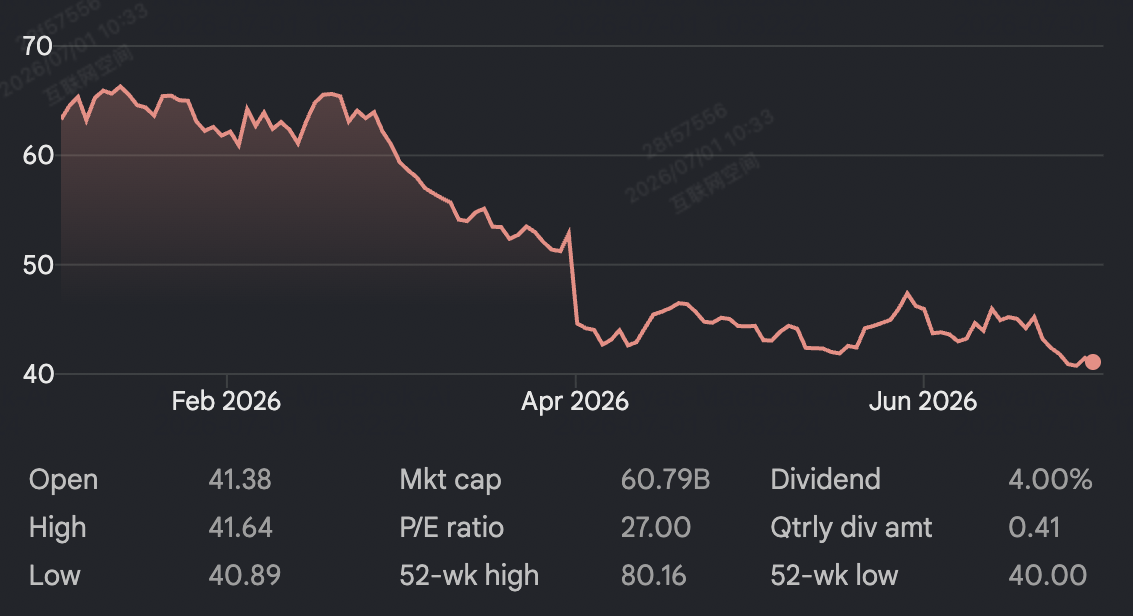
Nike stock performance YTD as of July 2026 | Source: Google Finance
Nike’s Fiscal Q4 2026 financial report showcased a stark divergence between headline numbers and core organic demand. Total quarterly revenue slipped 1% year-over-year to $10.97 billion, though it edged past Wall Street's consensus model of $10.86 billion. For the full fiscal year 2026, revenue flatlined at $46.40 billion, proving that top-line expansion has entirely stalled.
Structurally, Nike's gross margin surged by 8.9 percentage points to an impressive 49.2% in Q4. However, analysts are quick to note that this expansion was almost entirely driven by the $986 million Supreme Court tariff clawback.
Nike Inc. FY2026 Financial Overview
|
Financial Metric |
FY2025 Performance |
FY2026 Performance |
Year-over-Year Change |
|
Total Revenue |
$51.40 Billion |
$46.40 Billion |
-9.73% |
|
GAAP Net Income |
$5.70 Billion |
$3.11 Billion |
-45.43% |
|
Reported Q4 EPS |
$0.14 |
$0.72 |
4.1428 |
|
Adjusted Q4 EPS (Ex-Tariff) |
$0.14 |
$0.20 |
0.4285 |
|
Full Year Gross Margin |
44.60% |
42.90% |
-170 bps |
Excluding the $0.52 non-recurring tariff benefit, Nike’s adjusted organic EPS landed at $0.20. While this easily cleared the basement-level consensus target of $0.13, it highlights a business operating under severe margin pressure. Cautious global discretionary spending and persistent double-digit declines in Nike Sportswear and Jordan streetwear continue to trigger heavy promotional discounting to clear out stale digital inventory.
Nike 2026 Trading Strategy: Managing the Value Trap Risk
Successfully trading NKE shares during this restructuring phase requires market participants to bypass historical brand sentiment and map out exact fundamental and technical price parameters:
The $39.00 – $40.00 Technical Floor
Technical analysts view the $40.00 psychological horizontal zone as an absolute line in the sand. This area represents an 11-year low for the stock. If NKE manages to absorb the immediate post-earnings volume and holds weekly closes above $40.00, it confirms a deep institutional accumulation phase. A structural break below $39.00 would trigger a severe technical liquidation event.
'Flattish' Guidance Caps Immediate Upside
The primary ceiling on near-term long positions is management’s explicit forward guidance. CFO Matt Friend confirmed that Nike expects revenue and earnings to remain flattish through the first half of Fiscal 2027 (the remainder of calendar year 2026). Because a rapid operational inflection is off the table, the stock is highly likely to experience range-bound, sideways price action, making upside breakout strategies prone to false starts.
TradFi Macro Multiples
Trading Nike in 2026 means tracking global macroeconomic liquidity. With mainstream capital heavily concentrated in technology and AI infrastructure, consumer non-durables are trading at compressed multiples. At a current P/E of around 27.3x, Nike is historically cheap but still carries a premium relative to the broader apparel sector. Traders must monitor inventory health; any re-acceleration of role reductions beyond the 1,400 layoffs executed in April will signal further internal stress.
Nike Stock Forecast 2026: $55.00 Turnaround Target vs. $30.00 Bear Floor
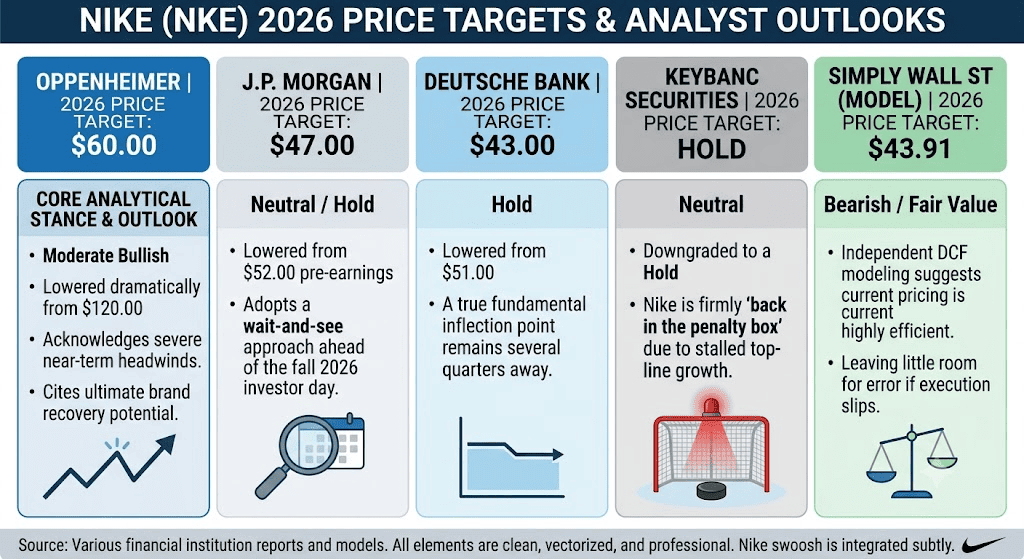
Nike stock price predictions for 2026 by Wall Street analysts
Wall Street institutions are deeply divided regarding Nike's turnaround velocity, splitting the stock into three distinct price projection pathways for the remainder of 2026:
The Bull Case for NKE Stock: $55.00 – $60.00 Recovery on Wholesale Rebound
Bulls argue that Nike’s massive structural moat remains completely intact. Under this framework, the Sport Offense initiative successfully scales next-generation running and basketball product lines into wholesale channels by Q4 2026, reclaiming market share from upstarts.
Simultaneously, the commercial tailwinds from the North American World Cup, where Nike's digital sell-through rates reached a commanding 28%, significantly outperforming Adidas at 7%, are projected to re-ignite brand equity. If gross margins structurally stabilize near 43% without accounting gimmicks, patient institutional capital is expected to re-rate NKE toward its median target of $55.00 to $60.00.
Nike's Base Case: $45.00 – $50.00 Consensus Plateau
Supported by cautious adjustments from J.P. Morgan ($47.00 target) and Deutsche Bank ($43.00 target), the base case projects a highly volatile, range-bound consolidation phase. In this scenario, Nike successfully transitions its financial leadership to incoming CFO David Denton without operational friction, while North American footwear expansion (+3% in Q4) offsets ongoing weakness in lifestyle and apparel.
However, upside momentum faces a firm fundamental ceiling. The market will continue to apply a strict turnaround risk discount due to the protracted 12% sales drop in Greater China and flat multi-quarter revenue projections. This leaves NKE confined to a realistic trading band of $45.00 to $50.00.
The Bear Case for Nike Stock: $30.00 – $35.00 Value Trap Breakdown
The bearish narrative, echoed by Oppenheimer’s aggressive pre-earnings price target cut down to $60.00 and quantitative value models, focuses on deep structural decay. If consumer discretionary spending faces an extended global macro pullback driven by prolonged inflation, Nike's core sportswear segments will deteriorate further.
Furthermore, if hyper-aggressive challenger brands continue to erode market share across North America and Europe while Chinese digital sales fail to stabilize, standard earnings multiples will compress. A failure to fund Nike's current 4.0% dividend entirely out of organic, non-tariff operating cash flows would expose the stock to a steep capitulation selloff down toward the $30.00 to $35.00 range.
Nike (NKE) Price Predictions for 2026 by Wall Street Analysts
|
Covering Institution |
2026 Price Target |
Core Analytical Stance & Outlook |
|
Oppenheimer |
$60.00 |
Moderate Bullish: Lowered dramatically from $120.00; acknowledges severe near-term headwinds but cites ultimate brand recovery potential. |
|
J.P. Morgan |
$47.00 |
Neutral / Hold: Lowered from $52.00 pre-earnings; adopts a wait-and-see approach ahead of the fall 2026 investor day. |
|
Deutsche Bank |
$43.00 |
Hold: Lowered from $51.00; notes that a true fundamental inflection point remains several quarters away. |
|
KeyBanc Securities |
Hold |
Neutral: Downgraded to a Hold; states that Nike is firmly "back in the penalty box" due to stalled top-line growth. |
|
Simply Wall St (Model) |
$43.91 |
Bearish / Fair Value: Independent DCF modeling suggests current pricing is highly efficient, leaving little room for error if execution slips. |
How to Trade Nike (NKE) Stock Futures on BingX TradFi
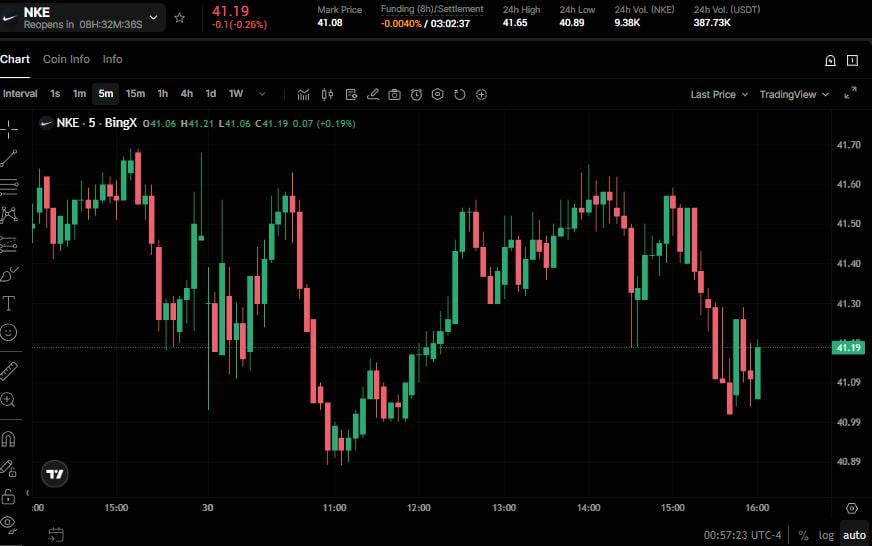
NKE/US perpetual contract on BingX TradFi market
Using the advanced BingX TradFi infrastructure, market participants can seamlessly gain exposure to legacy equities without leaving the digital asset ecosystem.
- Access the BingX TradFi Portal: Log into your verified BingX account and navigate to the TradFi terminal on the main trading dashboard.
- Locate the Asset: Use the search bar to locate the NKE/USDT perpetual contract.
- Select Margin and Leverage: Choose your preferred risk framework. Utilize Isolated Margin to strictly contain individual position risk, or Cross Margin to utilize your broader USDT pool liquidity. Set a highly disciplined leverage multiplier.
- Establish Position Direction: Select Open Long if you anticipate that insider buying, structural wholesale recoveries, and World Cup sales will spark a major turnaround toward Wall Street's $55.00 median target; select Open Short if you expect Greater China weakness, leadership transitions, and soft retail spending to break the $39.00 support.
- Deploy Strict Risk Protocols: Input your exact execution price, define your absolute position sizing, and immediately activate mandatory Take-Profit / Stop-Loss (TP/SL) coordinates to safeguard your capital against sudden intra-day market gaps.
Top 5 Risks to Consider Before Trading Nike Stock
Before committing trading capital to Nike equity, market participants must thoroughly evaluate these specialized risk vectors:
- Structural Turnaround Inertia: Corporate turnarounds for global retail giants are notoriously slow. Re-engineering product pipelines, correcting retail distribution mistakes, and restoring brand equity can easily take 18 to 24 months, leaving capital exposed to dead money risk.
- Intense Competitive Disruption: Nike is no longer competing in a duopoly. The permanent structural rise of specialized brands like On Holding, Deckers (Hoka), and a resurgent Adidas represents a secular shift in consumer preference that premium marketing may not easily fix.
- Geopolitical and Trade Policy Vulnerability: As an international brand reliant on global manufacturing, Nike remains hyper-exposed to shifting trade policies and tariffs. While the recent Supreme Court decision provided a temporary cash cushion, any renewed trade friction will instantly squeeze margins.
- Dividend Coverage Pressures: Although the current 4% dividend yield is highly attractive to income investors, earnings power has degraded to the point where funding capital returns out of standard operating cash flow is becoming increasingly tight, flashing a long-term safety warning.
- Macroeconomic Discretionary Risk: High global energy costs and sticky inflation continue to erode middle-class consumer savings. Premium athletic gear is inherently discretionary; if broader retail traffic trends downward, Nike's recovery timeline will immediately stretch.
Final Thoughts: Is Nike (NKE) a Good Stock to Buy in 2026?
NIKE, Inc. represents a classic, highly polarizing value-turnaround play. The corporate entity is explicitly no longer a premium-growth vehicle; it is an asset-backed titan attempting to clean up massive marketplace execution errors under a newly deployed legacy leadership team. The firm's deep institutional moat, unparalleled global distribution capabilities, and aggressive insider buying confirm that the long-term structural foundations are far from broken.
However, trading an equity navigating a prolonged top-line flatline requires intense patience and strict risk management. For short-term tactical traders, Nike's 11-year lows provide an exceptionally clean technical structure to trade against, utilizing tight stop-losses directly below the $39.00 support floor. Conversely, macro investors must manage position sizes defensively, waiting for definitive proof of organic revenue acceleration in North America and structural stabilization in Greater China before over-allocating capital.
Risk Reminder: Turnaround equities feature elevated execution and structural risks. Enforce disciplined position sizing, keep trailing stop-losses active, and perform comprehensive independent due diligence.
Related Reading
- Apple (AAPL) Stock Outlook for 2026: MacBook Neo Growth or AI Valuation Trap?
- HIVE Digital (HIVE) Price Prediction 2026: $10.00 Sovereign AI Moonshot or $148M Debt Trap?
- Pfizer Stock Price Prediction 2026: High-Yield Value Opportunity or Structural Value Trap?
- AMC Stock Price Prediction 2026: Fundamental Turnaround or Massive Dilution Trap?
- Ford Stock Price Prediction 2026: $20 Data Center Battery Boom or Legacy Recall Trap?
