

Merck & Co. Inc. (MRK) is one of the world’s largest pharmaceutical companies, with major businesses in oncology, vaccines, infectious disease, cardiometabolic medicine and animal health. KEYTRUDA, an immunotherapy that helps the immune system recognize and attack cancer cells, remains the company’s most important product and the foundation of its oncology franchise. Newer medicines, formulations and acquired pipeline assets are becoming more important as Merck prepares for KEYTRUDA’s expected 2028 patent expiration. This gives Merck a large and profitable commercial base, but also makes pipeline execution and diversification central to the long-term investment case.
The growth story increasingly depends on what comes after KEYTRUDA. In August 2026, Merck and Moderna reported positive Phase 3 melanoma results for intismeran plus KEYTRUDA, adding another potential extension to the oncology franchise. The result followed Q2 revenue of $16.6 billion, KEYTRUDA family sales of $8.4 billion and higher full-year revenue guidance. For investors, the key question is whether new oncology combinations, acquisitions and other pipeline programs can scale quickly enough to offset future KEYTRUDA patent pressure and support growth beyond the current franchise.
The MRK stock forecast for 2026 now centers on two competing views:
- The diversification case: Bulls expect the deep oncology and cardiometabolic pipeline, new launches such as the oral PCSK9 inhibitor and WINREVAIR, animal health strength, and the intismeran melanoma win to build a growth base beyond KEYTRUDA, with analyst targets raised as high as $155.
- The patent cliff case: Bears see KEYTRUDA, at roughly $8.4 billion a quarter, facing US patent expiration in 2028, US growth moderating at peak penetration, and one-time acquisition charges pressuring near-term earnings.
This guide breaks down the MRK stock forecast, 2026 price scenarios, key risks, and analyst views, drawing on the August 4 earnings release and August 19 melanoma trial results, plus how to trade MRK stock futures on BingX TradFi with USDT collateral.
Top 5 Things for Merck Investors to Know in August 2026
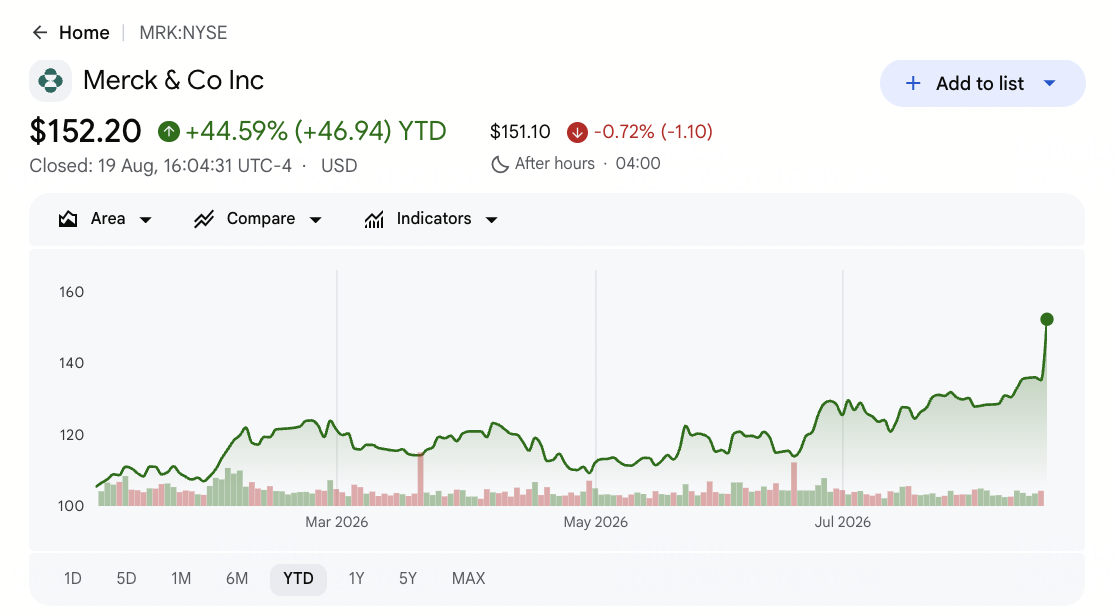
- Q2 revenue reached $16.6 billion and grew 5%. Revenue came in above the $16.36 billion consensus, supported by oncology and animal health. Management also raised full-year revenue guidance to $66.3 billion to $67.3 billion.
- KEYTRUDA family sales reached $8.4 billion. The franchise grew 4% year over year, including $463 million from subcutaneous KEYTRUDA QLEX. The slower growth of the original intravenous formulation keeps patent-expiry planning central to the long-term outlook.
- A one-time acquisition charge drove the reported loss. Merck posted a non-GAAP loss of $0.13 per share after a $2.31 per share charge tied to the Terns Pharmaceuticals acquisition. EPS guidance was reduced to $2.66 to $2.76 to reflect deal-related costs.
- Pipeline progress is strengthening the diversification case. Positive Phase 3 results across oncology and immunology, including the intismeran melanoma readout, added to Merck’s effort to build growth beyond KEYTRUDA. The next test is whether these programs convert into approvals and meaningful revenue.
- Analysts raised targets as confidence improved. Daiwa moved to $143, JPMorgan to $150, Guggenheim to $146 and Argus to $145. The revisions point to stronger confidence in Merck’s post-KEYTRUDA pipeline, while execution remains the main valuation test.
What Is Merck & Co Inc (MRK)?

Merck & Co Inc, known as MSD outside the United States and Canada, is one of the world’s largest pharmaceutical companies. Its business spans prescription medicines, vaccines and animal health, with oncology at the center of the portfolio. KEYTRUDA, an immunotherapy that helps the immune system recognize and attack cancer cells, remains Merck’s most important product, while newer businesses in cardiometabolic disease, immunology and vaccines are becoming increasingly important as the company prepares for the drug’s expected U.S. patent expiration in 2028.
The growth story now depends on whether Merck can build enough new revenue around and beyond KEYTRUDA. The company is expanding the franchise into earlier-stage cancers and new formulations such as KEYTRUDA QLEX, while also developing newer products including WINREVAIR, WELIREG, LIPFENDRA and OHTUVAYRE. Its oncology pipeline also includes antibody-drug conjugates and the intismeran cancer vaccine partnership with Moderna. For investors, the key question is whether these newer products and pipeline programs can scale quickly enough to offset future KEYTRUDA patent pressure and support durable growth.
Read More: Moderna (MRNA) Price Prediction 2026: Can Cancer Vaccine Momentum Push MRNA Stock Toward $180?
Merck (MRK) Q2 2026 Earnings: What Drove Revenue Growth and the Reported Loss
- Revenue growth was led by oncology and animal health. Second-quarter revenue rose 5% year over year to $16.6 billion and came in above the $16.36 billion consensus. The result supported Merck’s decision to raise and narrow its full-year revenue outlook.
- KEYTRUDA continued to grow, but the core franchise is maturing. KEYTRUDA family sales increased 4% to $8.4 billion, including contributions from the newer QLEX formulation. The slower growth of the original intravenous product keeps the 2028 patent-expiry challenge central to the long-term thesis.
- A one-time Terns charge drove the reported loss. Merck recorded a $2.31 per share charge tied to the Terns Pharmaceuticals acquisition, resulting in a non-GAAP loss of $0.13 per share. Investors should separate that deal-related impact from the underlying operating performance.
- Newer products and approvals added diversification. WELIREG sales rose 67% to $271 million, while approval of LIPFENDRA expanded Merck’s cardiometabolic portfolio. These newer assets matter because future growth increasingly depends on revenue sources beyond KEYTRUDA.
- Guidance reinforced the revenue outlook. Merck raised and narrowed full-year revenue guidance to $66.3 billion to $67.3 billion, implying 2% to 4% growth. EPS guidance of $2.66 to $2.76 incorporated acquisition-related charges, making revenue growth and pipeline execution the cleaner near-term operating signals.
Merck Q2 2026 Financial and Consensus Profile: Revenue, EPS and Pipeline
Merck's Q2 results showed solid revenue growth and continued pipeline progress alongside a reported loss driven by acquisition-related charges. The table separates underlying operating performance from one-time items and highlights the longer-term KEYTRUDA transition.
|
Financial Metric |
Guidance / Consensus |
Reported / Actual |
Surprise |
|
Q2 2026 Revenue |
~ $16.36 billion consensus |
$16.6 billion |
Beat. Up 5% year over year. |
|
Q2 2026 Non-GAAP EPS |
~ $0.16 to $0.27 expected |
$(0.13) |
Below expectations. A $2.31 per share Terns acquisition charge drove the loss. |
|
Q2 2026 KEYTRUDA Family Sales |
- |
$8.4 billion |
Growth. Up 4% year over year. |
|
Q2 2026 KEYTRUDA QLEX Sales |
- |
$463 million |
New contribution. The subcutaneous formulation added to franchise sales. |
|
Q2 2026 WELIREG Sales |
- |
$271 million |
Strong growth. Up 67% year over year. |
|
Q2 2026 Gross Margin |
- |
81.10% |
Lower. Down 110 basis points, including inventory-reserve pressure. |
|
FY2026 Revenue Guidance |
Raised |
$66.3 billion to $67.3 billion |
Higher. Implies roughly 2% to 4% growth. |
|
FY2026 Non-GAAP EPS Guidance |
- |
$2.66 to $2.76 |
Adjusted. Includes about $2.43 per share of one-time charges. |
|
KEYTRUDA U.S. Patent Expiry |
- |
2028 |
Long-term overhang. Replacing future KEYTRUDA revenue remains central to the investment case. |
For context, Merck is using acquisitions and internal pipeline development to reduce its dependence on KEYTRUDA ahead of the expected 2028 U.S. patent expiration. The August 19 intismeran melanoma result added another potential growth path around the franchise, while newer products such as WELIREG and KEYTRUDA QLEX are already contributing revenue. The key question is whether these assets and the broader pipeline can scale fast enough to offset future patent pressure and acquisition-related spending.
Merck (MRK) 2026 Investment Outlook: $170 Bull Case vs. $130 Bear Case
Merck's outlook for the rest of 2026 depends on one central question: whether the melanoma breakthrough and broader pipeline progress can support another leg higher after the stock’s sharp re-rating, or whether much of the post-KEYTRUDA growth story is already reflected in the current price.
The Bull Case: Pipeline Momentum Pushes MRK Toward $170
The bullish case begins with stronger confidence in Merck’s post-KEYTRUDA pipeline. The positive Phase 3 intismeran melanoma result adds another potential growth path around the franchise, while newer products such as WELIREG and WINREVAIR and additional late-stage programs are broadening the revenue base.
This outcome requires the newer assets to continue moving from clinical success into approvals and meaningful sales. With MRK already trading around $150, further upside depends less on simple re-rating and more on continued pipeline wins, stronger launch execution and evidence that Merck can replace future KEYTRUDA revenue.
The Base Case: Strong Pipeline Progress Keeps MRK Between $145 and $160
The base case assumes Merck holds most of its post-readout gains while investors reassess how much pipeline value is already reflected in the stock. KEYTRUDA continues generating substantial cash flow, newer products grow and full-year revenue remains within management’s guidance.
This scenario would keep MRK near its current level rather than assuming another immediate re-rating. Confirmation would come from additional approvals, sustained revenue growth in newer products and evidence that the portfolio is gradually becoming less dependent on KEYTRUDA.
The Bear Case: Valuation and Patent Concerns Pull MRK Toward $130
The bear case does not require the pipeline thesis to collapse. It requires expectations to cool after the sharp rally while investors refocus on KEYTRUDA’s 2028 U.S. patent expiration and the time required for newer products to become large enough to replace it.
The clearest triggers would be pipeline setbacks, slower launch ramps or weaker-than-expected revenue growth. If replacement revenue develops more slowly than expected, MRK could retrace part of its recent re-rating toward the $130 area.
MRK Stock Price Forecasts for 2026 By Wall Street Analysts
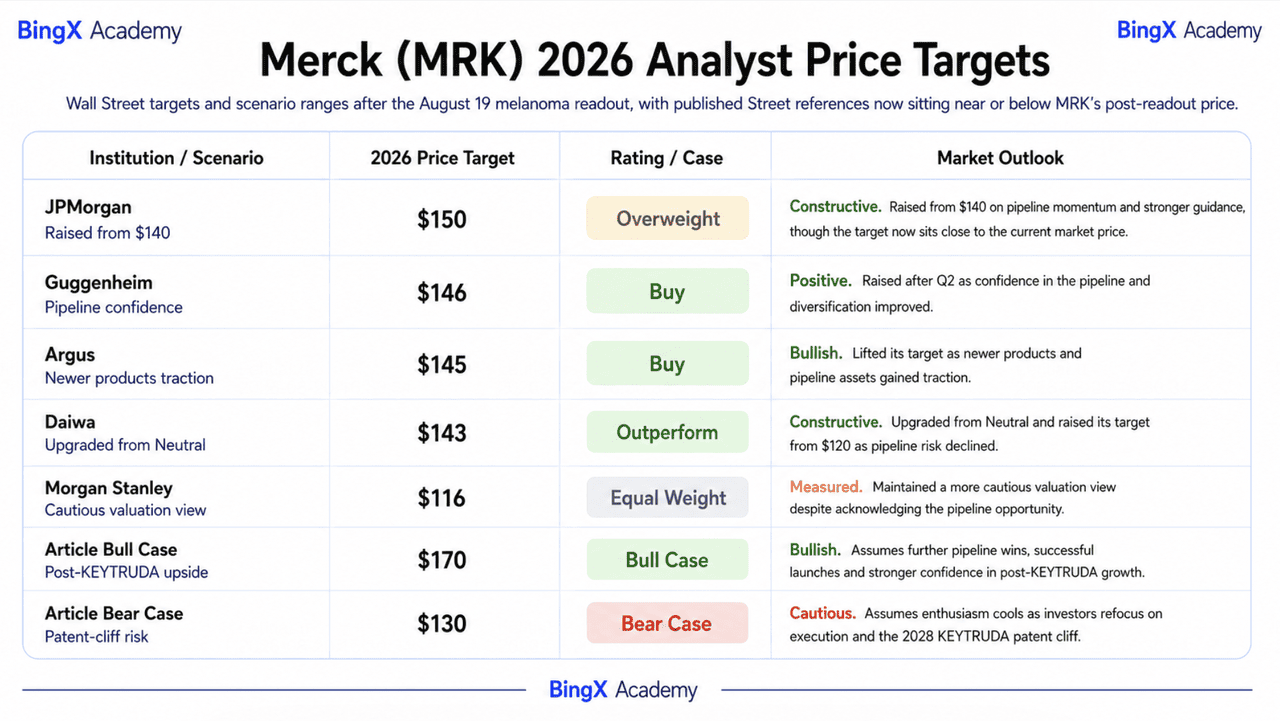
Most published analyst targets were set before the August 19 melanoma readout and now sit near or below MRK’s post-readout price. The table therefore shows the latest available Street reference points alongside article scenarios that better reflect the stock’s current valuation range.
|
Institution / Scenario |
2026 Price Target |
Rating / Case |
Market Outlook |
|
JPMorgan |
USD $150 |
Overweight |
Constructive. Raised from $140 on pipeline momentum and stronger guidance, but the target now sits close to the current market price. |
|
Guggenheim |
USD $146 |
Buy |
Positive. Raised after Q2 as confidence in the pipeline and diversification improved. |
|
Argus |
USD $145 |
Buy |
Bullish. Lifted its target as newer products and pipeline assets gained traction. |
|
Daiwa |
USD $143 |
Outperform |
Constructive. Upgraded from Neutral and raised its target from $120 as pipeline risk declined. |
|
Morgan Stanley |
USD $116 |
Equal Weight |
Measured. Maintained a more cautious valuation view despite acknowledging the pipeline opportunity. |
|
Article Bull Case |
USD $170 |
Bull Case |
Bullish. Assumes further pipeline wins, successful launches and stronger confidence in post-KEYTRUDA growth. |
|
Article Bear Case |
USD $130 |
Bear Case |
Cautious. Assumes enthusiasm cools as investors refocus on execution and the 2028 KEYTRUDA patent cliff. |
How to Trade Merck & Co Inc (MRK) Stock on BingX
Navigate the volatility of Merck's pipeline and earnings cycle using BingX TradFi and BingX AI tools. By leveraging AI-driven predictive analytics, you can better anticipate market sentiment shifts and price action around clinical readouts and regulatory decisions.
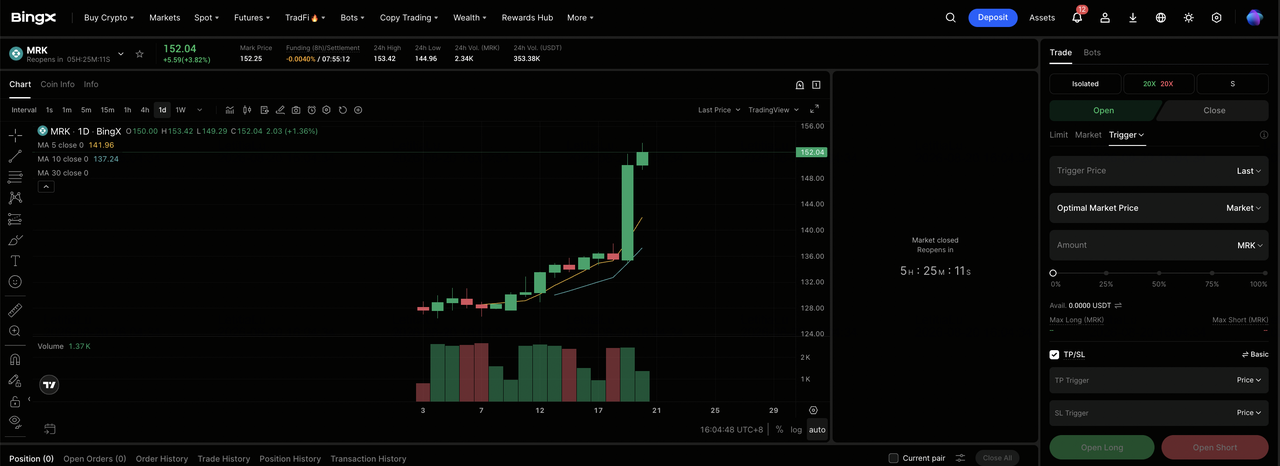
Step 1: Access BingX TradFi. Sign up and navigate to the specialized TradFi section. Complete KYC if required in your region and enable two-factor authentication before funding an account.
Step 2: Select Merck & Co Inc (MRK). Deposit USDT, then search for and select the MRK-USDT perpetual futures contract.
Step 3: Choose your direction. Select Open Long if you expect the pipeline to keep de-risking, new launches to scale, and diversification to offset the KEYTRUDA cliff. Select Open Short if you expect KEYTRUDA growth to keep moderating, pipeline setbacks to emerge, or the 2028 patent expiration to weigh on the stock.
Step 4: Select leverage and margin mode. Choose Isolated or Cross-Margin based on your risk tolerance. Because MRK can move sharply on pipeline readouts and regulatory decisions, as the recent target hikes showed, conservative leverage and clear position sizing are important.
Step 5: Execute strict risk protocols. Set Take-Profit and Stop-Loss (TP/SL) levels before or immediately after entering the trade. MRK can react quickly to quarterly earnings and guidance, KEYTRUDA sales trends, clinical trial readouts, FDA decisions, acquisition announcements, and patent-cliff commentary.
Top 5 Risks to Watch for MRK Investors in 2026
Merck’s pipeline progress supports the upside case, but five risks could determine whether newer products can offset future pressure on the KEYTRUDA franchise.
- KEYTRUDA faces a 2028 patent cliff. The franchise generates roughly $8.4 billion per quarter and is expected to lose U.S. exclusivity in 2028. Replacing that revenue remains the central long-term challenge.
- Revenue remains concentrated in oncology. KEYTRUDA and the broader oncology portfolio account for a large share of Merck’s growth. A slowdown or setback in the franchise could have an outsized impact on results.
- Acquisition costs can pressure near-term earnings. Charges tied to Terns and other transactions have already affected quarterly EPS and full-year guidance. Continued dealmaking could create additional earnings volatility.
- KEYTRUDA growth is beginning to mature. The original intravenous formulation is growing more slowly as penetration increases across established indications. The key question is whether newer formulations and indications can extend the franchise.
- Pipeline execution remains uncertain. The tulisokibart systemic sclerosis study missed its primary endpoint, showing that not every program will succeed. Additional clinical setbacks could weaken confidence in Merck’s post-KEYTRUDA growth plan.
Final Thoughts: Should You Invest in Merck in 2026?
Merck in August 2026 is a company trying to prove that growth can continue beyond KEYTRUDA. Q2 revenue reached $16.6 billion, KEYTRUDA family sales were $8.4 billion, full-year revenue guidance was raised, and multiple pipeline programs advanced, including the positive intismeran melanoma readout. The unresolved question is whether these newer products and pipeline assets can scale quickly enough to offset future KEYTRUDA patent pressure.
The bull case is that Merck’s expanding oncology, cardiometabolic and vaccine portfolio creates a broader growth base before KEYTRUDA loses U.S. exclusivity in 2028. The bear case is that KEYTRUDA remains too large a share of the business, growth is maturing, and pipeline or acquisition setbacks slow the transition. The next confirmation points are newer-product sales, additional approvals, pipeline readouts and evidence that revenue growth is becoming less dependent on KEYTRUDA.
Risk Reminder: Trading and investing in equities like MRK involves a high risk of capital loss. Merck is exposed to patent expirations, clinical and regulatory outcomes, acquisition execution and concentration in the KEYTRUDA franchise, any of which can move the stock materially. Conduct independent research before allocating capital.
Related Reading
- Moderna (MRNA) Price Prediction 2026: Can Cancer Vaccine Momentum Push MRNA Stock Toward $180?
- Pfizer Stock Price Prediction 2026: High-Yield Value Opportunity or Structural Value Trap?
- Abbott (ABT) Stock Price Outlook 2026: Can Medical Device Growth Push ABT Above $130?
- Johnson & Johnson (JNJ) Price Prediction 2026: Can Oncology Growth Carry JNJ Past $100 Billion?
- Eli Lilly (LLY) Stock Outlook 2026: Can Mounjaro and Zepbound Momentum Drive LLYON Stock to $1,200+?
