
Upgrading a top-tier layer-2 scaling network's native asset is a complex architectural and strategic shift. When Polygon launched its network token migration, replacing the native asset MATIC with the newly designed POL coin, it wasn't performing a superficial marketing rebrand. Instead, it was deploying a deep protocol-level transformation tailored to its ambitious Polygon 2.0 ecosystem vision.
Through 2025 and into mid-2026, the scaling landscape shifted from isolated rollups toward frictionless multi-chain systems. The original MATIC framework, built primarily to handle gas fees and single-chain staking on the isolated Polygon Proof-of-Stake (PoS) sidechain, could not scale to meet this multi-chain demand.
Enter the POL token. By mid-2026, successive network updates like the Madhugiri hard fork and the Rio upgrade successfully pushed the network's processing capacity to 5,000 payments per second with 1.5-second block times, preparing Polygon for mainstream merchant adoption. Major global settlement platforms like Shift4 have already integrated Polygon stablecoin rails, processing asset transfers 24/7.
For crypto traders navigating these structural updates, knowing the core mechanics behind Polygon (MATIC) is no longer optional. Maximizing portfolio efficiency requires understanding the technical "Why" behind the migration, evaluating its tokenomics, and exploring how to manage your positions securely via the advanced tool suite on BingX.
What Is Polygon (POL) and How Does It Work?
Polygon (POL) is a high-throughput Layer-2 scaling ecosystem engineered to turn Ethereum into a highly interoperable "Value Layer of the Internet" by processing transactions off-chain before settling them to the mainnet. Operating with a circulating supply of 10.66 billion tokens and a market capitalization of approximately $770.92 million, the network uses its newly upgraded native token, POL, to coordinate security and gas mechanics. Technically, Polygon has evolved beyond its legacy Proof-of-Stake sidechain framework into a multi-chain network powered by the AggLayer, a decentralized aggregation protocol that cryptographically unifies liquidity and state transitions across separate zero-knowledge (ZK) networks.
Practically, the network functions as enterprise-grade financial infrastructure capable of handling high-volume consumer payments and real-world asset tokenization. Following major 2025–2026 code enhancements like the Madhugiri hard fork and the Rio upgrade, Polygon expanded its block gas capacity to 160 million, allowing it to process up to 5,000 transactions per second (TPS) with 1.5-second block times at a fraction of a cent per transaction. Rather than locking capital into isolated environments, validators can leverage POL’s hyperproductive token design to participate in multi-chain staking, securing the main PoS chain alongside independent, custom-built Chain Development Kit (CDK) sub-networks simultaneously, while capturing a diversified stream of transaction fees.
Why Did Polygon Migrate From MATIC to POL Token in 2024–2026?
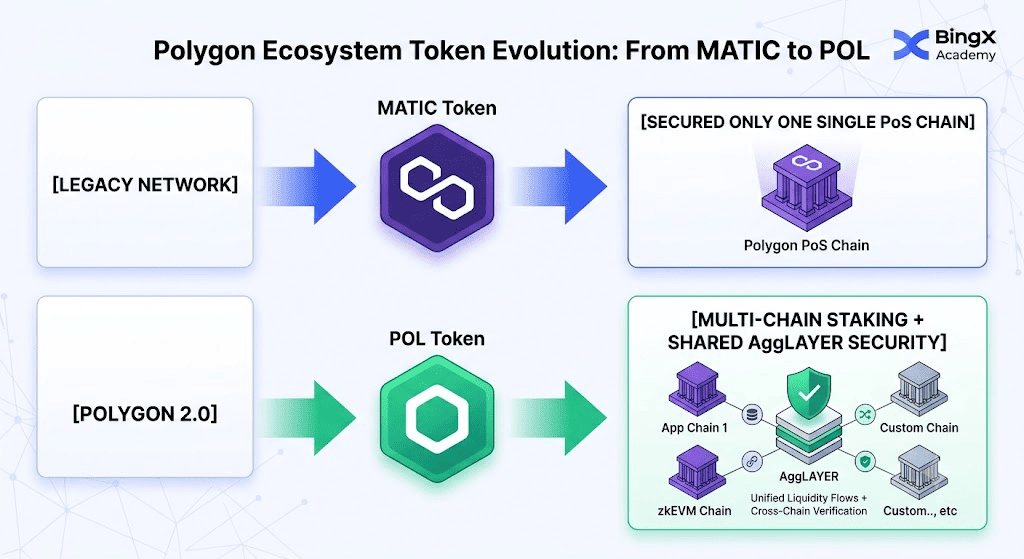
To truly evaluate what is POL, we must examine the architectural limitations of its predecessor. Launched in 2017, the original Matic Network structure relied heavily on a basic sidechain configuration. While excellent for cheap transactions, the legacy token contract could not coordinate shared security or fast liquidity transfers across separate, independent layer-2 networks.
The multi-year migration process, which officially commenced its public phases on September 4, 2024, resolved these legacy friction points by executing a structural network-level overhaul:
- Dismantling Fragmentation via the AggLayer: Instead of forcing users to bridge assets across separate blockchains, Polygon 2.0 introduces the AggLayer (Aggregation Layer). This cross-chain aggregation protocol pools multi-chain liquidity and state updates securely. The POL coin acts as the foundational governance and settlement asset coordinating this layer.
- Zero-Knowledge Hardware Acceleration: In early 2026, Polygon Labs finalized a partnership with Fabric Cryptography to deploy custom Verifiable Processing Units (VPUs) optimized for Plonky3 zero-knowledge proofs. This hardware integration targets a 100x reduction in proof generation overhead, making ZK-rollups highly practical.
- The Gigagas Scalability Roadmap: Through parameter optimization and boosting block gas limits up to 160 million, Polygon's technical framework successfully achieved a 5,000 TPS milestone in June 2026, establishing standard enterprise-grade infrastructure capable of challenging legacy global payment networks.
Hyperproductivity in Polygon: How POL Token Secures Multiple Chains
The defining innovation of the POL coin architecture is its design as a hyperproductive token. Under traditional proof-of-stake models, an asset can only secure one single network at any given moment. If a validator wishes to protect a new layer-2 chain, they must lock up an entirely different token, creating significant fragmentation.
POL solves this through advanced multi-chain staking. This protocol mechanism allows validators to stake their single POL pool to secure multiple distinct chains simultaneously within the broader Polygon ecosystem.
MATIC vs. POL Core Functional Profile At a Glance
|
Structural Feature |
Legacy Token: MATIC |
Next-Generation Token: POL |
|
Primary Architectural Role |
Monolithic single-chain engine |
Interoperable multi-chain hyperproductive asset |
|
Gas Fee Operations |
Confined strictly to Polygon PoS |
Native across PoS, customizable for CDK networks |
|
Staking Capabilities |
Restricted to one network layer |
Multi-chain staking across multiple chains |
|
Cross-Chain Interoperability |
Fragmented via legacy bridges |
Unified natively via zero-knowledge AggLayer |
|
Maximum Transaction Flow |
~32 Transactions Per Second |
Up to 5,000+ TPS (Targeting 100,000+ via Gigagas) |
Under this model, active validators do not just collect transaction fees from one chain. A single validator node can validate transactions on the Polygon PoS chain, secure an enterprise gaming network built using the Chain Development Kit (CDK), and earn rewards from zero-knowledge rollup infrastructure simultaneously. This approach dramatically amplifies structural capital efficiency while providing institutional-grade protection to newly launched subnetworks.
Polygon Tokenomics 2.0: POL Annual Emissions and the Community Treasury
The structural transition from Polygon (MATIC) to Polygon (POL) introduced an updated economic model built to support long-term ecosystem viability and decentralization. While MATIC maintained a strict, static supply cap of 10 billion tokens, the POL tokenomics framework deploys an orderly, predictable annual emission protocol.
What Is the POL 2% Tokenomics Rule?
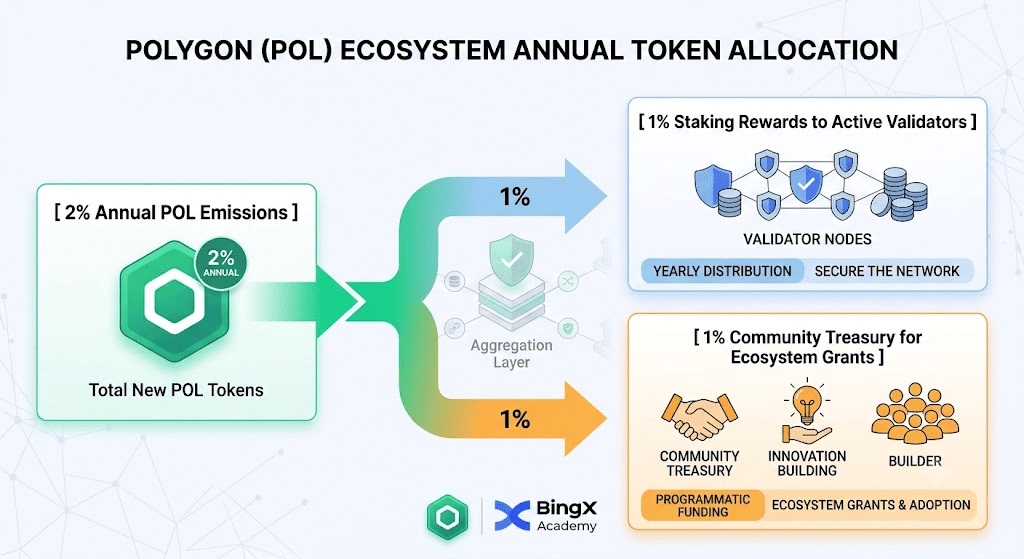
POL implements a continuous 2% annual emission model over a decade. This emission curve is structurally divided into two non-overlapping ecosystem categories:
- 1% to Validator Rewards: Directed programmatically into the staking smart contract to incentivize validators, maintaining deep network security and economic alignment.
- 1% to the Community Treasury: Funneled into a community-controlled fund to finance continuous protocol research, core developer grants, and ecosystem adoption initiatives.
To counter this emission model, Polygon retains a base fee-burning mechanism that permanently destroys a portion of transaction fees as network utilization increases. Additionally, a landmark community governance milestone passed in March 2026 directed 50% of all priority fees directly to POL stakers. This adjustment significantly elevates reward yield potentials for active holders, balancing the asset's structural supply curve with sustained utility and demand.
How to Trade Polygon Ecosystem Token (POL) on BingX
BingX provides a comprehensive ecosystem powered by advanced algorithmic tools and the embedded BingX AI smart trading assistant to streamline how you analyze trends, evaluate positions, and manage portfolio risk across different digital asset strategies.
Buy and Sell POL on the Spot Market
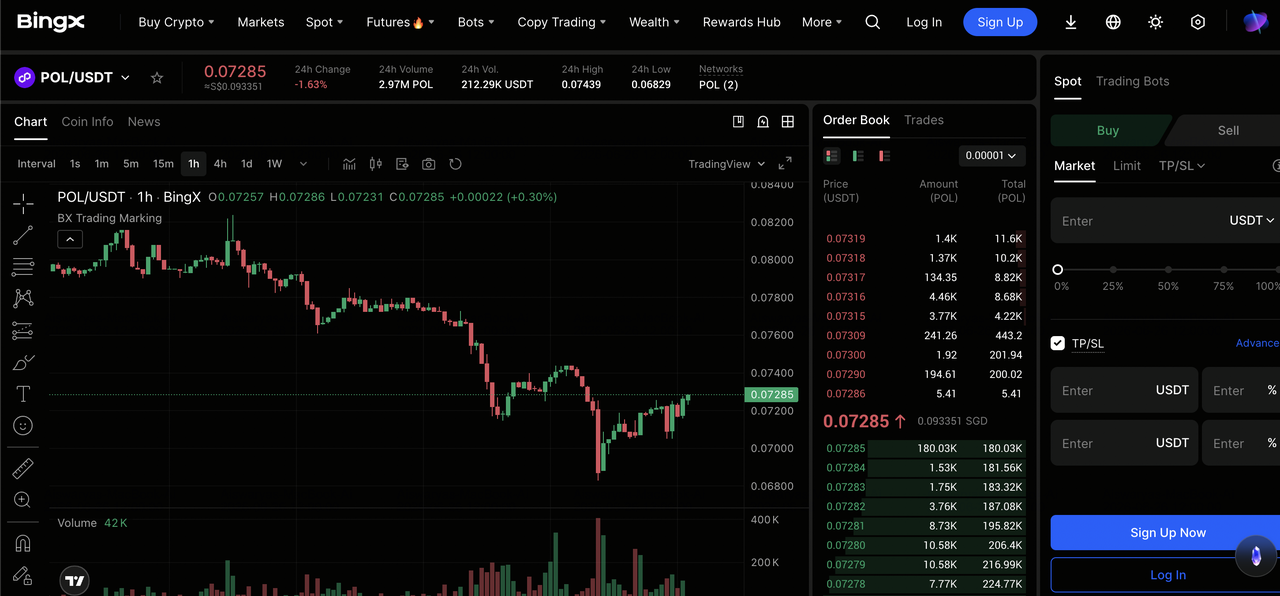
POL/USDT trading pair on BingX spot market
- Log in to your BingX account, navigate to the top navigation dashboard, hover over Spot, and select Spot to open the trading interface.
- Use the asset search engine located on the left section of your layout to search for POL/USDT to load the real-time asset chart.
- Review order book depth and use the execution panel to select a Market Order for instant execution, or a Limit Order to specify your targeted entry zone.
- Input your desired allocation size in USDT, click Buy POL, and monitor your filled tokens securely inside your integrated spot wallet account.
Long or Short POL with Leverage in the Futures Market
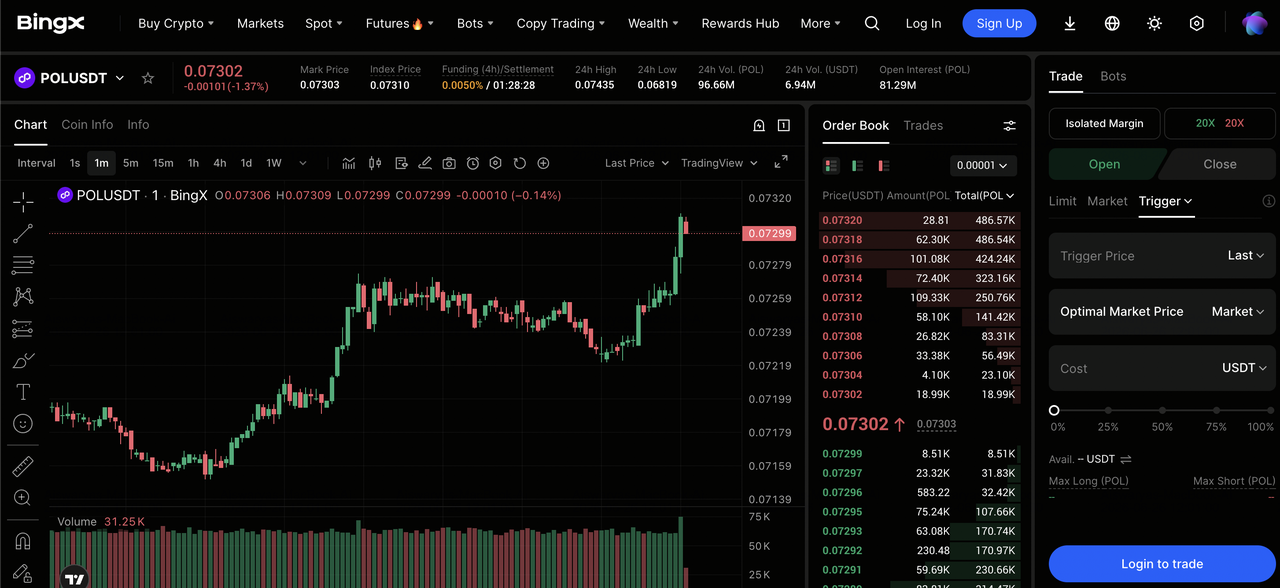
POL/USDT perpetual contract on BingX futures market
- Navigate to the main dashboard menu, hover over Futures, and click Perpetual Futures to initialize the high-liquidity contract console.
- Click the asset pair menu in the upper-left corner and select the POL/USDT Perpetual contract pair.
- Select your margin preference (Isolated Margin to isolate risk to an individual position, or Cross Margin to share collateral pools) and set your leverage scale, e.g., a disciplined 2x–5x.
- Open the trade panel to select Long if your analytical metrics forecast a technical trend breakout, or select Short to position for a downside macro correction.
- Set precise Take-Profit (TP) and Stop-Loss (SL) trigger thresholds in the order module before clicking the transaction button to lock in clear risk management boundaries.
5 Key Considerations for the POL Migration Era
Navigating the architectural shift from legacy MATIC to the upgraded POL ecosystem requires a strategic approach to wallet configurations, native token utility, and network migration rules.
- Automatic vs. Manual Migration Paths: For assets held natively on the Polygon PoS chain, the 1:1 migration was completed automatically. However, if your tokens are held on the Ethereum L1 mainnet, you must connect to the official Polygon Portal to manually process the contract upgrade.
- Wallet Display and Network Settings: If your wallet balance still reflects the legacy ticker, this is simply a local visual display issue. Update your wallet's network settings manually, changing the network Currency Symbol field from MATIC to POL.
- Yield Optimization from Priority Fees: Following the March 2026 governance vote, holding and staking POL offers enhanced incentive capture by securing a 50% split of network priority fees, augmenting standard validation rewards.
- Exchange Infrastructure Upgrades: Be aware that major exchanges periodically conduct standard technical maintenance or temporary deposit/withdrawal adjustments during scheduled protocol hard forks. Always verify status indicators on your asset dashboard before executing large transfers.
- Real-World Infrastructure Growth: The long-term valuation model for POL relies on enterprise processing volume. As mega-processors integrate stablecoin settlements natively onto the network, transaction fee burning acts as a long-term deflationary counterbalance to the 2% annual emission schedule.
Conclusion: What Is the Long-Term Value Proposition of POL?
The architectural migration from MATIC to POL marks a structural milestone in Polygon's roadmap, transitioning the network from a single, monolithic sidechain into an aggregated multi-chain ecosystem. By implementing multi-chain staking, launching the AggLayer to unify liquidity, and scaling transaction throughput to a stable 5,000 TPS, Polygon has built a functional infrastructure layer designed for institutional asset tokenization and enterprise-grade Web3 payments. For long-term market participants, utilizing spot allocation or contract execution modules on platforms like BingX provides a practical framework for managing exposure to this evolving network layout.
Risk Reminder: Capital allocation to digital assets carries substantial market and technical risks. Despite fundamental upgrades and high-throughput milestones, the long-term value accrual of the POL coin remains directly tied to ongoing network adoption, ecosystem chain integration, and the competitive dynamics of the Layer-2 scaling market. Furthermore, the protocol's 2% annual emission model requires consistent transaction volume and fee-burning efficiency to balance structural token supply over time. Users should monitor network utilization metrics, execute disciplined risk management strategies, and conduct independent due diligence before committing capital.
Related Reading
- What Is Polygon (POL) in 2026? From Sidechain to Aggregated Layer
- How to Add Polygon (POL) to MetaMask Wallet
- Connect MetaMask to BNB, Polygon & Supported Blockchains: A Step-by-Step Guide
- What Are the Top Ethereum Layer-2 Projects of 2026?
FAQs on Polygon's MATIC to POL Migration
1. Is MATIC still usable or interchangeable with POL?
No. The MATIC token has been succeeded by POL as the native token for gas and staking across the ecosystem. The old tokens are not interchangeable on active network layers; all functions have completely shifted to POL.
2. What happens if I leave my tokens on a centralized exchange like BingX?
For users holding legacy tokens on Tier-1 centralized exchanges, the migration, conversion, and ticker configurations are handled completely automatically by the platform's infrastructure team, requiring no manual interaction on your part.
3. Does the 2% annual emission model make POL heavily inflationary?
While the 2% annual issuance introduces new supply to support validators and the community treasury, the model features built-in deflationary balance points. The network burns a percentage of base transaction fees, and expanding enterprise payment volume helps offset this emission over time.
4. How does Polygon's AggLayer change things for ordinary web3 users?
The AggLayer completely removes the friction of traditional cross-chain bridging. Users can interact with decentralized applications spanning multiple separate chains seamlessly, experiencing the entire ecosystem as if it were a single, unified network layer.
