

Mastercard (MA) operates one of the world's largest electronic payment networks, connecting consumers, merchants, financial institutions and governments. The core network earns revenue from domestic assessments, cross-border activity and transaction processing, while value-added services extend the model into cybersecurity, analytics, loyalty and consulting. That mix creates a powerful compounding engine, though the shares remain sensitive to consumer health, international travel, client incentives and the premium valuation assigned to large payment networks.
The latest quarter strengthened the operating case. Q2 2026 net revenue increased 14% year over year, adjusted earnings grew faster than revenue, and value-added services expanded 20%. Cross-border volume and switched transactions also remained healthy. The investment debate now turns on whether Mastercard can preserve that breadth as comparisons become harder and whether services can keep improving the revenue mix without rebates, regulation or alternative payment rails weakening network economics.
The MA stock forecast for 2026 now centers on two competing views:
- The global payments and services case: resilient spending, international travel and faster services growth can support durable earnings compounding and a higher valuation reference.
- The valuation and disruption case: slower consumption, richer client incentives, regulation and new account-to-account or stablecoin rails can reduce the growth premium even if the network remains profitable.
This guide breaks down the MA stock forecast, 2026 price scenarios, key risks, and analyst outlooks, drawing on Mastercard's July 30 Q2 2026 earnings release, regulatory filing, and market data through September 2, plus how to trade MA stock futures on BingX TradFi with USDT collateral.
Top 5 Things for Mastercard Investors to Know in September 2026
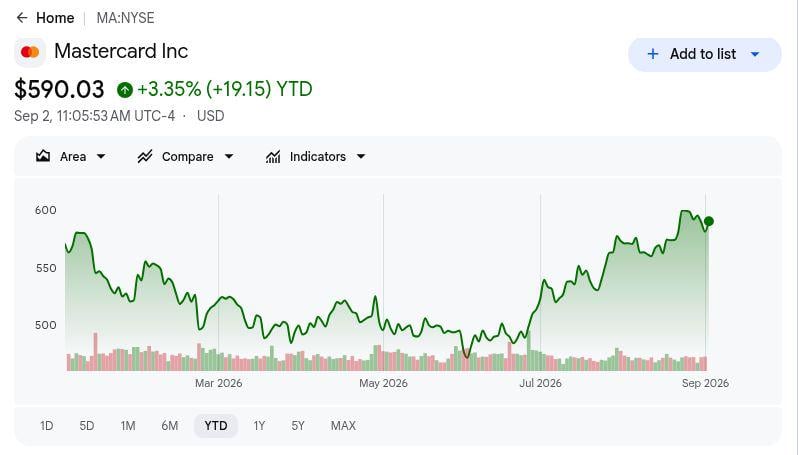
- MA was up about 8% YTD through September 1: The stock remained near the upper end of its 2026 range after a strong summer recovery. That supports the operating momentum story, but also leaves less room for earnings that only meet expectations.
- Q2 revenue grew 14% to $8.14 billion: Net revenue exceeded the tracked consensus, supported by higher payment activity and continued services growth. The beat was backed by broad transaction expansion rather than a one-off accounting benefit.
- Value-added services revenue grew 20%: Cybersecurity, analytics, consulting, and other services continued to outpace the core payment network, broadening Mastercard’s revenue mix and reducing reliance on transaction volumes alone.
- Cross-border volume increased 12%: International travel and commerce remained resilient despite macro uncertainty. Sustained double-digit cross-border growth remains an important contributor to revenue because these transactions typically carry attractive economics.
- Post-earnings analyst targets span roughly $575 to above $650: The range remains broadly constructive but reflects different assumptions around consumer spending, cross-border growth, services momentum, and valuation. With MA trading near the upper end of its annual range, the higher targets require continued earnings and guidance upgrades.
What Is Mastercard (MA)?

Mastercard (MA) is a global payments technology company headquartered in Purchase, New York. It typically does not issue cards or lend directly to consumers. Instead, Mastercard operates the network, standards, and processing infrastructure that connect issuing banks, acquiring banks, merchants, and cardholders, allowing electronic payments to be authorized, cleared, and settled across markets and currencies. Its scale gives the company exposure to consumer spending, international travel, e-commerce, and the broader shift from cash to digital payments.
Its growth comes from two main engines. The core payment network benefits from higher gross dollar volume, cross-border spending, and switched transactions, while value-added services generate revenue from cybersecurity, identity, data analytics, consulting, loyalty, and open-finance tools. Mastercard is also expanding further into commercial payments, account-to-account transfers, digital identity, and open banking, broadening the business beyond traditional card transactions and giving it more ways to monetize existing customer relationships.
Read More: Top Financial Services and Fintech Stocks to Buy in 2026 Amid Agentic AI, Stablecoin Rails Shift
Mastercard (MA) Q2 2026 Earnings Overview: Revenue, EPS and Payment Volumes
Mastercard delivered a broad Q2 beat across revenue, earnings, margins, and network activity. Net revenue reached $9.277 billion versus $9.08 billion expected, adjusted EPS came in at $5.04 versus $4.77, gross dollar volume reached $2.9 trillion, and adjusted operating margin was 61.1%. Cross-border volume, switched transactions, and value-added services also remained strong, while $4.9 billion of share repurchases added further per-share support.
|
Financial Metric |
Guidance / Consensus |
Reported / Actual |
Surprise |
|
Q2 net revenue |
$9.08B |
$9.277B |
Beat. About 2% above consensus; up 14% YoY. |
|
Adjusted diluted EPS |
$4.77 |
$5.04 |
Beat. About 6% above consensus; up 21% YoY. |
|
GAAP net income |
— |
$4.388B |
Improved. Up 19% year over year. |
|
GAAP diluted EPS |
— |
$4.97 |
Improved. Up 22% year over year. |
|
Adjusted operating margin |
— |
61.10% |
Expanded. Earnings grew faster than revenue. |
|
Gross dollar volume |
— |
$2.9T; +8% local currency |
Positive. Spending remained resilient. |
|
Cross-border volume |
— |
+12% local currency |
Positive. International commerce remained firm. |
|
Switched transactions |
— |
0.09 |
Positive. Network activity broadened. |
|
Value-added services revenue |
— |
0.2 |
Strong. Services outgrew the payment network. |
|
Q2 share repurchases |
— |
$4.9B |
Supportive. Buybacks reduced the share count. |
- Net revenue of $9.277 billion rose 14%: The result came in roughly 2% above the tracked consensus, with growth supported by both payment activity and services. That breadth suggests Mastercard was not relying on one geography or a temporary pricing effect.
- Adjusted EPS of $5.04 beat consensus by about 6%: Adjusted earnings increased 21% year over year, faster than revenue, showing stronger operating leverage and additional support from share repurchases.
- Gross dollar volume reached $2.9 trillion: Local-currency GDV increased 8%, indicating resilient consumer and commercial spending across the network despite uneven macro conditions.
- Cross-border volume grew 12% and switched transactions rose 9%: International spending remained a high-value growth driver, while transaction growth confirmed healthy network usage beyond nominal spending gains.
- Value-added services revenue increased 20%: Cybersecurity, analytics, consulting, identity, and other services continued to outpace the core payment network, strengthening Mastercard’s revenue mix beyond transaction processing alone.
Mastercard (MA) 2026 Investment Outlook: $760 Bull Case vs. $520 Bear Case
The central test is whether Mastercard can convert healthy payment activity into services-led earnings growth without a consumer slowdown, incentive pressure or valuation reset interrupting the compounding profile.
The Bull Case: Services and Cross-Border Growth Push MA Toward $760
The Bull Case assumes cross-border spending remains strong, switched transactions continue growing, and value-added services keep outpacing the core payment network. That mix would support revenue growth and operating leverage, especially if cybersecurity, analytics, and money-movement products deepen customer relationships without a sharp rise in incentives.
A move toward $760 would require sustained double-digit services growth, resilient international travel, and continued earnings revisions. Strong consumer spending and stable cross-border economics would provide the clearest confirmation of this scenario.
The Base Case: Resilient Payments Keep MA Between $620 and $700
The Base Case assumes payment volumes remain healthy while growth gradually normalizes. Cross-border activity moderates from recent strength, value-added services continue expanding faster than the network, and stable margins plus share repurchases support per-share earnings.
Under this scenario, MA could trade mainly between $620 and $700. High-single-digit network growth, double-digit services growth, and controlled incentives would support the range, while weaker cross-border trends would push the outlook closer to the bear case.
The Bear Case: Slower Spending and Multiple Compression Pull MA Toward $520
The Bear Case assumes consumer and business spending weakens, international travel slows, and higher client incentives absorb more revenue. Alternative payment rails do not need to displace Mastercard outright; slower incremental growth alone could reduce the premium investors are willing to pay.
A move toward $520 would become more likely if switched transactions and cross-border volumes weaken, services growth slows materially, or operating leverage reverses. Mastercard could remain highly profitable under this scenario, but lower earnings expectations and valuation compression would pressure the stock.
MA Stock Price Forecasts for 2026 by Wall Street Analysts
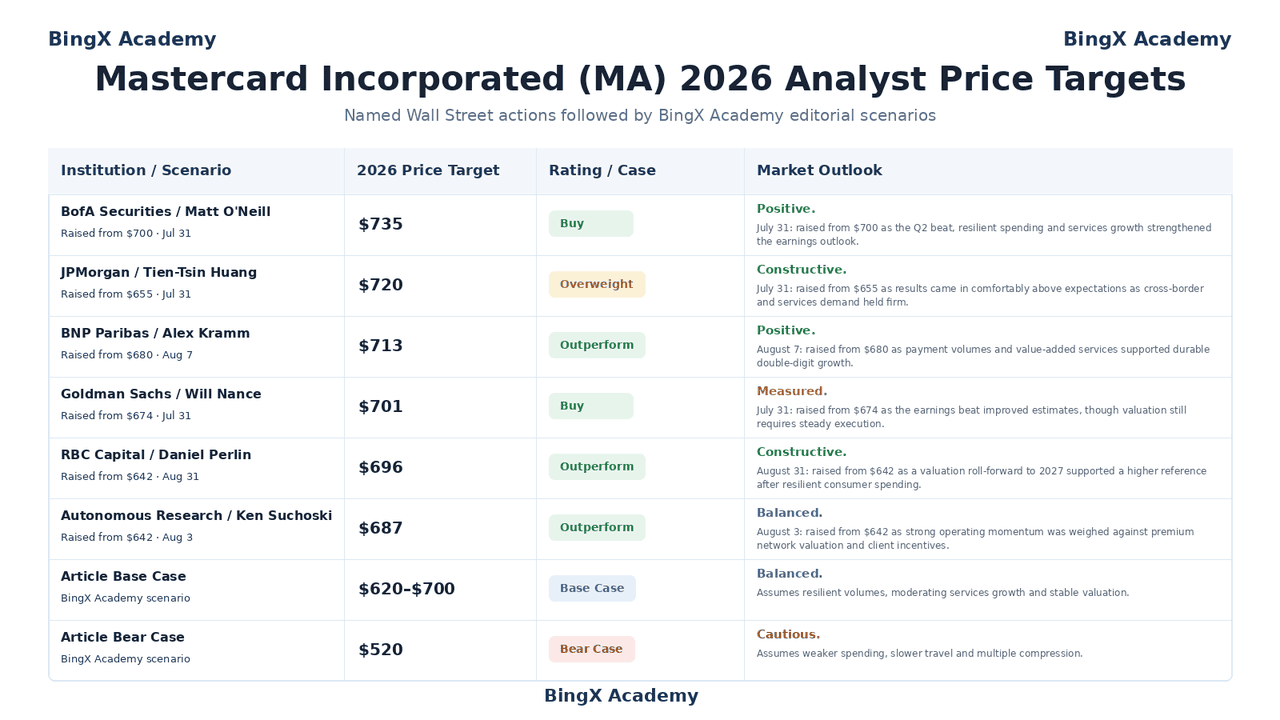
The selected dated actions show a constructive Street view after Q2, though they also reveal how much execution is already expected. Article Base and Bear cases are conditional BingX Academy research scenarios and remain separate from named analyst targets.
|
Institution / Scenario |
2026 Price Target |
Rating / Case |
Market Outlook |
|
BofA Securities |
$735 |
Buy |
Positive. July 31: raised from $700 as the Q2 beat, resilient spending and services growth strengthened the earnings outlook. |
|
JPMorgan |
$720 |
Overweight |
Constructive. July 31: raised from $655 as results came in comfortably above expectations and cross-border demand held firm. |
|
BNP Paribas |
$713 |
Outperform |
Positive. August 7: raised from $680 as payment volumes and value-added services supported durable double-digit growth. |
|
Goldman Sachs |
$701 |
Buy |
Measured. July 31: raised from $674 as the earnings beat improved estimates, though valuation still requires steady execution. |
|
RBC Capital |
$696 |
Outperform |
Constructive. August 31: raised from $642 as a valuation roll-forward to 2027 supported a higher reference after resilient consumer spending. |
|
Autonomous Research |
$687 |
Outperform |
Balanced. August 3: raised from $642 as strong operating momentum was weighed against premium valuation and client incentives. |
|
Article Base Case |
$620–$700 |
Base Case |
Balanced. Assumes resilient volumes, moderating services growth and stable valuation. |
|
Article Bear Case |
$520 |
Bear Case |
Cautious. Assumes weaker spending, slower travel and multiple compression. |
How to Trade Mastercard (MA) Stock on BingX
Mastercard can react quickly to earnings, payment-volume releases, travel data, regulation and changes in consumer confidence. BingX TradFi provides long and short exposure through a USDT-settled perpetual contract, so risk controls matter as much as directional analysis.
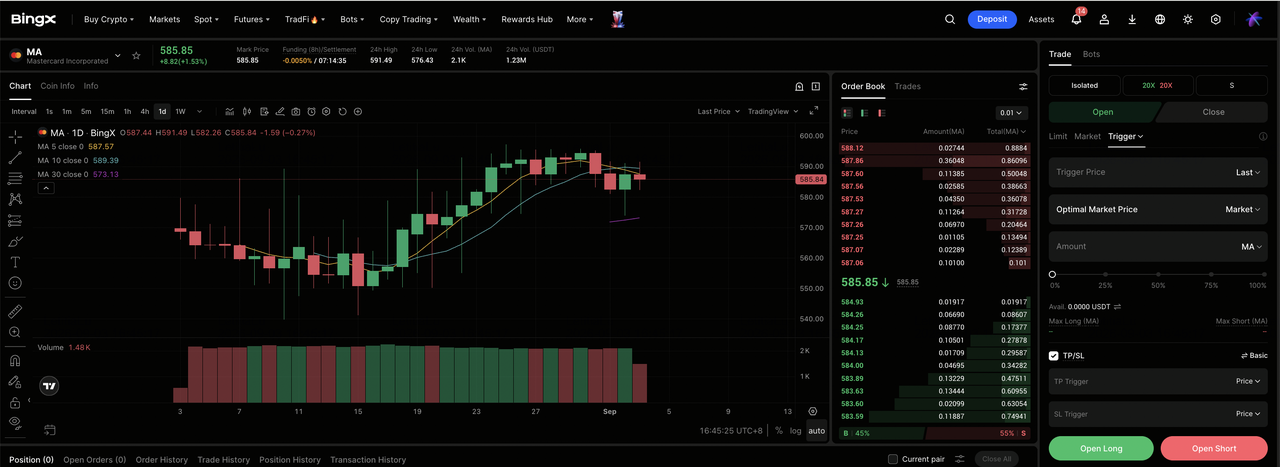
Step 1: Access BingX TradFi. Sign up, complete KYC, enable two-factor authentication, and open the TradFi market.
Step 2: Select Mastercard (MA). Deposit USDT, then search for the MA-USDT perpetual contract.
Step 3: Choose your direction. Select Open Long or Short according to whether payments, cross-border activity and services strengthen or whether spending and valuation weaken.
Step 4: Select leverage and margin mode. Choose Isolated or Cross-Margin based on risk tolerance. A premium large-cap network can still move sharply around quarterly releases and regulatory decisions, so conservative sizing is important.
Step 5: Execute strict risk protocols. Set Take-Profit and Stop-Loss levels before or immediately after entry. MA can respond to consumer data, travel trends, analyst revisions, litigation and alternative-rail announcements.
Top 5 Risks to Watch for Mastercard Investors in 2026
Mastercard’s outlook remains supported by resilient payment activity and services growth, but several risks could pressure revenue, margins, or valuation if conditions weaken.
- Consumer weakness could slow payment volumes and earnings growth: Softer household or business spending would reduce gross dollar volume and switched transactions, limiting the operating leverage Mastercard benefits from when network activity is strong.
- Cross-border growth could normalize: International travel and commerce are high-value revenue drivers for Mastercard. A slowdown from the current 12% cross-border growth rate could weigh disproportionately on revenue and earnings expectations.
- Higher client incentives could dilute strong volume growth: Competition for major banks, merchants, and payment relationships may require richer rebates and incentives, reducing the amount of revenue Mastercard retains even when transaction volumes remain healthy.
- Regulation and litigation could change network economics: Interchange rules, routing mandates, antitrust actions, and data requirements could raise compliance costs or reduce pricing flexibility across key markets.
- Alternative payment rails and operational failures could weaken the network advantage: Account-to-account payments, digital wallets, and stablecoins may capture incremental flows, while outages, fraud, or cybersecurity incidents could create direct costs and damage customer trust.
Final Thoughts: Should You Invest in Mastercard in 2026?
Mastercard's operating quality remains clear. Q2 produced broad revenue growth, faster adjusted earnings expansion, resilient cross-border activity and strong services growth. The network remains highly scalable, and services provide a credible path to deeper monetization beyond traditional card processing.
The bull case requires that breadth to persist and translate into continuing estimate revisions. The bear case requires no collapse in the franchise, only softer spending, slower travel or a lower valuation multiple. Conservative traders may prefer to monitor cross-border growth, switched transactions, value-added services, incentives and operating leverage before treating any scenario as confirmed.
Risk Reminder: Trading and investing in equities like MA involves a high risk of capital loss. Consumer spending, cross-border travel, regulation, litigation, cybersecurity, client incentives and leveraged perpetual contracts can produce rapid losses. Conduct independent research before allocating capital.
Related Reading
- Top Financial Services and Fintech Stocks to Buy in 2026 Amid Agentic AI, Stablecoin Rails Shift
- Visa (V) Stock Forecast 2026: Can Cross-Border Payment Growth and AI Push V Toward $460?
- JPMorgan Chase (JPM) Price Prediction 2026: Fortress Defense or AI-Driven Alpha at $341?
- Goldman Sachs (GS) Price Prediction 2026: Record Quarter Momentum or Valuation Ceiling at $1,140?
- Morgan Stanley (MS) Price Prediction 2026: Investment Bank Resurgence or $170 Correction?
