

Kopin (KOPN) develops microdisplays, optical modules and integrated vision systems for defense, AI infrastructure, industrial, medical and consumer applications. Its products combine liquid-crystal, OLED and MicroLED displays with optics, electronics and low-power custom silicon. Defense programs currently provide the clearest revenue path, while MicroLED manufacturing and Neural I/o optical interconnects add larger long-term opportunities with higher execution risk.
The latest quarter showed why the stock has attracted renewed attention. Kopin Q2 2026 revenue rose 51% to $12.7 million, non-product revenue increased 433% to $5.1 million and the operating loss narrowed by $2.0 million to $3.5 million. The investment case depends on whether funded development and prototype wins convert into recurring production orders before cash needs or program delays weaken per-share value.
The KOPN stock forecast for 2026 now centers on two competing views:
- The program-ramp and production-conversion case: MicroLED, Sentinel FPV and thermal-imaging programs could move from funded milestones and prototypes into larger production volumes and more predictable revenue.
- The commercialization and cash-runway case: government awards could slip, AI-interconnect commercialization could take longer and cash use could remain elevated before Kopin reaches sustainable profitability.
This guide breaks down the KOPN stock forecast, 2026 price scenarios, key risks and analyst outlooks, drawing on Kopin's August 10 Q2 2026 earnings release, quarterly filing and market data through September 18, plus how to trade KOPN stock futures on BingX TradFi with USDT collateral.
Top 5 Things for Kopin Investors to Know in September 2026
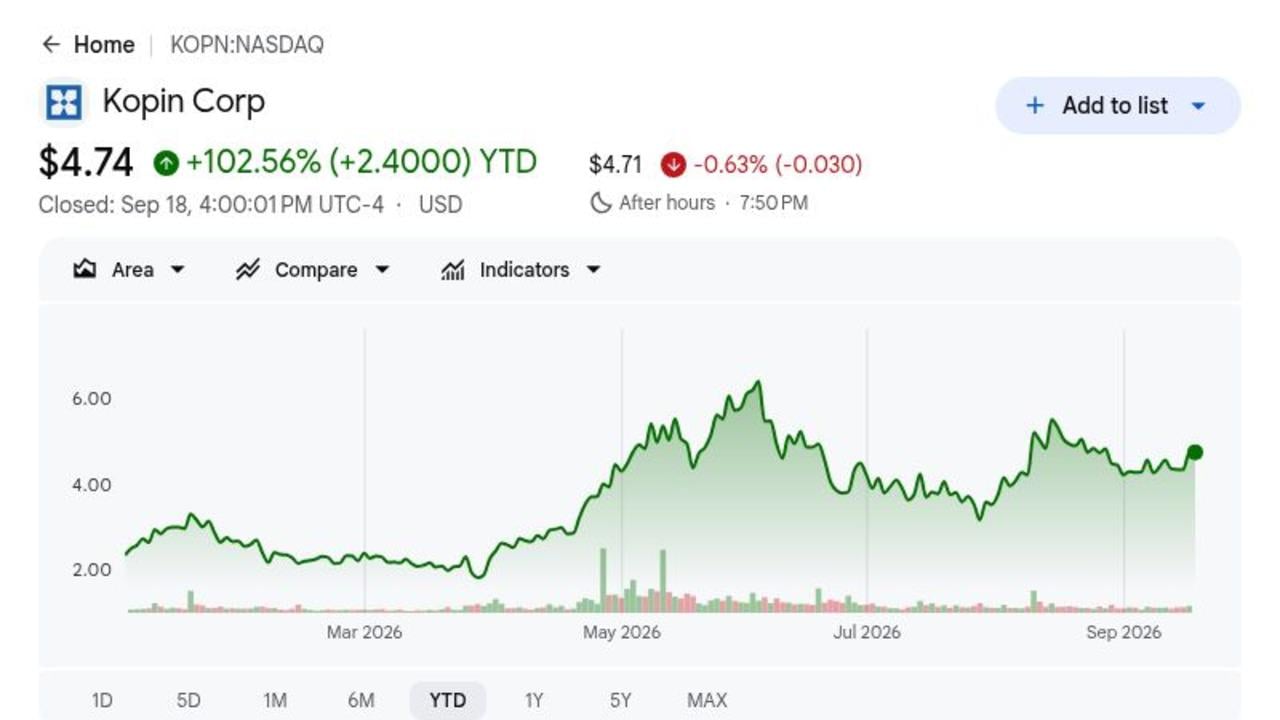
- KOPN closed at $4.74 on September 18 and was up 102.56% in 2026: Shares more than doubled as defense awards, MicroLED progress and AI-interconnect plans expanded the growth story. The $8.67 analyst consensus still implies upside, though the $6.50 to $12 range reflects major production and financing uncertainty.
- Q2 revenue reached $12.7 million, up 51%: Revenue rose from $8.5 million a year earlier. Product revenue increased only 2% to $7.6 million, showing that grants, collaboration work and funded development drove most of the quarter's growth.
- Non-product revenue surged 433% to $5.1 million: U.S. government MicroLED funding, Fabric.AI collaboration revenue and Off-the-Visor development for the U.S. Army drove the increase. These programs reduce near-term funding pressure, though repeat production orders remain the bigger test.
- Kopin exceeded 150,000 nits in full-color MicroLED brightness: The milestone surpassed the government program threshold and keeps domestic production targeted for mid-2027. Kopin still needs integration into Army-backed systems and follow-on procurement to turn technical progress into recurring revenue.
- New awards include a $21.5 million thermal-imaging contract and a $2.4 million OLED order: Sentinel FPV prototype orders and a $3.2 million initial FPV contract further broaden the defense pipeline. Converting these wins into repeat production would make revenue less dependent on development timing.
What Is Kopin (KOPN)?
Kopin is an optical-systems and microdisplay company that designs components and assemblies for environments where size, brightness, power consumption and reliability matter. Its portfolio includes active-matrix liquid-crystal, LCOS, OLED and MicroLED displays, display modules, eyepieces, projection assemblies, head-mounted systems and custom silicon. Customers integrate these products into soldier systems, thermal weapon sights, avionics, training equipment, medical headsets, industrial inspection tools and wearable devices. Revenue comes from products, funded research, collaboration agreements, grants and licensing.
The long-term strategy centers on U.S.-based defense production and new optical links for AI infrastructure. Kopin's Army-backed IBAS program targets domestic full-color MicroLED production in mid-2027, and Sentinel FPV modules are being evaluated by contenders in the U.S. Government's Drone Dominance Program. Fabric.AI is collaborating on Neural I/o, a planned 1.6-terabit-per-second optical transceiver architecture, while Theon International is a strategic partner for DarkWAVE. A new Dallas optics and photonics center expands engineering capacity for these programs.
Read More: Top AI Optical Stocks to Buy in 2026: Photonics, Optics, Fiber, and Data Center Interconnects
Kopin (KOPN) Q2 2026 Earnings Overview: Revenue Growth, MicroLED Funding and Narrower Losses
Kopin reported $12.7 million of revenue, up 51%, as non-product revenue increased from $1.0 million to $5.1 million and product revenue reached $7.6 million. The operating loss narrowed from $5.5 million to $3.5 million, and net income attributable to common holders was $0.9 million. Cash stood at $24.3 million, while $26.0 million of restricted cash lifted total cash, restricted cash and securities to $50.3 million. The quarter improved the growth path, though much of the acceleration came from funded programs rather than repeat product sales.
|
Financial Metric |
Guidance / Consensus |
Reported / Actual |
Surprise |
|
Q2 2026 revenue |
$8.5M a year earlier |
$12.7M |
Expanded. Up 51% YoY. |
|
Product revenue |
$7.5M a year earlier |
$7.6M |
Stable. Defense offset weaker industrial demand. |
|
Non-product revenue |
$1.0M a year earlier |
$5.1M |
Surged. Up 433% on grants and collaboration work. |
|
Cost of product revenue |
$7.1M; 94% ratio |
$6.6M; 86% ratio |
Improved. Mix reduced the ratio eight points. |
|
R&D expense |
$1.9M a year earlier |
$4.5M |
Increased. Funded MicroLED activity lifted spending. |
|
Operating loss |
$5.5M loss a year earlier |
$3.5M loss |
Narrowed. Loss improved by $2.0M. |
|
Net income |
$5.2M loss a year earlier |
$0.9M; $0.00/share |
Improved. Gains and a tax benefit supported profit. |
|
Cash and equivalents |
— |
$24.3M |
Available. Total cash resources were $50.3M including restricted cash. |
- Revenue increased by $4.2 million to $12.7 million: The 51% gain reflected stronger program activity, though product revenue increased by only $0.1 million. Government funding and collaboration work drove nearly all of the incremental sales.
- Product revenue reached $7.6 million, up 2%: Thermal weapon sight and liquid-crystal display demand offset weaker industrial applications. The modest increase lagged total-company growth, making future defense production orders important to improving the revenue mix.
- Non-product revenue increased by $4.1 million: Government MicroLED funding, Fabric.AI collaboration work and the Army's Off-the-Visor program drove a 433% increase. The $5.1 million total represented about 40% of quarterly revenue, reducing near-term funding pressure but increasing dependence on milestone timing.
- Operating loss narrowed to $3.5 million: The $2.0 million improvement came even as R&D expense rose 133% to $4.5 million. Cost of product revenue also improved to 86% of product sales from 94%, supporting better operating leverage.
- Cash and equivalents were $24.3 million: Restricted cash accounted for $26.0 million of the $50.3 million broader total because of the BlueRadios litigation bond. The unrestricted balance is therefore the more relevant measure for funding operating losses and production investment.
Kopin (KOPN) 2026 Investment Outlook: $12 Bull Case vs. $3 Bear Case
Kopin's 2026 outlook depends on whether defense prototypes and funded development programs can turn into repeat production revenue. MicroLED progress supports the upside, while limited unrestricted cash and continued operating losses remain the main risks.
The Bull Case: Strong Defense Orders Push KOPN Toward $12
The Bull Case assumes Sentinel FPV evaluations convert into larger production orders, thermal-imaging programs expand and domestic MicroLED production stays on schedule for mid-2027. Neural I/O also reaches its planned CES demonstration with credible customer interest.
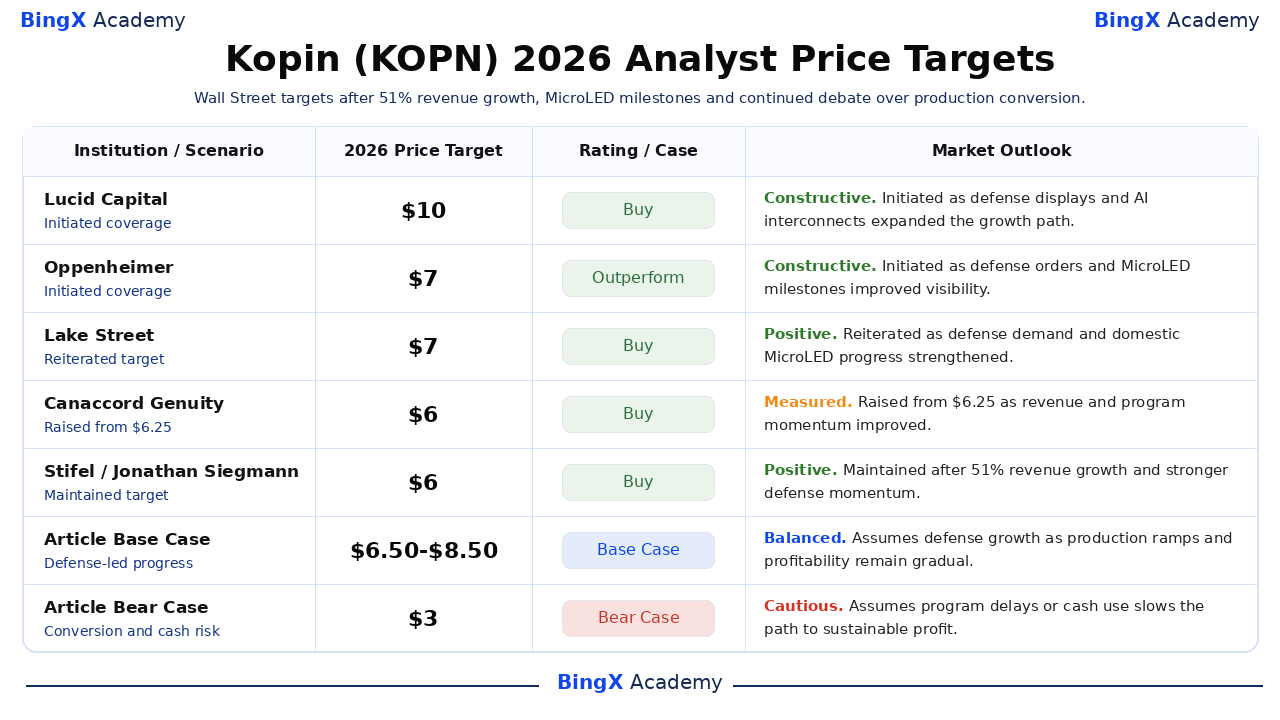
A move toward $12 would require product revenue to accelerate well beyond Q2's 2% growth, operating losses to narrow and major defense programs to move into repeat production without a large dilutive capital raise. Lucid Capital's $10 target provides a bullish reference, with $12 requiring stronger execution.
The Base Case: Steady Defense Growth Keeps KOPN Between $6.50 and $8.50
The Base Case assumes funded R&D and defense orders support growth while prototype conversion and MicroLED manufacturing progress gradually. Product margins improve from the Q2 cost ratio of 86%, though Kopin remains around break-even rather than consistently profitable.
Under this scenario, KOPN could trade mainly between $6.50 and $8.50. Repeat orders, stable cash and progress toward mid-2027 MicroLED production would support the range. Slower government awards or continued reliance on non-product revenue would cap the upper end.
The Bear Case: Program Delays and Cash Pressure Pull KOPN Toward $3
The Bear Case assumes prototype programs fail to convert on schedule and funded development remains more important than product shipments. Higher engineering costs keep cash use elevated before production volumes improve, while only $24.3 million of quarter-end cash and equivalents remains unrestricted.
A move toward $3 would become more likely if the MicroLED timetable slips, Sentinel FPV orders remain small or unrestricted cash declines quickly. Equity financing would add further pressure even if the long-term technology remains promising.
KOPN Stock Price Forecasts for 2026 By Wall Street Analysts
Six dated analyst actions range from $6 to $10. Firms broadly rate the shares Buy or Outperform, reflecting defense and MicroLED potential, though the distance between those targets and current operations shows how much future production conversion is embedded in the outlook.
|
Institution / Analyst |
2026 Price Target |
Rating |
Market Outlook |
|
Lucid Capital / Alex Fuhrman |
$10 |
Buy |
Constructive. May 13: initiated as defense displays and AI interconnects expanded the growth path. |
|
Oppenheimer / Martin Yang |
$7 |
Outperform |
Constructive. September 17: initiated as defense orders and MicroLED milestones improved visibility. |
|
Lake Street / Jaeson Schmidt |
$7 |
Buy |
Positive. September 15: reiterated as defense demand and domestic MicroLED progress strengthened. |
|
Canaccord Genuity / Austin Moeller |
$6.50 |
Buy |
Measured. August 20: raised from $6.25 as revenue and program momentum improved. |
|
Stifel / Jonathan Siegmann |
$6.50 |
Buy |
Positive. August 11: maintained after 51% revenue growth and stronger defense momentum. |
|
JonesTrading / Josh Sullivan |
$6 |
Buy |
Measured. April 27: initiated as defense programs offered upside despite commercialization risk. |
|
Article Base Case |
$6.50-$8.50 |
Base Case |
Balanced. Assumes defense growth as production ramps and profitability remain gradual. |
|
Article Bear Case |
$3 |
Bear Case |
Cautious. Assumes program delays or cash use slows the path to sustainable profit. |
How to Trade Kopin (KOPN) Stock on BingX
Trade Kopin's defense-order, MicroLED and AI-interconnect outlook using BingX TradFi and BingX AI tools. Because KOPN can react sharply to small contract announcements and program timing, traders should define the catalyst and loss limit before entering a position.
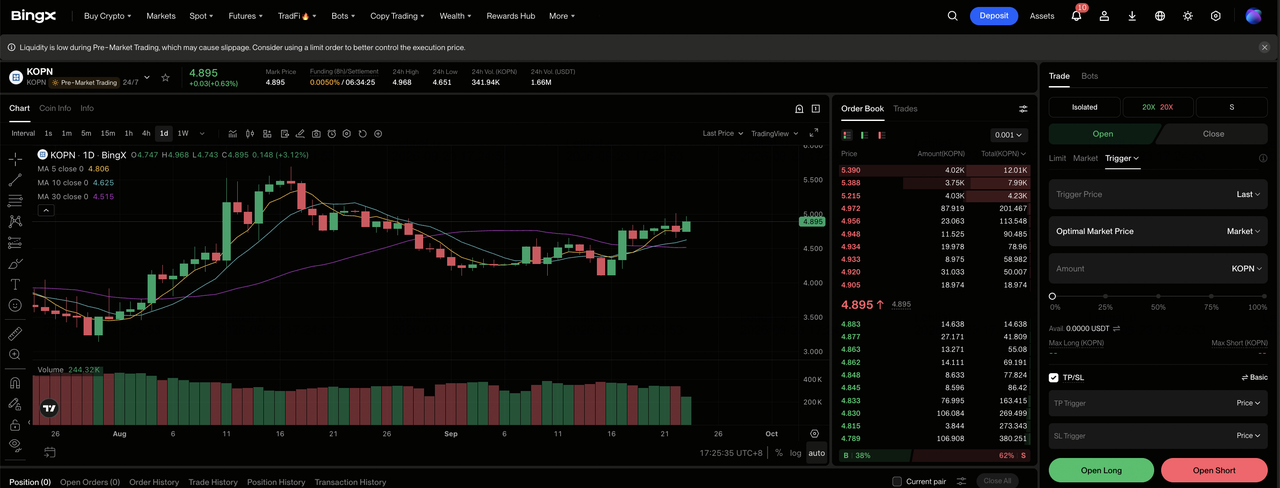
Step 1: Access BingX TradFi. Sign up and navigate to the specialized TradFi section on the BingX exchange dashboard.
Step 2: Select Kopin (KOPN). Search for and select the KOPN-USDT perpetual futures contract.
Step 3: Choose your direction. Select Open Long if defense prototypes convert and MicroLED stays on schedule. Select Open Short if awards slip or cash pressure increases.
Step 4: Select leverage and margin mode. Choose Isolated or Cross-Margin based on your risk tolerance. A 102.56% YTD gain shows why conservative leverage and sizing matter.
Step 5: Execute strict risk protocols. Set Take-Profit and Stop-Loss (TP/SL) levels before or immediately after entering the trade. KOPN can move quickly on contract awards, technical milestones, earnings and financing.
Top 5 Risks to Watch for KOPN Investors in 2026
Kopin's outlook depends on converting defense and display programs into repeat production while managing customer concentration, funding needs and a volatile small-cap valuation.
- Prototype wins may not become large production orders: Q2 product revenue rose only 2% to $7.6 million even as total revenue increased 51%. If defense and MicroLED programs stay in development longer, product growth may remain too weak to support profitability.
- Government contract timing can create uneven revenue: Sentinel FPV, Army MicroLED and thermal-imaging programs depend on procurement approvals and funding schedules. Delays could move awards and shipments between quarters even when demand remains intact.
- Large individual programs create concentration risk: Kopin generated only $12.7 million of quarterly revenue, making each major defense contract important. A delay or reduction in the $21.5 million thermal-imaging program or another large award could materially affect growth.
- Limited unrestricted cash raises dilution risk: Kopin had $24.3 million of cash and equivalents available for operations, while $26.0 million was restricted for a litigation bond. Continued losses could require additional capital and dilute existing shareholders.
- The 102.56% YTD rally leaves less room for misses: KOPN closed at $4.74 after more than doubling in 2026. Delayed production milestones, weaker orders or slower MicroLED progress could quickly compress the valuation.
Final Thoughts: Should You Invest in KOPN in 2026?
Kopin's Q2 combined 51% revenue growth, a 433% increase in non-product revenue and a $2.0 million narrower operating loss. Army-backed MicroLED, Sentinel FPV, thermal imaging and Fabric.AI give the company several concrete growth paths. The central issue is whether those programs become repeat production revenue before cash needs increase.
The Bull Case needs production conversion and better margins to support $12. The Bear Case reflects delays, cash pressure and a move toward $3. Conservative traders may watch product revenue, unrestricted cash, MicroLED timing, Sentinel FPV awards, thermal-imaging shipments and operating losses before treating the 2026 rally as durable. Product growth above Q2’s 2% rate and another reduction from the $3.5 million operating loss would provide stronger evidence that funded development is converting into scalable commercial revenue.
Risk Reminder: Trading and investing in equities like KOPN involves a risk of capital loss. Contract timing, technical execution, customer concentration, financing and leveraged trading can produce rapid losses. Conduct independent research before allocating capital.
Related Reading
- Top AI Optical Stocks to Buy in 2026: Photonics, Optics, Fiber, and Data Center Interconnects
- Top Defense Stocks to Buy in 2026: Primes, Missiles, Drones, Space, and AI-Enabled Warfare
- Applied Materials (AMAT) Price Prediction 2026: Can AI Equipment Demand Push AMAT Toward $850?
- AXT Inc. (AXTI) Price Prediction 2026: Can AI Optical Demand Push AXTI Toward $28?
- Ciena (CIEN) Price Prediction 2026: Can AI Optical Networking Demand Push CIEN Toward $400?
- Nokia (NOK) Price Prediction 2026: Can AI Networking Push NOK Toward $21?
