
Intel (INTC) designs and manufactures processors for personal computers, servers, artificial intelligence systems and network infrastructure, and also operates a contract chipmaking business. Core and Xeon processors remain central to product revenue, while Intel Foundry, advanced packaging and custom silicon are becoming more important to the long-term turnaround. This integrated model offers leverage to AI compute and U.S. semiconductor manufacturing, though it also exposes the stock to process-node execution, large capital requirements and intense competition.
Its latest quarter showed that demand recovered faster than profitability. INTC Q2 2026 revenue reached $16.13 billion, up 25.4% year over year, while adjusted EPS of $0.42 doubled the $0.21 consensus. Data Center and AI revenue jumped 59% to $6.26 billion, yet Intel Foundry still lost about $2.1 billion. The investment case depends on whether CPU growth and higher utilization can narrow those manufacturing losses.
The INTC stock forecast for 2026 now centers on two competing views:
- The AI compute and foundry case: constrained server CPU supply, stronger pricing and external 14A engagements could lift utilization, margins and confidence in Intel's manufacturing strategy.
- The execution and valuation case: persistent foundry losses, high capital spending and competition from AMD, Arm and TSMC could leave earnings below the level implied by the 2026 rally.
This guide breaks down the INTC stock forecast, 2026 price scenarios, key risks and analyst outlooks, drawing on Intel's July 23 Q2 2026 earnings release, quarterly filing and market data through September 10, plus how to trade INTC stock futures on BingX TradFi with USDT collateral.
Top 5 Things for Intel Investors to Know in September 2026
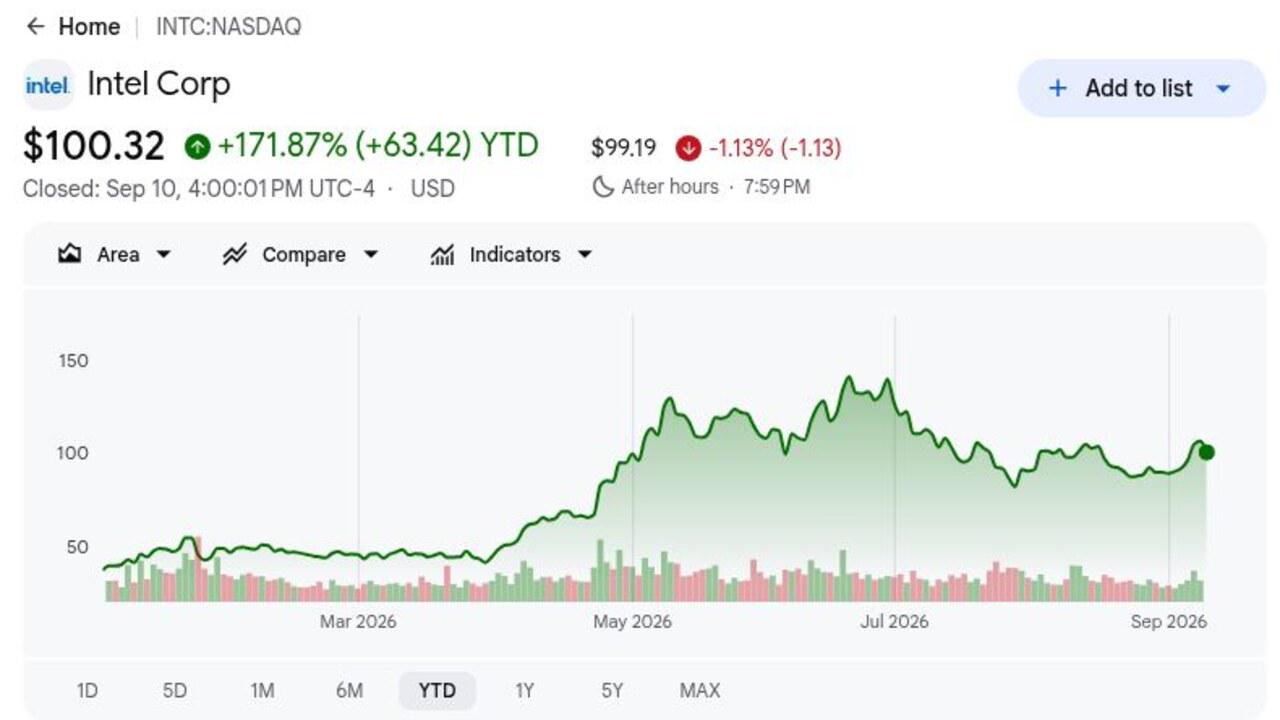
- INTC closed at $100.32 on September 10 and remained up 171.87% YTD: The rally reflects a sharp reappraisal of Intel's CPU demand and manufacturing prospects, though the stock remained roughly 30% below its $142.34 52-week high. That gap shows how quickly expectations can change when foundry progress or valuation concerns shift.
- Q2 revenue reached $16.13 billion and grew 25.4%: Sales exceeded the $14.42 billion LSEG consensus by $1.71 billion, and adjusted EPS of $0.42 doubled the $0.21 estimate. The magnitude of the beat showed that AI-related CPU demand was translating into both revenue and adjusted profit.
- Data Center and AI revenue surged 59% to $6.26 billion: The segment beat the $5.37 billion consensus by $890 million as agentic AI workloads increased server CPU demand. Intel must sustain that momentum because foundry investment still consumes substantial earnings and cash.
- Q3 revenue guidance reached $15.8 billion to $16.8 billion: The $16.3 billion midpoint stood $1.2 billion above the $15.1 billion consensus, while the capital expenditure plan rose by $2 billion to $20 billion. Stronger demand supports investment, though returns must eventually appear in margins.
- Intel committed to 14A high-volume manufacturing in 2028: Risk production is scheduled for the second half of 2027, and Tesla's Terafab engagement provides an external proof point. The long runway makes customer commitments, yields and advanced-packaging demand more important than a single quarterly revenue figure.
What Is Intel (INTC)?
Intel is an integrated semiconductor company that designs products and manufactures many of them in its own fabrication plants. Its Client Computing Group sells Core processors and platform components for notebooks and desktops, while Data Center and AI supplies Xeon CPUs, accelerators and related products for cloud, enterprise and communications systems. Intel Foundry provides wafer manufacturing, advanced packaging and process technology to internal and external customers. Revenue therefore depends on product volume and pricing as well as factory utilization, yields and customer commitments.
Intel's long-term strategy combines a stronger x86 CPU franchise with a globally distributed foundry network. Management has committed to 14A risk production in the second half of 2027 and high-volume manufacturing in 2028, supported by advanced packaging and High-NA EUV deployment. Tesla's Terafab AI-chip engagement gives 14A an external customer signal, and Intel continues building U.S. manufacturing capacity with government support. Outside semiconductors, the multi-year McLaren Racing partnership extends Intel compute across design, simulation and trackside operations rather than serving as a quarterly sales initiative.
Read More: Top AI Semiconductor Stocks to Buy in 2026: AI Chips and Supply Chain Complete Guide
Intel (INTC) Q2 2026 Earnings Overview: Revenue, EPS and AI CPU Growth
Intel delivered $16.13 billion in Q2 revenue versus $14.42 billion expected, adjusted EPS of $0.42 versus $0.21 expected, and $6.26 billion of Data Center and AI revenue, up 59%. Intel Foundry revenue rose 31% to $5.77 billion, though the unit still lost about $2.1 billion. Q3 revenue guidance of $15.8 billion to $16.8 billion exceeded consensus, leaving investors to weigh stronger demand against the cost of manufacturing expansion.
Read More: Intel (INTC) Q2 2026 Earnings News: $16.13B Revenue Beat Overshadowed by a 7.89% Drop
|
Financial Metric |
Guidance / Consensus |
Reported / Actual |
Surprise |
|
Q2 2026 revenue |
$14.42B LSEG consensus |
$16.13B |
Beat. $1.71B above consensus; up 25.4% YoY. |
|
Q2 non-GAAP diluted EPS |
$0.21 LSEG consensus |
$0.42 |
Beat. Doubled consensus and reversed a year-ago $0.10 loss. |
|
Q2 GAAP net loss |
— |
$11.0B loss |
Distorted. Included $13.6B of mark-to-market losses tied to the Secure Enclave agreement. |
|
Q2 non-GAAP net income |
— |
$2.2B |
Improved. Strong demand produced positive adjusted earnings. |
|
Q2 GAAP gross margin |
— |
40.10% |
Expanded. Better mix and utilization supported recovery. |
|
Data Center and AI revenue |
$5.37B consensus |
$6.26B; +59% YoY |
Beat. $890M above consensus. |
|
Client Computing revenue |
$7.89B consensus |
$8.88B |
Beat. $990M above consensus. |
|
Intel Foundry revenue |
$5.55B consensus |
$5.77B; +31% YoY |
Beat. $220M above consensus, though operating loss remained about $2.1B. |
|
Q2 operating cash flow |
— |
$7.0B |
Positive. Supported higher manufacturing investment. |
|
Q3 2026 revenue outlook |
$15.1B consensus |
$15.8B–$16.8B |
Above. Midpoint exceeds consensus by $1.2B. |
|
Q3 non-GAAP EPS outlook |
$0.27 consensus |
$0.38 |
Above. Eleven cents ahead of consensus. |
|
2026 capital expenditure |
Prior $18B |
$20B |
Raised. Added $2B as demand and customer engagement improved. |
- Revenue of $16.13 billion beat consensus by $1.71 billion: The 25.4% year-over-year increase marked Intel's strongest growth in more than 15 years. Demand improved across both client and data-center processors, making the recovery broader than one product category.
- Adjusted EPS of $0.42 exceeded consensus by $0.21: The result reversed a year-ago adjusted loss of $0.10 per share. Non-GAAP net income of $2.2 billion showed stronger revenue was beginning to translate into operating leverage.
- Data Center and AI revenue of $6.26 billion beat by $890 million: The segment grew 59%, supporting the view that agentic AI can lift CPU demand alongside accelerators. Sustained Xeon demand could improve product mix and factory utilization.
- Foundry revenue rose 31% to $5.77 billion, but the unit still lost about $2.1 billion: The $220 million revenue beat showed improving traction. Higher utilization and better gross margins remain necessary before foundry becomes a meaningful earnings contributor.
- The Q3 revenue midpoint exceeded consensus by about $1.2 billion: Guidance of $15.8 billion to $16.8 billion and a $2 billion capex increase signal confidence in demand. The roughly $20 billion investment plan still raises the burden on cash conversion and future returns.
Read More: Top AI Semiconductor Stocks to Buy in 2026: AI Chips and Supply Chain Complete Guide
Intel Stock Price Prediction 2026: $145 Bull Case vs. $60 Bear Case
Intel's investment outlook depends on whether the 2026 CPU rebound can finance a credible foundry transition. The scenarios below are editorial ranges rather than Wall Street promises, and each requires observable changes in segment growth, margins, customer commitments and capital returns.
The Bull Case: Strong AI Server Demand Pushes INTC Toward $145
The Bull Case assumes server CPU shortages support pricing, Data Center and AI revenue continues growing well above Intel's average, and Foundry converts customer interest into committed wafer and packaging volume. Higher utilization would help revenue outpace fixed manufacturing costs and lift gross margin above Q2's 40.1%.
A move toward $145 would require Q3 revenue near the $16.8 billion ceiling, continued adjusted profitability and more 14A customers before the 2027 risk-production window. BofA's $135 target provides a bullish Street reference, though further upside also requires evidence that the $2.1 billion Foundry loss is narrowing.
The Base Case: Steady CPU Demand Keeps INTC Between $85 and $115
The Base Case assumes strong Xeon demand and higher-value PC processors keep revenue healthy, while Foundry losses improve gradually. Intel stays on track for its 2028 14A schedule and executes the $20 billion capex plan, though investors wait for clearer external-customer economics before assigning more value to its manufacturing assets.
Under this scenario, INTC could trade mainly between $85 and $115. Revenue within the Q3 range, adjusted EPS near $0.38 and steady gross-margin progress would support the band. A renewed product slowdown or larger Foundry loss would weaken the upper end.
The Bear Case: Foundry Losses and Chip Delays Pull INTC Toward $60
The Bear Case assumes CPU supply normalizes before Intel establishes durable pricing power, while AMD and Arm-based systems take more share. If external 14A commitments remain limited, Intel would carry factory depreciation, R&D costs and capacity spending without enough third-party revenue to absorb them.
A move toward $60 would become more likely if Data Center and AI growth falls sharply below 59%, gross margin retreats from 40.1%, or the 2027 risk-production schedule slips. Weaker operating cash flow alongside $20 billion of capex would increase financing or dilution concerns and pressure the valuation.
Intel Stock Price Forecasts for 2026 By Wall Street Analysts
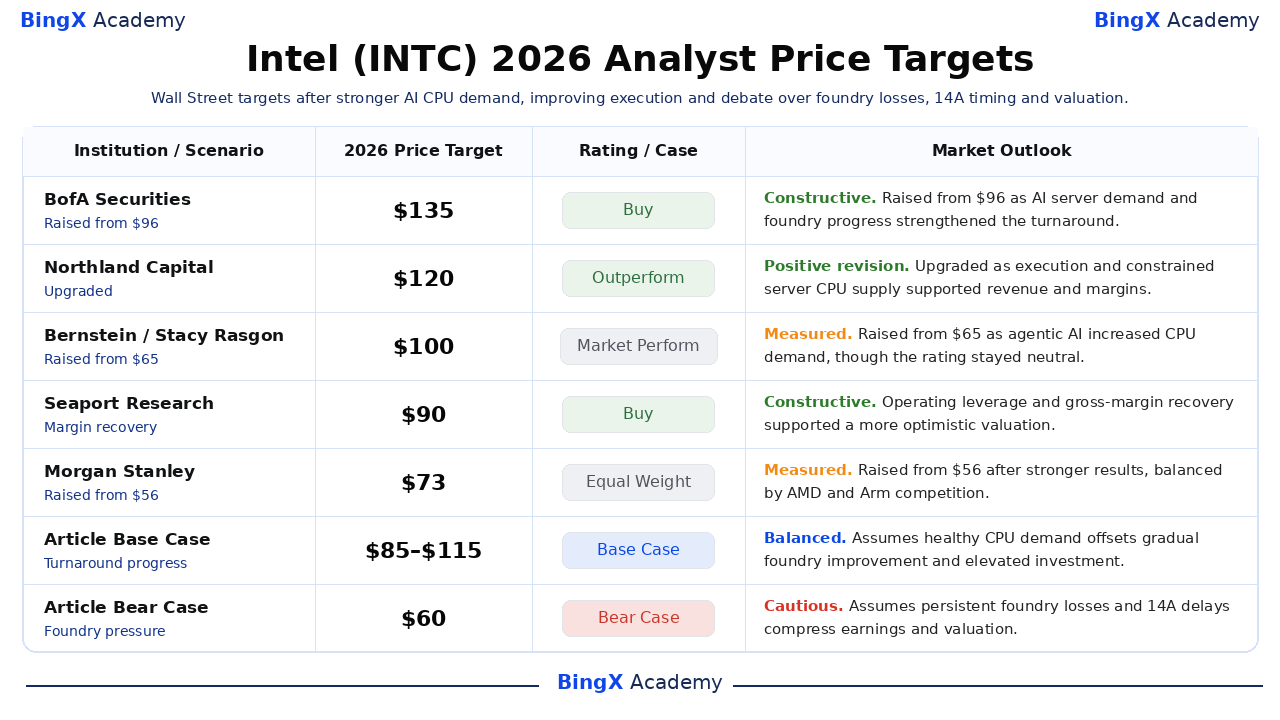
Intel targets span $70 to $135, reflecting disagreement over whether AI CPU demand and foundry engagements justify the stock's rapid re-rating. The higher targets assume margin recovery and customer wins, while cautious targets recognize the time and capital required to make 14A economically competitive.
|
Institution |
2026 Price Target |
Rating |
Market Outlook |
|
BofA Securities |
$135 |
Buy |
Constructive. June 11: raised from $96 in a double upgrade as AI server CPUs and foundry customer prospects strengthened. |
|
Northland Capital |
$120 |
Outperform |
Positive revision. September 8: upgraded from Market Perform as execution improved and server CPU supply remained constrained. |
|
Bernstein |
$100 |
Market Perform |
Measured. June 17: raised from $65 as agentic AI increased CPU demand, while retaining a neutral rating. |
|
Seaport Research |
$90 |
Buy |
Constructive. April 24: higher operating leverage and a stronger margin profile supported a more optimistic valuation. |
|
Morgan Stanley |
$73 |
Equal Weight |
Measured. April 24: raised from $56 after stronger results, balanced by AMD and Arm competitive risks. |
|
KeyBanc |
$70 |
Overweight |
Constructive. April 6: raised from $65 as CPU shortages supported expected 10%–15% pricing actions. |
|
Article Base Case |
$85–$115 |
Base Case |
Balanced. Assumes healthy CPU demand offsets gradual foundry improvement and elevated investment. |
|
Article Bear Case |
$60 |
Bear Case |
Cautious. Assumes persistent foundry losses and 14A delays compress earnings and valuation. |
How to Trade Intel (INTC) Stock on BingX
Trade Intel's AI CPU demand, foundry execution and 14A outlook using BingX TradFi and BingX AI tools. Because INTC can react sharply to customer announcements, manufacturing milestones and margin guidance, traders should define both the catalyst and risk limits before entering a position.
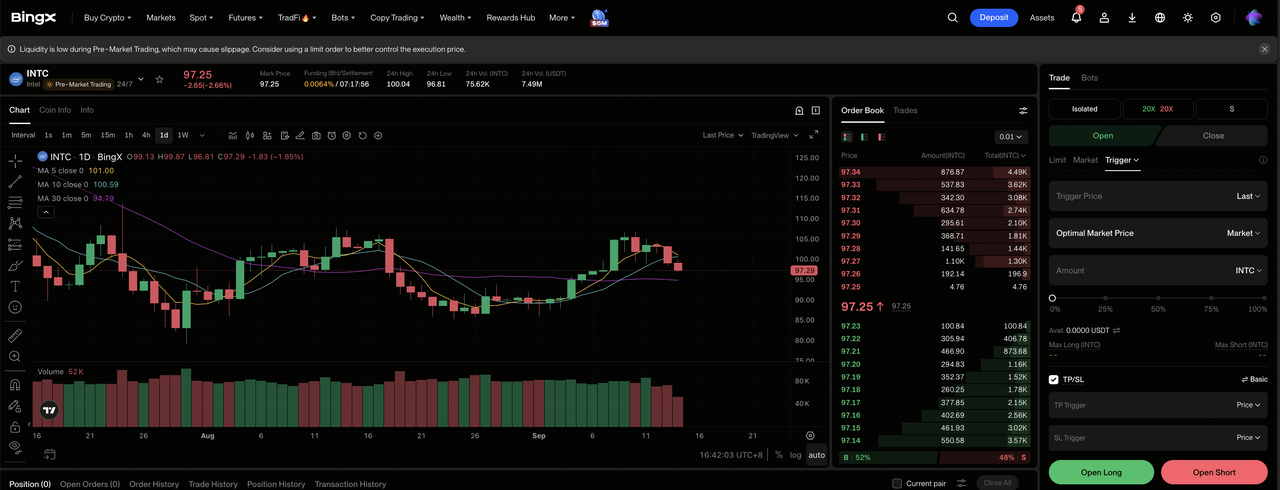
Step 1: Access BingX TradFi. Sign up and navigate to the specialized TradFi section on the BingX exchange dashboard.
Step 2: Select Intel (INTC). Search for and select the INTC-USDT perpetual futures contract.
Step 3: Choose your direction. Select Open Long if AI CPU growth remains strong and foundry losses narrow. Select Open Short if 14A timing slips or margins weaken.
Step 4: Select leverage and margin mode. Choose Isolated or Cross-Margin based on your risk tolerance. The 171.87% YTD move and 30% retreat from the 52-week high show why conservative leverage and clear position sizing are important.
Step 5: Execute strict risk protocols. Set Take-Profit and Stop-Loss (TP/SL) levels before or immediately after entering the trade. INTC can react quickly to Xeon demand, customer wins, capex changes, gross-margin guidance and manufacturing milestones.
Top 5 Risks to Watch for Intel Investors in 2026
Intel's recovery depends on both product demand and a capital-intensive manufacturing turnaround. These risks can affect earnings, cash flow and valuation.
- Foundry losses can absorb product profits: Intel Foundry generated $5.77 billion in Q2 revenue but lost about $2.1 billion. Slow improvements in utilization and yields could keep consolidated earnings under pressure.
- A $20 billion capex plan raises cash and dilution risk: Intel increased planned spending from $18 billion after stronger demand. If the $7.0 billion Q2 operating cash inflow is not sustained, factory investment could pressure free cash flow or require more financing.
- AMD and Arm can pressure CPU share and pricing: Intel's $6.26 billion DCAI result benefited from server supply constraints and AI demand. Stronger competition could weaken the 10%–15% pricing power expected by KeyBanc and pressure margins.
- 14A execution remains a multi-year dependency: Risk production is planned for the second half of 2027, with volume manufacturing targeted for 2028. Yield problems, equipment delays or limited external commitments could push revenue further out.
- Accounting and capital structure can obscure per-share progress: Q2's $11.0 billion GAAP loss included $13.6 billion of mark-to-market charges, versus $2.2 billion of non-GAAP income. Large strategic or equity transactions could still create volatility and dilution.
Final Thoughts: Should You Invest in Intel in 2026?
Intel's $16.13 billion Q2 revenue, $0.42 adjusted EPS and 59% Data Center and AI growth provide tangible evidence that the operating turnaround has advanced. The unresolved issue is economic conversion. A $2.1 billion Foundry loss and $20 billion capex plan mean stronger sales must produce higher margins, customer commitments and durable cash flow.
Investors should monitor DCAI growth, Foundry operating loss, gross margin, external 14A commitments and operating cash conversion. Continued improvement supports the $85 to $115 base case and could open a path toward $145. A delayed node ramp, renewed share losses or heavier financing needs would make the $60 bear case more relevant.
Risk Reminder: Stock-linked perpetual futures are leveraged products. Prices can move rapidly, losses may exceed the initial margin committed, and third-party analyst targets do not guarantee future performance. Use position limits, conservative leverage and predefined exits.
Related Reading
- Top 10 AI Infrastructure Stocks to Buy in 2026: Chip Manufacturing and Design Leaders
- Top AI Semiconductor Stocks to Buy in 2026: AI Chips and Supply Chain Complete Guide
- Top 10 AI Hardware Stocks to Watch in 2026: The Architecture Driving Next-Gen Intelligence
- Top AI Data Center Stocks to Buy in 2026: Cloud, Servers, and AI Compute Infrastructure
- Top High-Performance Computing (HPC) Stocks to Watch in 2026: Accelerated Computing Market Leaders
