

Litecoin (LTC) continues to be a cornerstone of the Proof-of-Work (PoW) ecosystem in 2026. Often referred to as the digital silver to Bitcoin's gold, Litecoin’s network produces blocks every 2.5 minutes, four times faster than its predecessor. As the market matures, the security provided by Litecoin’s miners remains essential for global decentralized commerce.
For beginners entering the space in 2026, mining Litecoin is no longer a task for standard PCs. It requires specialized hardware known as ASICs (Application-Specific Integrated Circuits) designed to solve the Scrypt algorithm. While the technical barrier has risen, the integration of new privacy features like MWEB and the continued growth of the hashrate, currently around 2.1 PH/s, make mining an active way to contribute to the network's thermodynamic security while earning LTC rewards.
What Is Litecoin Mining and How Does It Work?
Litecoin mining is the competitive process of dedicating hardware to solve complex cryptographic puzzles to validate transactions and secure the LTC blockchain. In 2026, the network produces a new block approximately every 2.5 minutes, which is four times faster than Bitcoin. For each block successfully added to the chain, miners are currently rewarded with 6.25 LTC plus transaction fees.
This mechanism serves as the backbone of Litecoin's Proof-of-Work (PoW) model, ensuring the network remains censorship-resistant. To maintain this decentralization, the network relies on a global, distributed hashrate. In 2026, the total network hashrate has reached a formidable 2.1–2.3 PH/s, reflecting a high level of institutional-grade security.
Read more: How to Mine Bitcoin (BTC) in 2025: A Beginner's Guide
What Is the Role of Scrypt in Litecoin Mining?
While Bitcoin utilizes the SHA-256 algorithm, Litecoin employs Scrypt. Scrypt was specifically designed to be more memory-intensive, requiring rapid access to high-speed RAM rather than just raw processing speed.
In the early 2010s, this allowed hobbyists to mine with standard GPUs. However, in 2026, the environment has shifted entirely to Scrypt-specific ASICs. These machines utilize specialized memory buffers to handle the Scrypt work with exponentially higher efficiency. For example, a modern ASIC like the Antminer L11 can output 21 GH/s, making general-purpose hardware (which might output only a few MH/s) virtually obsolete in terms of profitability.
Read more: How to Mine Dogecoin in 2026: A Complete Guide
Key Metrics to Watch for Litecoin Miners in 2026
Success in mining LTC depends on real-time data analysis. Below are the critical metrics to monitor:
- Network Hashrate (2.2 PH/s Avg.): This is the total computing power of the entire Litecoin network. If the hashrate rises while your personal hashrate remains static, your probability of finding a block and earning rewards decreases.
- Mining Difficulty (90 Million): Every 504 blocks, roughly every 3.5 days, Litecoin’s difficulty adjusts. If more miners join the network, the puzzles become harder to solve. This ensures the 2.5-minute block time remains consistent regardless of how much power is added.
- MWEB Peg-In/Peg-Out Volume: With the MimbleWimble Extension Block (MWEB), miners are now responsible for validating confidential transactions. Monitoring MWEB liquidity, which is currently averaging 150,000 LTC locked, is essential, as miners earn fees from these private transactions.
- Electrical Efficiency (J/MH): In 2026, the Golden Ratio for profitability is an efficiency of 0.17 to 0.22 J/MH. Machines operating outside this range often fail to cover their electricity costs at standard residential rates.
Read more: Cloud Mining vs. Staking Crypto: What’s a Better Way to Earn Passive Income in 2026?
Why Mine Litecoin (LTC) in 2026: 5 Key Strategic Benefits
For infrastructure-focused investors and technical hobbyists, mining LTC in 2026 represents a unique utility-first investment. Unlike many newer protocols, Litecoin's value proposition for miners is built on over 14 years of network uptime and a massive lead in physical payment adoption.
- Double-Dip Revenue: Merged Mining with Dogecoin - Litecoin’s greatest competitive edge is Auxiliary Proof-of-Work (AuxPoW). By securing the Scrypt-based Dogecoin (DOGE) network simultaneously, miners earn two separate reward streams for the same unit of electricity. In 2026, DOGE rewards often contribute significantly to the overall Satoshi-equivalent yield, acting as a crucial hedge against LTC price volatility.
- Deep Liquidity and High Velocity in Commerce - Litecoin remains the Medium of Exchange king. Data from major payment processors shows LTC consistently ranking as a top-three payment method alongside BTC and ETH. For miners, this high transaction volume translates into a consistent and growing fee market, ensuring that even as block rewards halve, transaction throughput provides a sustainable revenue floor.
- Institutional Stability via Spot Litecoin ETFs - The 2025 launch of the Canary Litecoin ETF (LTCC) has fundamentally changed the mining risk profile. Institutional accumulation through ETFs provides a price floor and reduces the flash crash risks seen in previous cycles. For miners, this means more predictable ROI (Return on Investment) calculations when amortizing the high upfront cost of ASIC hardware like the Bitmain L11.
- 100% Fair Launch and Regulatory Clarity - In an era of regulatory scrutiny regarding pre-mined tokens and insider allocations, Litecoin stands as a pure commodity. Every single one of the 77.1 million LTC currently in circulation was either mined or purchased on the open market. This fair distribution minimizes the risk of sudden supply dumps from venture capital firms and positions LTC favorably under global financial regulations.
- Enhanced Privacy Protocol (MWEB) Adoption - The MimbleWimble Extension Block (MWEB) has matured in 2026, with over $10 million in value frequently locked in the privacy layer. Miners who support MWEB earn specialized fees for processing confidential transactions. This feature allows Litecoin to compete with privacy-focused coins while maintaining the transparency required for listing on major centralized exchanges.
How to Start Mining Litecoin: A Step-by-Step Guide
Launching a mining operation in 2026 requires a strategic combination of specialized hardware, updated software, and optimized power management to ensure a profitable return on investment.
- Choose Your Hardware: In 2026, the most effective miners are the Bitmain Antminer L11 and the VolcMiner D1 series. For home-based beginners, compact units like the PlebSource Hammer or ElphaPex DG2 Mini are preferred for their lower noise levels and power consumption.
- Set Up a Secure Wallet: You will need a wallet that supports the latest network updates. Litecoin Core v0.21.5.4 is highly recommended to ensure compatibility with recent security patches following the April 2025 MWEB-related reorg.
- Join a Mining Pool: Solo mining is virtually impossible for beginners. Pools like ViaBTC, LitecoinPool.org, or F2Pool allow you to combine your hashrate with others to receive steady, daily payouts.
- Configure Your ASIC
- Connect the miner to your home network via Ethernet.
- Access the miner’s IP dashboard via your web browser.
- Enter the Stratum URL of your chosen pool and your LTC wallet address.
Bonus: The Merged Mining Advantage to Mine LTC and DOGE
While this guide focuses on Litecoin, the Scrypt algorithm allows for Merged Mining. This means that while you mine Litecoin, you can simultaneously mine Dogecoin (DOGE) on the same setup without any additional electricity cost or hardware. This two-for-one reward system significantly improves the ROI of Scrypt ASICs.
Read more: $DOGE Price Prediction: Will Dogecoin Hit $1 in 2025?
How to Buy Litecoin (LTC) on BingX
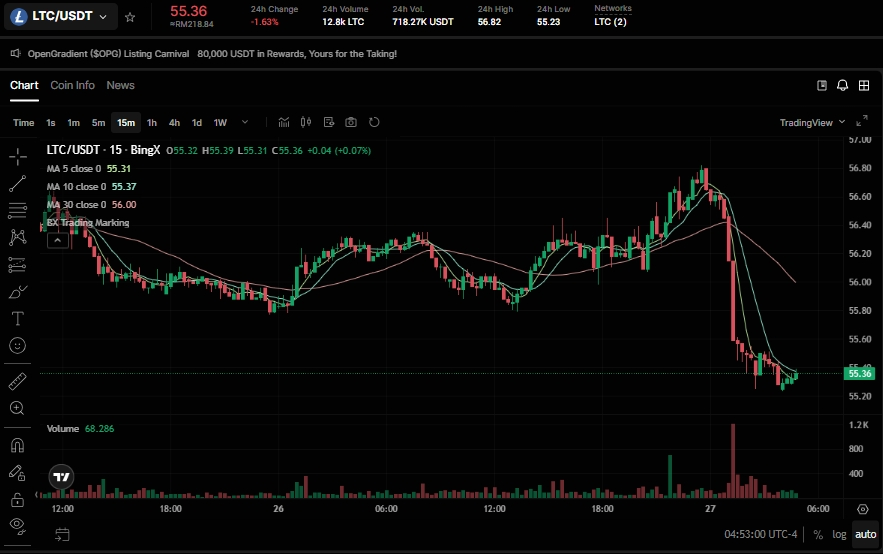
LTC/USDT trading pair on BingX spot market
If you aren't ready to invest in hardware, you can participate in the Litecoin economy directly via BingX. Here's how to buy LTC on BingX spot market.
- Fund Account: Deposit USDT or buy it via the Buy Crypto tab.
- Spot Market: Navigate to the LTC/USDT pair.
- Buy: Use a Market Order for an instant purchase or a Limit Order to target a specific price point.
- Stake: Use BingX Earn to lock your LTC and earn passive rewards similar to a mining yield without the hardware overhead.
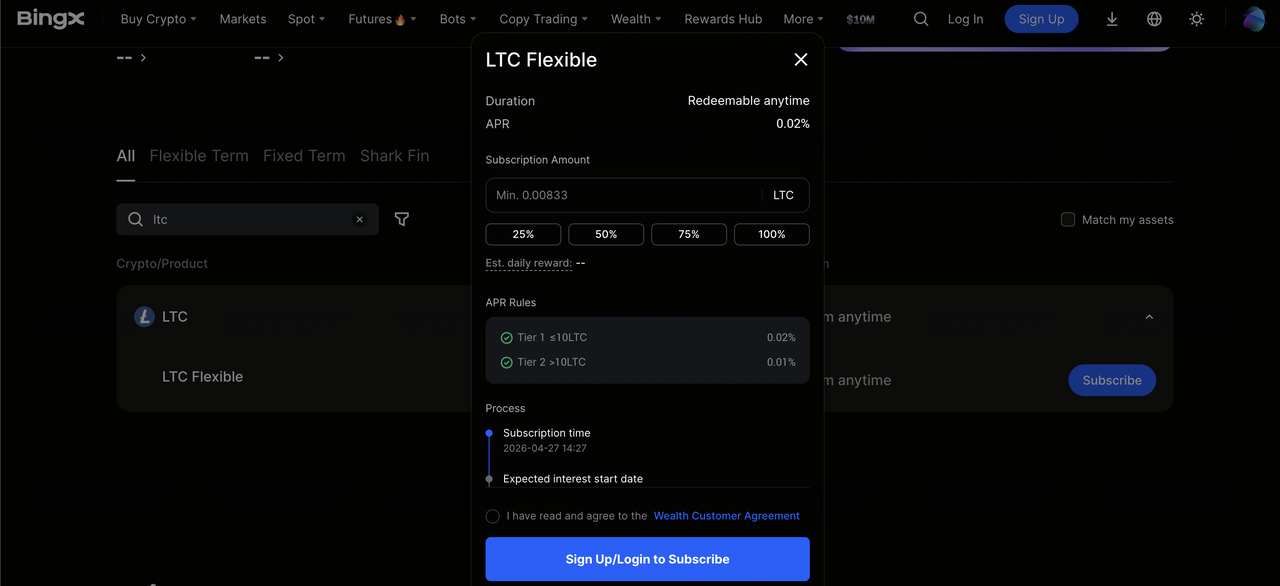
Earn passive income on Litecoin holdings with BingX Earn
Top 5 Risks and Considerations for Litecoin Mining in 2026
Navigating the Litecoin mining landscape in 2026 requires a proactive approach to technical security and a rigorous analysis of operational overhead to remain competitive in a high-hashrate environment.
- Software Synchronization and Patch Management: As evidenced by the 13-block chain reorg on April 25, 2026, failing to update to the latest node software (currently Litecoin Core v0.21.5.4) can leave your operation vulnerable to exploits and lead to the rejection of your mined blocks by the rest of the network.
- Electricity Arbitrage: With network difficulty at historic highs, profitability is razor-thin; if your electricity costs exceed $0.10–$0.12/kWh, the depreciation and power consumption of your ASIC may outweigh the market value of the LTC produced, making direct acquisition a more viable strategy.
- MWEB Stability and Regulatory Shifts: While the MimbleWimble Extension Block (MWEB) provides valuable privacy, it introduces technical complexity that can lead to network forks if not properly managed, and any future regulatory pivot against privacy-enhanced coins could impact the liquidity of your rewards on certain exchanges.
- Hardware Obsolescence Cycles: The Scrypt ASIC market moves rapidly, and older machines with an efficiency rating above 0.25 J/MH risk becoming e-waste if the LTC/DOGE price ratio does not keep pace with the increasing network difficulty.
- Merged Mining Dependency: Since a significant portion of Scrypt mining revenue now relies on Dogecoin rewards, your total profitability is heavily exposed to the market volatility of two separate assets rather than just Litecoin alone.
Final Word: Is Litecoin Mining Right for You in 2026?
Litecoin mining in 2026 remains a viable path for those with access to industrial-grade hardware and competitive electricity rates, typically below $0.06/kWh. The maturity of the Scrypt ASIC market and the reliable secondary revenue from Dogecoin merged mining provide a more structured ROI profile than many newer, more volatile PoW projects. However, the recent April 2026 chain reorg serves as a practical reminder that success requires constant technical vigilance and the immediate implementation of mandatory software patches to protect your rewards.
For retail participants without specialized infrastructure, the high upfront cost of high-efficiency machines like the Bitmain L11 may not outweigh the simplicity of direct accumulation. While mining offers the unique benefit of generating virgin coins with no transaction history, the narrow margins in a high-hashrate environment mean that even minor shifts in network difficulty or energy costs can turn a profitable operation into a loss-making venture.
Risk Reminder: Cryptocurrency mining involves significant financial risk, including hardware depreciation, fluctuating network difficulty, and extreme price volatility. There is no guarantee of profit, and you should never invest more capital than you can afford to lose. Always perform a rigorous cost-benefit analysis based on your specific local energy costs and regulatory environment before purchasing hardware.
Related Reading
- What Are the Top Proof-of-Work (PoW) Coins to Mine in 2026?
- How to Mine Bitcoin (BTC) in 2025: A Beginner's Guide
- How to Mine Dogecoin in 2026: A Complete Guide
- Cloud Mining vs. Mining Pools vs. Solo Mining: What’s the Best Way to Mine Bitcoin in 2026?
- Cloud Mining vs. Staking Crypto: What’s a Better Way to Earn Passive Income in 2026?
- Is Bitcoin Mining Still Profitable in 2026: How to Calculate BTC Mining Profitability?
FAQs on Litecoin Mining
1. How long does it take to mine 1 LTC?
With a mid-range ASIC in a pool, this depends on the network difficulty. In 2026, a high-end Antminer L11 can often generate 1 LTC in just a few days.
2. Is there a risk of slashing in Litecoin mining?
No. Slashing is a PoS concept. In PoW, the "risk" is simply the cost of electricity if your miner fails to find a valid block or works on an invalid chain.
3. What is the current Litecoin block reward?
As of April 2026, the reward is 6.25 LTC. The next halving is expected in July 2027, which will reduce the reward to 3.125 LTC.
4. When is the next Litecoin halving?
The next Litecoin halving is projected to occur in July 2027. During this event, the block reward will be reduced by 50%, dropping from 6.25 LTC to 3.125 LTC.
