

In the 2026 crypto landscape, the infrastructure for cashing out Ethereum has bifurcated into two distinct philosophies. The Direct Sale route prioritizes simplicity and speed, moving assets from ETH to fiat in a single step. Conversely, the Stablecoin Route, swapping to USDC or USDT before exiting to a bank, has become the gold standard for medium-to-large transactions, offering a hedge against settlement-time volatility and access to deeper liquidity pools.
As Ethereum trades around the $2,000-$2,200 range in April 2026, understanding the invisible costs of these routes, specifically slippage and capital gains reporting, is essential. Whether you are cashing out $500 for a weekend trip or $50,000 for a down payment, your choice of route can mean the difference of hundreds, or even thousands, of dollars in leakage.
1. The Direct Sale Route: Simplicity and Speed to Convert Ethereum to Dollars
The direct sale method functions as a streamlined, single-tier transaction where Ethereum is liquidated immediately against a fiat order book. In 2026, this remains the most practical route for casual investors cashing out under $5,000, as it consolidates the exit into one taxable event and bypasses the secondary gas fees associated with swapping to an intermediary asset.
On high-performance exchanges like BingX, this process is often coupled with RTP (Real-Time Payments) or SEPA Instant rails, allowing funds to transition from a digital wallet to a traditional bank account in under 30 minutes. However, the trade-off for this convenience is lower order book depth; because ETH/USD pairs often lack the institutional liquidity found in stablecoin pools, executing large market orders here can trigger 0.3% to 0.8% in slippage, making it less efficient for whale transactions compared to the stablecoin route.
Advantages of Direct Sales for Converting ETH to USD
- Reduced Complexity: Ideal for newcomers who want to avoid the technical overhead of managing multiple trades.
- One-Step Execution: You move from a volatile crypto asset to spendable fiat in seconds, triggering only a single disposal event for tax record-keeping.
- Near-Instant Rails: In 2026, many CEXs use RTP (Real-Time Payments) or SEPA Instant, allowing the USD to hit your bank account almost as soon as the trade clears.
The Downside of Direct Sales: The Liquidity Gap
The primary risk of direct sales is slippage. Even in 2026, the liquidity for ETH/USD is often shallower than ETH/USDT. For a $20,000 sell order, a direct fiat pair might slip by 0.3%–0.5%, whereas the stablecoin pair remains stable.
2. The Stablecoin Route: The Professional’s Choice
For high-net-worth individuals and institutional traders, the stablecoin route serves as a professional-grade execution strategy designed to minimize market impact and settlement risk. By first swapping ETH for USDC, which in 2026 is favored for its audited reserves and seamless integration with US regulated banks, traders tap into the deepest liquidity pools in the crypto ecosystem, often reducing slippage to near-zero even on six-figure trades.
This two-step process effectively freezes the realized profit at the moment of the swap, shielding the user from Ethereum’s intraday volatility while the legacy banking system processes the final USD off-ramp. Furthermore, using an intermediate stablecoin allows for a more flexible exit; instead of moving the entire balance to a bank, traders can keep a portion of their dry powder in tokenized treasuries on-chain to earn passive yields of 4–5% until fiat is required for real-world expenses.
Why the Stablecoin Route Often Wins: Key Advantages of ETH to Stablecoin Conversion
- Slippage Compression: ETH/USDC and ETH/USDT pairs house the vast majority of Ethereum's global liquidity. By swapping here first, you ensure your execution price is as close to the global spot as possible.
- The Volatility Buffer: Bank withdrawals can occasionally face 24-hour delays. If you sell ETH directly and the transaction hits a snag, you are still in the trade until it settles. Swapping to a stablecoin first freezes your USD value, protecting your profit from a sudden market dump while your bank processes the ACH.
- Optimized Off-Ramps: Platforms like BingX, via Legend Trading, have optimized the stablecoin-to-fiat pipeline. In many cases, the combined fee of Swap + Withdrawal is lower than the high-spread Simple Buy/Sell fees charged for direct fiat trades.
The Downside of Converting ETH to Stablecoins: Operational Friction, Double Exposure
While liquid, the stablecoin route introduces multi-step friction and double disposal tax complexity. In 2026, every swap, from ETH to USDC and then USDC to USD, is a taxable event, requiring precise cost-basis tracking for 1099-DA reporting even if the stablecoin leg has zero gain.
Operationally, you are also exposed to stablecoin de-pegging risk; although rare for assets like USDC, any technical glitch or banking delay during the 24-hour window between the swap and the fiat withdrawal could temporarily trap your capital in a digital asset that is not yet hard cash. Additionally, on-chain traders must account for network gas fees, which, despite being under $0.30 on Layer 2s like Base or Arbitrum, still represent an extra layer of cost and technical touchpoints compared to the one-click simplicity of a direct sale.
Read more: USDC vs. USDT: Key Differences and Which Stablecoin to Choose in 2026?
Converting Ethereum to US Dollars: Direct Sale vs. Stablecoin Route at a Glance
Deciding whether it is better to convert ETH to USD or stablecoins when cashing out your Ethereum holdings depends heavily on your transaction volume. In 2026, the market has matured to offer specialized advantages for each path.
|
Feature |
Direct Sale (ETH → USD) |
Stablecoin Route (ETH → USDC → USD) |
|
Best For |
Small amounts (<$5k), beginners, and urgent speed. |
Medium-to-large amounts (>$10k) and volatile markets. |
|
Steps |
1 (Sell ETH for USD) |
2 (Swap ETH to Stable, then Sell for USD) |
|
Slippage |
Higher on large orders due to thinner fiat pairs. |
Lower; ETH/Stablecoin pairs are the deepest in the market. |
|
Volatility Risk |
Exposed to ETH price swings during settlement. |
Value is "locked" in USD terms immediately. |
|
Complexity |
Low (Single taxable event in some regions). |
Moderate (Two steps, two disposals for tax). |
In 2026, the direct ETH-to-USD route is the premier choice for retail liquidations under $5,000, where simplicity outweighs the marginal gains of multi-step hedging. On Tier-1 exchanges like BingX, users benefit from a single taxable disposal event and immediate access to real-time payment rails like RTP or SEPA Instant, often settling in under 60 minutes. While 'Simple Sell' interfaces can carry spreads as high as 1.5%, utilizing advanced spot markets reduces execution fees to a baseline of 0.1%–0.4%. However, because ETH/USD fiat pairs typically hold only 20–30% of the order book depth compared to stablecoin pairs, larger direct orders face invisible costs through slippage that can easily erode 0.5%–1.2% of the total principal.
For transactions exceeding $10,000, the stablecoin route (ETH → USDC/USDT → USD) is the mathematically superior path due to deeper liquidity and volatility insulation. By swapping ETH for USDC first, which in 2026 maintains the tightest regulatory alignment for onshore US banking, traders lock in their dollar-denominated value instantly, neutralizing the risk of an ETH price drop during the 24–48 hour bank settlement window.
Data from high-liquidity gateways like Legend Trading show that the combined leakage of this route is approximately 0.14%, significantly outperforming direct fiat pairs for whale-sized moves. This method also allows for dry powder management, enabling users to park gains on-chain and earn 4–5% yields in tokenized cash management solutions until they are ready to trigger the final fiat off-ramp.
Total Cost of Exit: 2026 ETH to USD Conversion Fee Comparison
Retaining your capital requires looking at the Total Leakage, the sum of trading fees, spreads, and withdrawal surcharges.
|
Method |
Avg. Leakage (Small <$5k) |
Avg. Leakage (Large >$50k) |
|
Direct Sale (CEX) |
0.15% - 0.45% |
0.50% - 1.2% (due to slippage) |
|
Stablecoin Route (BingX) |
0.20% - 0.30% |
0.14% - 0.25% |
|
Direct-to-Card (MetaMask) |
2.5% - 4.5% |
Not Recommended |
|
OTC Desk |
N/A |
Negotiated (Best for $100k+) |
Converting ETH to USD: Which Route Is Better for You?
Determining the optimal path depends on your transaction volume, as the 2026 market offers specialized advantages that vary significantly between small-scale liquidations and institutional-sized moves.
For Beginners and Small Cash-Outs: Direct Sale
If you are cashing out less than $5,000, the difference in slippage is negligible (often less than the cost of an extra gas fee). Stick to a reputable CEX like BingX and use a Limit Order on the advanced trading interface to keep fees at or below 0.1%.
For Medium-to-Large Holders: Stablecoin Route
If your transaction exceeds $10,000, use the stablecoin route.
- Swap ETH to USDC/USDT on the BingX Convert tool for 0% fee.
- Withdraw via the Convert Fiat feature to Legend Trading. This path ensures you capture the deepest liquidity and lock in your gains against 2026's market volatility.
How to Convert Ethereum (ETH) to US Dollar (USD) on BingX
Converting Ethereum (ETH) to USD on BingX in 2026 is a streamlined process, primarily facilitated through the Convert tool and the Legend Trading fiat gateway. Depending on your strategy, you can either sell directly or use the stablecoin route.
Option 1: The Direct Sale of ETH to USD
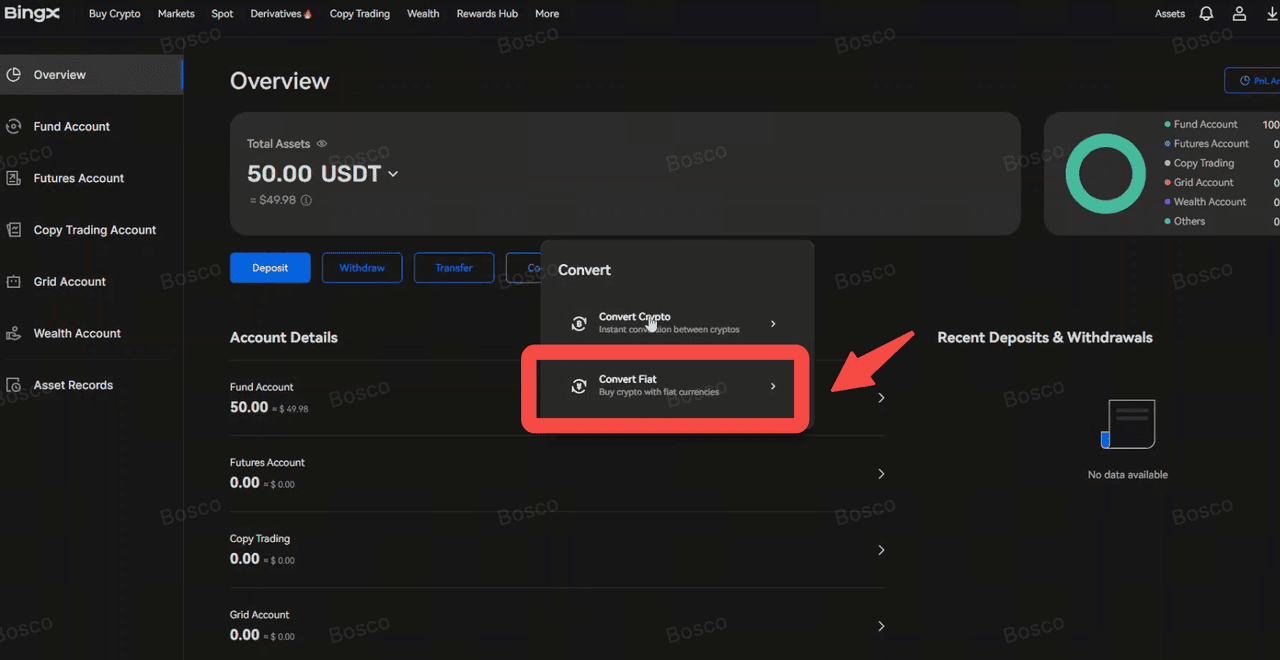
Best for small amounts and maximum speed.
- Log In and Transfer: Ensure your ETH is in your Fund Account. If it is in your Spot account, use the Transfer button to move it to Fund.
- Access Convert Fiat: On the top navigation bar, hover over Buy Crypto and select Convert Fiat.
- Set the Pair: Choose ETH as the From currency and USD as the To currency.
- Execute: Enter the amount of ETH you wish to sell. Review the real-time exchange rate and click Convert.
- Withdraw to Bank: Once your Fund Account reflects a USD balance, click Withdraw, select Fiat Withdrawal, and choose your linked bank account (processed via Legend Trading).
Option 2: The Stablecoin Route of ETH to USDT/USDC to USD
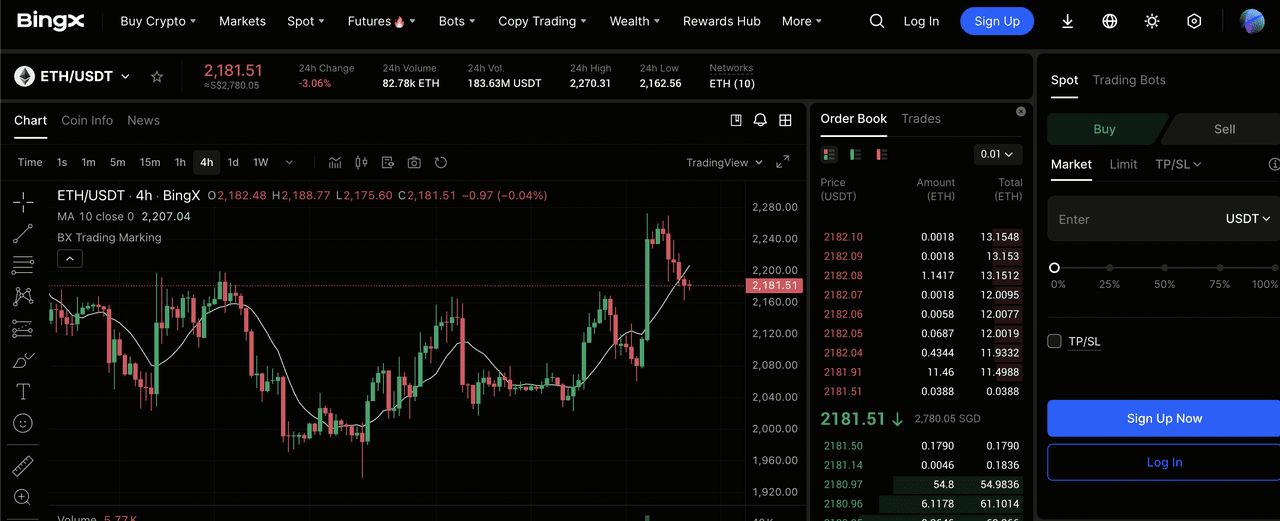
ETH/USDT trading pair on the spot market
Best for medium-to-large amounts to minimize slippage.
- Swap for Stablecoins: Navigate to Spot or use the Convert tool to exchange your ETH for USDT or USDC. This taps into the deepest liquidity pools to ensure you get the best market price.
- Move to Fund Account: Transfer your USDT or USDC from your Spot Account to your Fund Account.
- Convert to Fiat: Go to Buy Crypto, Convert Fiat. Select USDT or or USDC and convert it into USD.
- Initiate Withdrawal: Select Withdraw and choose the fiat option. For USD, you will typically use ACH or Wire Transfer via the Legend Trading portal. Alternatively, you can withdraw your USDT to USD via BingX P2P Trading, matching with verified merchants who support instant payment apps like Zelle or Venmo.
- Confirm: Review the fee (typically around 0.035% + a small fixed surcharge) and confirm the transaction. Funds typically arrive within 24 hours for SEPA Instant or 1-3 days for standard ACH.
Note: Ensure you have completed KYC Level 2 verification, as fiat withdrawals are restricted to verified accounts in 2026. Always double-check your bank details, as fiat transactions cannot be reversed once processed.
5 Key Considerations When Converting ETH to USD in 2026
Before finalizing your exit strategy in 2026, it is essential to evaluate the regulatory and fiscal obligations that accompany each conversion method.
- Mandatory Taxable Events: Regardless of the route chosen, converting crypto to fiat is a taxable event in major jurisdictions like the US, UK, and Brazil; specifically, the direct route triggers one event (ETH → USD), while the stablecoin route triggers two (ETH → USDC, then USDC → USD).
- 1099-DA Compliance: Starting in 2026, regulated exchanges are required to issue 1099-DA forms (or regional equivalents), making automated record-keeping and cost-basis tracking mandatory for all disposals.
- Cost-Basis Nuance: While the stablecoin route adds an extra layer of reporting, the cost-basis for the second leg (USDC → USD) is typically near zero, though the initial swap from ETH still realizes the full gain or loss.
- Mandatory KYC: In 2026, virtually all secure off-ramps require Level 2 KYC verification to comply with global Anti-Money Laundering (AML) standards, meaning anonymous large-scale cashing out is no longer a viable option.
- Professional Consultation: Because crypto-to-crypto swaps count as disposals under the latest 2026 tax codes, you should always consult a tax professional to ensure your reporting aligns with current local regulations.
Final Thoughts: Why BingX Is the Best Platform to Convert ETH and USD in 2026
Ultimately, the best way to convert Ethereum to USD in 2026 is defined by the scale of your transaction and your tolerance for market slippage. For casual users and small liquidations, the one-click convenience of a direct sale offers the most efficient path to liquidity. However, for those managing significant portfolios, the stablecoin route, leveraging the deep liquidity of ETH/USDC or ETH/USDT pairs, is the superior strategy for capital preservation. By prioritizing execution quality and understanding the underlying liquidity depth, traders can significantly reduce the invisible costs that often plague large-scale off-ramping.
BingX remains a premier choice for this transition, offering a highly integrated ecosystem that caters to both strategies. Whether you prefer the zero-fee simplicity of the BingX Convert tool for stablecoin swaps or the institutional-grade reliability of Legend Trading for direct fiat withdrawals, the platform provides the necessary speed and competitive rates (averaging 0.14% leakage) to maximize your realized gains. With support for real-time payment rails and a robust P2P marketplace, BingX ensures that moving from the Ethereum network to your traditional bank account is a secure, 24-hour process.
Risk Reminder: Digital asset trading involves significant risk. The prices of cryptocurrencies like ETH are highly volatile, and the value of your assets can fluctuate widely during the conversion and settlement process. Furthermore, ensure you are fully compliant with your local 2026 tax regulations, as all crypto-to-fiat conversions are considered taxable disposals. Always verify your bank's current policies regarding digital asset transfers to prevent unexpected account freezes.
Related Reading
- What Are the Best Ways to Convert Ethereum (ETH) to USD in 2026?
- What Are the Top 7 Fiat Off-Ramps for Crypto in 2026?
- Best Platforms for Instant Crypto Cashouts in 2026 A Speed vs. Cost Comparison
- How to Buy and Sell Crypto on the BingX App: A Step-by-Step Guide (2026)
FAQs on ETH to USD Conversion
1. Why is the stablecoin route cheaper for converting large amounts of ETH?
Large orders on direct fiat pairs (ETH/USD) can exhaust the buy side of the order book, forcing the price down as you sell. Stablecoin pairs (ETH/USDT) have significantly more depth, meaning large orders can be filled without moving the market price.
2. Is USDC safer than USDT for cashing out Ethereum in 2026?
USDC is generally preferred for fiat off-ramping due to its higher regulatory transparency and onshore US presence. USDT remains the king of trading liquidity but may face stricter scrutiny from some Western banking partners.
3. Does the stablecoin route for ETH conversion take longer?
Technically, it adds one extra click. However, because platforms like BingX have integrated these swaps into their Convert tools, the time difference is usually less than 60 seconds.
