


Eli Lilly (LLY) develops prescription medicines across cardiometabolic health, oncology, immunology, and neuroscience. Mounjaro and Zepbound have made diabetes and obesity treatments the central earnings engine, with combined Q2 sales of $14.871 billion, while oncology medicines, immunology products, and an expanding clinical pipeline provide additional sources of growth. That scale gives Lilly unusually broad exposure to the global obesity market, though it also leaves the stock sensitive to realized pricing, manufacturing execution, pipeline results, and an elevated valuation.
The latest quarter strengthened the demand case and exposed the main profitability tension. Eli Lily Q2 revenue rose 48% to $22.974 billion as volume increased 60%, yet realized prices fell 13% and reported operating margin declined 5.0 percentage points to 39.1%. The investment case depends on whether Lilly can keep expanding incretin access and supply while converting that volume into durable margin and earnings growth.
The LLY stock forecast for 2026 now centers on two competing views:
- The incretin expansion case: Mounjaro and Zepbound sustain high prescription growth, Foundayo broadens oral access, retatrutide advances toward filing, and new capacity supports further estimate increases.
- The pricing and valuation case: lower realized prices, portfolio spending, competitive GLP-1 launches, or a pipeline delay prevent earnings from growing fast enough to support the current valuation.
This guide breaks down the LLY stock forecast, 2026 price scenarios, key risks, and analyst outlooks, drawing on Eli Lilly's August 5, 2026 Q2 earnings release, regulatory filing, and market data through September 3, 2026, plus how to trade LLY stock futures on BingX TradFi with USDT collateral.
Top 5 Things for Eli Lilly Investors to Know in September 2026
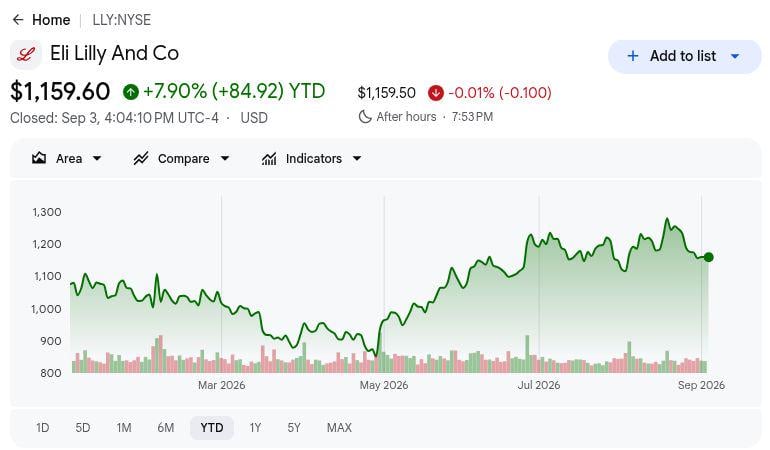
- LLY closed at $1,159.60 on September 3 and was up 7.90% YTD: The 52-week range of $712.05 to $1,292.65 shows how rapidly expectations have moved as investors weighed accelerating incretin demand against pricing, investment, and valuation risk.
- Q2 revenue rose 48% to $22.974 billion: The result exceeded the $20.69 billion consensus by $2.284 billion, showing that prescription volume and expanding global access outweighed lower realized prices during the quarter.
- Mounjaro revenue climbed 91% to $9.943 billion: Zepbound added $4.928 billion, up 46%, bringing combined quarterly sales to $14.871 billion and confirming that incretins now drive both Lilly's upside and its product concentration.
- Management raised 2026 revenue guidance to $85 billion to $87 billion: The midpoint increased by $2.5 billion from the prior $82 billion to $85 billion range, reflecting stronger demand even as acquired research costs absorbed part of the earnings benefit.
- Retatrutide produced up to 28.3% average weight loss at 80 weeks: Lilly plans an obesity filing in Q1 2027 and committed another $4.5 billion to Indiana manufacturing, linking the next pipeline catalyst with the capacity required to commercialize it at scale.
What Is Eli Lilly (LLY)?
Eli Lilly is a research-based pharmaceutical company whose prescription portfolio spans cardiometabolic health, oncology, immunology, and neuroscience. It markets medicines in about 90 countries and operates manufacturing plants in 10 countries, giving the company a global commercial and production network. Revenue increasingly comes from diabetes and obesity medicines led by Mounjaro and Zepbound, alongside products such as Verzenio in oncology and several immunology and neuroscience franchises. Lilly invested $13.337 billion in research and development in 2025, equal to 20.5% of sales, and supported clinical research in more than 55 countries with 12,771 R&D employees.
The current strategy is centered on expanding the incretin market, improving supply, and advancing the next generation of cardiometabolic medicines. Mounjaro, Zepbound, Foundayo, and retatrutide form the core of that effort, while Lilly's Boehringer Ingelheim collaboration generated a $250 million Jardiance sales milestone during Q2. Lilly is also building a co-innovation artificial-intelligence laboratory with NVIDIA and has more than 180 external partners through Catalyze360, extending its research model beyond internal drug discovery. Those programs could diversify future growth, though near-term results remain closely tied to incretin volume, pricing, reimbursement, and manufacturing capacity.
Read More: Top Pharma Stocks to Buy in 2026: Cancer Drugs, Weight-Loss Drugs, mRNA, and New Medicines
Eli Lilly (LLY) Q2 2026 Earnings Overview: Revenue, EPS and Obesity Drug Growth
Eli Lilly delivered a substantially stronger quarter than the market expected, with revenue of $22.974 billion versus $20.69 billion consensus, non-GAAP EPS of $8.38 versus $6.01 expected, and Mounjaro sales rising 91% to $9.943 billion. Management raised 2026 revenue guidance to $85 billion to $87 billion, though a $2.8 billion acquired IPR&D charge and a 5.0-percentage-point decline in reported operating margin showed how aggressively Lilly is funding the next phase of growth.
Read More: Eli Lilly (LLY) Q2 2026 Earnings Overview: GLP-1 Sales and Raised Guidance Drive a 4.86% Rally
|
Financial Metric |
Guidance / Consensus |
Reported / Actual |
Surprise |
|
Q2 revenue |
$20.69B consensus |
$22.974B |
Beat. $2.284B above consensus; up 48% YoY. |
|
Reported diluted EPS |
— |
$7.94 |
Improved. Up 26% from $6.29. |
|
Non-GAAP diluted EPS |
$6.01 consensus |
$8.38 |
Beat. $2.37 above consensus; up 33% YoY. |
|
Reported net income |
— |
$7.095B |
Improved. Up 25% from $5.661B. |
|
Mounjaro revenue |
— |
$9.943B; +91% YoY |
Accelerated. Outside-U.S. sales rose 172% to $5.2B. |
|
Zepbound revenue |
— |
$4.928B; +46% YoY |
Expanded. Demand outweighed lower realized prices. |
|
Reported gross margin |
— |
85.8%; +1.5pp YoY |
Expanded. Production cost and mix offset pricing. |
|
Reported operating margin |
— |
39.1%; -5.0pp YoY |
Declined. Portfolio investment offset gross-margin gains. |
|
Acquired IPR&D |
— |
$2.8B; $3.03/share |
Higher. Up from $154M and $0.14/share. |
|
2026 revenue guidance |
Prior $82B-$85B |
$85B-$87B |
Raised. Midpoint increased $2.5B. |
|
2026 non-GAAP EPS guidance |
Prior $35.50-$37.00 |
$35.50-$36.50 |
Mixed. Underlying midpoint rose $2.78 before $3.03 IPR&D. |
|
Retatrutide obesity package |
— |
Three more positive Phase 3 trials; BLA planned Q1 2027 |
Positive. Global obesity registration package complete. |
|
Indiana manufacturing |
— |
Additional $4.5B |
Expanded. Adds incretin capacity. |
- Revenue of $22.974 billion grew 48% and beat consensus by $2.284 billion: Prescription volume increased 60% as realized prices declined 13%, confirming powerful underlying demand while showing that price and mix remain important constraints on revenue conversion.
- Non-GAAP diluted EPS of $8.38 rose 33% and exceeded consensus by $2.37: Core profit absorbed a $3.03-per-share acquired IPR&D effect, showing that the operating franchise remained strong even as Lilly invested heavily in external pipeline assets.
- Mounjaro and Zepbound generated a combined $14.871 billion: Growth of 91% and 46%, respectively, made incretins the clearest source of upside to expectations, though the same concentration increases exposure to pricing, reimbursement, safety, and competitive developments.
- Gross margin expanded 1.5 percentage points to 85.8% as operating margin fell 5.0 points to 39.1%: Better production costs and mix improved product economics, while a 72% increase in operating expenses showed that portfolio spending is delaying broader operating leverage.
- The 2026 revenue outlook rose to $85 billion to $87 billion from $82 billion to $85 billion: The midpoint increased by $2.5 billion, and underlying non-GAAP EPS guidance improved by $2.78 before the $3.03 IPR&D charge, separating stronger operations from transaction-related costs.
Eli Lilly (LLY) 2026 Investment Outlook: $1,600 Bull Case vs. $850 Bear Case
The central test is whether incretin volume, new product access, and pipeline progress can continue raising earnings expectations faster than pricing pressure, investment, and valuation risk build.
The Bull Case: Obesity Drug Growth and Retatrutide Push LLY Toward $1,600
The Bull Case assumes Mounjaro and Zepbound maintain strong prescription growth as international access expands, Foundayo broadens the oral obesity market, and retatrutide advances toward its planned Q1 2027 filing. Added manufacturing capacity supports supply, allowing revenue to grow faster than portfolio expenses and operating leverage to improve.
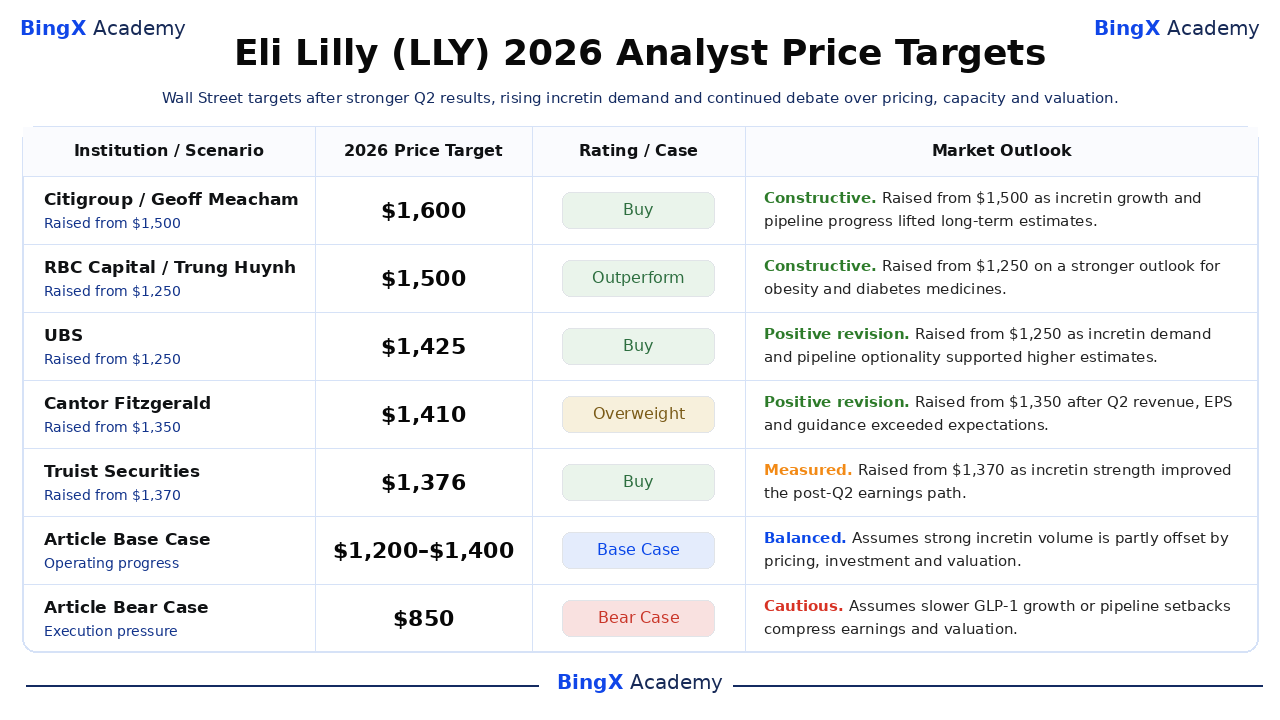
A move toward $1,600 would require full-year revenue to reach or exceed the $85 billion to $87 billion range, obesity and diabetes drug growth to remain well above total company growth, and operating margin to recover as acquired-research costs normalize. Citigroup’s $1,600 target provides the highest named analyst reference in the current set.
The Base Case: Strong Obesity Drug Demand Keeps LLY Between $1,200 and $1,400
The Base Case assumes Mounjaro and Zepbound demand remains strong, while lower realized pricing, heavy investment, and a premium valuation limit further re-rating. Revenue continues growing, but operating profit rises more slowly as Lilly funds manufacturing, clinical programs, and external assets.
Under this scenario, LLY could trade mainly between $1,200 and $1,400. Holding the annual guide, sustaining international Mounjaro growth, and improving operating margin would support the range, while a guidance cut or faster price erosion would weaken it.
The Bear Case: Pricing Pressure and Slower Growth Pull LLY Toward $850
The Bear Case assumes stronger GLP-1 competition and reimbursement pressure reduce realized pricing while market growth or treatment persistence slows. Heavy research, pipeline, and manufacturing spending would then weigh more heavily on earnings conversion even if prescription volumes continue rising.
A move toward $850 would become more likely if obesity-drug growth slows sharply, operating margin remains below the prior-year level, or a major pipeline or manufacturing milestone slips. Slower earnings revisions combined with multiple compression would be enough to pressure the stock.
LLY Stock Price Forecasts for 2026 By Wall Street Analysts
These targets are dated actions from named institutions rather than a single consensus forecast. Their range reflects different assumptions about incretin market growth, pipeline value, pricing, and profitability. The Article Base and Bear rows are editorial scenarios and remain separate from Wall Street research.
|
Institution / Scenario |
2026 Price Target |
Rating / Case |
Market Outlook |
|
Citigroup |
$1,600 |
Buy |
Constructive. July 15: raised from $1,500 to $1,600. Raised the target as incretin growth and pipeline progress supported higher long-term expectations. |
|
RBC Capital |
$1,500 |
Outperform |
Constructive. July 8: raised from $1,250 to $1,500. Raised the target on a stronger growth outlook for obesity and diabetes medicines. |
|
UBS |
$1,425 |
Buy |
Positive. July 13: raised from $1,250 to $1,425. Raised the target as incretin demand and pipeline optionality supported higher estimates. |
|
Cantor Fitzgerald |
$1,410 |
Overweight |
Positive. August 6: raised from $1,350 to $1,410. Raised the target after Q2 revenue and EPS exceeded expectations and guidance increased. |
|
Truist Securities |
$1,376 |
Buy |
Measured. August 7: raised from $1,370 to $1,376. Raised the target modestly as incretin strength improved the post-Q2 earnings path. |
|
Wells Fargo |
$1,330 |
Overweight |
Positive. August 6: raised from $1,280 to $1,330. Raised the target following stronger execution and continued Mounjaro and Zepbound demand. |
|
Article Base Case |
$1,350 |
Base Case |
Balanced. Assumes strong volume is partly offset by pricing, investment and valuation. |
|
Article Bear Case |
$850 |
Bear Case |
Cautious. Assumes pricing, slower GLP-1 expansion or pipeline setbacks compress earnings and valuation. |
How to Trade Eli Lilly (LLY) Stock on BingX
Trade Eli Lilly and Company's Mounjaro and Zepbound demand, global capacity expansion, pricing and pipeline outlook using BingX TradFi and BingX AI tools. Because LLY can react sharply to prescription data, trial results, regulatory decisions and guidance, traders should define both the catalyst and risk limits before entering a position.
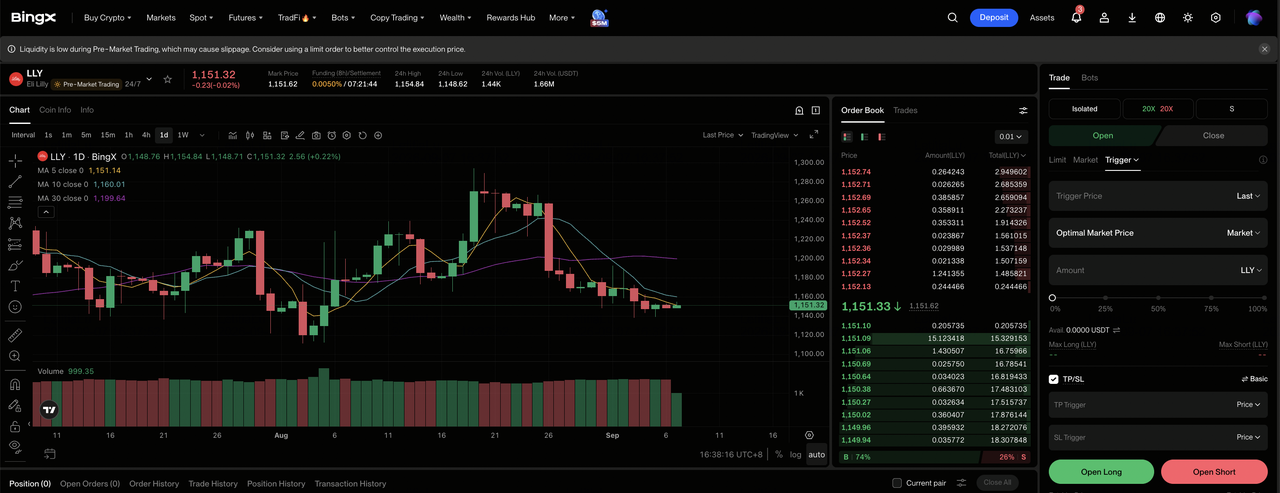
Step 1: Access BingX TradFi. Sign up and navigate to the specialized TradFi section on the BingX exchange dashboard.
Step 2: Select Eli Lilly (LLY). Search for and select the LLYUS-USDT perpetual futures contract.
Step 3: Choose your direction. Select Open Long if incretin demand and manufacturing expansion sustain revenue growth and raised guidance. Select Open Short if pricing pressure, trial setbacks or slower capacity execution weaken the growth outlook.
Step 4: Select leverage and margin mode. Choose Isolated or Cross-Margin based on your risk tolerance. The wide $712.05 to $1,292.65 52-week range shows why conservative leverage and clear position sizing are important.
Step 5: Execute strict risk protocols. Set Take-Profit and Stop-Loss (TP/SL) levels before or immediately after entering the trade. LLY can react quickly to prescription trends, trial results, regulatory decisions, capacity updates and guidance.
Top 5 Risks to Watch for Eli Lilly Investors in 2026
Lilly's outlook combines pricing, product concentration, portfolio spending, manufacturing execution, and valuation risk, with each factor capable of reducing earnings growth or the multiple investors assign to it.
- A 13% decline in realized prices could make earnings grow more slowly than prescriptions: Q2 volume increased 60%, though deeper rebates, reimbursement negotiations, or competitive discounting could reduce the revenue and margin generated from each additional treatment.
- Mounjaro and Zepbound concentration increases exposure to a single therapeutic market: The two medicines produced $14.871 billion of $22.974 billion in quarterly revenue, making safety, reimbursement, adherence, and competitor data unusually important to company-wide estimates.
- Acquired research costs can interrupt EPS conversion even during strong demand: Q2 acquired IPR&D reached $2.8 billion and special charges totaled $703 million, so continued transactions or unsuccessful assets could absorb cash without creating proportional future revenue.
- More than $55 billion of manufacturing commitments since 2020 raises execution demands: The additional $4.5 billion Indiana investment can expand supply, though construction delays, regulatory setbacks, or underused capacity could weaken cash returns on that spending.
- A trailing valuation near 38.9 times earnings amplifies estimate disappointment: Slower incretin growth, delayed pipeline milestones, or persistent operating-margin pressure could lead investors to apply a lower multiple even if Lilly continues producing absolute revenue growth.
Final Thoughts: Should You Invesat in Eli Lilly in 2026?
Lilly enters the rest of 2026 with Q2 revenue growth of 48%, full-year guidance of $85 billion to $87 billion, and a planned Q1 2027 retatrutide filing. Mounjaro and Zepbound have established the scale of the incretin franchise, while Foundayo, retatrutide, manufacturing expansion, and external research partnerships create additional routes to growth.
The $1,600 Bull Case requires sustained incretin volume, successful pipeline execution, and renewed operating leverage. The $1,200 to $1,400 Base Case allows lower pricing and heavy investment to offset part of that growth, while the $850 Bear Case reflects slower GLP-1 expansion and multiple compression. Conservative investors may wait for evidence that operating margin is recovering and realized-price pressure is stabilizing.
Risk Reminder: Trading and investing in equities like LLY involves a high risk of capital loss. Drug safety findings, regulatory decisions, reimbursement changes, clinical setbacks, manufacturing delays, and valuation compression can materially affect the stock. Conduct independent research before allocating capital.
Related Reading
- Top Pharma Stocks to Buy in 2026: Cancer Drugs, Weight-Loss Drugs, mRNA, and New Medicines
- Moderna (MRNA) Price Prediction 2026: Can Cancer Vaccine Momentum Push MRNA Stock Toward $180?
- Merck (MRK) Price Prediction 2026: Can Pipeline Momentum Push MRK Stock Toward $170?
- Abbott (ABT) Stock Price Outlook 2026: Can Medical Device Growth Push ABT Above $130?
- Johnson & Johnson (JNJ) Price Prediction 2026: Can Oncology Growth Carry JNJ Past $100 Billion?
- Pfizer Stock Price Prediction 2026: High-Yield Value Opportunity or Structural Value Trap?
