
For investors already familiar with spot trading, Ethereum (ETH) is more than just a simple buy-and-hold tool. Beyond the basic conversion of ETH to USD or TWD, you can also perform more advanced operations through trading pairs like ETH/USDT and ETH/USD. Through futures trading, you can profit from shorting during market downturns; through arbitrage strategies, you can seek relatively stable returns in price differences across different markets; through short-term trading, you can accumulate profits from intraday volatility. For large position holders, how to complete conversions at lower costs is equally important. These advanced methods each correspond to different risk structures and operational thresholds, and not all platforms can provide complete support.
Ethereum is the second-largest cryptocurrency by global trading volume, and ETH/USDT and ETH/USD are among the most liquid trading pairs on mainstream exchanges, making most advanced strategies relatively low-cost to execute. However, these strategies also place higher demands on trading platforms: futures trading requires stable funding rates and low taker costs, arbitrage relies on stability and matching speed, while short-term trading is more sensitive to order depth and slippage control.
This article will start from the usage scenarios of Taiwanese investors, organizing four common advanced trading methods, and explain the actual operational processes of BingX for each strategy, while comparing fee structures and functional differences across different platforms to help advanced users find the trading environment and funding routes that best suit their needs.
Key Takeaways
- ETH futures trading is suitable when market direction is clear. Investors can participate in the market by going long or short and use leverage to improve capital efficiency, but they also need to strictly manage risks and set stop losses to prevent magnified losses.
- Funding rate arbitrage and spot-perpetual hedging are the most common low-risk advanced strategies for ETH. Actual returns are highly dependent on trading costs, so choosing platforms with lower futures fees can effectively improve overall arbitrage efficiency.
- ETH short-term trading has extremely high requirements for execution efficiency. Taker fees and market liquidity directly affect final returns, so operations should prioritize platforms with low fees and stable order depth.
- Large-scale ETH to USD conversion or fiat currency exchanges show significant differences across platforms and funding routes in terms of fees, exchange rates, and processing speed. In practice, priority should be given to platforms with good liquidity for trading, followed by subsequent conversions to reduce overall costs.
- Before engaging in any advanced strategy, exchange stability, completeness of order types, and customer support quality are often more critical than the number of features, directly affecting strategy execution and fund security.
Advanced ETH to USD Trading Strategies: What Are Your Options?
Compared to simply selling ETH directly for USD, investors can also extend more operational opportunities during the conversion process through different trading mechanisms, such as hedging, arbitrage, or short-term trading before exchange to improve capital efficiency or reduce costs. For Taiwanese investors, these operations usually involve "overseas exchange trading → local platform withdrawal" route design, so strategy selection also needs to consider transfer costs and withdrawal processes simultaneously.
1. Futures Trading: Hedge Price Risk Before Converting
When holding ETH and planning to convert it to USD or TWD within a certain period, you can hedge by opening futures short positions to lock in the current price range in advance, avoiding market declines affecting the final exchange value. This "hedge first, then sell" approach essentially transfers price risk to the futures market, commonly used by users with large positions or those waiting for withdrawal windows. For Taiwanese investors, if funds need to be transferred from overseas platforms to local exchanges, the price volatility risk during this period can be effectively hedged through futures positions.
2. Arbitrage Strategies: How to Use Spreads and Funding Rates
ETH often shows temporary price differences between different exchanges or different trading pairs (such as ETH/USDT vs. ETH/USD). Investors can buy ETH on lower-priced platforms while simultaneously selling or directly converting to USD or stablecoins on higher-priced platforms, improving final exchange results through price spreads. For Taiwanese users, such operations usually combine asset transfers with withdrawal route design, such as choosing chains with lower transfer costs, then partnering with local platforms to complete cash-out, ensuring overall profits aren't eroded by fees.
3. Scalping: Profit from Price Volatility Before Converting
If not in a hurry to immediately convert ETH to USD or TWD, you can use short-term trading strategies to seek entry and exit opportunities in intraday or hourly price fluctuations, first increasing overall asset value before exchange. ETH itself has high liquidity and frequent volatility, making it a commonly used target for short-term traders. However, this method requires extremely high execution efficiency, as frequent trading accumulates fees and slippage costs, so in practice, platforms with low fees and stable matching must be chosen, otherwise profits can easily be offset by trading costs.
Extended reading: Scalping vs. Swing Trading in Futures Trading: Complete 2026 Strategy Comparison
4. Large-Volume Conversion: Minimize Slippage and Withdrawal Costs
When the goal is to convert large amounts of ETH to USD or TWD, the operational focus is not on trading strategies, but on how to reduce slippage and optimize funding routes. In practice, you should first complete transactions on exchanges with better liquidity depth to avoid large single orders causing price deviations, then transfer to local platforms via stablecoins (like USDT) for withdrawal. For Taiwanese investors, this "convert to stablecoins first → then withdraw" process is currently the most common and relatively cost-controllable approach.
Extended reading: How to Convert Ethereum to USD? Complete Taiwan ETH to USD Beginner Guide (2026)
BingX: A Low-Fee Platform for Active ETH/USD Traders
Founded in 2018, BingX provides diverse functions including spot trading, perpetual futures, copy trading, and dollar-cost averaging, supporting users from over 100 countries globally with complete Traditional Chinese interface. For ETH/USDT trading pairs, the platform supports both spot and perpetual futures modes, with spot maker and taker fees both at 0.1%, futures maker fee at 0.02%, and taker fee at 0.05%. This represents a clearly advantageous fee structure among mainstream exchanges, particularly suitable for short-term and advanced strategy use.
For users needing to execute arbitrage, hedging, or algorithmic trading, BingX provides complete API support and multiple order types, including market orders, limit orders, stop-loss/take-profit, and conditional orders, meeting most strategy requirements. Funding rates are settled every 8 hours with transparent historical data available for review, facilitating arbitrage timing planning. For the common operational path of Taiwanese users, most convert assets to USDT and withdraw via TRC-20 network to local platforms for further exchange, achieving a good balance between cost and efficiency in the overall process.
- Low Fee Structure: ETH spot taker fee at 0.1%, futures taker fee at 0.05%, providing competitive advantages among most mainstream exchanges, effectively reducing cost accumulation from short-term and arbitrage operations.
- Complete API Support: Provides stable REST and WebSocket APIs, suitable for arbitrage, quantitative trading, or cross-platform strategy execution, reducing manual operation delays.
- Comprehensive Order Types: Supports market orders, limit orders, stop-loss/take-profit, and conditional orders, allowing flexible configuration whether for short-term trading or risk management.
- Transparent Funding Rates: Funding rates settle every 8 hours with public historical records, allowing investors to adjust position strategies based on rate changes.
- Complete Traditional Chinese Support: Provides Traditional Chinese interface and 24/7 customer support, enabling real-time problem resolution and reduced communication costs during advanced trading or fund operations.
How to Trade ETH/USD Futures and Derivatives on BingX: Tutorial and Fee Comparison
Perpetual futures are currently the most mainstream ETH derivatives trading tool. Unlike delivery futures, perpetual futures have no expiration date and maintain the anchoring relationship between futures and spot prices through funding rate mechanisms. BingX's ETH-USDT perpetual futures have a maker fee of 0.02%, taker fee of 0.05%, funding rates settled every 8 hours, and futures leverage up to 125x. For advanced traders, the direction and absolute value of funding rates are important factors determining position costs and should be confirmed before opening positions.
Regarding margin mechanisms, BingX supports both cross margin mode (using total account balance as margin) and isolated margin mode (allocating fixed margin to individual positions). Advanced traders typically prefer isolated margin mode to control maximum loss range per trade. Setting stop-loss prices before opening positions is a basic risk management requirement for futures trading. BingX supports setting stop-loss/take-profit simultaneously with orders to avoid excessive losses due to forgotten orders.
BingX spot trading maker and taker fees are both 0.1%, perpetual futures maker fee 0.02%, taker fee 0.05%, with funding rates settled every 8 hours.
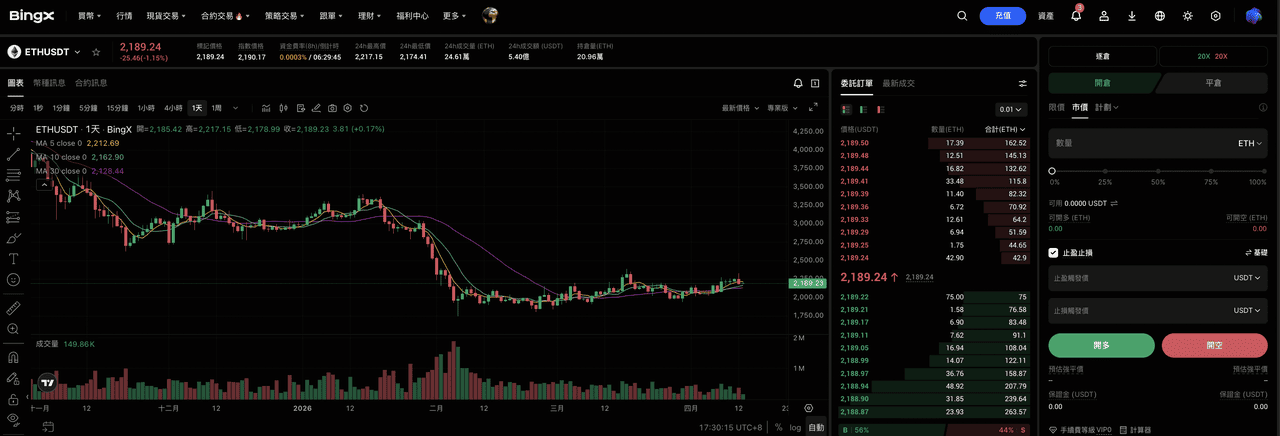
- Go to "Assets" → "Fund Transfer": Transfer USDT from spot account to perpetual futures account, ensuring sufficient futures account balance.
- Click "Trading" → "Perpetual Futures", search for ETH/USDT: Enter ETH perpetual futures page, confirm current funding rate and next settlement time.
- Select Margin Mode: Click "Cross" or "Isolated" to switch, advanced users are recommended to use isolated mode to control single trade risk limits.
- Set Leverage Multiple: Click leverage number to adjust, recommended to set based on market volatility, use lower leverage when ETH volatility is high.
- Use BingX AI to View Market Analysis: Before placing orders, use BingX AI to confirm market sentiment, support/resistance levels, and trend direction as auxiliary judgment for entry/exit timing.
- Choose Long or Short, Set Stop-Loss/Take-Profit and Submit: Choose limit order and input target price, simultaneously set stop-loss and take-profit levels, confirm fees before submitting order.
ETH to USD Arbitrage on BingX: Tools and Strategy Guide
For Taiwanese investors, ETH to USD doesn't necessarily require direct selling. It can also generate additional returns or reduce price risk while holding assets through arbitrage and hedging strategies. On BingX, the most common methods that can be completed on a single platform are "funding rate arbitrage" and "spot-perpetual hedging." Both core approaches involve establishing directionally neutral positions, shifting return sources from price judgment to rates or risk management, suitable for investors who don't wish to bear market volatility.
Strategy 1: Funding Rate Arbitrage
Funding rate arbitrage involves simultaneously holding ETH spot long positions and futures short positions to create completely hedged positions, earning funding rate returns from the futures market without bearing price volatility risk. When funding rates are positive, short position holders receive rates from long positions every 8 hours, forming stable cash flow. This strategy essentially converts ETH holdings into "USD-like yield assets," suitable for users seeking stable ETH return monetization.
On BingX, position costs mainly come from spot taker fees of 0.1% and futures taker fees of 0.05%, totaling about 0.15%. Therefore, before entry, you need to confirm whether funding rates are sufficient to cover costs and generate net profit.
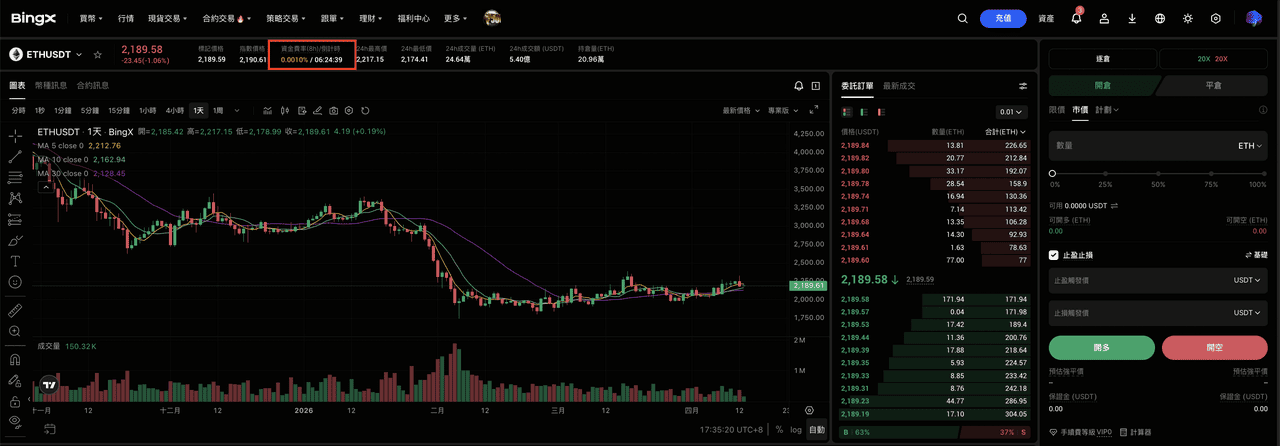
- Check Funding Rate: Go to ETH-USDT perpetual futures page, confirm current funding rate and settlement time, only enter when rates are positive and attractive.
- Buy Spot ETH: Enter "Trading" → "Spot", select ETH/USDT, use limit orders to buy target amount of ETH, reducing entry costs.
- Open Equal Amount Short Position: Go to "Perpetual Futures", select isolated mode, set leverage to 1x, use limit orders to open equal amount ETH short position, establishing complete hedge.
- Hold and Collect Rates: Settlement occurs every 8 hours, short positions automatically collect funding rates, viewable in account records.
- Close Based on Rate Changes: When funding rates decline or turn negative, simultaneously close spot and futures positions to lock in accumulated returns.
Is Now a Good Time for Funding Rate Arbitrage? Entry Checklist
- Are rates positive and above cost threshold: Estimate whether accumulated funding rate returns can cover approximately 0.15% position building costs, otherwise strategy is difficult to profit.
- Does single funding rate reach operational range: Recommend funding rates of at least 0.01%–0.03% per 8 hours, representing basic attractiveness in daily returns.
- Are rate trends stable: Observe whether historical funding rates are consistently positive and not highly volatile, avoiding short-term high rates that quickly turn negative.
- Is market liquidity sufficient: Confirm ETH/USDT trading depth is adequate to avoid additional slippage during entry/exit that erodes arbitrage returns.
- Are exit conditions clear: Pre-set closing conditions when funding rates decline or turn negative, preventing strategy from shifting from low-risk to loss-making.
Strategy 2: Spot-Perp Hedging
Spot-perpetual hedging is mainly used to "lock in ETH value," particularly suitable for investors who already hold large amounts of ETH but are uncertain about short-term USD conversion. By opening equal amount futures short positions, you can offset losses from price declines without selling spot holdings, essentially locking in USD value in advance.
This method is quite common among Taiwanese users, especially when waiting for withdrawals, transfers, or market observation, preventing asset shrinkage due to volatility during the process.
- Confirm Spot Holdings: Go to "Assets" page, confirm ETH quantity in spot account as hedging baseline.
- Transfer Margin: Transfer USDT from spot account to futures account, ensuring sufficient margin to support short positions.
- Open Equal Amount Short Position: Enter ETH-USDT perpetual futures page, select isolated mode, set leverage to 1x, open short position equal to spot holdings.
- Confirm Position Balance: Check that spot long and futures short positions are consistent, avoiding residual directional risk.
- Remove Hedge Based on Market Conditions: If deciding to exit, can simultaneously close short position and sell spot; if market turns bullish, can close short position first to restore pure long position.
How to Scalp ETH/USD on BingX for Short-Term Gains
Ethereum to USD short-term trading essentially involves rapid entry and exit in ETH/USDT or ETH/USD price fluctuations, accumulating returns through multiple trades, then converting to USD or fiat currency at appropriate timing. For Taiwanese investors, short-term operations usually occur during the "pre-withdrawal" asset utilization phase, so besides judging market direction, fee and slippage control directly determine whether final conversions to actual returns are effective.
The biggest cost in short-term trading comes from accumulated fees. Calculating 3 daily entries/exits with $1,000 per trade, if taker fees are 0.1%, monthly fees would be about $90; if 0.05% (futures), about $45. Fee differences rapidly compound in high-frequency operations. BingX perpetual futures taker fees at 0.05%, maker fees at 0.02%, provide clear advantages among mainstream platforms. Combined with limit orders, trading costs can be further reduced.
Besides fees, order depth and slippage are equally critical. ETH/USDT is one of BingX's highest trading volume pairs, providing stable slippage control for small to medium orders under normal market conditions, suitable for short-term operations ranging from $1,000 to $50,000. For traders preferring limit orders, the platform supports Post-Only mode, ensuring orders only execute as makers, avoiding conversion to takers and higher taker fees.
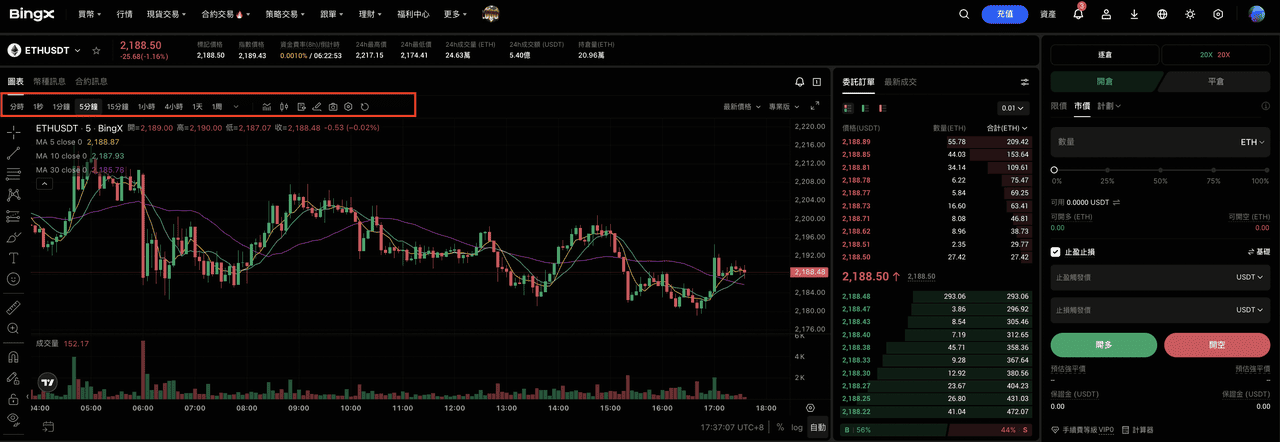
- Confirm Trading Pair and Time Frame: Enter BingX spot or futures page, select ETH/USDT, set candlestick periods according to strategy (such as 5-minute or 15-minute) to establish short-term operation baseline.
- Use BingX AI for Direction Assistance: View real-time market sentiment, trend analysis, and technical indicator summaries as reference for short-term entry direction.
- Use Limit Orders to Reduce Trading Costs: Input target entry price and select limit order for submission, executing at maker fee rate (0.02%) to avoid higher taker fees.
- Simultaneously Set Stop-Loss/Take-Profit: Set stop-loss and take-profit prices upon entry. Short-term strategies commonly use stop-loss ranges of about 0.5%–1.5% from entry price to prevent loss expansion from market reversals.
- Exit According to Trading Plan: Automatically execute when prices hit target or stop-loss levels, avoiding emotional interference with operational rhythm and ensuring strategy consistency.
Large-Volume ETH to USD Conversion: Path Comparison and Low-Cost Options for Taiwan Users
When holding large amounts of ETH requiring conversion to USD or TWD, route selection directly affects actual received amounts. Core considerations for large-scale exchanges include: slippage (whether selling large amounts of ETH will depress average execution prices), fees (total of trading fees plus withdrawal costs), and compliance (whether withdrawal routes meet Taiwan financial regulatory requirements). The following explains characteristics and suitable scenarios of several main routes.
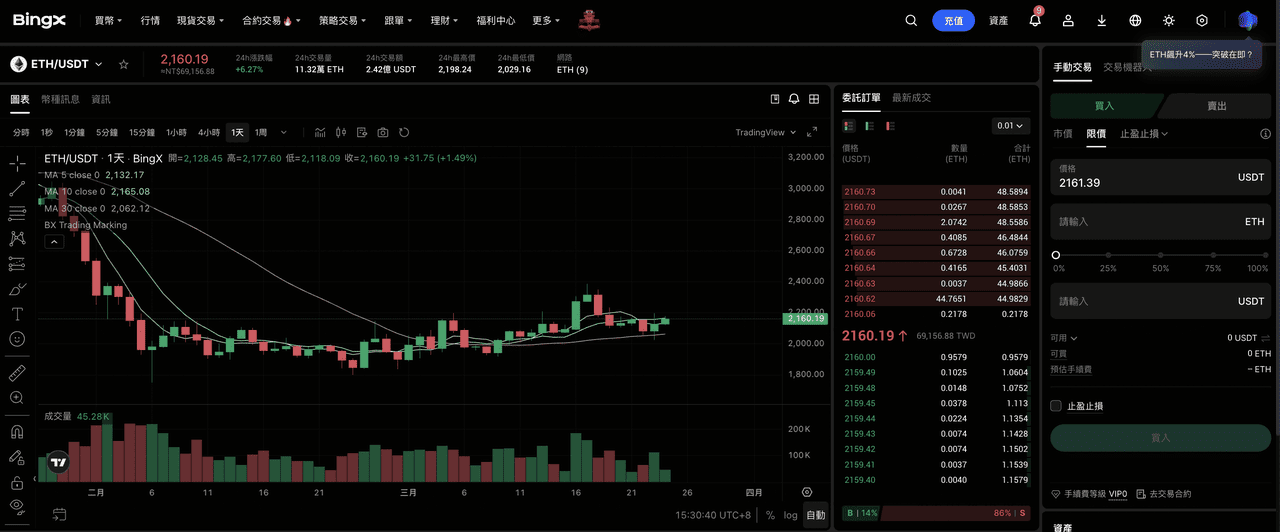
1. Exchange Spot Batch Selling: Batch selling ETH for USDT using limit orders on mainstream exchanges like BingX is the most common starting point for Taiwanese users' exchange processes. After completing conversion, you can withdraw to Taiwan local exchanges (like MAX or BitoPro) via TRC-20 network to convert to TWD. Batch ordering effectively reduces slippage risk from large market orders, TRC-20 withdrawal fees typically under $1, with transparent and controllable overall costs, particularly suitable for users with thousands to tens of thousands of dollars.
2. Stablecoin Transfer (On-chain Exchange): First withdraw ETH from BingX to on-chain, then exchange for USDC or USDT through decentralized exchanges (like Uniswap), finally transferring back to centralized exchanges for fiat withdrawal. This method suits users familiar with DeFi operations with higher flexibility, but requires bearing Ethereum mainnet gas fee fluctuations and stablecoin exchange rate impacts. During network congestion, overall costs may exceed direct exchange selling.
3. International Exchange SWIFT Withdrawal: First convert ETH to USDT on BingX, then transfer to international exchanges supporting USD withdrawal (like Kraken), wire transfer to bank accounts via SWIFT, suitable for users needing direct USD deposits. This method typically has fixed fees (about $25–$45), more suitable for tens of thousands of dollars or more to amortize costs, also commonly used for asset allocation or overseas fund transfers in practice.
4. OTC Over-the-Counter Trading (Not Recommended for General Users): While OTC can handle larger amounts and reduce market impact, Taiwan users engaging in P2P or private transactions through non-platform channels face fund security and transaction risks. For large requirements exceeding $100,000, prioritize OTC services provided by exchanges and operate through platforms with familiar processes.
|
Route |
Suitable Amount Range |
Main Costs |
Slippage Risk |
Operational Stability (Taiwan) |
Recommendation Level |
|
BingX Batch Selling + USDT Withdrawal |
Any amount (Especially suitable for $1K–$50K) |
Spot fees (0.1%) + withdrawal fees (< $1) |
Low (batch controllable) |
High |
★★★★★ |
|
Stablecoin On-chain Transfer (DeFi) |
Medium to large amounts |
Gas fees + stablecoin spread |
Low |
Medium |
★★★☆☆ |
|
International Exchange SWIFT Withdrawal |
Large amounts ($30,000+) |
Fixed fees ~$25–$45 |
Low |
Medium (bank dependent) |
★★★☆☆ |
|
OTC Over-the-Counter Trading |
Very large amounts ($100,000+) |
Negotiable (~0.1–0.5%) |
Very low |
Low |
★★☆☆☆ |
5 Key Factors to Consider Before Trading ETH to USD
When engaging in advanced Ethereum to USD (ETH/USD or ETH/USDT) trading, whether futures operations, arbitrage strategies, or large-scale fund allocation, actual risks often stem not only from price volatility but also from margin mechanisms, funding rate changes, and execution costs. Particularly on platforms like BingX that simultaneously support spot and derivatives trading, while operational flexibility increases, more comprehensive risk awareness and process planning are required.
The following organizes five key considerations often overlooked but actually affecting returns and risks before engaging in advanced ETH to USD trading:
- Futures Trading Risks and Margin Mechanisms: Ethereum to USD futures trading has leverage effects where price fluctuations are amplified, and actual losses may exceed initial margin. Before operating ETH-USDT perpetual futures on BingX, you should first understand maintenance margin ratios, forced liquidation price calculations, and funding rate impacts on position costs.
- Funding Rate and Arbitrage Risk Changes: Even ETH to USD funding rate arbitrage or spot hedging strategies are not completely risk-free. When funding rates turn negative, liquidity decreases, or market volatility intensifies, neutral positions may still generate losses, requiring continuous rate monitoring and clear closing conditions.
- API Automated Trading and Asset Security: When executing ETH to USD automated trading or arbitrage strategies through APIs, API keys must be properly secured. Setting IP whitelists and disabling withdrawal permissions is recommended to prevent asset risks from key leaks.
- Large Exchange Slippage and Fee Testing: Before conducting large-scale Ethereum to USD or TWD exchanges, recommend first testing complete routes with small amounts to confirm spot execution slippage, transfer fees, and actual arrival times, ensuring overall costs are controllable.
- Platform Fee and Market Condition Changes: Fee structures, funding rates, and market depth on platforms like BingX change with market conditions. Before entry, latest rates and liquidity conditions should be reconfirmed to avoid strategy deviations during actual execution.
Conclusion: Why BingX Is the Best Platform for Advanced ETH to USD Trading
Considering different usage scenarios including futures trading, arbitrage strategies, short-term operations, and large-scale exchanges, BingX provides a relatively balanced and practical trading environment among fee structures, liquidity, and feature completeness. For investors hoping to engage in advanced Ethereum to USD operations, platforms not only affect trading costs but directly determine whether strategies can be stably executed.
In practical operations, low futures taker fees (0.05%) and maker fees (0.02%) effectively reduce cost accumulation from short-term and arbitrage strategies; transparent funding rates with fixed settlement periods make arbitrage strategies easier to plan; while complete API support and order types can meet needs from manual trading to algorithmic strategies. For Taiwanese users, combining "BingX trading → USDT withdrawal → local exchange withdrawal" funding routes can also achieve good balance between cost and efficiency.
Compared to simply choosing exchanges, more importantly choosing an environment that can long-term support strategy execution. From fees, tools, to actual operational processes, BingX is currently a practical choice that balances cost efficiency and operational flexibility when conducting advanced ETH to USD trading.
Related Reading
- Where to Buy Bitcoin in Taiwan? 2026 Bitcoin Exchange Recommendations and Complete Purchase Process Tutorial
- How to Buy Ethereum in Taiwan? 2026 Ethereum Exchange Recommendations and Complete Purchase Process Tutorial
- How to Convert Ethereum to USD? Complete Taiwan ETH to USD Beginner Tutorial (2026)
- Taiwan Exchanges vs. International Exchanges: How to Choose the Right Cryptocurrency Trading Platform for You?
- Which Platform Has the Lowest Fees for ETH to USD Conversion in Taiwan? Comparison of 5 Major Exchanges' Fees and Withdrawal Costs (2026)
