

StonkFun (STONK) is a Solana-based token launch platform that lets creators issue new assets paired with selected memes, stocks, currencies, commodities, and other tokens. Instead of manually deploying a token and arranging liquidity, StonkFun provides a standardized launch process with a fixed supply, a chosen quote asset, and a bonding-curve mechanism that can later migrate liquidity into a Raydium pool. This places the platform within Solana’s launchpad ecosystem while adding a paired-asset model that can link new tokens to broader market themes.
As of September 7, 2026, StonkFun’s public launch flow states that new tokens begin on a bonding curve without upfront liquidity and graduate to Raydium after raising 85 SOL. STONK is the platform-launched asset, while SPYX is listed as its xStock quote asset and Raydium as the stated liquidity venue after graduation. The applicable fee structure depends on the selected launch configuration. This guide explains what StonkFun is, how the platform works, how STONK tokenomics function, the main risks to consider, and how to trade STONK on BingX.
What Is StonkFun (STONK)?
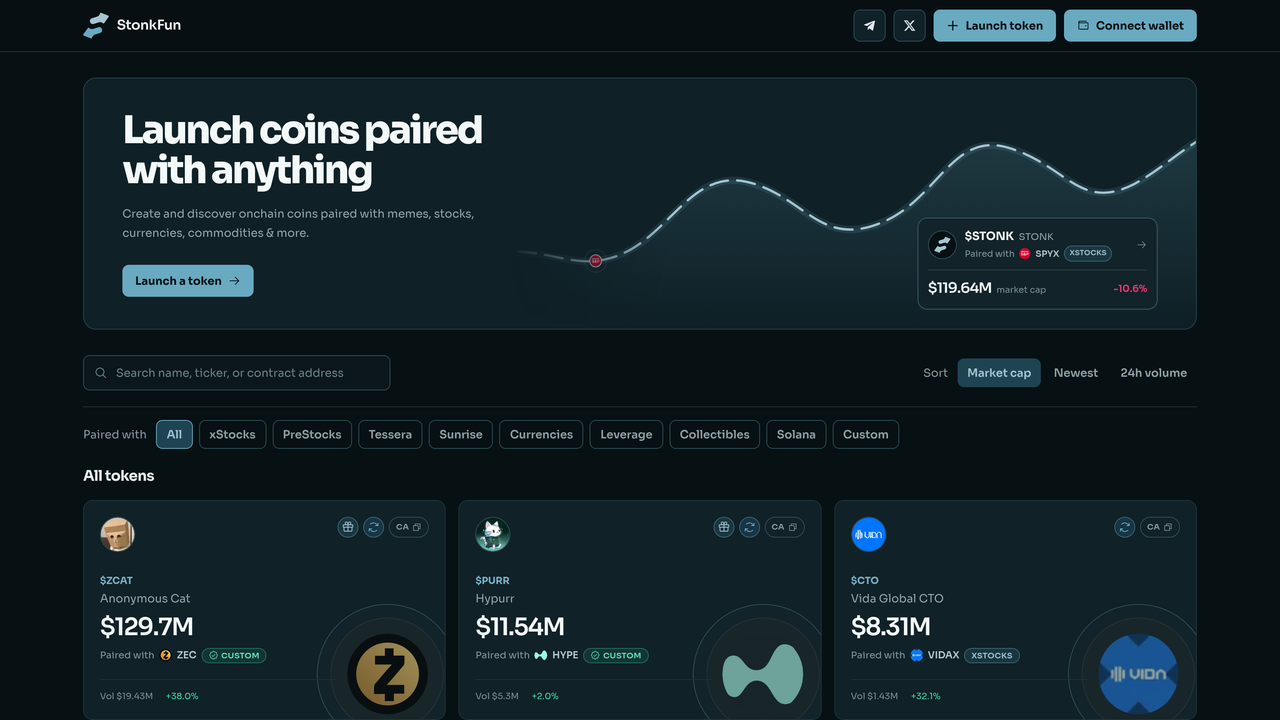
StonkFun (STONK) is a Solana-based token launch platform that lets users create and discover fixed-supply onchain assets paired with selected quote assets such as memes, stocks, currencies, commodities, and other tokens. Instead of requiring launchers to deploy a token and arrange liquidity manually, StonkFun provides a standardized flow that combines token creation, quote-asset selection, a bonding curve, and eventual migration into a Raydium liquidity pool. STONK itself was launched through this system and is paired with SPYX, which the platform labels as an S&P 500-related xStock quote asset.
Its model is built around simplifying the path from token creation to an active onchain market. New launches begin on a bonding curve without upfront liquidity and automatically graduate to a Raydium pool after reaching the documented 85 SOL threshold. STONK had already completed that process as of September 7, 2026 and was recorded as a standard-mode Raydium launch. The available public materials describe STONK primarily as a traded launchpad asset rather than equity ownership or a governance token, and do not document a verified team allocation, vesting schedule, or backer structure.
Key components of the StonkFun ecosystem include:
- Fixed-supply launch: New assets are created with a predefined supply through the StonkFun launch flow.
- Paired quote asset: Each token launches against a selected quote asset; STONK uses SPYX as its recorded xStock pair.
- Bonding-curve lifecycle: Trading begins on a bonding curve before external liquidity is established.
- 85 SOL graduation threshold: Once the documented threshold is reached, the token progresses to the next liquidity stage.
- Raydium liquidity pool: Graduated launches move into a Raydium pool for continued onchain trading.
How Does StonkFun Work?
StonkFun works as a Solana-based token launchpad that standardizes token creation, quote-asset selection, early trading, and liquidity migration. New launches use a fixed supply and begin on a bonding curve before moving into a Raydium pool once the platform’s graduation threshold is reached.
- A launcher creates a fixed-supply token: The launch flow lets users set the token name, symbol, image, and optional project links before creating the asset.
- The launcher chooses a quote asset: Tokens can be paired with selected memes, stocks, currencies, commodities, Solana assets, or custom tokens. The quote asset defines what the new token trades against rather than giving the token ownership of that underlying asset.
- Trading begins on a bonding curve: New tokens initially trade through the platform’s bonding-curve mechanism without requiring upfront liquidity. This provides the first stage of price discovery.
- Graduation moves liquidity to Raydium: Once a launch reaches the documented 85 SOL threshold, it automatically moves into a Raydium liquidity pool. STONK is already recorded as graduated, so this stage has been completed for the token.
- Launch mode determines the fee structure: Standard launches use the standard pool model, while reward-token launches can apply a permanently selected transfer tax distributed in the quote token. STONK is recorded as standard mode, so those reward-token tax mechanics do not apply to it.
Read More: What Is Raydium (RAY) DEX on Solana?
How to Create a Token on StonkFun and Pair It With Stocks, Crypto, or Other Assets
StonkFun lets users launch Solana tokens with custom quote assets through its Raydium LaunchLab integration. The newer flow combines token setup, bonding-curve trading, and eventual migration into a Raydium liquidity pool.
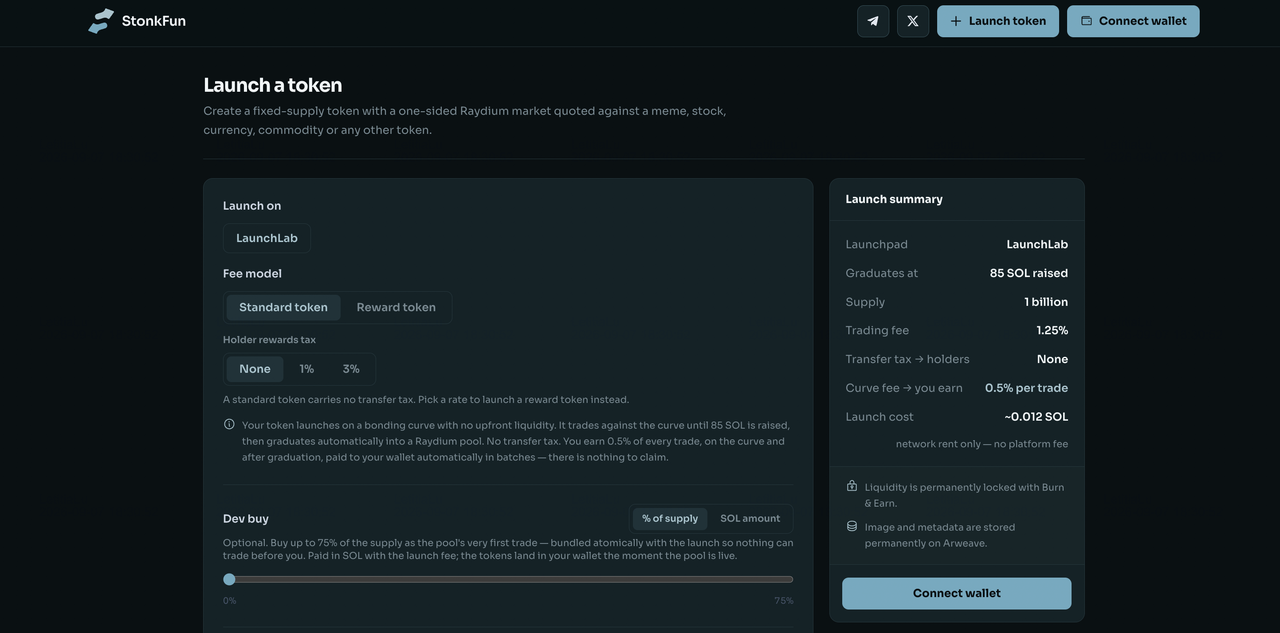
- Enter the token details: Go to the StonkFun Launch Page and choose the token name, ticker symbol, image, and optional social links. The current interface allows up to 32 characters for the name and 10 characters for the symbol.
- Choose a quote asset: Select the asset the new token will trade against. StonkFun supports custom quote assets, including eligible Solana tokens and tokenized-stock assets.
- Choose the launch configuration and deploy: The newer LaunchLab integration supports permissionless deployment, bonding curves, CPMM pools, and different fee settings. StonkFun states a deployment fee of about 0.03 SOL for this flow.
- Trading begins on the bonding curve: The token trades through the LaunchLab curve during its initial stage. The amount required for graduation depends on the launch configuration.
- Graduate to a Raydium pool: Once the configured graduation threshold is reached, liquidity moves into a Raydium pool for continued trading. Some StonkFun launches use an 85 SOL threshold, but this should be checked on the individual launch page.
In simple terms, the flow is set up the token → choose a quote asset → launch on the bonding curve → reach the graduation threshold → move to Raydium.
StonkFun vs. Pump.fun: What Are the Key Differences Between the Solana Token Launchpads?
StonkFun and Pump.fun both let users launch new Solana tokens without manually building the initial market, but their models differ in what tokens can trade against and where liquidity goes after graduation. StonkFun emphasizes custom quote assets, allowing launches to be paired with supported assets such as tokenized stocks, memes, and other Solana tokens. Pump.fun primarily uses SOL as the quote asset and follows a standardized bonding-curve-to-PumpSwap lifecycle.
|
Comparison |
StonkFun |
Pump.fun |
|
Core model |
Solana launchpad built around custom trading pairs |
Solana token launchpad with a standardized bonding curve |
|
Quote asset |
Supports custom quote assets, including tokenized stocks, memes, and other supported tokens |
Launches primarily trade against SOL |
|
Initial trading |
Bonding-curve trading through the Raydium LaunchLab integration |
Bonding-curve trading through Pump.fun |
|
After graduation |
Liquidity moves into a Raydium pool under the LaunchLab model |
Liquidity automatically migrates to PumpSwap |
|
Main advantage |
Lets creators choose what their token trades against |
Simple, standardized token-launch process with an established launch ecosystem |
|
Main tradeoff |
More launch configurations and quote-asset mechanics for users to understand |
Less flexibility over the quote asset and trading-pair design |
The clearest difference is pairing flexibility. StonkFun is designed around the idea of launching a token and pairing it with another supported asset, such as a tokenized stock, rather than defaulting every market to SOL. Pump.fun provides a more standardized route: a new token trades against SOL on its bonding curve and, after reaching its graduation threshold, automatically moves to PumpSwap.
Read More: What Is Pump.fun and How to Launch a Memecoin on This Solana Launchpad?
What Are the StonkFun (STONK) Tokenomics?
STONK launched on Solana with an original fixed supply of 1 billion tokens and trades primarily against SPYx, the xStocks S&P 500 ETF token. Its launch structure differs from a typical project token with separate team, investor, community, and treasury allocations. Onchain launch data from Bitquery shows the original supply was placed into Raydium liquidity, with mint and freeze authorities revoked at launch.
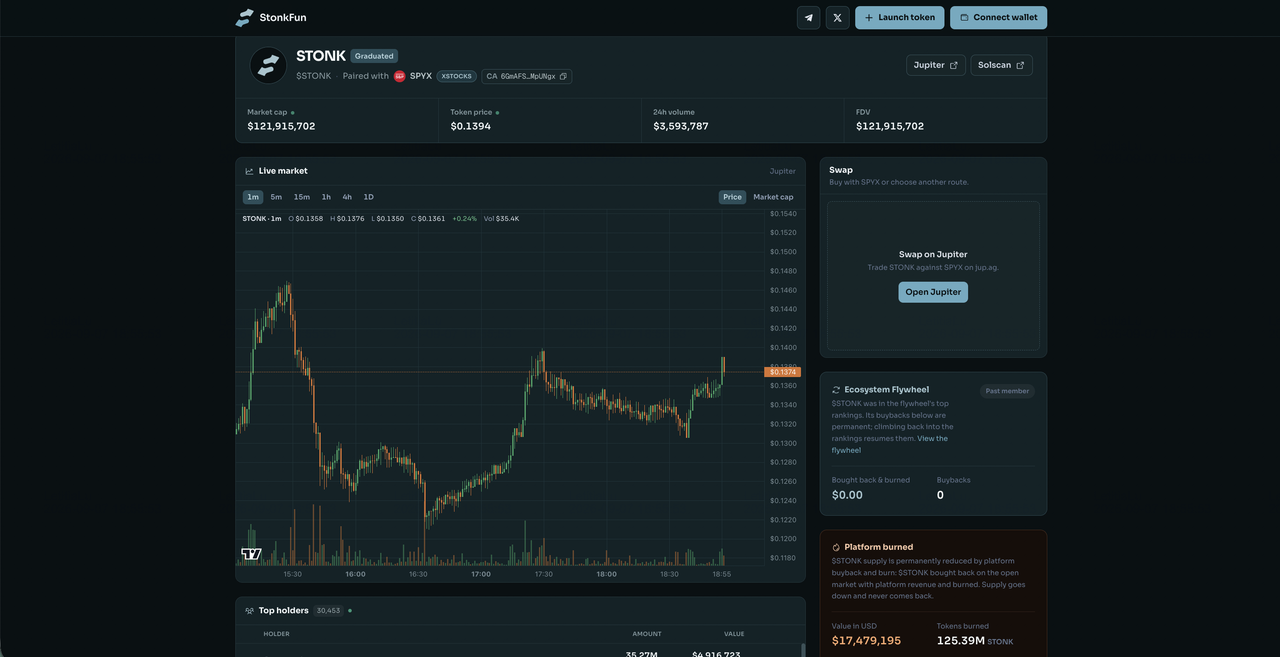
STONK also uses a buyback-and-burn mechanism tied to activity across StonkFun. The platform states that about 60% of trading-fee revenue is used to buy STONK and permanently burn it, linking token supply reduction to launchpad trading activity.
STONK Token Utility and Supply Mechanisms
- Fixed 1 billion supply: STONK launched with 1 billion tokens, and the revoked mint authority prevents additional issuance.
- Buyback and burn: About 60% of StonkFun trading-fee revenue is directed toward buying and burning STONK, creating a deflationary supply mechanism as platform activity grows.
- SPYx-paired market: STONK trades against SPYx on Raydium. The pairing defines its quote asset and does not give STONK holders ownership of SPYx or direct exposure to the underlying S&P 500 ETF.
- Platform fee capture: Higher trading activity across StonkFun can generate more fee revenue available for STONK buybacks and burns, connecting token demand indirectly to platform usage.
- No scheduled token unlocks identified: The available launch data does not show a conventional team or investor vesting schedule, so STONK does not appear to face the same scheduled unlock structure common to many project tokens.
STONK Token Allocation
Bitquery’s onchain analysis shows that the original 1 billion STONK was placed into two one-sided Raydium liquidity positions containing 950 million and 50 million tokens. No separate team, investor, treasury, or community allocation has been confirmed from the available launch data.
|
Supply Component |
STONK Amount |
Share of Original Supply |
|
Original supply |
1.00B STONK |
100% |
|
Initial Raydium liquidity |
950M + 50M STONK |
100% |
|
Team / investor vesting |
Not identified |
— |
|
Additional minting |
Disabled after mint authority revocation |
— |
STONK’s tokenomics are therefore driven primarily by its fixed supply, Raydium market structure, and buyback-and-burn mechanism, rather than scheduled team or investor token unlocks.
How to Trade StonkFun (STONK) on BingX
BingX offers two ways to gain exposure to StonkFun: spot trading for users who want to buy and own STONK directly, and futures trading for active traders who want long or short exposure to STONK price movements.
Spot Trading: Buy and Own STONK Directly
Spot trading is the simplest way to buy STONK on BingX. Once purchased, STONK can be held in the BingX spot account or withdrawn to a Solana-compatible self-custody wallet if withdrawals are supported.
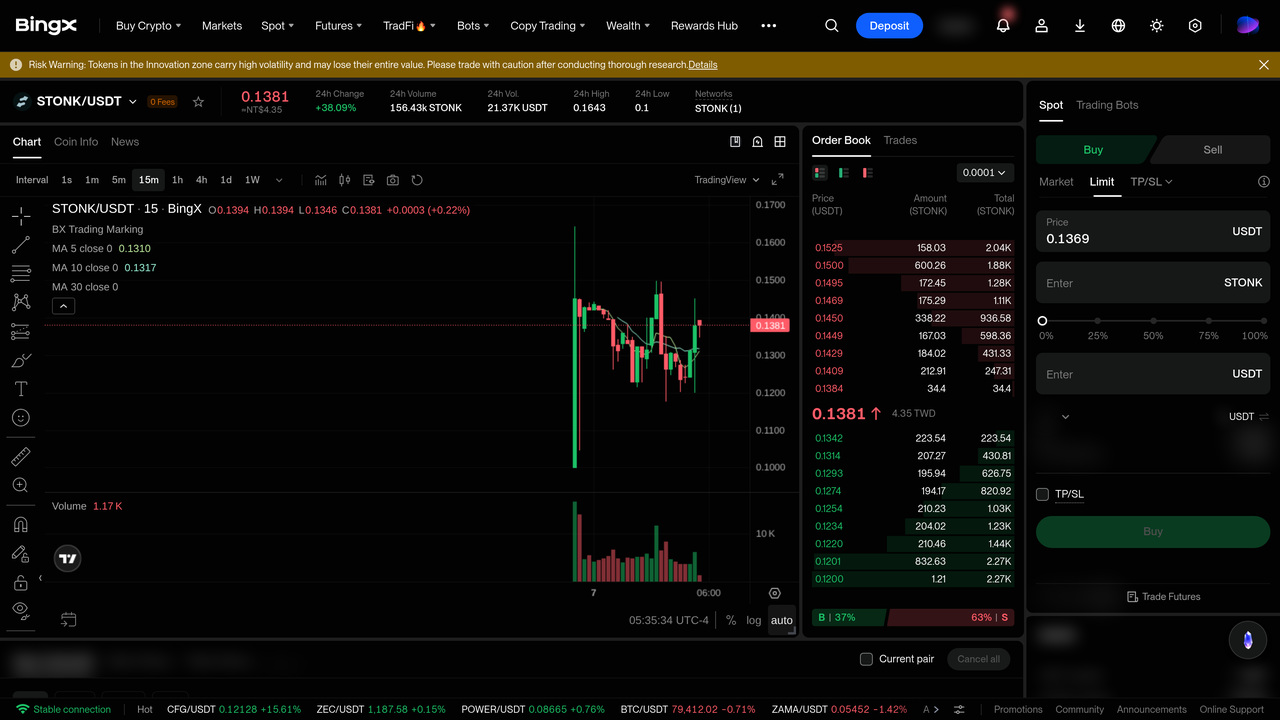
Step 1: Account setup and security. Sign up, complete the required KYC, and enable two-factor authentication.
Step 2: Fund your spot account. Deposit USDT or another supported asset.
Step 3: Open the spot market. Search for the STONK/USDT trading pair.
Step 4: Place your order. Use a market or limit order depending on your preferred entry price.
Step 5: Manage your STONK. Hold it on BingX or withdraw it to a Solana-compatible self-custody wallet such as Phantom or Solflare if withdrawals are supported.
Futures Trading: Trade STONK Price Movements
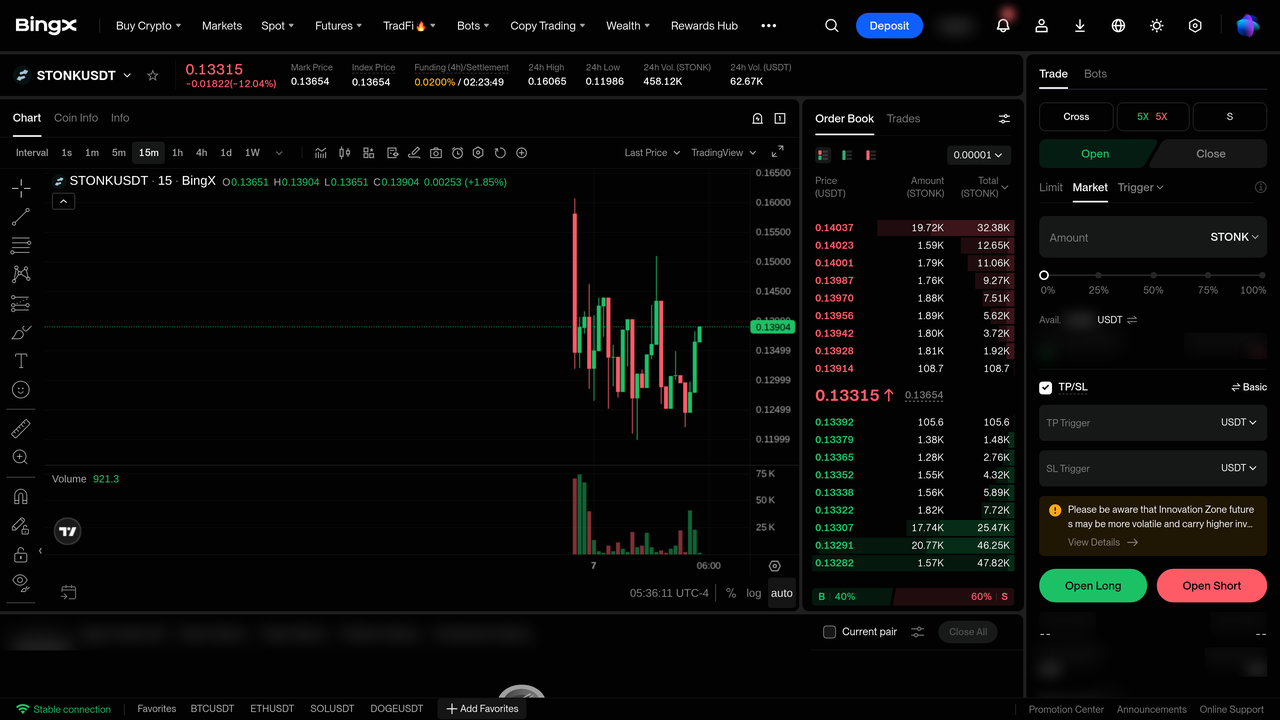
BingX also offers STONK-USDT perpetual futures, allowing traders to go long or short without owning the underlying token. Because futures use leverage, they can amplify both gains and losses and carry liquidation risk.
Step 1: Account setup and security. Sign up, complete KYC, and enable two-factor authentication.
Step 2: Transfer collateral. Move USDT into your futures account to use as margin.
Step 3: Select the contract. Open the STONK-USDT perpetual contract.
Step 4: Choose direction and leverage. Open long or short based on your market view and use leverage that matches your risk tolerance.
Step 5: Execute the trade. Enter the order size and choose a market or limit order.
Step 6: Manage risk. Set stop-loss and take-profit levels before or immediately after entry.
Risks and Considerations Before Investing in StonkFun (STONK)
StonkFun’s investment case depends on whether demand for its paired-asset launch model and buyback-and-burn mechanism can outweigh the uncertainty around supply, liquidity, and early-stage market execution.
- STONK’s SPYX pairing does not mean S&P 500 ownership: SPYX is the quote asset for the trading pair, but holding STONK does not provide index ownership, price tracking, or redemption rights tied to the S&P 500.
- Token distribution is only partly documented: Bitquery confirms the original 1 billion-token supply and Raydium liquidity structure, but no separate official team, investor, treasury, or vesting schedule has been identified.
- Trading depends on multiple onchain components: Bonding-curve mechanics, quote assets, Raydium liquidity, and smart-contract interactions all affect execution. Technical issues or thin liquidity can lead to wider spreads and sharper price moves.
- STONK can experience high volatility: BingX displayed an Innovation Zone volatility advisory for STONK on September 7, 2026. Early-stage tokens can move sharply as liquidity, trading activity, and market sentiment change.
- Leverage can magnify losses in STONK futures: Perpetual contracts allow traders to increase exposure, but they also introduce liquidation risk. Position sizing, conservative leverage, and predefined stop-loss levels remain important.
Final Thoughts: Should You Invest in StonkFun (STONK) in 2026?
StonkFun offers a different Solana launch model by letting creators pair new tokens with selected quote assets before moving from bonding-curve trading into Raydium liquidity. STONK itself has already graduated and now represents the platform’s broader paired-asset narrative, while its fixed supply and buyback-and-burn mechanism give the token a clearer supply structure than many early-stage launchpad assets.
The key question for 2026 is whether StonkFun can turn that launch format into sustained trading activity and recurring demand for STONK. Investors should watch platform volume, buyback-and-burn activity, Raydium liquidity, holder concentration, quote-asset conditions, and any changes to StonkFun’s launch mechanics. Stronger adoption could support the token, while thin liquidity, technical issues, and sharp market volatility remain important considerations.
Related Reading
- What Are the Best Memecoin Launchpads to Know in 2026?
- How to Use a Solana Bundle Checker for Safe Token Buys
- What Is Pump.fun and How to Launch a Memecoin on This Solana Launchpad?
- LetsBONK.fun vs Pump.fun: Which Solana Memecoin Launchpad Should You Use in 2026?
- What Are the Top 7 Solana DEXs to Trade in 2026?
- What Is Meteora DLMM? A Beginner's Guide to Solana DEXs' Liquidity Powerhouse
FAQs About StonkFun (STONK)
1. What makes StonkFun different from other Solana launchpads?
StonkFun lets creators launch tokens against custom quote assets instead of requiring every market to use SOL or USDC. Its launch flow combines bonding-curve trading with migration into Raydium liquidity.
2. What blockchain is STONK on?
STONK is issued on Solana. Its contract address is 6GmAFSYs4gk3FDao5FzzySQpPZaWsa4rUJHacpMpUNgx. Users should verify the contract before transferring or trading the token.
3. What is STONK’s total supply?
Bitquery’s onchain launch data shows an original fixed supply of 1 billion STONK. Mint authority was revoked at launch, preventing additional issuance.
4. Which wallets support STONK?
STONK can be stored in Solana-compatible self-custody wallets such as Phantom, Solflare, and Backpack. Users should verify the token contract before adding or transferring STONK.
5. Why can StonkFun tokens be paired with different assets?
StonkFun supports custom quote tokens, including tokenized assets that exist on Solana. This means a new token can trade against assets such as SPYx instead of only SOL or USDC. The pairing defines the market and does not mean the new token owns or represents the quote asset.
6. Is STONK officially related to the S&P 500?
No. There is no documented official relationship between STONK and the S&P 500 or S&P Dow Jones Indices. STONK is simply paired with SPYx in its market, which does not make STONK an S&P 500 product, index tracker, or ownership interest.
