Orochi Network (ON) is a blockchain-agnostic Verifiable Data Infrastructure designed to turn raw data into cryptographically verifiable data for enterprises and Web3 applications. Instead of asking applications to trust centralized servers or opaque intermediaries, Orochi uses advanced cryptography to prove that data is correct without exposing the underlying information. The project describes itself as the world's first Zero-Knowledge Data Availability Layer, and it addresses one of blockchain's more persistent tensions: how to deliver full transparency and genuine privacy at the same time.
Orochi was built around cryptographic research and has received grants from organizations including the Ethereum Foundation, Mina Protocol, the Web3 Foundation, and BNB Chain, with reported funding of around 12 million dollars. The ecosystem has several key parts: ON is the native token that powers governance, staking, and fees, zkDatabase is the verifiable database at the core of the stack, Orand provides verifiable randomness, Orocle delivers verifiable oracle data, and the zkDA Layer handles data availability. This guide explains what Orochi is, how the network works, how ON tokenomics function, the main risks to consider, and how to trade ON on BingX.
What Is Orochi Network (ON)?
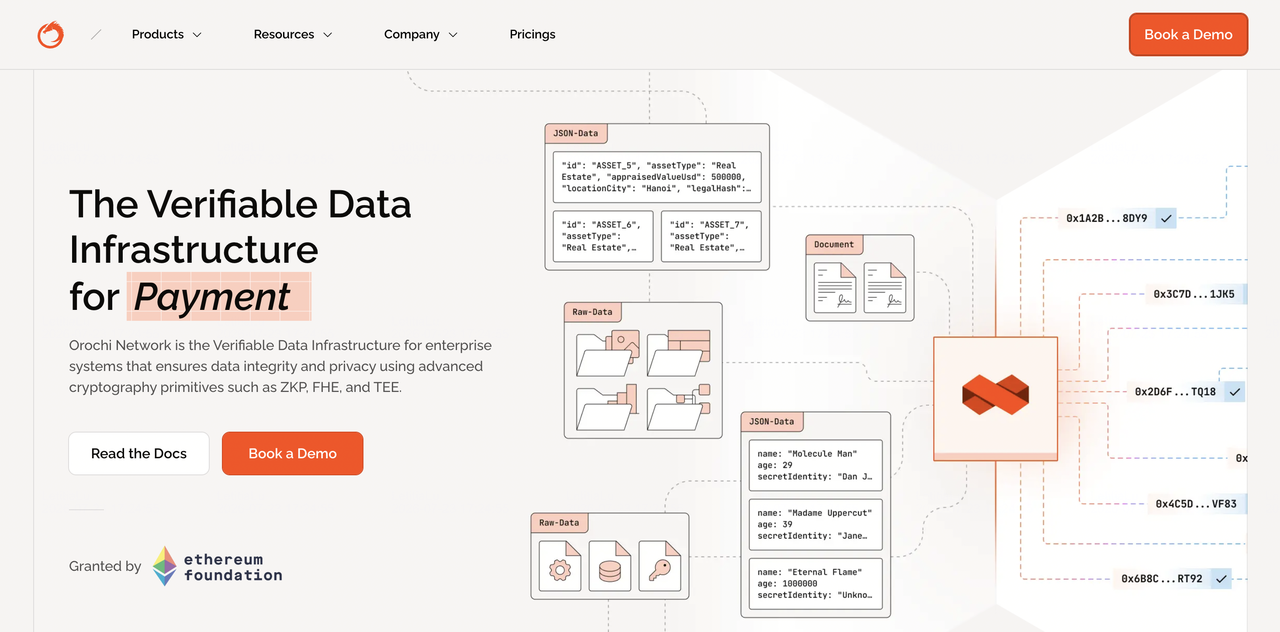
Orochi Network (ON) is a Verifiable Data Infrastructure designed to ensure data integrity, security, and interoperability across both Web2 and Web3 applications. It combines three core cryptographic primitives: Zero-Knowledge Proofs (ZKP), Fully Homomorphic Encryption (FHE), and Trusted Execution Environments (TEE). Together these let the network process and prove data without compromising confidentiality, so users can trust the system's outputs while sensitive information stays protected.
The infrastructure is modular and powered by zkDatabase, which enables verifiable computation and storage. By applying zero-knowledge proofs, Orochi processes off-chain data with cryptographic integrity before syncing it to on-chain state. This replaces trust-based oracles with continuous validity proofs, which the project positions as a backbone for applications including tokenized real-world assets, DeFi, and stablecoins. The design is deliberately blockchain-agnostic and proof-system agnostic, integrating natively with EVM-compatible chains and specialized networks.
The core idea behind Orochi is simple: data should carry its own proof of correctness. ON is the token that coordinates fees, staking, and governance across that infrastructure.
Key components of the Orochi ecosystem include:
- ON token: The native token powering every interaction within the network, from governance and staking to paying transaction fees.
- zkDatabase: A zero-knowledge database that operates as a verifiable database for the Web3 era, differing from traditional NoSQL systems by natively integrating proofs rather than relying on centralized server trust.
- Orand: A decentralized random number generator built on Elliptic Curve Verifiable Random Functions (ECVRF), delivering tamper-proof, verifiable randomness for applications and smart contracts.
- Orocle: A decentralized oracle that fetches and verifies off-chain data so smart contracts can use real-world information reliably.
- zkMemory and zkDA Layer: A universal memory prover for zkVM execution and a zero-knowledge data availability layer for modular blockchains.
Read More: What Are the Top Zero-Knowledge (ZK) Crypto Projects of 2026?
How Does Orochi Network Work?
Orochi works as a modular verifiable data layer whose products, proofs, and incentives are coordinated by cryptographic primitives and the ON token.
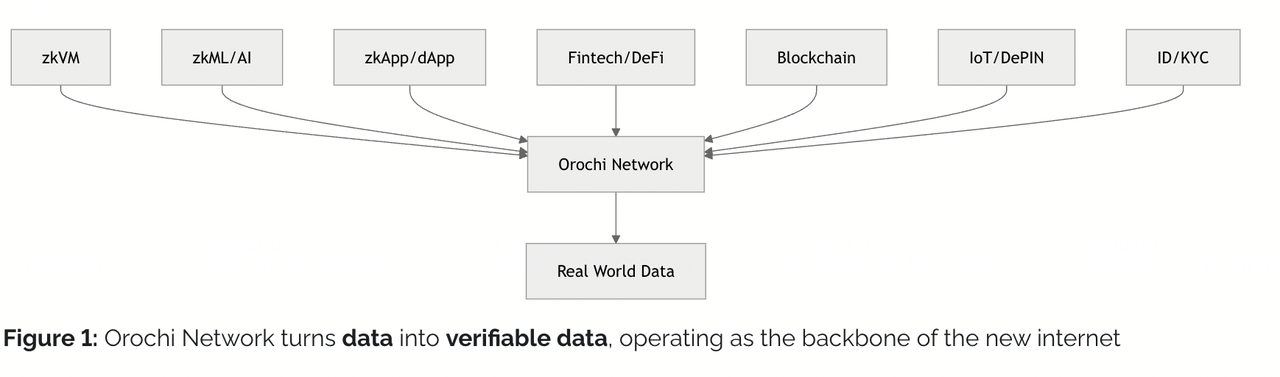
Source: Orochi Whitepaper
- A verifiable data pipeline covers every step: Data is sampled and verified in a trustworthy manner, stored immutably with proof of its integrity, and retrieved with verification that it matches the original, so each stage is backed by cryptographic proof.
- zkDatabase enables verifiable storage and computation: Off-chain data is processed with zero-knowledge proofs to guarantee integrity and privacy before syncing to on-chain state, replacing trust-based intermediaries with continuous validity proofs.
- Three primitives work together: Zero-Knowledge Proofs handle verification, Fully Homomorphic Encryption supports computation on encrypted data, and Trusted Execution Environments provide secure processing, giving applications transparency and privacy simultaneously.
- Orand and Orocle serve applications directly: Verifiable randomness and verifiable oracle data are delivered to smart contracts across a wide set of integrated chains, giving developers building blocks rather than requiring them to implement cryptography themselves.
- ON coordinates the network: The token pays for transactions, secures the network through staking, and grants governance rights, tying network usage to token demand.
Orochi vs. Traditional Oracles and Databases: Key Differences
|
Feature |
Orochi |
Traditional Oracles |
Conventional Databases |
|
Trust model |
Uses zero-knowledge proofs |
Relies on trusted reporters |
Relies on the database operator |
|
Data verification |
Cryptographically verifiable |
Depends on network accuracy |
Depends on server security |
|
Best for |
RWA, regulated finance, gaming, auditable records |
Price feeds and external blockchain data |
Standard web and enterprise applications |
|
Main tradeoff |
More complex and less mature |
Requires trust in the oracle network |
Centralized trust and control |
Orochi is often compared to traditional oracle networks and conventional databases because it serves a similar function of supplying and storing data for applications, but its trust model is fundamentally different. A traditional oracle asks users to trust a set of reporters, and a traditional database like MongoDB relies on centralized trust and server security.
The main difference is that Orochi replaces trust with proof. zkDatabase operates as a verifiable database that natively integrates zero-knowledge proofs, rather than depending on the operator's honesty. For developers, the comparison comes down to requirements: traditional oracles and databases suit applications where operator trust is acceptable and simplicity matters, while Orochi suits applications where data integrity must be cryptographically demonstrable, such as tokenized real-world assets, regulated finance, verifiable gaming outcomes, or auditable records. The tradeoff is added cryptographic complexity and the execution risk that comes with newer infrastructure.
What Are the Orochi Network (ON) Tokenomics?
ON tokenomics center on a capped total supply with a circulating portion that has expanded since launch. Reported figures place total supply at 700 million ON, with circulating supply in the range of roughly 140 to 144 million at various points during 2026, meaning a significant share of supply remains to be released over time. The token launched through a series of funding and launch events, with the project reported to have raised around 20 million dollars across multiple rounds.
ON Token Utility and Supply Mechanisms
ON has four primary utilities across the Orochi ecosystem:
- Validator staking: Validators stake ON to participate in proof-of-stake consensus, secure the network, and earn rewards based on their contributions.
- Distributed storage: Users pay ON to lease space on Orochi’s distributed storage network, while storage providers receive fees for maintaining the infrastructure.
- ZK sequencer rewards: Zero-knowledge sequencers earn ON for processing transactions, preserving privacy, and supporting network scalability.
- Transaction fees: ON covers transaction fees and other interactions across Orochi’s products and network services.
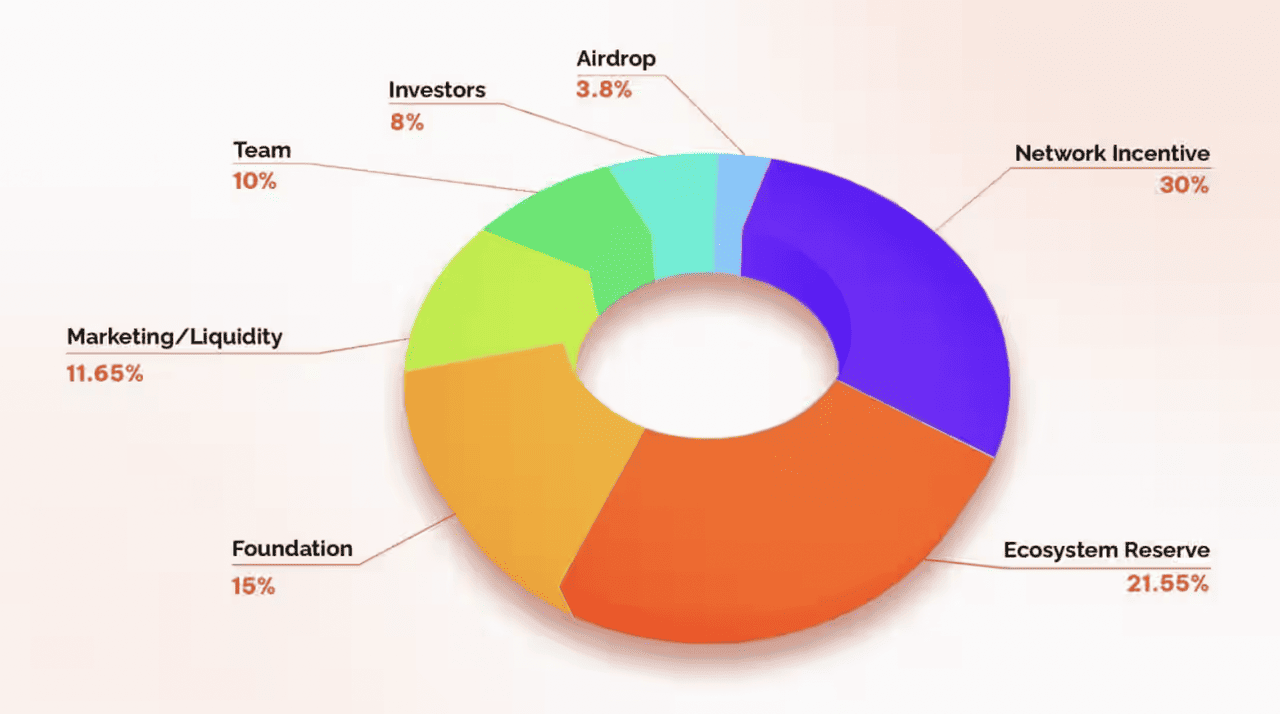
ON Token Allocation
|
Allocation |
ON Tokens |
Share |
|
Network incentives |
300 million |
30% |
|
Ecosystem reserve |
215.5 million |
21.55% |
|
Foundation |
150 million |
15% |
|
Marketing and liquidity |
116.5 million |
11.65% |
|
Team |
100 million |
10% |
|
Investors |
80 million |
8% |
|
Airdrop |
38 million |
3.80% |
Network incentives form the largest allocation and fund validator and ZK sequencer rewards. The ecosystem reserve supports grants, hackathons, research, and additional network incentives, while the Foundation allocation covers development, formal verification, liquidity support, and contingency
When Was the Orochi Network (ON) Airdrop?
Orochi allocated 38 million ON, equal to 3.8% of the total token supply, to its community airdrop. The allocation rewarded early provers, ambassadors, community supporters, and users who contributed before the token launch through programs such as Contribute-to-Earn, ONProver, ONACTIVE, and ONtegrity NFT campaigns.
The official ON token generation event portal opened in December 2025, allowing eligible users to check their allocation and vesting schedule. Since eligibility and distribution terms varied by campaign, participants were advised to verify their rewards only through Orochi Network’s official website and social channels.
How to Trade Orochi Network (ON) on BingX
BingX offers ways to gain exposure to Orochi Network depending on whether the goal is direct ownership or short-term trading. Spot trading suits users who want to buy and hold ON, while futures trading, where available, is designed for active traders who want long or short exposure to ON price movements.
Spot Trading: Buy and Own ON Directly
Spot trading is the most straightforward way to buy Orochi Network on BingX. When users buy ON on the spot market, they own the asset directly and can hold it in the BingX spot account, transfer it, or withdraw it to a compatible self-custody wallet.
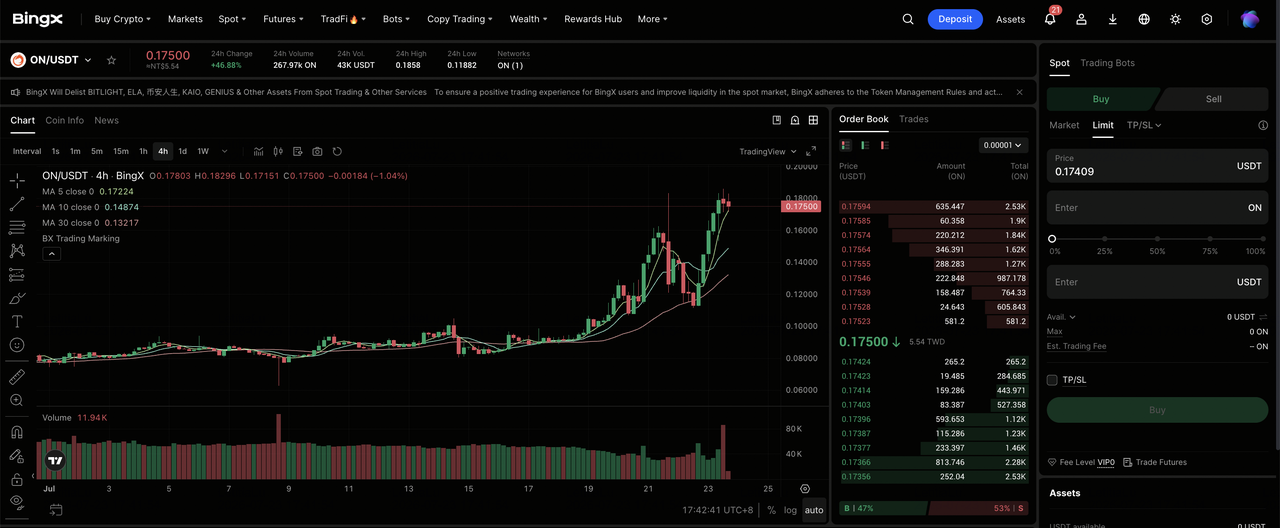
Step 1: Account setup and security. Sign up and log into your BingX account, complete the identity verification (KYC) required in your region, and enable two-factor authentication.
Step 2: Fund your spot account. Deposit USDT or another supported asset into your BingX spot account. Where available, users can also use supported fiat on-ramp options.
Step 3: Navigate to the spot market. Search for the ON/USDT trading pair.
Step 4: Place your order. Choose a market order to buy ON immediately at the current price, or use a limit order to set the price you want to pay.
Step 5: Manage your ON. Once filled, your ON appears in your spot account. You can keep it on BingX for convenience or withdraw it to a compatible self-custody wallet for staking or ecosystem participation. ON is issued across multiple standards, so confirm the correct network before withdrawing.
Futures Trading: Trade ON Price Movements
For active traders, perpetual futures allow users to trade ON price movements without holding the underlying asset, using USDT as margin. Traders can open long positions if they expect ON to rise, or short positions if they expect ON to fall. Where a contract is available on BingX, the process follows the standard perpetual futures flow.
Because futures involve leverage, they can amplify both gains and losses. This approach is more suitable for traders who already have a clear risk plan and understand liquidation risk, particularly for a small-cap infrastructure token like ON that can move sharply on low liquidity and unlock events.
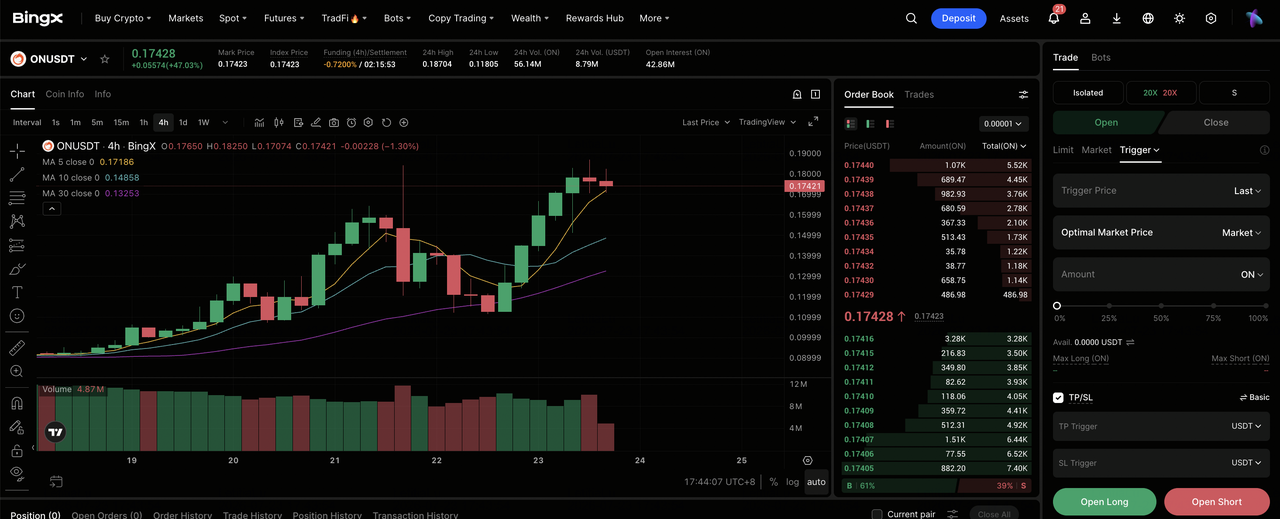
Step 1: Transfer collateral. Move USDT from your spot account into your futures account, where it will serve as margin.
Step 2: Select the contract. Search for the ON-USDT perpetual contract and confirm you have selected the correct one before placing an order.
Step 3: Set direction and leverage. Open long if you expect ON to rise, or open short if you expect ON to decline. Choose leverage based on your risk tolerance and position size.
Step 4: Execute the trade. Enter the order amount and choose a market or limit order depending on your trading plan.
Step 5: Manage risk. Set stop-loss and take-profit orders before or immediately after entering the position. Profit and loss settle dynamically in USDT.
Risks and Considerations Before Investing in Orochi Network (ON)
Orochi has genuine cryptographic research, named foundation grants, and a working product suite. However, ON still carries risks tied to supply, adoption, competition, and market size.
- Future unlocks can pressure price: With total supply capped at 700 million and only a portion circulating, scheduled releases can add meaningful supply if demand does not grow alongside it.
- Adoption must scale beyond a niche: Verifiable data infrastructure is a technically compelling idea, but ON's value depends on enterprises and Web3 applications adopting it at scale rather than treating it as experimental.
- Competitive landscape: Orochi competes with established oracle networks, data availability layers, and zero-knowledge infrastructure providers, several of which have larger ecosystems and deeper liquidity.
- Small-cap volatility and liquidity: ON has traded well below its all-time high and carries a relatively small market capitalization, so thin liquidity can produce sharp price swings.
- Data inconsistency across trackers: Reported circulating supply and market capitalization have varied between sources, so users should verify figures independently rather than relying on a single tracker.
Final Thoughts: Should You Invest in Orochi Network (ON) in 2026?
Orochi Network is one of the more research-driven infrastructure projects in the zero-knowledge space, combining zkDatabase, verifiable randomness, and verifiable oracle data into a modular stack aimed at both Web2 enterprises and Web3 applications. Its 2026 story is anchored by zkDatabase adoption, multi-chain integration of Orand and Orocle, and a focus on tokenized real-world assets.
The key question for 2026 is whether verifiable data infrastructure becomes a requirement rather than a nice-to-have. Orochi's foundation grants, contributions to Ethereum improvement proposals, and shipped product suite set it apart from projects that exist mainly as whitepapers, but ON remains a small-cap token exposed to unlock pressure, competition, and thin liquidity. For investors and traders, the most important metrics to watch are zkDatabase and product adoption, integration count across chains, enterprise partnerships, unlock schedules, and liquidity depth.
Related Reading
- What Are the Top Zero-Knowledge (ZK) Crypto Projects of 2026?
- What Is Data Availability (DA) and How Does It Work for Scaling Blockchains?
- What Is Chainlink: the Oracle Network Powering DeFi, RWAs, and the Future of Finance?
- What Is Zcash (ZEC) Privacy Coin Powered By zk-SNARKs?
FAQs About Orochi Network (ON)
1. What is zkDatabase?
zkDatabase is Orochi's zero-knowledge database, which functions as a verifiable database for Web3. Unlike traditional NoSQL systems that depend on centralized trust and server security, it natively integrates zero-knowledge proofs so that queries and stored data can be verified cryptographically.
2. What are Orand and Orocle?
Orand is a decentralized random number generator built on Elliptic Curve Verifiable Random Functions, providing tamper-proof randomness for applications and smart contracts. Orocle is a decentralized oracle that fetches and verifies off-chain data for use on blockchains. Both are integrated across a wide range of chains.
3. What is the ON token used for?
ON powers interactions across the Orochi network, including paying transaction fees, staking to support network security, and participating in governance. Its demand is tied to usage of the network's products.
4. Which wallets support ON?
ON has been issued across multiple token standards, including ERC-20 and BEP-20 versions. Users should confirm which network their ON is on and use a compatible wallet, always verifying the correct network before transferring to avoid loss of funds.
