

COTI (COTI) is a programmable privacy layer for Web3 that uses Garbled Circuits to keep transaction amounts, balances, and smart contract data confidential while remaining verifiable on-chain. It allows developers to build privacy-focused applications across DeFi, payments, identity, governance, and AI without sacrificing blockchain transparency.
Originally launched as a payments network in 2019, COTI shifted toward programmable privacy with its V2 mainnet. COTI is used for fees, staking, and network operations, gCOTI supports Treasury governance, and gcEVM provides a privacy-enabled execution environment. In 2026, the project is expanding its privacy technology to other blockchains, introducing more deflationary tokenomics, and retiring its V1 network. This guide covers how COTI works, its tokenomics, key risks, and how to trade COTI on BingX.
What Is COTI (COTI)?
Source: COTI
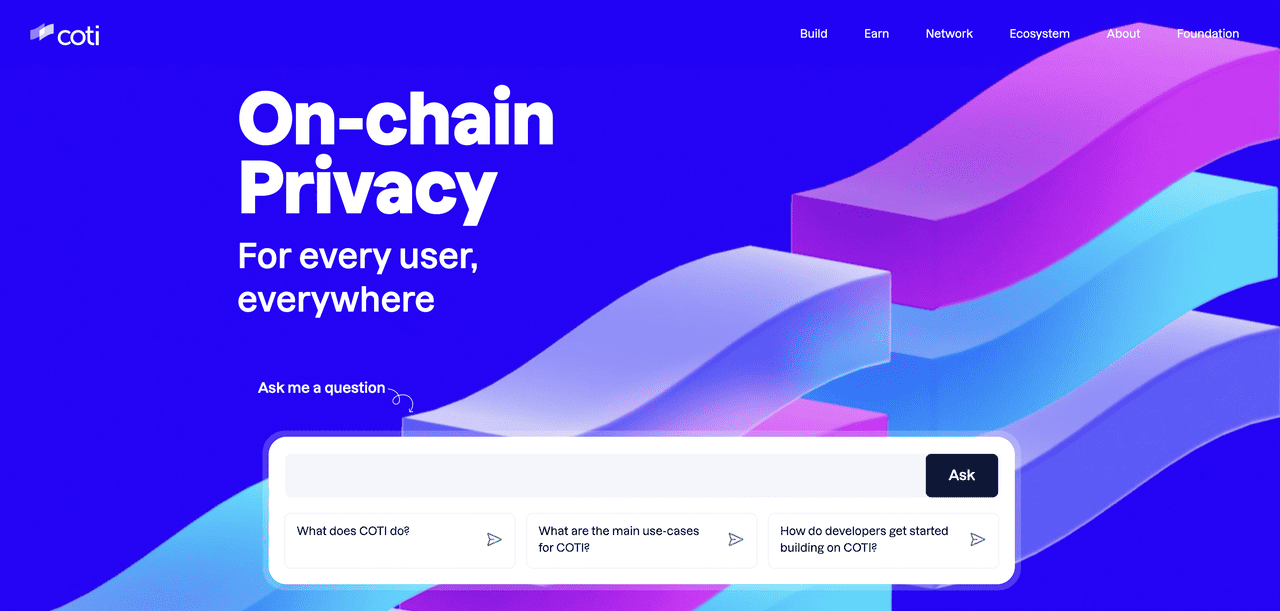
COTI (COTI) is a programmable privacy layer designed to bring confidentiality to blockchain applications without sacrificing verifiability or regulatory flexibility. Built as an Ethereum-compatible network, COTI V2 allows developers to create smart contracts where selected information, such as transaction amounts, balances, identity data, or contract conditions, remains encrypted rather than fully visible on-chain. This makes the network relevant for DeFi, payments, enterprise applications, governance, identity, and AI use cases that require greater control over sensitive data.
What makes COTI distinct is its use of Garbled Circuits, a cryptographic technique that allows multiple parties to compute over private information without revealing the underlying data. Developed with Soda Labs, COTI’s gcEVM combines this privacy model with full EVM compatibility, allowing developers to use familiar Ethereum tools and Solidity contracts. COTI positions the technology as faster and lighter than some privacy alternatives, including fully homomorphic encryption, while serving a different purpose from zero-knowledge proofs.
The COTI token is used for fees, staking, and network operations, while gCOTI governs the Treasury. Together, these components support COTI’s broader goal of making privacy programmable and composable across Web3 applications.
Key components of the COTI ecosystem include:
- COTI token: The native token used for transaction fees, staking, and network operations across the privacy layer.
- gCOTI: The governance token that gives holders control over the COTI Treasury, including how collected fees are allocated or burned.
- Garbled Circuits: The cryptographic engine that enables confidential computation over private data.
- gcEVM: The EVM-compatible, privacy-enabled execution environment where developers deploy confidential smart contracts.
- Treasury: The community-governed pool that aggregates network fees and directs rewards or burns under gCOTI governance.
What Are Garbled Circuits?
Garbled Circuits are a cryptographic technique, first described in theory in the 1980s, that lets multiple parties jointly evaluate a function over their private inputs without any party revealing its data to the others. COTI became one of the first networks to deploy this method in production for on-chain confidentiality. In practice, this means transactions and smart contract executions can keep details such as transferred amounts or contract terms private between the involved parties while still being processed on-chain. COTI integrates its garbling protocol within a broader multi-party computation design, and its security model relies on a threshold of network nodes operating honestly rather than on specialized hardware.
Read More: What Are the Top Zero-Knowledge (ZK) Crypto Projects of 2026?
How Does COTI Work?
COTI works as a programmable privacy layer whose confidential computation, fees, and governance are coordinated by Garbled Circuits, the COTI token, and the gCOTI-governed Treasury. Developers build privacy-enabled applications using the gcEVM, and the network processes confidential transactions across a set of community-operated nodes.
- Garbled Circuits enable confidential computation: The network uses garbling protocols within a multi-party computation design so that transaction and contract data can stay encrypted while still being validated on-chain.
- The gcEVM supports familiar development: Because the execution environment is EVM-compatible, developers can build confidential applications using standard Ethereum tooling rather than learning an entirely new stack.
- Nodes secure the network: COTI relies on a threshold of honest nodes to maintain integrity, and its roadmap includes scaling to a larger set of community-operated nodes through its Nodes V2 system.
- Fees flow into the Treasury: Transaction fees paid in COTI are aggregated into a dedicated Treasury, which the community can direct toward participant rewards or toward burning tokens to reduce supply.
- gCOTI governs the protocol: gCOTI holders vote on Treasury decisions, giving the community influence over reward distribution, burns, and other economic parameters.
COTI vs. ZKsync vs. Zcash: Key Differences
COTI, ZKsync, and Zcash all use advanced cryptography, but they solve different problems. COTI focuses on programmable confidentiality, ZKsync uses zero-knowledge proofs mainly to scale Ethereum, and Zcash uses zk-SNARKs to support private payments.
|
Feature |
COTI |
ZKsync |
Zcash |
|
Core technology |
Garbled Circuits |
Zero-knowledge validity proofs |
zk-SNARKs |
|
Primary purpose |
Programmable confidential computation |
Ethereum scaling |
Private digital payments |
|
Privacy model |
Selected data can remain encrypted during computation |
Standard transaction activity is generally public |
Shielded transactions can hide sender, receiver, and amount |
|
Smart contract support |
EVM-compatible through gcEVM |
Ethereum-compatible smart contracts |
Limited compared with general-purpose smart contract chains |
|
Main use cases |
Private DeFi, payments, identity, enterprise, and AI |
Lower-cost Ethereum applications |
Confidential transfers |
|
Main distinction |
Computes over shared private inputs |
Proves transaction batches efficiently |
Protects payment details |
COTI is best suited to applications that need to process confidential data inside smart contracts. ZKsync is primarily a scaling network, while Zcash is mainly designed for private asset transfers.
Read More: What Are the Top 7 Privacy Coins to Watch in 2026?
What Are the COTI (COTI) Tokenomics?
COTI tokenomics combine an original supply of approximately 2 billion tokens with staking, network fees, and additional emissions introduced under COTI V2. COTI is the network’s utility token and is used for gas, staking-related participation, rewards, and network operations. Collected fees may also be redistributed or burned through governance decisions, meaning supply reduction depends on network activity and how the community chooses to use those fees.
COTI Token Utility and Supply Mechanisms
- Transaction fees: COTI pays gas fees for transfers, smart contract execution, and confidential computation on COTI V2.
- Staking and participation: Users can lock COTI through staking or node-related programs to earn rewards and support network operations.
- Community-controlled fees: Network fees are collected in designated accounts and may be managed through community governance.
- Potential token burns: Collected fees may be distributed as rewards or burned. Token burning is possible, though it is not automatic.
- Network operations: COTI supports node incentives, privacy applications, liquidity programs, and other infrastructure across the ecosystem.
COTI Token Allocation
COTI’s original 2 billion-token supply was allocated across ecosystem incentives, token sales, the team, and advisors.
|
Allocation |
Share |
COTI Amount |
|
Incentive pool and liquidity reserve |
45% |
900 million |
|
Token sales |
Up to 30% |
Up to 600 million |
|
Team |
15% |
300 million |
|
Advisors |
10% |
200 million |
Source: COTI Medium
Team tokens were originally subject to a lock-up and gradual release schedule, while advisor vesting periods varied by allocation.
COTI V2 emissions follow a separate distribution model:
- 58% for node operators, liquidity providers, and other ecosystem participants
- 18% for developers
- 24% for grants and ecosystem incentive programs
The project has stated that V2 emissions do not include additional allocations for the team, venture-capital investors, or advisors. The original allocation and the V2 emissions model should therefore be treated as separate parts of COTI’s token supply structure.
How to Trade COTI (COTI) on BingX
BingX offers ways to gain exposure to COTI depending on whether the goal is direct ownership or short-term trading. Spot trading suits users who want to buy and hold COTI, while futures trading is designed for active traders who want long or short exposure to COTI price movements.
Spot Trading: Buy and Own COTI Directly
Spot trading is the most straightforward way to buy COTI on BingX. When users buy COTI on the spot market, they own the asset directly and can hold it in the BingX spot account, transfer it, or withdraw it to a compatible self-custody wallet.
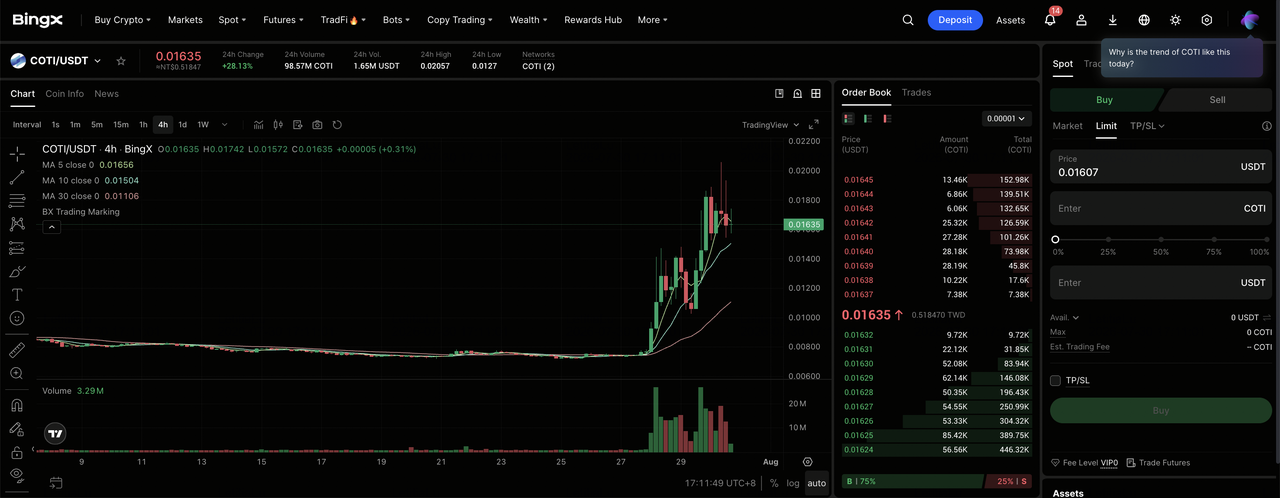
Step 1: Account setup and security. Sign up and log into your BingX account, complete the identity verification (KYC) required in your region, and enable two-factor authentication.
Step 2: Fund your spot account. Deposit USDT or another supported asset into your BingX spot account. Where available, users can also use supported fiat on-ramp options.
Step 3: Navigate to the spot market. Search for the COTI/USDT trading pair.
Step 4: Place your order. Choose a market order to buy COTI immediately at the current price, or use a limit order to set the price you want to pay.
Step 5: Manage your COTI. Once filled, your COTI appears in your spot account. You can keep it on BingX for convenience or withdraw it to a compatible self-custody wallet, take care to use the correct network and to check the current V1 to V2 migration status.
Futures Trading: Trade COTI Price Movements
For active traders, BingX offers USDT-margined COTI perpetual futures. Futures allow users to trade COTI price movements without holding the underlying asset, with the flexibility to open long positions if they expect COTI to rise or short positions if they expect COTI to fall.
Because futures involve leverage, they can amplify both gains and losses. This approach is more suitable for traders who already have a clear risk plan and understand liquidation risk, particularly for an asset like COTI that is sensitive to privacy-narrative sentiment, partnership announcements, and broader market cycles.
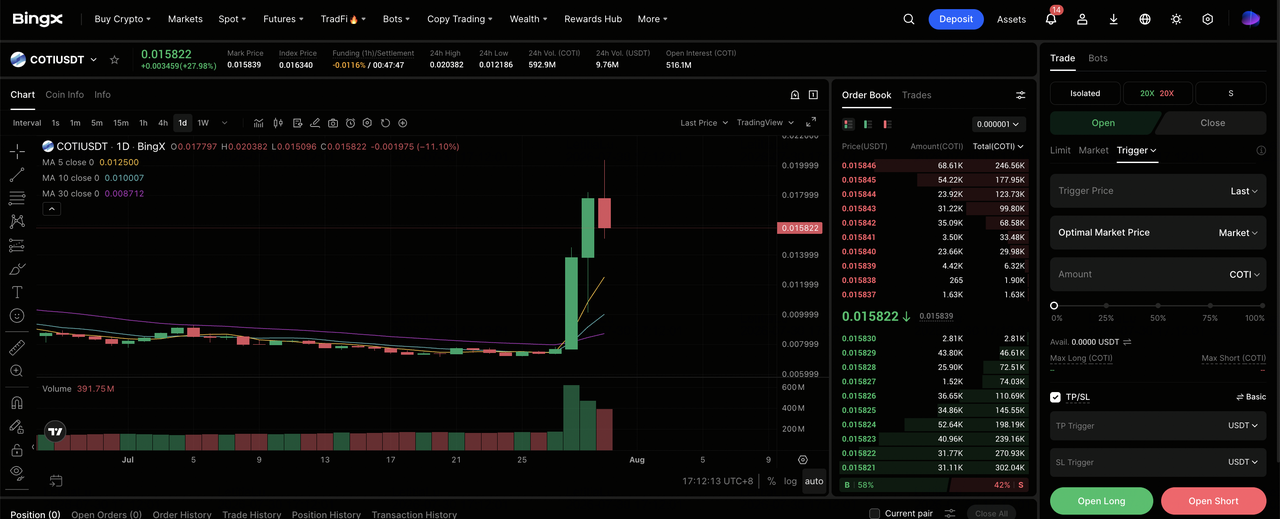
Step 1: Transfer collateral. Move USDT from your spot account into your futures account, where it will serve as margin.
Step 2: Select the contract. Search for the COTI-USDT perpetual contract.
Step 3: Set direction and leverage. Open long if you expect COTI to rise, or open short if you expect COTI to decline. Choose leverage based on your risk tolerance and position size.
Step 4: Execute the trade. Enter the order amount and choose a market or limit order depending on your trading plan.
Step 5: Manage risk. Set stop-loss and take-profit orders before or immediately after entering the position. Profit and loss settle dynamically in USDT.
Risks and Considerations Before Investing in COTI (COTI)
COTI offers a distinct privacy architecture and a clear V2 strategy, though its long-term value still depends on adoption, execution, and sustainable demand for the token.
- Limited adoption: COTI needs developers, institutions, and users to build and use privacy-enabled applications. Strong technology alone may not create meaningful network activity.
- Technical complexity: Garbled Circuits and multi-party computation are advanced systems that depend on correct implementation, reliable infrastructure, and sufficient participation from honest network operators.
- V1-to-V2 migration: Some holders must move assets from the older network to COTI V2. Using incorrect contracts, wallets, or unofficial migration tools could result in lost access to funds.
- Strong competition: COTI competes with zero-knowledge, fully homomorphic encryption, and other privacy technologies that may attract more developers, users, or liquidity.
- Uncertain supply reduction: Fee burns are not automatic and depend on governance decisions and network usage. Limited activity could weaken token demand and reduce the expected deflationary effect.
- High price volatility: COTI remains sensitive to broader crypto market conditions and may experience sharp price swings during periods of low liquidity or risk-off sentiment.
Final Thoughts: Should You Invest in COTI (COTI) in 2026?
COTI is a programmable privacy layer built around Garbled Circuits, positioned to bring confidential computation to DeFi, payments, identity, governance, and AI applications across multiple chains. Its potential depends on whether developers adopt its privacy stack and whether privacy demand grows as a durable narrative.
Its Garbled Circuits technology and EVM compatibility set it apart, but COTI remains exposed to adoption uncertainty, execution and migration risk, competition from other privacy methods, and market volatility. Investors should monitor multichain integrations, developer activity, node network growth, burn and staking metrics, the V1 sunset process, and official token disclosures.
This article is for educational purposes only and does not constitute financial advice. Cryptocurrency trading carries significant risk, and you should conduct your own research before making any investment decisions.
Related Reading
- What Are the Top Zero-Knowledge (ZK) Crypto Projects of 2026?
- What Are the Top 7 Privacy Coins to Watch in 2026?
- What Is ZKsync (ZK) Ethereum Layer-2 Network and How Does It Work?
- What Is Zcash (ZEC) Privacy Coin Powered By zk-SNARKs?
- Zcash (ZEC) vs. Monero (XMR): Which is the Better Privacy Coin in 2026?
FAQs About COTI (COTI)
1. What is the difference between COTI and gCOTI?
COTI is the native utility token used for fees, staking, and network operations. gCOTI is the governance token that gives holders control over the COTI Treasury, including how collected fees are allocated or burned.
2. What happened with COTI V2 and the V1 sunset?
COTI launched its V2 mainnet to deliver its programmable privacy layer with Garbled Circuits, and the COTI Foundation announced plans to retire the older V1 network. Holders on major exchanges or holding standard ERC-20 tokens generally do not need to act, while some wallet holders may need to migrate. Users should verify current requirements through official COTI channels.
3. What is the COTI token used for?
COTI is used for transaction fees, staking to earn rewards and support operations, and network activity across the privacy layer. Fees can flow into a community-governed Treasury that may distribute rewards or burn tokens.
4. Which wallets support COTI?
COTI can be stored in wallets that support its relevant network and standard, including EVM-compatible wallets such as MetaMask for ERC-20 COTI. Users should always verify the official contract address, confirm the correct network, and check the current migration status before transferring COTI to avoid loss of funds.
