


Pharmaceutical stocks are being shaped by several major trends in 2026, including rapid growth in weight-loss drugs, new cancer treatments, mRNA medicines beyond COVID vaccines, and upcoming patent expirations for some of the industry’s biggest products. These shifts are creating very different opportunities across the sector, from large companies with steady drug revenue to smaller biotechs whose valuations can change sharply after clinical trial results or regulatory decisions.
This guide covers the key pharma stocks to watch in 2026 across weight loss and diabetes, cancer treatment, mRNA, immunology, and diversified healthcare. It explains what is driving each company’s growth, the main risks to watch, and how selected stocks can be traded on BingX TradFi through USDT-margined perpetual contracts.
What Drives Pharma Stocks in 2026: The Key Forces
Pharma stocks are influenced by different drug markets, product cycles, and clinical developments. Four themes are especially important in 2026.
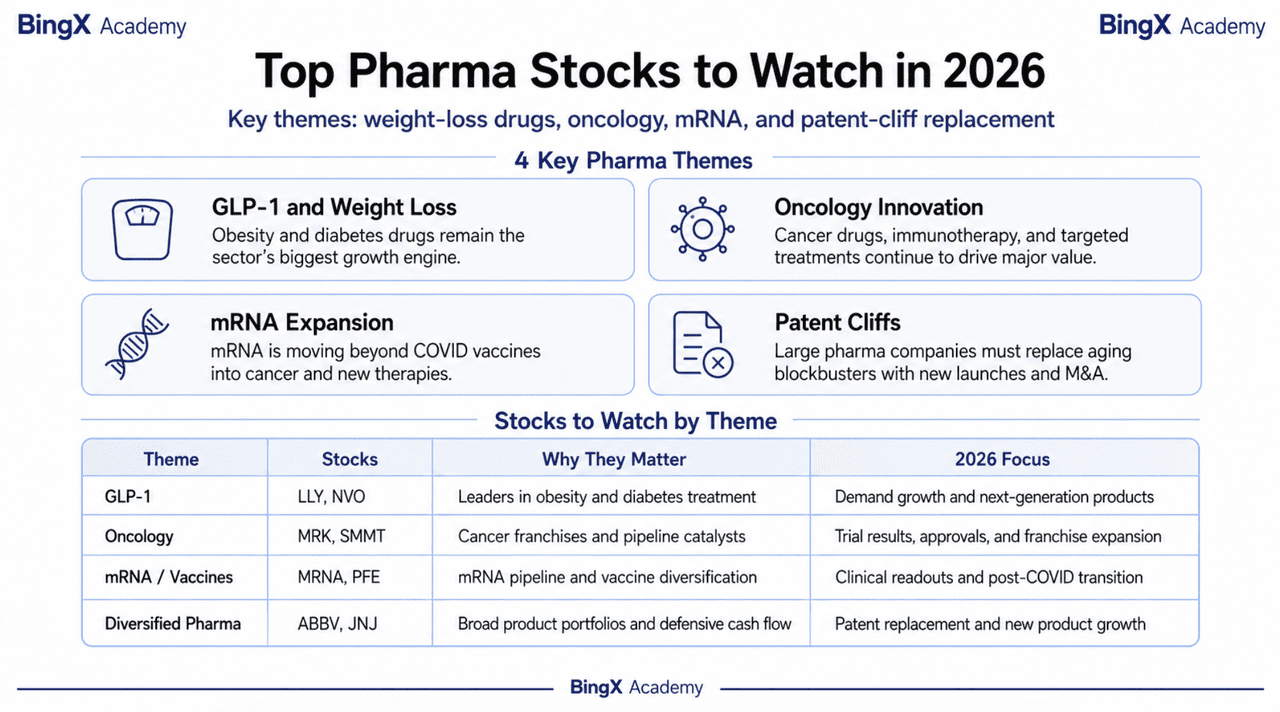
- Weight-loss drugs are driving major growth. Drugs such as Ozempic, Wegovy, Mounjaro, and Zepbound have created one of the fastest-growing markets in pharma. New oral treatments and broader insurance coverage could expand the market further, making obesity and diabetes a major growth engine for companies such as Eli Lilly and Novo Nordisk.
- Cancer drugs remain a major source of innovation. Immunotherapies, targeted treatments, antibody-drug conjugates, and personalized cancer vaccines are creating new growth opportunities. Companies with successful cancer drugs can generate large and durable revenue, although many still depend heavily on a few blockbuster products.
- Patent expirations are forcing companies to find new growth. Several major drugs will lose exclusivity over the next few years, opening the door to cheaper competition. Large pharma companies are responding by acquiring biotechs, launching new medicines, and investing more heavily in their pipelines.
- mRNA and newer drug technologies are moving beyond vaccines. mRNA is now being tested in cancer, rare diseases, and other treatments, while newer drug platforms are targeting diseases in different ways. These companies can offer greater upside, but their stocks are also more sensitive to clinical trial and regulatory results.
The key theme in 2026 is the contrast between established pharma companies with large existing drug businesses and faster-growing innovators built around newer treatments. Investors can choose between more stable earnings, higher-growth pipelines, or a combination of both.
2026 Pharma Stocks Overview and Comparison
Pharma stocks span mRNA medicine, oncology, GLP-1 obesity drugs, immunology, and diversified healthcare. This comparison shows how each company is positioned in the 2026 pharmaceutical landscape.
|
Company |
Ticker |
Primary Focus |
Key Advantages |
What to Watch in 2026 |
|
Moderna |
MRNA |
mRNA medicine |
Pioneer of mRNA vaccines and therapeutics |
Cancer and rare-disease pipeline; path toward breakeven |
|
Merck & Co. |
MRK |
Oncology and vaccines |
Maker of KEYTRUDA, one of the world’s top-selling cancer drugs |
New launches and pipeline progress ahead of the KEYTRUDA patent cliff |
|
Eli Lilly |
LLY |
GLP-1 and diabetes |
Leader in obesity and diabetes drugs |
Revenue growth, oral GLP-1 launch, and obesity-market expansion |
|
Novo Nordisk |
NVO |
GLP-1 and diabetes |
Maker of Ozempic and Wegovy; early GLP-1 leader |
Market-share competition with Lilly and growth of oral Wegovy |
|
AbbVie |
ABBV |
Immunology |
Maker of Skyrizi and Rinvoq; successfully moving beyond Humira |
Immunology growth, higher guidance, and pipeline expansion |
|
Johnson & Johnson |
JNJ |
Diversified healthcare |
Broad portfolio across pharmaceuticals and medical devices |
Oncology growth, new-product launches, and full-year guidance |
|
Pfizer |
PFE |
Diversified pharma |
Large global drug portfolio, deep pipeline, and dividend income |
Cost reductions, pipeline execution, and recovery beyond COVID products |
|
Summit Therapeutics |
SMMT |
Oncology |
Clinical-stage biotech centered on ivonescimab |
Lung-cancer trial results and other binary clinical catalysts |
| Iovance Biotherapeutics | IOVA | Oncology and cell therapy | FDA-approved personalized cell therapy for advanced melanoma | Amtagvi sales growth, international expansion, and trials in other solid tumors |
2026 Pharma Market Overview: From GLP-1 to Oncology and New Drug Launches
The 2026 pharma cycle is being driven by a few major growth engines: GLP-1 obesity drugs, oncology, patent-driven dealmaking, and fast-scaling new medicines. The numbers show how concentrated that growth has become, with leading products and franchises adding billions of dollars in quarterly revenue. Four forces explain where the strongest momentum is emerging.
- GLP-1 growth is running near 50% at the sector leader. Eli Lilly’s quarterly revenue rose 48% year over year to nearly $23 billion, led by Mounjaro and Zepbound. That pace shows how quickly obesity and diabetes drugs are reshaping large-cap pharma growth.
- Oncology blockbusters can generate more than $8 billion a quarter. Merck’s KEYTRUDA family reached $8.4 billion in quarterly sales, highlighting how valuable successful cancer franchises remain and why oncology continues to attract heavy research spending.
- Patent pressure is driving multi-billion-dollar acquisitions. Large drugmakers are spending aggressively to add new pipelines before older products lose exclusivity. AbbVie’s planned acquisition of Apogee Therapeutics for roughly $10.9 billion shows the scale of that replacement strategy.
- New launches are already contributing more than $1 billion per quarter. Merck’s newer products, including WINREVAIR and KEYTRUDA QLEX, generated about $1.5 billion in a quarter. The ability to scale new medicines quickly is becoming one of the clearest tests of successful pipeline execution.
What Are the Top Pharma Stocks in 2026?
Eight companies stand out across five major areas of the pharma market:
- mRNA medicine: Moderna (MRNA)
- Oncology: Merck (MRK), Summit Therapeutics (SMMT), and Iovance Biotherapeutics (IOVA)
- GLP-1 and diabetes: Eli Lilly (LLY) and Novo Nordisk (NVO)
- Immunology: AbbVie (ABBV)
- Diversified healthcare: Johnson & Johnson (JNJ) and Pfizer (PFE)
Together, they cover the main forces shaping pharma in 2026, from mRNA and cancer treatments to obesity drugs, immunology, and large diversified drug portfolios.
A. mRNA and Next-Generation Medicine
The mRNA platform proven during the pandemic is now being applied to cancer, rare diseases, and new vaccines. These names carry higher risk tied to clinical outcomes, but offer exposure to a technology still early in its commercial life.
1. Moderna (MRNA)
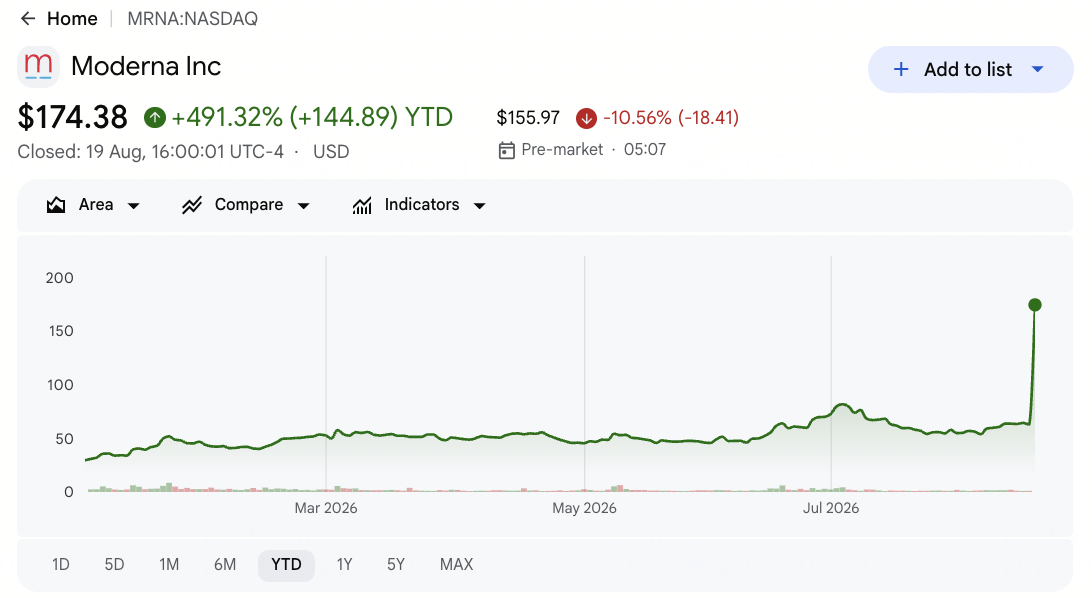
Core Role: mRNA vaccines and personalized cancer therapies
Moderna is a pioneer of mRNA medicine, using the technology behind its COVID vaccine to build a broader pipeline across respiratory vaccines, oncology, rare diseases, and other infectious diseases. It is also developing individualized cancer therapies with Merck and next-generation vaccines, making it one of the clearest listed plays on mRNA beyond COVID.
Q2 2026 revenue was $145 million, up 2.1% year over year, while net loss narrowed to $1.97 per share versus the $2.07 estimate. Management also lowered 2026 cost guidance and continues to target cash breakeven by 2028. The main risks are declining COVID revenue, ongoing losses, and binary clinical outcomes, but the pipeline still offers meaningful upside if newer programs succeed.
Read More: Moderna (MRNA) Price Prediction 2026: Can Cancer Vaccine Momentum Push MRNA Stock Toward $180?
MRNA Price Trend (2020-2026 YTD)
|
Year |
Yearly High |
Yearly Low |
Annual Return |
Market Conditions |
|
2020 |
$178.00 |
$18.00 |
4.34 |
COVID vaccine development; pandemic surge |
|
2021 |
$497.00 |
$104.00 |
1.43 |
Vaccine rollout; record revenue peak |
|
2022 |
$217.00 |
$115.00 |
-30% |
Post-pandemic normalization begins |
|
2023 |
$217.00 |
$62.00 |
-45% |
COVID revenue decline; pipeline focus |
|
2024 |
$180.00 |
$37.00 |
-60% |
Vaccine demand falls; losses widen |
|
2025 |
$60.00 |
$23.00 |
-15% |
Pipeline repositioning; cost cuts |
|
2026 YTD |
~$63 (Aug) |
~$23 (Jan) |
+5% YTD |
Q2 loss narrows; breakeven target 2028; pipeline progress |
B. Oncology
Cancer treatment is the largest area of pharmaceutical innovation, home to the industry's most valuable drugs. These companies range from established leaders with blockbuster immunotherapies to clinical-stage biotechs chasing the next breakthrough.
2. Merck (MRK)
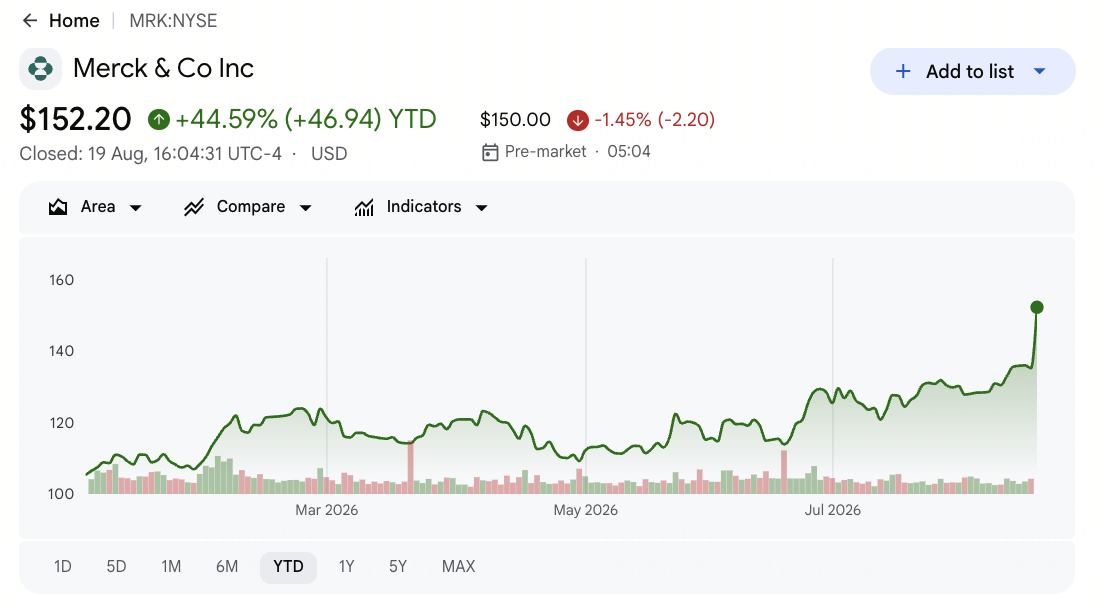
Core Role: Oncology leader and vaccine maker
Merck is one of the world’s largest pharmaceutical companies, anchored by KEYTRUDA, its leading cancer immunotherapy, alongside Gardasil and a growing portfolio of newer products. KEYTRUDA accounts for roughly half of pharmaceutical sales, making Merck a major oncology leader but also leaving the company exposed to the drug’s expected 2028 patent expiration.
Q2 2026 results beat estimates, with KEYTRUDA family sales reaching $8.4 billion, up 4%, while WINREVAIR sales rose 75% to $588 million and recently launched products totaled $1.5 billion. Merck raised full-year revenue guidance to $66.3 billion to $67.3 billion, though acquisition charges pressured profit guidance. The main risk remains the KEYTRUDA patent cliff, while newer launches and pipeline progress support the diversification case.
Read More: Merck (MRK) Price Prediction 2026: Can Pipeline Momentum Push MRK Stock Toward $170?
MRK Price Trend (2020-2026 YTD)
|
Year |
Yearly High |
Yearly Low |
Annual Return |
Market Conditions |
|
2020 |
$92.00 |
$65.00 |
-10% |
Pandemic disruption; Keytruda growth |
|
2021 |
$91.00 |
$68.00 |
0.08 |
Vaccine focus; Organon spinoff |
|
2022 |
$115.00 |
$73.00 |
0.45 |
Keytruda strength; defensive rotation |
|
2023 |
$119.00 |
$99.00 |
-2% |
Gardasil growth; pipeline building |
|
2024 |
$135.00 |
$95.00 |
-6% |
Keytruda peak concerns; patent cliff focus |
|
2025 |
$105.00 |
$73.00 |
-18% |
Patent cliff overhang; China Gardasil weakness |
|
2026 YTD |
~$140 (Aug) |
~$73 (Jan) |
+31% YTD |
Q2 beat; Winrevair +75%; new launches ramp |
3. Summit Therapeutics (SMMT)
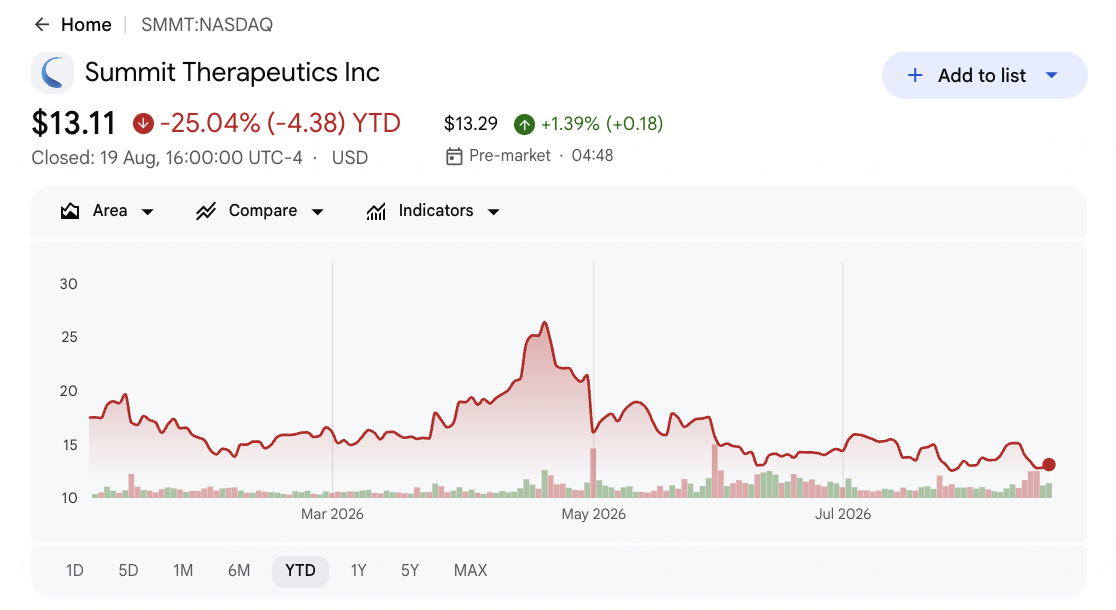
Core Role: Lung cancer biotech developing ivonescimab
Summit Therapeutics is a clinical-stage biotech focused on cancer, best known for ivonescimab, a bispecific antibody being tested mainly in lung cancer. The drug is being evaluated across the HARMONi trial program and has received FDA Fast Track designation, making Summit a high-risk oncology stock whose value depends heavily on clinical results.
Because Summit has minimal commercial revenue, investors are mainly pricing the future potential of ivonescimab. Positive trial results could strengthen its position in lung cancer, while disappointing data or regulatory setbacks could sharply weaken the stock. That makes SMMT one of the most volatile names in the group, with high upside potential but equally high clinical risk.
SMMT Price Trend (2020-2026 YTD)
|
Year |
Yearly High |
Yearly Low |
Annual Return |
Market Conditions |
|
2020 |
$9.00 |
$1.50 |
-40% |
Early-stage clinical pipeline |
|
2021 |
$12.00 |
$2.00 |
0.3 |
Antibiotic and oncology programs |
|
2022 |
$4.00 |
$1.00 |
-70% |
Pre-ivonescimab; cash constraints |
|
2023 |
$5.00 |
$1.00 |
0.8 |
Ivonescimab licensing from Akeso |
|
2024 |
$33.00 |
$2.00 |
5.5 |
Ivonescimab China data; HARMONi hype |
|
2025 |
$35.00 |
$16.00 |
0.4 |
HARMONi trial anticipation; volatility |
|
2026 YTD |
~$30 (est.) |
~$16 (est.) |
-10% YTD |
HARMONi readouts; Fast Track; binary catalysts |
4. Iovance Biotherapeutics (IOVA)
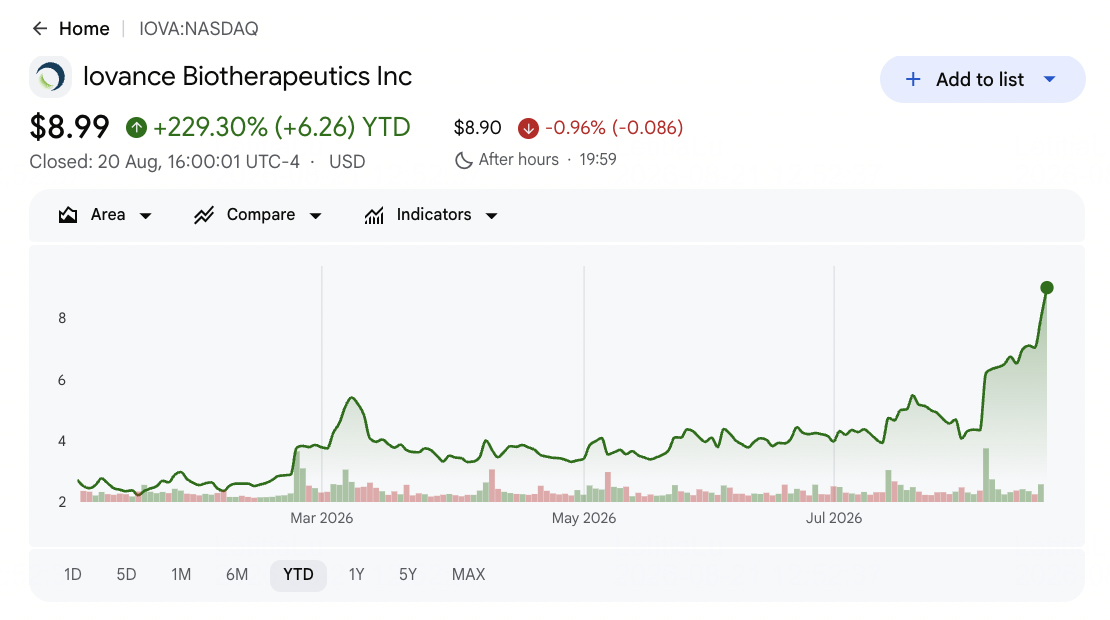
Core Role: Cancer cell therapy for solid tumors
Iovance Biotherapeutics is a cancer-focused biotech developing cell therapies that use a patient’s own immune cells to attack tumors. Its main product, Amtagvi, is an FDA-approved one-time treatment for advanced melanoma and gives Iovance direct exposure to a newer form of personalized cancer therapy. Unlike traditional cancer drugs, the treatment is made from immune cells collected from each individual patient.
Q2 2026 revenue reached $99.3 million, up 66% year over year, including about $91 million from Amtagvi, while gross margin improved to 56%. Iovance is expanding Amtagvi internationally and studying its cell-therapy platform in other solid tumors, including lung cancer and sarcoma. The main risks are continued losses, complex manufacturing, treatment-center execution, and heavy dependence on Amtagvi for near-term growth.
IOVA Price Trend (2020-2026 YTD)
|
Year |
Yearly High |
Yearly Low |
Annual Return |
Market Conditions |
|
2020 |
$50.00 |
$16.00 |
11% |
Pandemic disruption; TIL pipeline development |
|
2021 |
$34.00 |
$12.00 |
-55% |
Clinical delays; regulatory uncertainty |
|
2022 |
$17.00 |
$5.00 |
-20% |
Cash concerns; BLA preparation |
|
2023 |
$17.00 |
$5.00 |
40% |
Amtagvi FDA path; approval anticipation |
|
2024 |
$19.00 |
$6.00 |
-40% |
Amtagvi launch begins; commercial ramp |
|
2025 |
$9.00 |
$2.00 |
-60% |
Slow early launch; dilution concerns |
|
2026 YTD |
~$6 (Aug) |
~$1.50 (Apr) |
+130% YTD |
Record Q2 rev +66%; margin 56%; Amtagvi uptake |
C. GLP-1 and Diabetes
The GLP-1 class of obesity and diabetes drugs has become the fastest-growing category in pharma. These two companies dominate the market and are locked in an intense rivalry for share as oral versions expand access.
5. Eli Lilly (LLY)
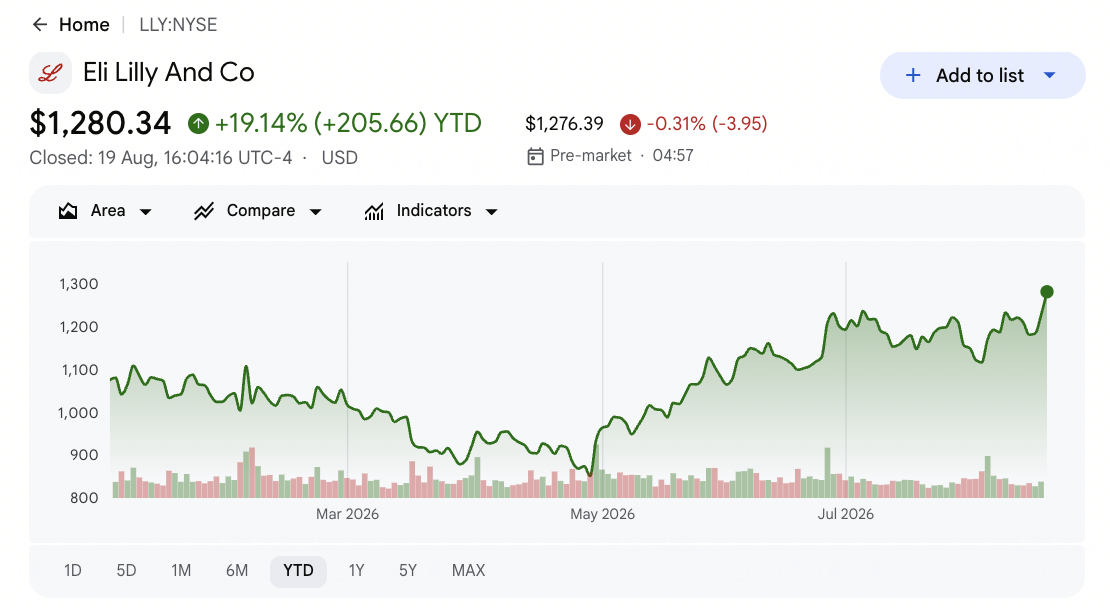
Core Role: GLP-1 and obesity drug leader
Eli Lilly is one of the biggest beneficiaries of the obesity-drug boom, led by Mounjaro for diabetes and Zepbound for obesity. Both are based on tirzepatide, and the company is expanding further with oral GLP-1 treatments and next-generation drugs such as retatrutide, keeping Lilly at the center of the fastest-growing area in pharma.
Q2 2026 revenue jumped 48% to $22.97 billion, with Mounjaro sales up 91% to $9.94 billion and Zepbound continuing to grow strongly. Management raised full-year revenue guidance to $85 billion to $87 billion. The main risks are pricing pressure, intense competition, and a premium valuation, but Lilly remains one of the clearest large-cap plays on obesity and diabetes growth.
Read More: Eli Lilly (LLY) Stock Outlook 2026: Can Mounjaro and Zepbound Momentum Drive LLYON Stock to $1,200+?
LLY Price Trend (2020-2026 YTD)
|
Year |
Yearly High |
Yearly Low |
Annual Return |
Market Conditions |
|
2020 |
$170.00 |
$117.00 |
0.32 |
Pandemic; diabetes franchise growth |
|
2021 |
$276.00 |
$153.00 |
0.66 |
Pipeline momentum; Alzheimer's hopes |
|
2022 |
$335.00 |
$221.00 |
0.32 |
Mounjaro launch; obesity potential |
|
2023 |
$629.00 |
$309.00 |
0.59 |
Zepbound approval; GLP-1 mania begins |
|
2024 |
$972.00 |
$488.00 |
0.32 |
Obesity demand surges; supply ramps |
|
2025 |
$1,000.00 |
$600.00 |
-1% |
Consolidation; pricing and competition focus |
|
2026 YTD |
~$1,220 (Aug) |
~$700 (Jan) |
+11% YTD |
Revenue +48%; $1T market cap; oral GLP-1 launch |
6. Novo Nordisk (NVO)
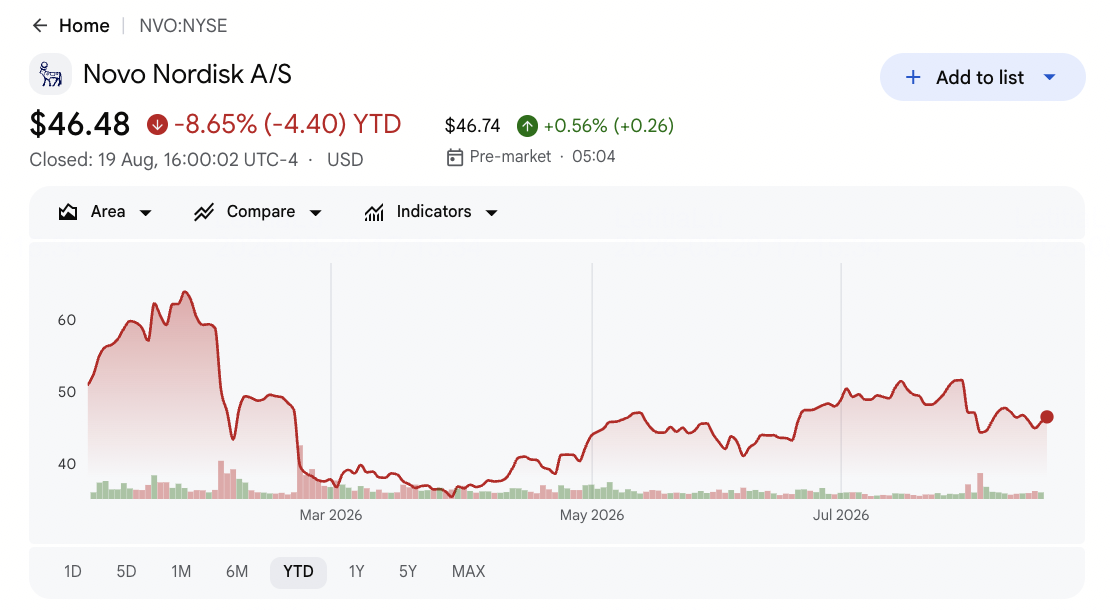
Core Role: GLP-1 obesity and diabetes drug leader
Novo Nordisk is a global leader in diabetes and obesity care, best known for Ozempic and Wegovy, both based on semaglutide. The company helped pioneer the modern GLP-1 market and is now expanding with oral Wegovy, higher-dose formulations, and next-generation candidates such as CagriSema as it competes more directly with Eli Lilly.
Q2 2026 adjusted sales grew 7% at constant exchange rates to DKK 78.5 billion, but competition and pricing pressure remain key concerns. CagriSema disappointed against Lilly’s tirzepatide, while upcoming price cuts for Wegovy and Ozempic could pressure growth. Novo still offers major exposure to the obesity market, but its 2026 story is increasingly about defending share and rebuilding momentum.
NVO Price Trend (2020-2026 YTD)
|
Year |
Yearly High |
Yearly Low |
Annual Return |
Market Conditions |
|
2020 |
$71.00 |
$45.00 |
0.18 |
Diabetes franchise; Ozempic growth |
|
2021 |
$118.00 |
$67.00 |
0.67 |
Wegovy approval; obesity market opens |
|
2022 |
$119.00 |
$92.00 |
0.26 |
GLP-1 demand surges; supply constraints |
|
2023 |
$107.00 |
$65.00 |
0.51 |
Obesity mania; blockbuster demand |
|
2024 |
$148.00 |
$80.00 |
-12% |
Share loss to Lilly begins; trial concerns |
|
2025 |
$90.00 |
$45.00 |
-45% |
CagriSema disappointment; guidance cuts |
|
2026 YTD |
~$60 (est.) |
~$45 (Jan) |
-8% YTD |
CagriSema setback; pricing cuts; Wegovy pill scales |
D. Immunology and Diversified Healthcare
Beyond the hottest growth themes, some of pharma's most stable returns come from immunology franchises and diversified healthcare giants that combine drugs, vaccines, and medical devices. These names offer lower-risk, cash-generative exposure.
7. AbbVie (ABBV)
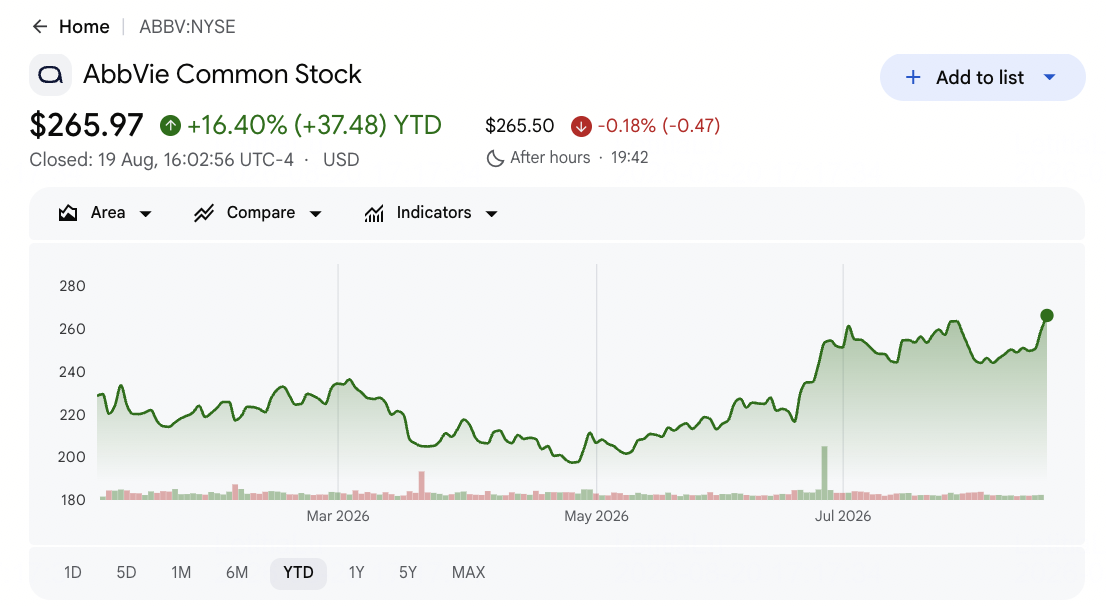
Core Role: Immunology leader in autoimmune disease treatments
AbbVie is a large biopharmaceutical company best known for immunology. Its main growth drugs are Skyrizi, used to treat autoimmune diseases such as psoriasis and Crohn’s disease, and Rinvoq, used for conditions including rheumatoid arthritis and ulcerative colitis. These newer medicines are replacing revenue lost from Humira, while AbbVie also operates in neuroscience, oncology, and aesthetics.
Q2 2026 revenue rose 10.2% to $16.99 billion, with Skyrizi sales up 24% to $5.5 billion and Rinvoq up 23.7% to $2.5 billion, more than offsetting a 36% decline in Humira. AbbVie also raised full-year revenue guidance and agreed to acquire Apogee Therapeutics for $10.9 billion. The main risks are continued Humira erosion and acquisition execution, while Skyrizi and Rinvoq remain the key growth engines.
ABBV Price Trend (2020-2026 YTD)
|
Year |
Yearly High |
Yearly Low |
Annual Return |
Market Conditions |
|
2020 |
$109.00 |
$63.00 |
0.25 |
Pandemic; Humira peak; Allergan deal |
|
2021 |
$135.00 |
$100.00 |
0.32 |
Skyrizi and Rinvoq launch momentum |
|
2022 |
$175.00 |
$134.00 |
0.24 |
Immunology growth; Humira cliff nears |
|
2023 |
$168.00 |
$132.00 |
-6% |
Humira erosion begins; transition year |
|
2024 |
$207.00 |
$153.00 |
0.18 |
Skyrizi and Rinvoq scale; post-Humira proof |
|
2025 |
$218.00 |
$170.00 |
0.12 |
Immunology leadership; dividend strength |
|
2026 YTD |
~$220 (Aug) |
~$170 (Jan) |
+8% YTD |
Q2 rev +10%; guidance raised; Apogee deal |
8. Johnson & Johnson (JNJ)
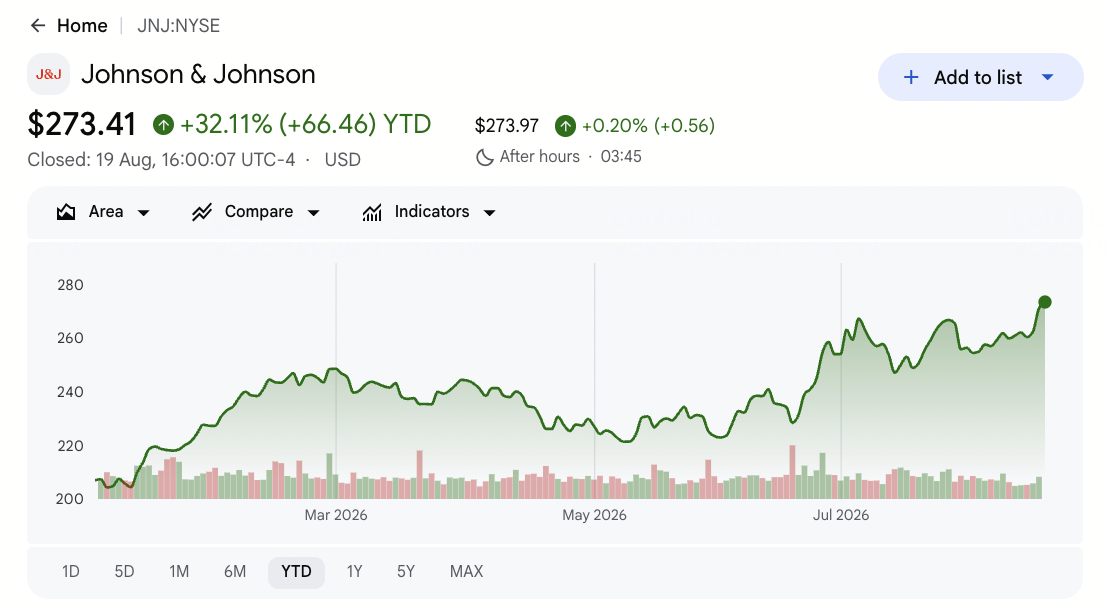
Core Role: Diversified healthcare leader in drugs and medical devices
Johnson & Johnson is one of the world’s largest healthcare companies, with businesses spanning prescription medicines and medical technology. Its drug portfolio includes Darzalex for multiple myeloma, alongside other cancer, neuroscience, and immunology treatments, while its MedTech business covers cardiovascular devices, surgery, vision, and orthopaedics.
Q2 2026 sales rose 6.6% to $25.3 billion, with adjusted EPS of $2.90, and management raised full-year guidance to about $101.1 billion in revenue and $11.68 in adjusted EPS. Oncology sales increased 16.1% to $7.4 billion, led by Darzalex, Carvykti, and Rybrevant. The main risks are talc litigation and biosimilar competition for Stelara, but J&J’s broad mix of drugs and medical devices makes it one of the more defensive large-cap healthcare names.
Read More: Johnson & Johnson (JNJ) Price Prediction 2026: Can Oncology Growth Carry JNJ Past $100 Billion?
JNJ Price Trend (2020-2026 YTD)
|
Year |
Yearly High |
Yearly Low |
Annual Return |
Market Conditions |
|
2020 |
$158.00 |
$110.00 |
0.08 |
Pandemic; vaccine development; stability |
|
2021 |
$179.00 |
$151.00 |
0.1 |
Recovery; consumer health spinoff planning |
|
2022 |
$186.00 |
$155.00 |
0.03 |
Defensive rotation; Kenvue spinoff prep |
|
2023 |
$175.00 |
$144.00 |
-11% |
Talc litigation; Kenvue separation |
|
2024 |
$168.00 |
$143.00 |
-7% |
Litigation overhang; pipeline focus |
|
2025 |
$165.00 |
$140.00 |
0.05 |
Oncology momentum; talc resolution efforts |
|
2026 YTD |
~$180 (Aug) |
~$150 (Jan) |
+20% YTD |
Q2 oncology +16%; guidance raised; outperformance |
9. Pfizer (PFE)
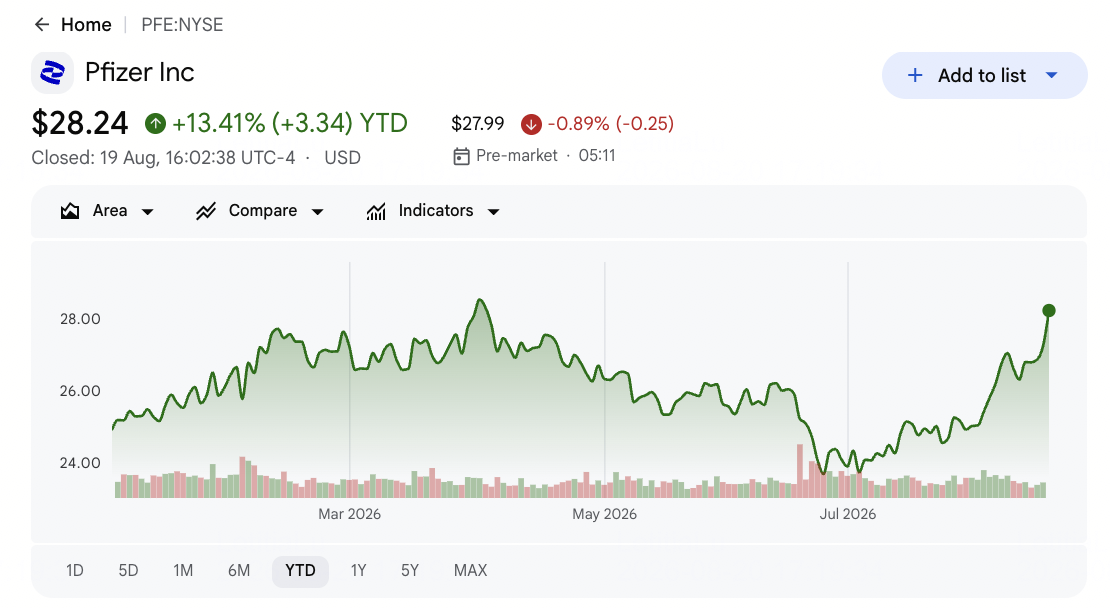
Core Role: Large-cap pharma focused on oncology, vaccines, and turnaround growth
Pfizer is one of the world’s largest pharmaceutical companies, with major businesses in oncology, vaccines, internal medicine, and infectious disease. After COVID vaccine and antiviral revenue declined from pandemic-era highs, the company shifted toward cost cuts, pipeline development, and oncology expansion, including the acquisition of cancer-drug specialist Seagen.
Pfizer’s 2026 story is mainly about rebuilding growth. Management has focused on improving margins, cutting billions in costs, and expanding its cancer portfolio while new medicines move through the pipeline. The main risks are slower post-COVID growth and uneven pipeline execution, but Pfizer offers a lower valuation and high dividend yield compared with many large-cap pharma peers.
Read More: Pfizer Stock Price Prediction 2026: High-Yield Value Opportunity or Structural Value Trap?
PFE Price Trend (2020-2026 YTD)
|
Year |
Yearly High |
Yearly Low |
Annual Return |
Market Conditions |
|
2020 |
$43.00 |
$27.00 |
-2% |
Pandemic; COVID vaccine development |
|
2021 |
$61.00 |
$34.00 |
0.6 |
COVID vaccine and antiviral boom |
|
2022 |
$61.00 |
$41.00 |
-13% |
Peak COVID revenue; reset begins |
|
2023 |
$54.00 |
$25.00 |
-44% |
COVID revenue collapse; Seagen deal |
|
2024 |
$31.00 |
$25.00 |
-8% |
Turnaround begins; cost cuts launch |
|
2025 |
$28.00 |
$20.00 |
-5% |
Value focus; dividend yield; pipeline build |
|
2026 YTD |
~$28 (Aug) |
~$22 (Jan) |
+10% YTD |
Guidance raised; cost cuts; oncology pipeline |
How to Trade Pharma Stocks on BingX
BingX offers a crypto-native way to gain exposure to leading pharma stocks without using a traditional brokerage account. The main execution path is through USDT-margined perpetual contracts on BingX TradFi, which allow active traders to go long or short and trade around earnings, drug approvals, clinical trial readouts, and broader healthcare-sector trends.
Long or Short Pharma Stock Futures with USDT on BingX TradFi
For active traders looking to capitalize on short-term momentum, earnings volatility, or clinical catalysts, BingX TradFi allows users to trade pharma-linked stock futures with USDT. These USDT-settled perpetual contracts mirror the price movements of underlying equities, offering flexible long and short exposure without requiring users to hold the physical stock.
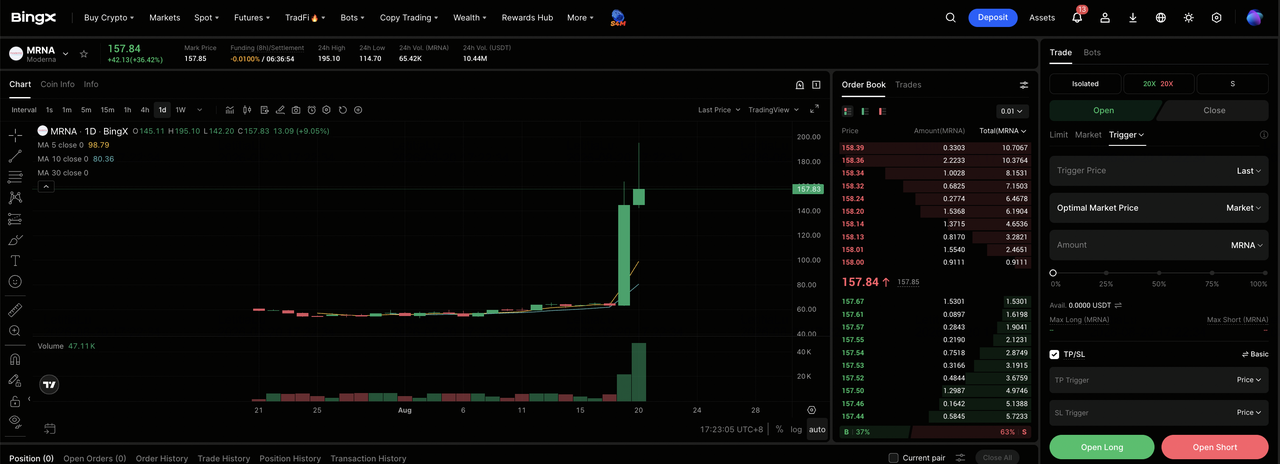
Step 1: Account setup and security. Sign up and log into your BingX account, complete the identity verification (KYC) required in your region, and enable two-factor authentication.
Step 2: Allocate trading capital. Transfer USDT from your spot wallet into your futures account, where it will serve as collateral.
Step 3: Select your contract. Navigate to the TradFi markets page or the futures trading section. Choose pharma-linked perpetual contracts such as MRNA-USDT, MRK-USDT, LLY-USDT, NVO-USDT, ABBV-USDT, JNJ-USDT, PFE-USDT, IOVA-USDT or SMMT-USDT.
Step 4: Set direction and leverage. Open long if you expect the stock price to rise, or open short if you expect a pullback. Choose leverage based on your risk plan.
Step 5: Execute and manage risk. Set stop-loss and take-profit orders before submitting the trade. PnL settles dynamically in USDT.
Risks and Core Considerations When Trading Pharma Stocks
Pharma stocks can benefit from strong healthcare demand and major drug launches, but performance can change quickly around trial results, patent expirations, pricing, competition, and regulation.
- Clinical trial outcomes can move stocks sharply. Clinical-stage companies such as Summit Therapeutics can rise or fall dramatically after a single trial readout. Failed studies can erase expected pipeline value, while positive results can trigger major re-ratings.
- Patent expirations can create large revenue gaps. Blockbuster drugs eventually lose exclusivity and face cheaper competition. Companies such as Merck must build enough new revenue to offset future pressure on major products like KEYTRUDA.
- Pricing and competition can pressure growth. Government policy, insurance coverage, price cuts, and rival drugs can affect both revenue and margins. This is especially important in fast-growing markets such as GLP-1 obesity and diabetes drugs.
- Legal and regulatory issues can create unexpected costs. Drug approvals, safety reviews, and litigation can affect both established and emerging companies. Johnson & Johnson’s talc litigation is one example of how legal exposure can remain significant.
- Leverage increases the impact of pharma volatility. Earnings, trial data, approvals, and policy headlines can trigger large price moves. Traders using USDT-margined futures should control position size and use clear stop-loss levels.
Final Thoughts: Should You Add Pharma Stocks to Your 2026 Portfolio?
The eight stocks above offer different ways to gain exposure to the 2026 pharma market. Moderna represents mRNA medicine, Merck and Summit Therapeutics offer different levels of oncology exposure, Eli Lilly and Novo Nordisk lead GLP-1 obesity drugs, AbbVie anchors immunology, while Johnson & Johnson and Pfizer provide broader large-cap healthcare exposure.
The main difference is risk. Large-cap names offer stronger cash flow, established products, and more diversified revenue, while Moderna and Summit depend more heavily on pipeline execution and clinical outcomes. For traders using BingX TradFi, position sizing, leverage control, and stop-loss orders are especially important because pharma stocks can move sharply on earnings, trial results, approvals, and policy headlines.
Related Reading
- Top 10 Quantum Computing Stocks to Watch in 2026: Companies Driving Next-Gen Computation
- Top Space Stocks to Buy Ahead of SpaceX IPO
- Top Financial Services and Fintech Stocks to Buy in 2026 Amid Agentic AI, Stablecoin Rails Shift
- Top AI Server Stocks to Buy in 2026: Rack-Scale Systems, GPU Servers, and AI Servers Infrastructure
- Top AI Optical Stocks to Buy in 2026: Photonics, Optics, Fiber, and Data Center Interconnects
- Top AI Data Center Stocks to Buy in 2026: Cloud, Servers, and AI Compute Infrastructure
