

RTX Corporation (RTX) is an aerospace and defense company operating through Collins Aerospace, Pratt & Whitney and Raytheon. Collins supplies avionics, interiors, actuation and mission systems, Pratt & Whitney builds commercial and military aircraft engines, and Raytheon produces missiles, radars and air-defense systems. This mix provides exposure to airline flight activity and government security spending, but it also leaves earnings sensitive to engine deliveries, supplier performance and fixed-price program costs.
The latest quarter showed that both sides of the portfolio are expanding. RTX Corporation Q2 2026 adjusted sales reached $24.71 billion, up 14% year over year, adjusted EPS rose to $1.89 from $1.56, and backlog increased 22% to $289 billion. Pratt & Whitney sales grew 16% to $8.89 billion and Raytheon sales rose 18% to $8.27 billion, making production throughput and margin conversion the central investment questions.
The RTX stock forecast for 2026 now centers on two competing views:
- The backlog-conversion and margin case: commercial aftermarket demand, higher engine deliveries and missile replenishment could convert the $170 billion commercial and $119 billion defense backlog into faster earnings and free-cash-flow growth.
- The production and program-cost case: supplier shortages, GTF inspection work or cost growth on fixed-price defense programs could delay deliveries and prevent revenue growth from producing the margin expansion required for a durable re-rating.
This guide breaks down the RTX stock forecast, 2026 price scenarios, key risks and analyst outlooks, drawing on RTX Corporation's July 23 Q2 2026 earnings release, quarterly filing and market data through September 24, plus how to trade RTX stock futures on BingX TradFi with USDT collateral.
Top 5 Things for RTX Corporation Investors to Know in September 2026
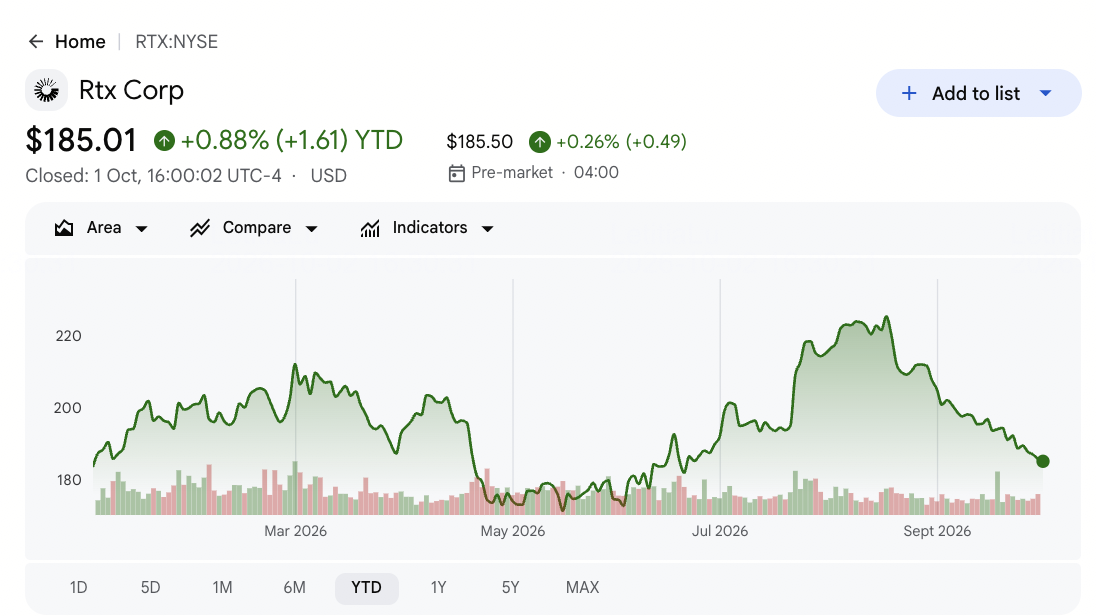
- RTX closed at $185.01 on October 2 and remained up 2.84% YTD: the stock had retreated from its $226.88 52-week high even after a strong Q2 beat. That gap shows that investors are weighing a larger earnings outlook against production execution, rather than treating defense demand alone as enough for a higher valuation.
- Q2 adjusted sales reached $24.71 billion and rose 14%: revenue exceeded the $22.90 billion consensus by $1.81 billion, while adjusted EPS of $1.89 beat the $1.66 estimate by $0.23. The breadth of the beat indicates that the quarter benefited from both commercial aerospace and defense rather than a single program.
- Backlog climbed 22% to $289 billion: commercial orders represented $170 billion and defense orders represented $119 billion, up from total backlog of $271 billion at the end of Q1. The larger book supports multi-year revenue visibility, though delivery schedules and supplier capacity determine how quickly it becomes cash.
- Management raised 2026 adjusted sales to 95billion-96 billion: the prior range was 92.5billion-93.5 billion, and the new midpoint stands $1.42 billion above the $94.08 billion analyst estimate cited after the release. Adjusted EPS guidance also moved to 7.10-7.25 from 6.70-6.90.
- Raytheon generated $10 billion of international first-half bookings: European customers contributed $7 billion as governments replenished missile and air-defense inventories. That demand supports Patriot, Standard and AMRAAM production, but it also raises the importance of factory expansion and on-time delivery.
What Is RTX Corporation (RTX)?
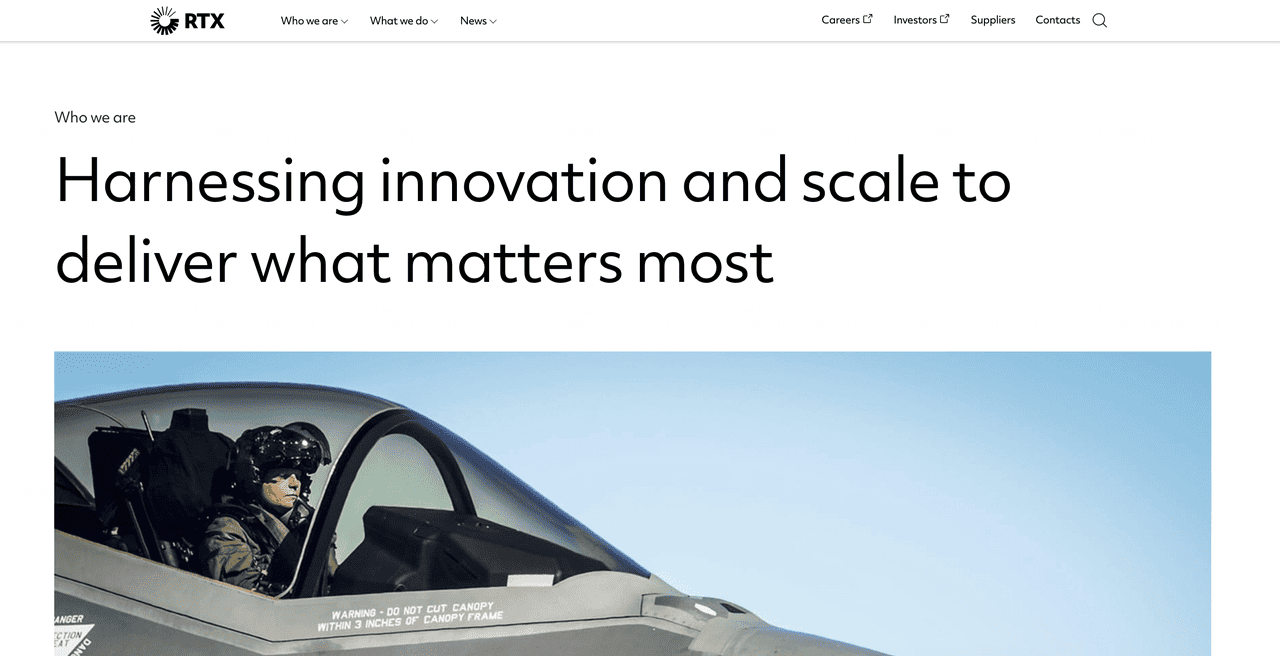
RTX is one of the largest aerospace and defense suppliers in the world. Collins Aerospace sells aircraft systems, avionics, interiors and connected-aviation products to commercial airlines, aircraft manufacturers and military customers. Pratt & Whitney earns revenue from engine deliveries and long-duration aftermarket service for the GTF commercial family and military platforms such as the F135. Raytheon supplies missiles, radar, sensors and integrated air-defense systems, creating a business model that combines equipment deliveries with recurring maintenance and sustainment.
Its long-term strategy is to increase production across both commercial aerospace and defense while using a $289 billion backlog to support capacity decisions. Pratt & Whitney supplies GTF engines for Airbus A320neo-family aircraft and F135 engines for Lockheed Martin's F-35, while Raytheon's Patriot, Standard and AMRAAM systems serve the United States and allied governments. Collins supports aircraft makers and operators across the full flight lifecycle. These installed platforms can create decades of parts and service demand, though suppliers and factories must keep pace with the delivery schedule.
Read More: Top Defense Stocks to Buy in 2026: Primes, Missiles, Drones, Space, and AI-Enabled Warfare
RTX Corporation (RTX) Q2 2026 Earnings Overview: Revenue Beat, Strong Backlog and Higher Guidance
RTX reported Q2 adjusted sales of $24.71 billion versus $22.90 billion expected, adjusted EPS of $1.89 versus $1.66 expected, and GAAP net income of $2.14 billion. Pratt & Whitney sales rose 16% to $8.89 billion, Raytheon sales increased 18% to $8.27 billion, and backlog reached $289 billion. Management raised adjusted sales guidance to 95billion-96 billion and adjusted EPS to 7.10-7.25, leaving production and cash conversion as the main constraints.
|
Financial Metric |
Guidance / Consensus |
Reported / Actual |
Surprise |
|
Q2 adjusted sales |
$22.90B consensus |
$24.71B |
Beat. $1.81B above consensus; up 14% YoY. |
|
Q2 adjusted EPS |
$1.66 consensus |
$1.89 |
Beat. $0.23 above consensus and up from $1.56. |
|
Q2 GAAP net income |
— |
$2.14B |
Positive. Equal to $1.57 per diluted share. |
|
Pratt & Whitney sales |
— |
$8.89B |
Accelerated. Up 16% on engine and service demand. |
|
Raytheon sales |
— |
$8.27B |
Accelerated. Up 18% on missile and air-defense demand. |
|
Quarter-end backlog |
$271B at Q1 end |
$289B |
Expanded. Up 22% YoY, including $170B commercial and $119B defense. |
|
2026 adjusted sales outlook |
Prior 92.5B-93.5B |
95B-96B |
Raised. Midpoint $1.42B above $94.08B consensus. |
|
2026 adjusted EPS outlook |
Prior 6.70-6.90 |
7.10-7.25 |
Raised. Midpoint $0.26 above $6.92 consensus. |
|
2026 free cash flow outlook |
Prior 7.5B-8.0B |
8.5B-8.75B |
Raised. Stronger operations improved cash expectations. |
- Adjusted sales of $24.71 billion beat consensus by $1.81 billion: the 14% increase was broad enough to support higher full-year guidance, showing that commercial aftermarket and defense demand are contributing at the same time. The new 95billion-96 billion annual range makes second-half delivery execution more important.
- Adjusted EPS of $1.89 exceeded estimates by $0.23: EPS also rose from $1.56 a year earlier, indicating that revenue growth is reaching earnings even as RTX funds capacity and supplier recovery. The increase supports the raised 7.10-7.25 full-year outlook.
- Pratt & Whitney sales rose 16% to $8.89 billion: GTF and military-engine demand strengthened the installed-base opportunity, though engine availability and inspection schedules still govern the pace of deliveries and aftermarket profit. On-time output is essential to turning demand into margin.
- Raytheon sales increased 18% to $8.27 billion: demand for Patriot, Standard and AMRAAM systems drove growth, and $7 billion of the unit's $10 billion international first-half bookings came from Europe. Those awards support capacity expansion but raise delivery requirements.
- Backlog expanded to $289 billion from $271 billion in one quarter: the $18 billion sequential increase provides visibility, but the valuation benefit depends on converting orders into deliveries without excess cost or working-capital use. Commercial orders accounted for $170 billion of the total.
RTX Corporation (RTX) 2026 Investment Outlook: $260 Bull Case vs. $165 Bear Case
RTX's 2026 outlook depends on whether its large backlog can translate into stronger revenue, margins, and cash flow as aerospace recovery and defense demand continue. The upside comes from higher aftermarket activity, production growth, and improved execution, while supplier constraints, program costs, and delivery delays remain the main risks.
The Bull Case: Strong Backlog Conversion Pushes RTX Toward $260
The Bull Case assumes commercial aftermarket activity remains strong, Pratt & Whitney increases engine deliveries, and Raytheon expands missile production. The $289 billion backlog converts smoothly, while a stronger services mix and higher production volume allow profit growth to outpace sales.
A move toward $260 would require adjusted sales near or above $96 billion, EPS above the $7.25 guidance ceiling, and free cash flow above $8.5 billion. Stable GTF inspection costs and continued European defense demand would provide the clearest confirmation.
The Base Case: Steady Aerospace and Defense Growth Keeps RTX Between $205 and $235
The Base Case assumes demand remains healthy across Collins, Pratt & Whitney, and Raytheon, but supplier constraints and program costs limit margin expansion. Sales stay within the $95 billion to $96 billion range, while backlog remains above $280 billion and supports steady growth.
RTX could trade mainly between $205 and $235 under these conditions. Adjusted EPS within the $7.10 to $7.25 range, free cash flow above $8 billion, and steady engine deliveries would support the range. Further production delays would weaken the upper end.
The Bear Case: Slower Production and Higher Costs Pull RTX Toward $165
The Bear Case assumes engine deliveries slow, supplier shortages persist, and fixed-price defense programs absorb higher labor and material costs. Revenue may still grow from backlog, but weaker conversion would reduce profit and cash flow while pressuring the valuation multiple.
A move toward $165 would become more likely if sales guidance falls below $95 billion, free cash flow drops below $8 billion, or backlog conversion slows. Higher GTF inspection costs or additional defense-program charges would increase downside pressure.
RTX Stock Price Forecasts for 2026 By Wall Street Analysts
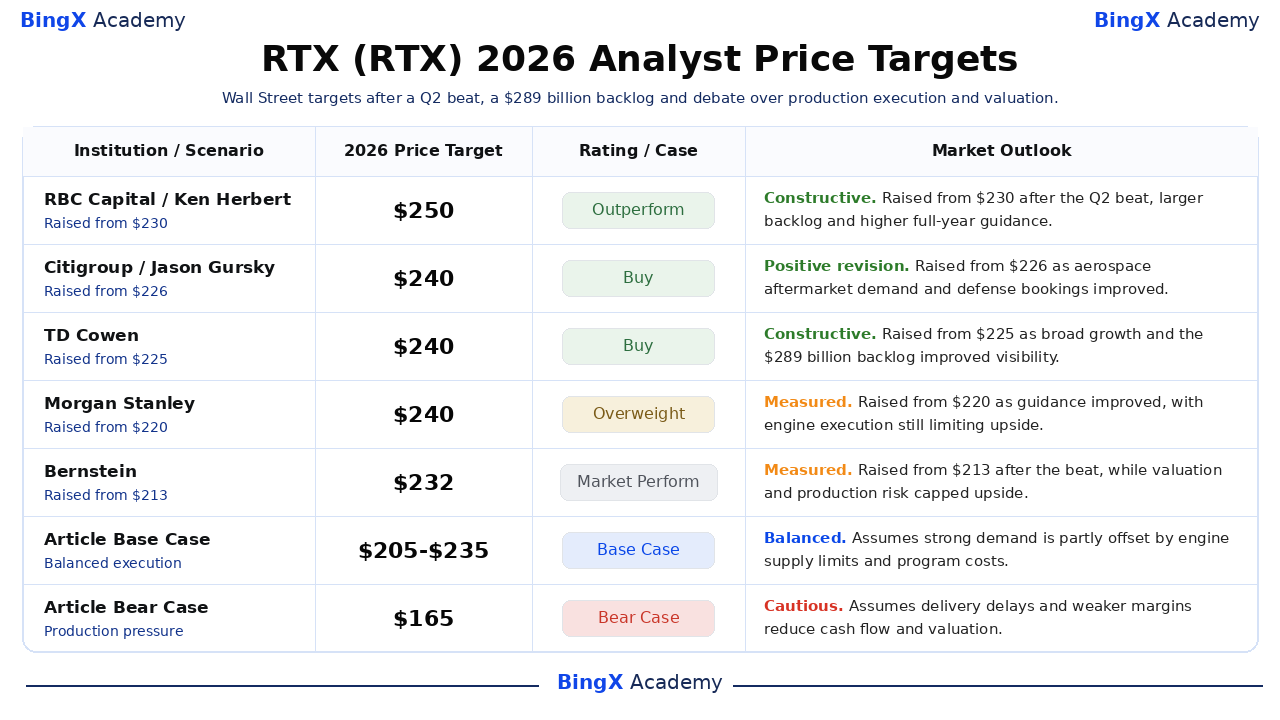
These five dated analyst actions range from $232 to $250 and reflect different assumptions about aftermarket durability, defense bookings, production execution and valuation. The targets sit above the September 24 close of $188.61, though each depends on stronger delivery and cash conversion. The Base and Bear rows are BingX Academy editorial scenarios and are labeled separately.
|
Institution / Scenario |
2026 Price Target |
Rating / Case |
Market Outlook |
|
RBC Capital / Ken Herbert |
$250 |
Outperform |
Constructive. July 24: raised from $230 after the Q2 beat, larger backlog and higher full-year guidance. |
|
Citigroup / Jason Gursky |
$240 |
Buy |
Positive revision. August 13: raised from $226 as aerospace aftermarket demand and defense bookings improved. |
|
TD Cowen / Gautam Khanna |
$240 |
Buy |
Constructive. July 27: raised from $225 as broad growth and the $289 billion backlog improved visibility. |
|
Morgan Stanley / Kristine Liwag |
$240 |
Overweight |
Measured. July 24: raised from $220 as guidance improved, with engine execution still limiting upside. |
|
Bernstein / Douglas Harned |
$232 |
Market Perform |
Measured. July 24: raised from $213 after the beat, while valuation and production risk capped upside. |
|
Article Base Case |
205-235 |
Base Case |
Balanced. Assumes strong demand is partly offset by engine supply limits and program costs. |
|
Article Bear Case |
$165 |
Bear Case |
Cautious. Assumes delivery delays and weaker margins reduce cash flow and valuation. |
How to Trade RTX Corporation (RTX) Stock on BingX
Trade RTX's commercial-aerospace, defense-booking and production outlook using BingX TradFi and BingX AI tools. Because RTX can react sharply to earnings, contract awards and engine updates, traders should define both the catalyst and risk limits before entering a position.
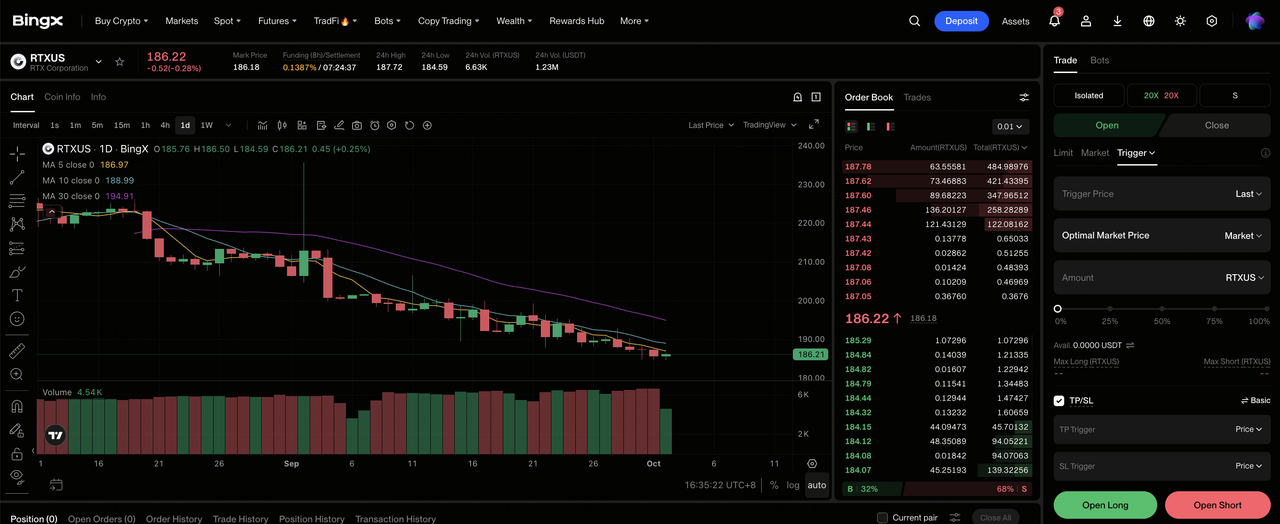
Step 1: Access BingX TradFi. Sign up and navigate to the specialized TradFi section on the BingX exchange dashboard.
Step 2: Select RTX Corporation (RTX). Search for and select the RTXUS-USDT perpetual futures contract.
Step 3: Choose your direction. Select Open Long if backlog conversion, engine deliveries and defense margins improve. Select Open Short if production delays or program costs weaken cash conversion.
Step 4: Select leverage and margin mode. Choose Isolated or Cross-Margin based on your risk tolerance. The retreat from a $226.88 52-week high to $188.61 shows why conservative leverage and clear position sizing are important.
Step 5: Execute strict risk protocols. Set Take-Profit and Stop-Loss (TP/SL) levels before or immediately after entering the trade. RTX can react quickly to earnings, guidance, aircraft deliveries, engine inspections, missile awards and defense-budget changes.
Top 5 Risks to Watch for RTX Corporation Investors in 2026
RTX combines strong end-market demand with complex manufacturing and long-duration contracts, so execution failures can reduce per-share value even when backlog is growing.
- Supplier shortages can delay engine and systems deliveries: Pratt & Whitney sales rose 16% to $8.89 billion, yet constrained castings, electronics or labor could prevent output from matching demand and defer both revenue and aftermarket cash.
- Fixed-price defense programs can absorb cost inflation: Raytheon sales increased 18% to $8.27 billion, but labor, material or redesign costs on older contracts may compress margins before new pricing reaches the income statement. That would weaken EPS despite higher deliveries.
- GTF inspection costs can pressure cash conversion: Pratt & Whitney must support airlines through inspections and fleet-management work. Higher compensation or shop-visit expense could reduce the free cash flow expected from the 8.5billion-8.75 billion outlook.
- Government budgets can shift award and delivery timing: defense backlog totals $119 billion, yet appropriations, export approvals and customer priorities can move production schedules. Delays would slow working-capital recovery, defer factory utilization and reduce near-term earnings visibility.
- A commercial aerospace slowdown can weaken aftermarket demand: the $170 billion commercial backlog benefits from high flight activity and older fleets. Lower airline traffic, fuel shocks or a faster arrival of new aircraft could reduce service demand and pressure Collins and Pratt margins.
Final Thoughts: Should You Invest in RTX Corporation in 2026?
RTX entered the second half with a broad beat, higher guidance and a $289 billion backlog. Q2 adjusted sales rose 14% to $24.71 billion, adjusted EPS reached $1.89 and management lifted full-year adjusted sales to 95billion-96 billion. Those figures support the growth thesis, though the fall from the 52-week high shows that investors still require proof of production and cash conversion.
The Bull Case requires engine deliveries, missile output and aftermarket margins to push shares toward $260. The Bear Case reflects supplier delays and program-cost pressure toward $165. Conservative traders may wait for backlog above $280 billion, free cash flow above $8.5 billion and evidence that adjusted EPS can exceed $7.25 before increasing exposure.
Risk Reminder: Trading and investing in equities like RTX involves a high risk of capital loss. Aerospace cycles, defense budgets, supplier constraints, engine inspections, program costs, valuation changes and leverage can produce rapid losses. Conduct independent research before allocating capital.
Related Reading
- Top Defense Stocks to Buy in 2026: Primes, Missiles, Drones, Space, and AI-Enabled Warfare
- Top Space Stocks to Buy Ahead of SpaceX IPO
- Lockheed Martin (LMT) Price Prediction 2026: Can Record Backlog Push LMT Toward $700?
- Rocket Lab (RKLB) Price Prediction 2026: Can New Rocket and Defense Growth Push RKLB Toward $150?
- Redwire (RDW) Price Prediction 2026: Can Space and Defense Orders Push RDW Toward $24?
- Sidus Space (SIDU) Price Prediction 2026: Can Satellite and Edge AI Growth Push SIDU Toward $6?
