


Oracle (ORCL) sells database technology, cloud infrastructure and enterprise applications. Its mature software base still supplies recurring revenue and customer relationships, as Oracle Cloud Infrastructure, or OCI, becomes more important to long-term growth. That transition gives Oracle direct exposure to AI training and inference demand, though it also makes the stock sensitive to data-center costs, project timing and large-customer concentration.
Its latest quarter showed the transition accelerating. Oracle fiscal Q1 FY2027 revenue reached $19.35 billion, up 30% year over year, and non-GAAP diluted EPS reached $1.92. OCI revenue jumped 121% to $7.4 billion, though $28.5 billion of quarterly capital expenditure and negative $5.40 billion of free cash flow kept funding and returns central to the debate.
The ORCL stock forecast for 2026 now centers on two competing views:
- The AI cloud conversion case: a $664 billion backlog and new capacity could sustain rapid revenue and earnings growth.
- The capital intensity case: debt, dilution and weak free cash flow could limit the valuation even as OCI expands.
This guide breaks down the ORCL stock forecast, 2026 price scenarios, key risks and analyst outlooks, drawing on Oracle's September 10 fiscal Q1 FY2027 earnings release, quarterly disclosures and market data through September 10, plus how to trade ORCL stock futures on BingX TradFi with USDT collateral.
Top 5 Things for Oracle Investors to Know in September 2026
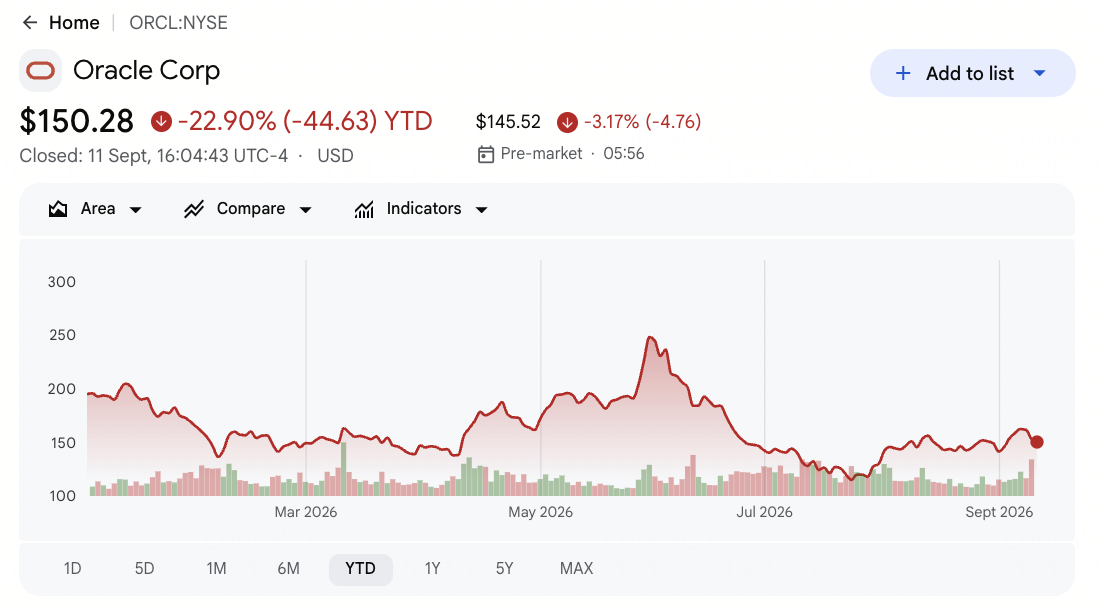
- ORCL closed at $152.94 on September 10 and was down 21.53% YTD: Shares remained more than 50% below the $331.00 52-week high. The gap reflects concerns around financing, customer concentration and execution as Oracle expands AI infrastructure.
- Quarterly revenue reached $19.35 billion, up 30% year over year: Revenue beat consensus by about $220 million, while adjusted EPS of $1.92 topped the $1.74 estimate. OCI growth is now large enough to materially affect consolidated results.
- OCI revenue rose 121% to $7.4 billion: The result beat the roughly $7.19 billion estimate as AI training and inference demand increased. Oracle still needs to add capacity fast enough to convert demand into revenue.
- Remaining performance obligations reached $664 billion: Backlog exceeded the roughly $639.9 billion expectation, while Oracle signed more than $30 billion of new AI cloud contracts. Stronger backlog conversion could improve future revenue visibility.
- Capital expenditure reached $28.5 billion as free cash flow fell to negative $5.40 billion: Cash burn was better than the negative $9.56 billion estimate, helped by customer prepayments. Even so, spending above quarterly revenue keeps financing and return-on-investment concerns in focus.
What Is Oracle (ORCL)?
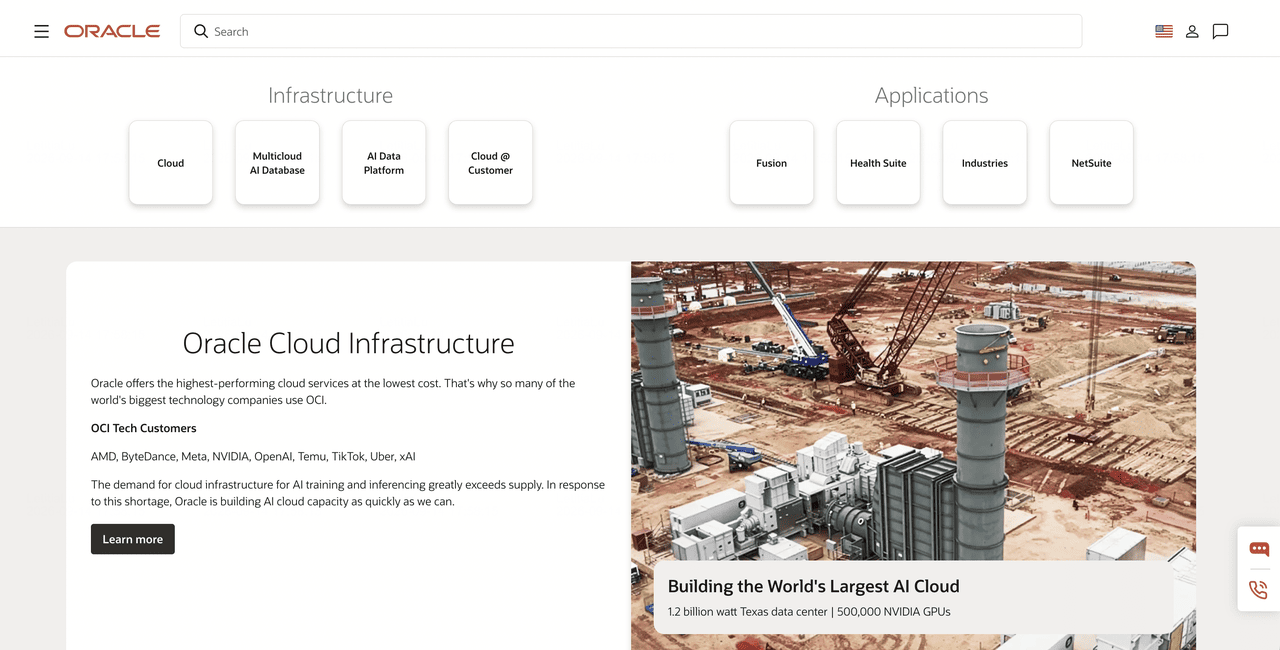
Oracle is an enterprise technology company built around databases, cloud services and business applications. OCI supplies computing, storage, networking and accelerated AI infrastructure, while Oracle AI Database and Exadata manage high-value corporate data. Fusion provides cloud software for finance, human resources, supply chains and customer operations, with NetSuite serving smaller and mid-sized organizations. Revenue comes from subscriptions, cloud consumption, software licenses, support and hardware-linked services across private, public and multicloud environments.
Oracle's long-term strategy connects AI infrastructure with the data and workflows already used by large organizations. OpenAI, Meta, NVIDIA, xAI, ByteDance, TikTok and Uber are among the technology customers named on Oracle's site, and Oracle is expanding AI capacity to address demand that still exceeds supply. Its multicloud database footprint also spans AWS, Microsoft Azure and Google Cloud, letting customers run Oracle databases alongside other cloud platforms. Fusion, Oracle Health and industry applications extend this strategy from infrastructure into recurring business workflows.
Read More: Top AI Data Center Stocks to Buy in 2026: Cloud, Servers, and AI Compute Infrastructure
Oracle (ORCL) Q1 FY2027 Earnings Overview: Revenue, OCI Growth and Cash-Burn Improvement
Oracle delivered $19.35 billion of revenue versus $19.13 billion expected, adjusted EPS of $1.92 versus $1.74 expected and OCI revenue of $7.4 billion, up 121%. GAAP net income rose 60% to $4.70 billion, remaining performance obligations reached $664 billion and free cash flow was negative $5.40 billion after $28.5 billion of capital expenditure. The quarter strengthened the demand case, though cash conversion remains the central tradeoff.
|
Financial Metric |
Guidance / Consensus |
Reported / Actual |
Surprise |
|
Q1 FY2027 revenue |
$19.13B consensus |
$19.35B |
Beat. About $220M above consensus; up 30% YoY. |
|
Q1 non-GAAP diluted EPS |
$1.74 consensus |
$1.92 |
Beat. $0.18 above consensus; up 31% YoY. |
|
Q1 GAAP net income |
$4.10B consensus |
$4.70B |
Beat. Up 60% YoY as revenue scale lifted earnings. |
|
Q1 GAAP diluted EPS |
— |
$1.56 |
Improved. Up 54% year over year. |
|
Cloud revenue |
— |
$11.6B; +62% YoY |
Accelerated. Cloud represented about 60% of total revenue. |
|
OCI revenue |
$7.19B consensus |
$7.4B; +121% YoY |
Beat. AI training and inference demand more than doubled IaaS revenue. |
|
Remaining performance obligations |
$639.9B consensus |
$664B |
Beat. More than $30B of new AI cloud contracts expanded visibility. |
|
Q1 capital expenditure |
— |
$28.5B |
Elevated. Spending exceeded quarterly revenue and pressured cash flow. |
|
Q1 free cash flow |
-$9.56B consensus |
-$5.40B |
Better. Customer prepayments reduced the expected cash burn. |
|
Q2 revenue growth outlook |
— |
30%-34% constant currency |
Strong. Cloud revenue is expected to grow 64%-70%. |
|
FY2027 revenue outlook |
Prior: about $90B |
At least $90B |
Reaffirmed. Capacity delivery remains the key conversion test. |
|
FY2027 non-GAAP EPS |
Prior: $8.05 |
$8.10 |
Raised. Higher cloud revenue outweighed financing and mix pressure. |
- Revenue of $19.35 billion beat consensus by about $220 million: Sales rose 30% year over year as cloud reached roughly 60% of revenue. The mix shift shows AI demand is converting into reported sales, though the beat remained modest relative to Oracle's backlog.
- Adjusted EPS of $1.92 beat the $1.74 estimate by $0.18: Adjusted earnings rose 31%, while GAAP net income increased 60% to $4.70 billion. Profit growth alongside cloud expansion helps ease concerns that infrastructure spending will immediately weaken operating leverage.
- OCI revenue of $7.4 billion grew 121% and beat consensus: The result topped the $7.19 billion estimate as more data-center capacity supported AI workloads. Sustaining that growth requires Oracle to bring power and computing capacity online without major delays or cost overruns.
- RPO of $664 billion exceeded expectations by about $24 billion: More than $30 billion of new AI cloud contracts expanded the backlog. Better contract economics could reduce the funding burden as more of that demand converts into revenue.
- Free cash flow was negative $5.40 billion after $28.5 billion of capex: The deficit was $4.16 billion better than consensus, helped by $11.36 billion of customer prepayments. Funding pressure has eased, though operating cash flow still needs to catch up with the infrastructure build.
Oracle Stock Price Prediction 2026: $260 Bull Case vs. $110 Bear Case
Oracle's investment outlook depends on how quickly its $664 billion backlog becomes revenue and whether contract economics can support returns after an unusually capital-intensive build. The scenarios below are editorial ranges, not Wall Street targets or guaranteed outcomes.
The Bull Case: Strong Cloud Growth Pushes ORCL Toward $260
The Bull Case assumes OCI remains Oracle's main growth engine after revenue rose 121% to $7.4 billion. New capacity converts the $664 billion backlog on schedule, customers continue prepaying for deployments and newer AI contracts require less capital than earlier agreements.
A move toward $260 would require 30% to 34% Q2 revenue growth, cloud growth near the guided 64% to 70% range and visible improvement from negative $5.40 billion free cash flow. Continued EPS upgrades beyond the new $8.10 FY2027 target would strengthen the case.
The Base Case: Steady Cloud Growth Keeps ORCL Between $185 and $225
The Base Case assumes OCI remains strong as growth normalizes from 121%, while database and application subscriptions preserve recurring revenue. Backlog conversion supports at least $90 billion of FY2027 revenue, though heavy spending keeps free cash flow and valuation below prior peaks.
Under this scenario, ORCL could trade mainly between $185 and $225. Capacity additions, stable project schedules and better-than-expected cash burn would support the range. Higher capital needs without matching revenue growth would limit upside.
The Bear Case: Data-Center Delays Pull ORCL Toward $110
The Bear Case assumes data-center projects slip or major customers defer workloads. Oracle would then carry financing, lease and construction costs before enough cloud revenue arrives, keeping free cash flow negative and weakening confidence in the $664 billion backlog.
A move toward $110 would become more likely if OCI growth falls sharply below guidance, annual revenue misses $90 billion or capex rises beyond current plans. Higher interest costs or equity issuance would add further pressure to earnings and valuation.
Oracle Stock Price Forecasts for 2026 By Wall Street Analysts
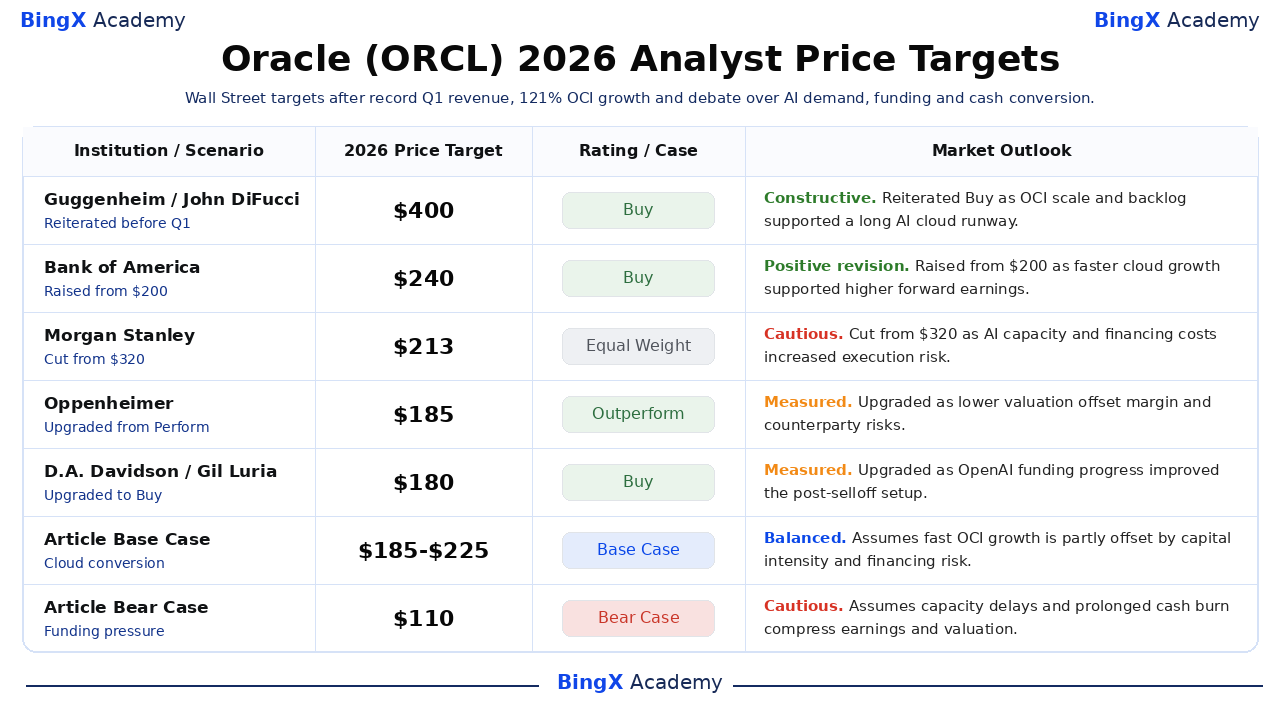
Wall Street targets span $180 to $400 across the five cited actions, reflecting disagreement over whether OCI growth and a $664 billion backlog can outweigh capital intensity. The targets predate or immediately precede Q1 results, so they are reference points rather than synchronized post-earnings forecasts or price promises.
|
Institution / Scenario |
2026 Price Target |
Rating / Case |
Market Outlook |
|
Guggenheim / John DiFucci |
$400 |
Buy |
Constructive. September 8: reiterated as OCI scale and backlog supported a long AI cloud runway. |
|
Bank of America / Brad Sills |
$240 |
Buy |
Positive revision. June 9: raised from $200 as faster cloud growth supported higher forward earnings. |
|
Morgan Stanley / Keith Weiss |
$213 |
Equal Weight |
Cautious. January 23: cut from $320 as AI capacity and financing costs increased execution risk. |
|
Oppenheimer / Brian Schwartz |
$185 |
Outperform |
Measured. February 25: upgraded from Perform as lower valuation offset margin and counterparty risks. |
|
D.A. Davidson / Gil Luria |
$180 |
Buy |
Measured. February 9: upgraded to Buy as OpenAI funding progress improved the post-selloff setup. |
|
Article Base Case |
$185-$225 |
Base Case |
Balanced. Assumes fast OCI growth is partly offset by capital intensity and financing risk. |
|
Article Bear Case |
$110 |
Bear Case |
Cautious. Assumes capacity delays and prolonged cash burn compress earnings and valuation. |
How to Trade Oracle (ORCL) Stock on BingX
Trade Oracle's AI cloud demand, capacity delivery and cash-flow outlook using BingX TradFi and BingX AI tools. Because ORCL can react sharply to cloud bookings, capital-spending plans and large-customer disclosures, traders should define both the catalyst and risk limits before entering a position.
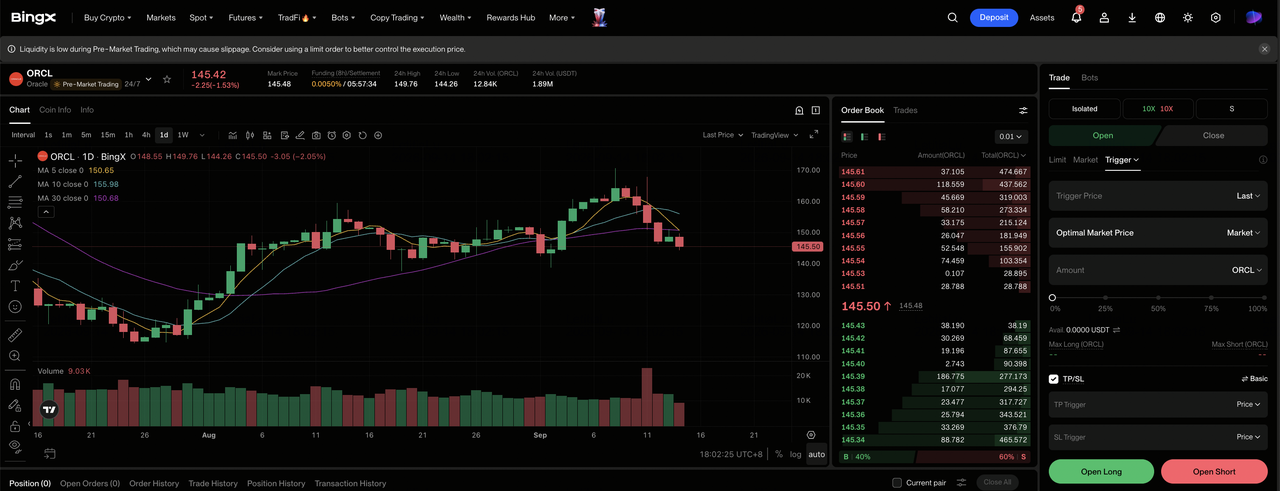
Step 1: Access BingX TradFi. Sign up and navigate to the specialized TradFi section on the BingX exchange dashboard.
Step 2: Select Oracle (ORCL). Search for and select the ORCL-USDT perpetual futures contract.
Step 3: Choose your direction. Select Open Long if OCI growth and backlog conversion improve earnings and cash flow. Select Open Short if capacity delays or financing costs weaken returns.
Step 4: Select leverage and margin mode. Choose Isolated or Cross-Margin based on your risk tolerance. The 21.53% YTD decline shows why conservative leverage and clear position sizing are important.
Step 5: Execute strict risk protocols. Set Take-Profit and Stop-Loss (TP/SL) levels before or immediately after entering the trade. ORCL can react quickly to cloud guidance, backlog updates, capex plans and customer concentration.
Top 5 Risks to Watch for Oracle Investors in 2026
Oracle's upside depends on capacity expansion, customer demand, financing and cloud economics. These risks can affect revenue conversion, free cash flow and valuation.
- Heavy capex raises the return hurdle: Oracle spent $28.5 billion in the quarter against $19.35 billion of revenue, contributing to negative $5.40 billion free cash flow. Slow utilization or weaker pricing could leave financing and depreciation costs ahead of profits.
- A $664 billion backlog increases execution risk: Large AI contracts provide visibility but also increase dependence on major customers and project timing. Delayed deployments could affect revenue, utilization and cash receipts across several quarters.
- OCI growth depends on data centers arriving on time: OCI revenue grew 121% to $7.4 billion, but expansion requires power, land, networking equipment and accelerators. Construction delays or supply shortages could slow backlog conversion.
- Cloud growth could pressure software margins: OCI is growing much faster than Oracle's traditional software businesses. If lower-margin infrastructure becomes a larger share of revenue, sales can rise quickly while margins and cash conversion improve more slowly.
- More financing could reduce per-share upside: Oracle's buildout may require additional debt, leases or equity. Higher interest expense or share issuance could limit EPS growth even if cloud revenue remains strong.
Final Thoughts: Should You Invest in Oracle in 2026?
Oracle's Q1 results strengthened the operating case. Revenue grew 30%, OCI revenue rose 121%, adjusted EPS beat consensus by $0.18 and RPO reached $664 billion. The key question is no longer whether AI cloud demand exists. It is whether Oracle can deliver capacity and turn that contracted demand into profitable revenue faster than investment, interest and dilution consume the gains.
The $185-$225 Base Case offers the most balanced framework because it recognizes both rapid cloud conversion and negative $5.40 billion free cash flow. A conservative investor should monitor OCI growth, quarterly capex, customer prepayments, RPO additions and progress toward at least $90 billion of FY2027 revenue. Improvement across those measures would support upside, while project delays or renewed cash burn would strengthen the Bear Case.
Risk Reminder: These scenarios are conditional research estimates, not investment advice or guaranteed returns. Shares and leveraged contracts can lose value, and leveraged positions may be liquidated.
Related Reading
- Top AI Data Center Stocks to Buy in 2026: Cloud, Servers, and AI Compute Infrastructure
- Top AI Compute and GPU Stocks to Buy in 2026: The Shift to Inference and Custom Silicon
- Top AI Semiconductor Stocks to Buy in 2026: AI Chips and Supply Chain Complete Guide
- Top 10 AI Infrastructure Stocks to Buy in 2026: Chip Manufacturing and Design Leaders
- Top AI Hyperscaler Stocks to Watch in 2026: The $700 Billion Cloud Infrastructure Race
- Top AI Cloud Infrastructure Stocks to Buy in 2026 Amid Hyperscaler Capex and the Neocloud Boom
