

Occidental Petroleum (OXY) is an integrated energy producer centered on oil and gas assets in the United States and the Middle East, supported by midstream infrastructure and a developing carbon-management platform. The Permian Basin remains its largest operating engine, while CrownRock acreage has added scale and inventory. This portfolio gives Occidental direct exposure to higher crude prices, yet leaves earnings sensitive to commodity cycles, geopolitical disruption and acquisition-related leverage.
Its latest quarter showed the benefit and volatility of that model. OXY Q2 2026 revenue reached $8.065 billion, adjusted EPS rose to $2.40 and worldwide production averaged 1.433 million barrels of oil equivalent per day. Occidental also realized $96.78 per barrel for oil, making the earnings improvement unusually dependent on a price environment that can reverse as quickly as it strengthened.
The OXY stock forecast for 2026 now centers on two competing views:
- The higher-oil and deleveraging case: strong realized prices, production discipline and lower capital spending accelerate free cash flow and reduce balance-sheet constraints.
- The normalization case: easing supply disruption lowers crude prices before debt reduction and carbon investments create enough durable per-share value.
This guide breaks down the OXY stock forecast, 2026 price scenarios, key risks and analyst outlooks, drawing on Occidental Petroleum's August 5 Q2 2026 earnings release, quarterly filing and market data through September 10, plus how to trade OXY stock futures on BingX TradFi with USDT collateral.
Top 5 Things for Occidental Petroleum Investors to Know in September 2026
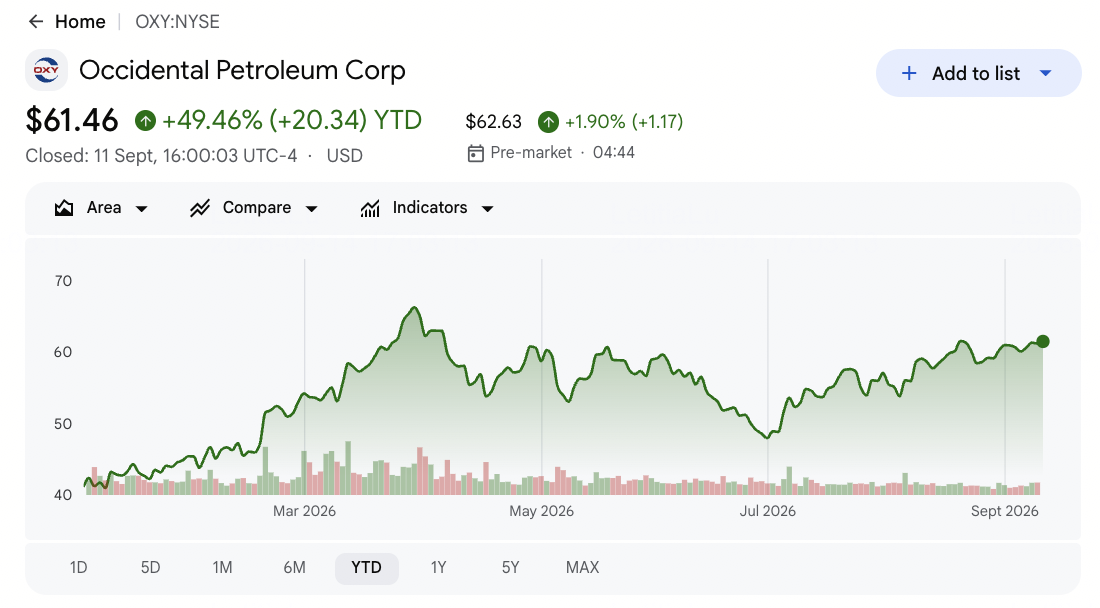
- OXY closed at $61.16 after gaining about 45% in 2026: The rally reflects higher crude prices and stronger earnings rather than valuation expansion alone. Shares remain below the $79 Street high, leaving upside if cash flow stays elevated.
- Q2 revenue reached $8.065 billion, up 53.4%: Sales beat the $7.25 billion consensus by about $815 million, while adjusted EPS of $2.40 topped the $1.84 estimate by $0.56. Higher realized prices flowed strongly through Occidental's cost base.
- Worldwide production averaged 1.433 million boe/d, up 2.4%: Output exceeded the high end of guidance as U.S. operations offset weaker international volumes. International production still fell 12% to 205,000 boe/d.
- 2026 capital spending was cut to $5.5 billion–$5.9 billion: The midpoint fell $800 million from the prior range, while production guidance narrowed to 1.42–1.45 million boe/d. Maintaining output with less spending would support free cash flow and debt reduction.
- Principal debt fell to $11.818 billion from $20.427 billion: The roughly $8.6 billion reduction gives Occidental more flexibility after the CrownRock acquisition and $9.7 billion OxyChem sale. Lower oil prices could still slow further deleveraging and shareholder returns.
What Is Occidental Petroleum (OXY)?
Occidental Petroleum is a Houston-based energy company that develops oil and natural-gas resources across the Permian Basin, the Rockies, the Gulf of Mexico and selected Middle Eastern markets. Its upstream business earns revenue by producing and selling crude oil, natural-gas liquids and natural gas. Midstream and power assets move, process and market hydrocarbons, helping connect production to customers and export markets. The result is a cash-flow model driven by production volumes, realized commodity prices, operating costs and the capital needed to replace declining reserves.
Occidental's long-term direction increasingly combines a larger Permian position with balance-sheet repair and carbon management. The CrownRock acquisition expanded its unconventional Permian inventory, while the completed $9.7 billion sale of OxyChem to Berkshire Hathaway allowed $6.5 billion of proceeds to support debt reduction and sharpen the portfolio around energy production. Through 1PointFive, Occidental is also developing STRATOS and other direct-air-capture projects intended to sell durable carbon-removal services. These programs broaden its potential revenue base, though oil and gas remain the primary drivers of earnings and valuation.
Read More: Top Energy Stocks and ETFs to Buy in 2026: The AI Power Crunch Meets Geopolitical Volatility
Occidental Petroleum (OXY) Q2 2026 Earnings Overview: Higher Oil Prices Drive a $2.40 EPS Beat
Occidental generated Q2 revenue of $8.065 billion versus $7.25 billion expected, adjusted EPS of $2.40 versus $1.84 expected and GAAP net income of $2.98 billion. Production averaged 1.433 million boe/d as the realized oil price rose above 50% to $96.78 per barrel. Management then lowered 2026 capital spending to $5.5 billion–$5.9 billion, though international output fell 12% to 205,000 boe/d.
Read More: Occidental Petroleum (OXY) Q2 2026 Earnings Overview: $2.40 EPS Beat Drives a 4.14% Price Rally
|
Financial Metric |
Guidance / Consensus |
Reported / Actual |
Surprise |
|
Q2 2026 revenue |
$7.25B consensus |
$8.065B |
Beat. About $815M above consensus and up 53.4% YoY. |
|
Q2 adjusted diluted EPS |
$1.84 consensus |
$2.40 |
Beat. $0.56 above consensus and highest since Q3 2022. |
|
Q2 GAAP diluted EPS |
Not provided |
$2.75 |
Improved. Higher realized oil prices lifted reported earnings. |
|
Q2 GAAP net income |
Not provided |
$2.98B |
Improved. Quarterly profit reached its highest level since 2022. |
|
Q2 worldwide production |
Company guidance range |
1.433 MMboe/d |
Beat. Finished above the high end of guidance and rose 2.4% YoY. |
|
Q2 realized oil price |
Prior-year level near $64/bbl |
$96.78/bbl |
Expanded. More than 50% higher YoY amid supply disruption. |
|
Q2 international production |
Prior year |
205,000 boe/d |
Declined. Down 12% as Middle East disruption constrained output. |
|
2026 production outlook |
Prior wider range |
1.42–1.45 MMboe/d |
Tightened. Maintains high output despite international disruption. |
|
2026 capital spending |
Prior $6.3B–$6.7B |
$5.5B–$5.9B |
Lowered. Midpoint fell $800M, supporting free cash flow. |
|
Principal debt |
$20.427B earlier level |
$11.818B |
Improved. Deleveraging reduced principal debt by about $8.6B. |
- Revenue of $8.065 billion grew 53.4% and beat by $815 million: Occidental's realized oil price rose to $96.78 per barrel, driving strong operating leverage. That also leaves earnings exposed if crude prices normalize.
- Adjusted EPS of $2.40 exceeded consensus by $0.56: The 30% beat lifted adjusted earnings to their highest level since Q3 2022. Strong price realization supported both the $0.28 quarterly dividend and further debt reduction.
- Production of 1.433 million boe/d increased 2.4%: U.S. assets drove the gain and output exceeded the top of guidance. International production still fell 12% to 205,000 boe/d.
- Realized oil prices rose more than 50% to $96.78 per barrel: Brent averaged $89.62 during the quarter, up 19.2% year over year. Occidental benefited from both higher production and unusually strong commodity pricing.
- The capital-spending midpoint fell $800 million to $5.7 billion: Management kept production guidance at 1.42–1.45 million boe/d despite lower spending. Delivering both would improve capital efficiency, free cash flow and debt reduction.
Read More: Natural Gas Price Prediction 2026: $15 Global Energy Shock or U.S. Glut Trap?
Occidental Petroleum (OXY) Price Prediction 2026: Bull, Base and Bear Scenarios
OXY's investment outlook turns on the interaction between commodity prices and capital allocation. Production near 1.42–1.45 million boe/d supplies the operating base, though realized prices determine how much cash remains after the $5.5 billion–$5.9 billion capital program, interest, dividends and further debt reduction.
The Bull Case: Higher Oil Prices Push OXY Toward $85
The Bull Case assumes oil stays near the upper end of a $90–$110 range while worldwide production holds near the 1.45 million boe/d top of guidance. A $5.7 billion capital-spending midpoint would preserve more cash for debt reduction and shareholder returns.
A move toward $85 would require production to stay near guidance, realized prices to remain well above the prior-year level near $64 per barrel and principal debt to fall below $11.818 billion. Strong free cash flow and further analyst estimate increases would support the case.
The Base Case: Steady Production Keeps OXY Between $62 and $72
The Base Case assumes oil prices moderate from Q2 levels while U.S. production keeps total output within the 1.42–1.45 million boe/d range. Lower capital spending offsets part of the price decline, and debt reduction continues at a slower pace.
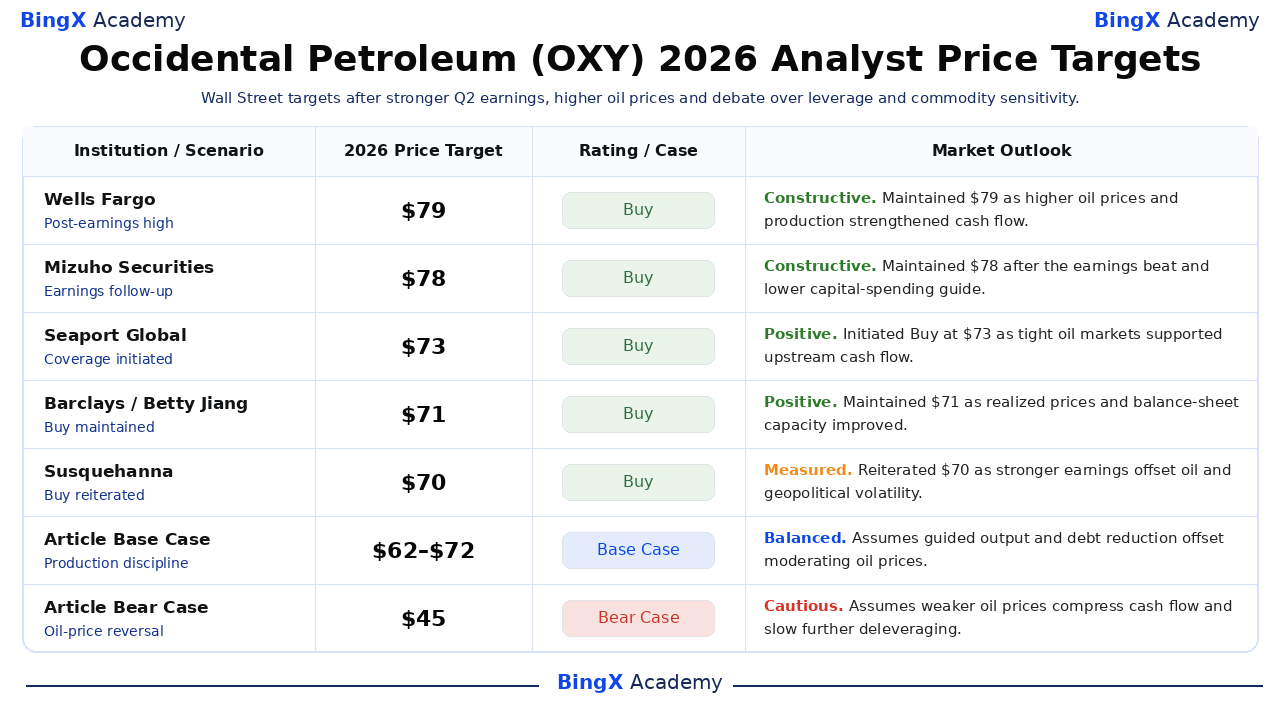
Under this scenario, OXY could trade mainly between $62 and $72, close to analyst targets from $69 to $73. Stable Permian volumes, capital spending within $5.5 billion to $5.9 billion and falling principal debt would support the range.
The Bear Case: Lower Oil Prices Pull OXY Toward $45
The Bear Case assumes oil falls toward $70 per barrel, reducing the realized-price advantage that drove Q2 revenue up 53.4%. International disruption or faster U.S. decline rates could also push production below the 1.42 million boe/d lower bound.
A move toward $45 would become more likely if weaker prices reduce free cash flow, principal debt stops falling from $11.818 billion or carbon projects require spending before generating revenue. Slower deleveraging and weaker cash flow would pressure the stock.
2026 Wall Street OXY Stock Price Forecasts
Wall Street remains constructive yet divided after Occidental's Q2 earnings beat. The five highest selected targets range from $70 to $79, compared with the September 10 close of $61.16, while Morgan Stanley sits at $69. The spread reflects different assumptions for oil prices, production durability, capital efficiency and the pace of debt reduction.
|
Institution / Scenario |
2026 Price Target |
Rating / Case |
Market Outlook |
|
Wells Fargo |
$79 |
Buy |
Constructive. August 6: maintained its Street-high target after stronger oil prices, production and quarterly earnings. |
|
Mizuho Securities |
$78 |
Buy |
Constructive. August 6: maintained a bullish target after the earnings beat and lower capital-spending outlook. |
|
Seaport Global |
$73 |
Buy |
Positive. September 2: initiated coverage as oil-market tightness supported upstream cash flow. |
|
Barclays |
$71 |
Buy |
Positive. August 17: maintained Buy as higher realized prices and balance-sheet capacity supported valuation. |
|
Susquehanna |
$70 |
Buy |
Measured. August 11: reiterated Buy while balancing improved earnings against commodity and geopolitical volatility. |
|
Morgan Stanley |
$69 |
Equal Weight |
Balanced. August 20: reiterated a neutral stance as strong oil-linked earnings were weighed against valuation and cyclicality. |
|
Article Base Case |
$62–$72 |
Base Case |
Balanced. Assumes guided production and debt reduction offset moderating oil prices. |
|
Article Bear Case |
$45 |
Bear Case |
Cautious. Assumes weaker oil prices compress cash flow and slow further deleveraging. |
How to Trade Occidental Petroleum (OXY) Stock on BingX
Trade Occidental Petroleum's oil-price, production and deleveraging outlook using BingX TradFi and BingX AI tools. Because OXY can react quickly to crude prices, geopolitical news, operating guidance and capital-allocation decisions, traders should define both the catalyst and risk limits before entering a position.
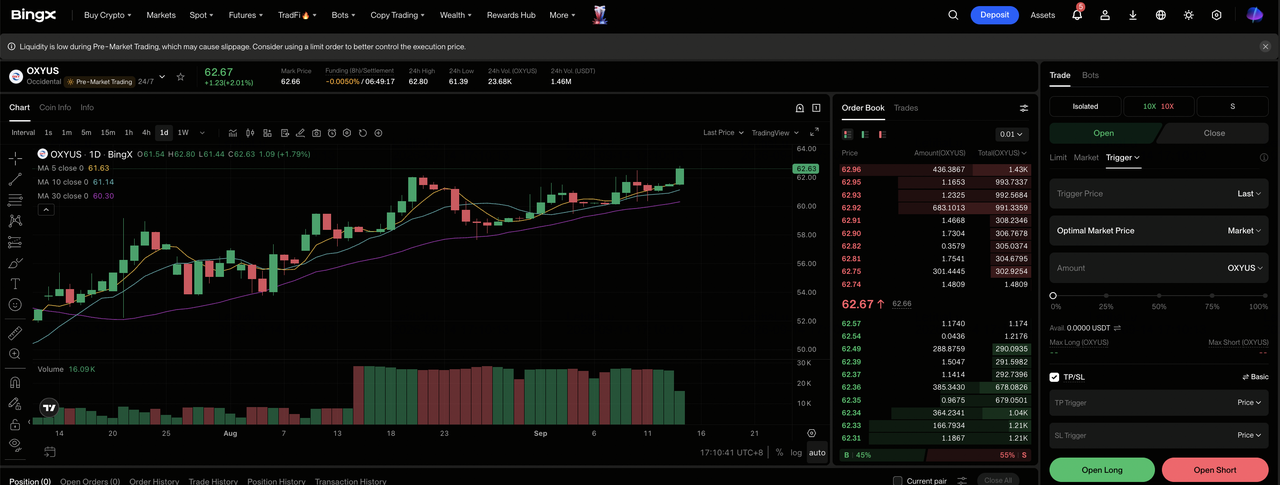
Step 1: Access BingX TradFi. Sign up and navigate to the specialized TradFi section on the BingX exchange dashboard.
Step 2: Select Occidental Petroleum (OXY). Search for and select the OXY-USDT perpetual futures contract.
Step 3: Choose your direction. Select Open Long if elevated oil prices and capital discipline accelerate free cash flow. Select Open Short if lower crude prices or production disruption weakens earnings.
Step 4: Select leverage and margin mode. Choose Isolated or Cross-Margin based on your risk tolerance. OXY's roughly 45% YTD advance and direct commodity sensitivity make conservative leverage and clear position sizing important.
Step 5: Execute strict risk protocols. Set Take-Profit and Stop-Loss (TP/SL) levels before or immediately after entering the trade. OXY can react quickly to oil prices, Middle East developments, production guidance, capital spending and debt updates.
Top 5 Risks to Watch for Occidental Petroleum Investors in 2026
Occidental's valuation depends on commodity prices, operating performance and balance-sheet progress. These risks can reduce free cash flow, slow deleveraging or pressure OXY's valuation.
- Lower oil prices could cut cash flow quickly: Q2 realized oil prices rose more than 50% to $96.78 per barrel and helped revenue grow 53.4%. A retreat toward $70 would reduce upstream margins and leave less cash after $5.5 billion to $5.9 billion of capital spending.
- Middle East disruption could reduce production: International output fell 12% to 205,000 boe/d even as total production rose 2.4%. Further disruptions could keep barrels offline and limit the benefit of higher benchmark prices.
- Higher field costs could weaken capital efficiency: Occidental expects to sustain 1.42–1.45 million boe/d with $5.5 billion to $5.9 billion of spending. Higher decline rates or service costs could absorb more free cash flow.
- Debt still competes with shareholder returns: Principal debt has fallen to $11.818 billion from $20.427 billion, but interest and maturities still require cash. Lower commodity prices could slow repayments and delay stronger dividends or buybacks.
- Carbon projects still face execution risk: 1PointFive and STRATOS could add long-term revenue, but returns depend on construction, operating costs and customer demand. Changes to tax credits or permitting could delay cash inflows.
Final Thoughts: Is OXY a Good Investment in 2026?
Occidental enters the rest of 2026 with stronger operating momentum than its earlier valuation implied. Q2 revenue of $8.065 billion, adjusted EPS of $2.40 and production of 1.433 million boe/d show meaningful exposure to elevated oil prices. Lower capital guidance also creates a clearer route for free cash flow to reduce $11.818 billion of principal debt.
The tradeoff is that much of the improvement remains commodity-driven. A conservative investor should monitor realized oil prices, production against the 1.42–1.45 million boe/d outlook, capital spending against the $5.5 billion–$5.9 billion range and the pace of debt reduction. Those measures will show whether OXY can support $62–$72 or build toward $85.
Risk Reminder: Trading and investing in OXY involves a high risk of capital loss. Oil and gas prices, production outages, geopolitical disruption, leverage, capital requirements, carbon-project execution and valuation changes can materially affect the stock. Conduct independent research and use disciplined position sizing before allocating capital.
Related Reading
- Top Energy Stocks and ETFs to Buy in 2026: The AI Power Crunch Meets Geopolitical Volatility
- Top AI Energy Stocks to Buy in 2026: Nuclear, Gas, Fuel Cells, and the AI Power Buildout
- Natural Gas Price Prediction 2026: $15 Global Energy Shock or U.S. Glut Trap?
- ExxonMobil (XOM) Price Prediction 2026: Can Oil and Production Growth Push XOM Toward $205?
- SLB Stock Prediction 2026: $83 Digital AI Breakout or $48 Geopolitical Trap?
- NuScale Power (SMR) Price Prediction 2026: Clean Energy Breakthrough or Capital-Intensive Mirage?
