

HP Inc. (HPQ) is a global technology company combining personal systems, peripherals, and printing products. Its model depends on PC demand, enterprise refresh cycles, component costs, pricing, product mix, and supplies revenue. The company is diversifying through AI-enabled devices, connected experiences, and recurring services. It returns cash through dividends and repurchases.
In 2026, the main question is whether HP can turn AI PC adoption into profitable growth after Q3 FY26 revenue rose 12.5% year over year. Management raised FY26 EPS and free-cash-flow guidance, but Personal Systems margins are expected to bottom in Q4 FY26. The company is also navigating a CEO transition. For investors, the key question is whether the margin trough becomes a credible FY27 recovery.
The HPQ stock forecast for 2026 now centers on two competing views:
- The AI PC and margin-recovery Bull case: AI PC adoption, premium mix, and margin recovery can support targets as high as $36.
- The value-trap Bear case: Component inflation, Printing weakness, and delayed margin recovery keep earnings under pressure despite the raised guidance.
This guide breaks down the HPQ stock forecast, 2026 price scenarios, key risks, analyst views, and the Q3 FY26 earnings release, then explains how to trade HPQ stock futures on BingX TradFi with USDT collateral.
Top 5 Things for HP Inc. Investors to Know in August 2026
HPQ is sensitive to PC demand, AI PC mix, component costs, Printing, tariffs, free cash flow, and valuation.
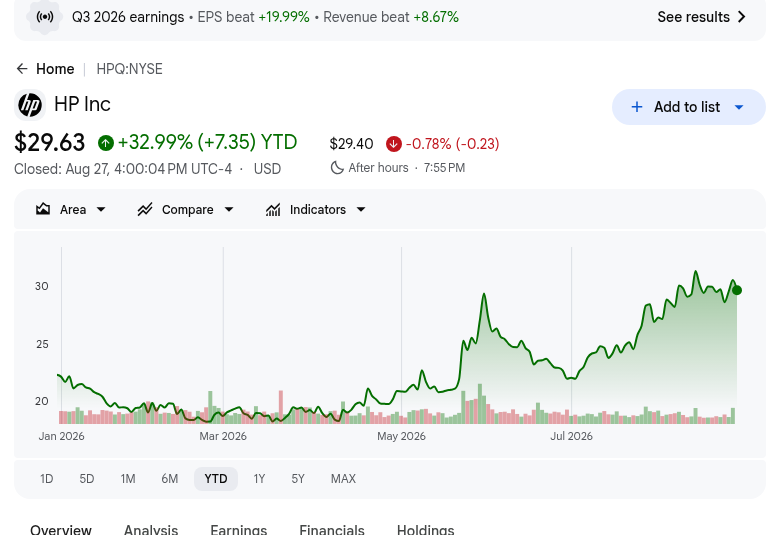
- Q3 FY26 revenue reached $15.68 billion. Q3 FY26 revenue reached $15.68 billion, up 12.5% year over year and above the $14.85 billion consensus estimate. The result showed strong price and mix, although total units declined 16%. Future quarters must prove that growth remains profitable as component costs and enterprise demand change.
- Q3 FY26 non-GAAP EPS was $0.83. Q3 FY26 non-GAAP EPS was $0.83, above the $0.75 consensus estimate by 10.67%. The beat included tariff-refund support, so investors should separate one-time assistance from recurring operating improvement. Margin recovery and cost mitigation will determine whether EPS revisions continue higher.
- AI PCs reached 46% of shipments. AI PCs reached 46% of shipments in Q3 FY26, and HP expects 50% by fiscal year-end. That mix could support premium pricing and refresh demand, but only if customers value the feature set. Investors should watch adoption, average selling prices, and Personal Systems margin conversion.
- FY26 EPS guidance rose to $3.19-$3.29. FY26 non-GAAP EPS guidance rose to $3.19-$3.29, while free-cash-flow guidance rose to $3.0-$3.2 billion. The outlook strengthens the capital-return case but includes tariff-related support. Confirmation requires delivery through Q4 and a cleaner FY27 margin recovery.
- Seven named analysts show target dispersion from $17 to $26. Seven named analysts show target dispersion from $17 to $26, highlighting disagreement about HPQ’s margin trough and AI PC economics. UBS, TD Cowen, and JPMorgan Chase & Co. sit at $26, while Morgan Stanley is at $17. The spread makes execution evidence more important than headline consensus.
What Is HP Inc. (HPQ)?
HP Inc. is a global technology company focused on personal computers, workstations, peripherals, and printing products. Its Personal Systems business includes commercial and consumer PCs and related services, while Printing covers printers, supplies, and managed-print solutions. HP also continues to expand into AI-enabled PCs, connected devices, and subscription-style services that can add more recurring revenue.
The company serves consumers, businesses, and public-sector customers through a large global sales and distribution network. Its performance depends heavily on PC replacement cycles, printing demand, component costs, tariffs, foreign exchange, and competitive pricing. AI PCs could support higher-value device sales and a new upgrade cycle, while the more mature printing business remains important for recurring supplies revenue and overall profitability.
HP Inc. (HPQ) Q3 FY26 Earnings: 5 Drivers Behind the HPQ Outlook
- Revenue rose 12.5% to $15.68 billion and beat consensus by 5.6%. Revenue came in above the roughly $14.85 billion estimate despite a 16% decline in total units, showing that pricing and product mix helped offset weaker volumes. The key question is whether that benefit can continue as component costs rise.
- Non-GAAP EPS reached $0.83 and beat expectations by 10.7%. EPS topped the roughly $0.75 consensus, although the quarter included a favorable tariff-refund contribution. Sustainable earnings growth will depend more on margin recovery, pricing, and cost control.
- Personal Systems revenue grew 18% to $11.8 billion. AI PCs represented 46% of shipments, and HP expects that share to reach about 50% by fiscal year-end. The main test is whether premium AI-PC mix can support stronger margins as the upgrade cycle develops.
- FY26 EPS and free-cash-flow guidance moved higher. HP raised non-GAAP EPS guidance to $3.19-$3.29 from $2.90-$3.10 and increased free-cash-flow guidance to $3.0-$3.2 billion. Stronger cash generation also supports dividends and share repurchases.
- Q4 is expected to mark the Personal Systems margin trough. HP guided to Q4 non-GAAP EPS of $0.69-$0.79 while pointing to pricing, contract revisions, product redesigns, and premium mix as recovery drivers. Evidence of improving margins in FY27 would strengthen the outlook.
HP Q3 FY26 Financial and Consensus Profile: Revenue, EPS, AI PC Mix, and Cash Flow
HP delivered a revenue beat and raised its full-year outlook, but growth quality matters. Personal Systems expanded while total units fell, indicating price and mix were important; Printing remained a drag and margins are expected to bottom in Q4 FY26.
|
Financial Metric |
Guidance / Consensus |
Reported / Actual |
Surprise |
|
Q3 FY26 revenue |
$14.85B consensus |
$15.68 billion actual; +12.5% YoY |
Beat. 5.59% above consensus. |
|
Q3 FY26 non-GAAP diluted EPS |
$0.75 consensus |
$0.83 actual; +10.67% vs. consensus |
Beat. +10.67% versus consensus; EPS beat included tariff-refund support. |
|
Personal Systems revenue |
— |
$466.3 million; +29% |
Strong. Member growth and cross-buy expanded it. |
|
FY26 non-GAAP EPS guidance |
— |
$84.5 million; -23% |
Weak. A client transition remained a drag. |
|
FY26 free cash flow guidance |
— |
$357.8 million; 30% margin |
Strong. EBITDA rose 44%; leverage held. |
|
AI PC shipment mix |
— |
$45.5 billion deposits; +$5.3 billion in Q2 |
Strong. Deposits expanded the funding base. |
|
Q4 FY26 non-GAAP EPS guidance |
$0.69-$0.79 Q4 FY26 non-GAAP EPS guidance |
$4.75 billion-$4.85 billion; 32%-35% growth |
Raised. Management increased the range after Q2. |
|
Printing revenue |
— |
51% of new products from existing members |
Strong. Existing-member adoption can improve efficiency. |
For context, HP combines mature hardware cash flow with cyclical PC demand and recurring Printing supplies. Raised guidance can support shareholder returns while component inflation is addressed. The key question is whether AI PC mix and mitigation actions support margins while demand remains resilient.
HP Inc. (HPQ) 2026 Investment Outlook: $36 Bull Case vs. $21 Bear Case
HPQ’s outlook for the rest of 2026 depends on one central question: whether AI PC adoption, pricing, and cost actions can offset component inflation and Printing weakness, or whether margin pressure delays the recovery.
The Bull Case: AI PC and Margin Recovery Push HPQ Toward $36
The Bull Case assumes HP converts AI PC adoption into a profitable refresh cycle rather than only higher unit value. Premium mix, pricing discipline, and mitigation actions support Personal Systems margins after the Q4 trough. Free cash flow remains strong enough to fund shareholder returns.
A move toward $36 would require higher FY27 earnings revisions and sustained margin recovery. The strongest confirmation would be AI PCs reaching 50% of shipments, Printing stabilizing, and cash flow supporting dividends and repurchases.
The Base Case: Guidance Delivery Keeps HPQ Between $25 and $30
The Base Case treats HP as a cash-generative hardware company entering a margin-recovery phase. Personal Systems growth and AI PC mix offset softer Printing. Investors value the company on delivered guidance while waiting for evidence of FY27 operating improvement.
HPQ could trade mainly between $25 and $30 while investors await proof that Q4 is the margin trough. Under this scenario, key confirmation points include stable PC demand, improving margins, AI PC mix, and free cash flow.
The Bear Case: Margin Pressure Pulls HPQ Toward $21
The Bear Case assumes HP wins unit economics only partially as memory and component costs rise. Personal Systems margins bottom later than expected, while Printing remains a drag. The CEO transition adds execution uncertainty.
A move toward $21 would become more likely if tariff benefits fade, cost inflation persists, AI PCs fail to support premium pricing, and free cash flow weakens. In that scenario, multiple compression would dominate the stock.
HPQ Stock Price Forecasts for 2026 By Wall Street Analysts
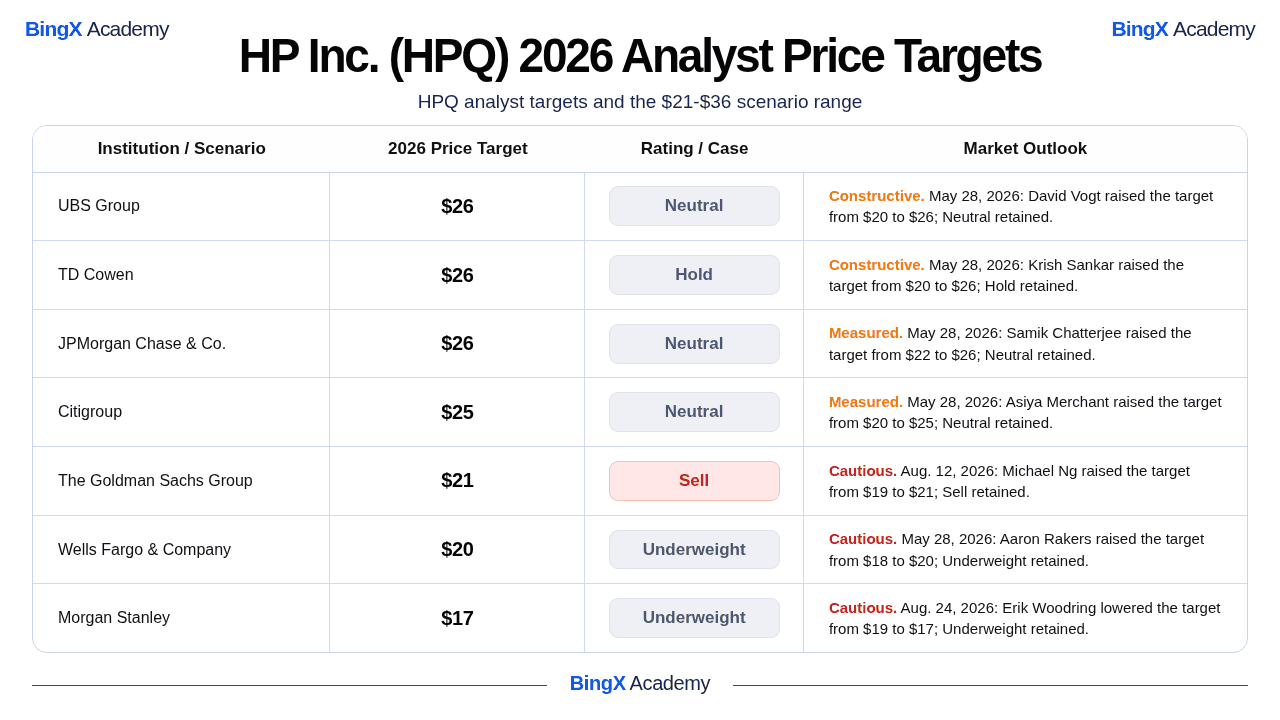
Dated third-party analyst actions show a wide target spread from $20 to $32. Evercore set the high end at $32, while Wells Fargo and Goldman Sachs remain cautious at $20 and $21; Morgan Stanley is even more conservative at $17, creating a clear disagreement over margin recovery.
|
Institution / Scenario |
2026 Price Target |
Rating / Case |
Market Outlook |
|
UBS Group |
$26 |
Neutral |
Constructive. May 28, 2026: David Vogt raised the target from $20 to $26; Neutral retained. |
|
TD Cowen |
$26 |
Hold |
Constructive. May 28, 2026: Krish Sankar raised the target from $20 to $26; Hold retained. |
|
JPMorgan Chase & Co. |
$26 |
Neutral |
Measured. May 28, 2026: Samik Chatterjee raised the target from $22 to $26; Neutral retained. |
|
Citigroup |
$25 |
Neutral |
Measured. May 28, 2026: Asiya Merchant raised the target from $20 to $25; Neutral retained. |
|
The Goldman Sachs Group |
$21 |
Sell |
Cautious. Aug. 12, 2026: Michael Ng raised the target from $19 to $21; Sell retained. |
|
Wells Fargo & Company |
$20 |
Underweight |
Cautious. May 28, 2026: Aaron Rakers raised the target from $18 to $20; Underweight retained. |
|
Morgan Stanley |
$17 |
Underweight |
Cautious. Aug. 24, 2026: Erik Woodring lowered the target from $19 to $17; Underweight retained. |
How to Trade HP Inc. (HPQ) Stock on BingX
Navigate HPQ’s earnings cycle, PC demand, AI-PC adoption, and margin recovery using BingX TradFi and BingX AI tools. These can provide additional market context around earnings, guidance, and sentiment, while HPQ-USDT remains a TradFi perpetual contract rather than direct share ownership.
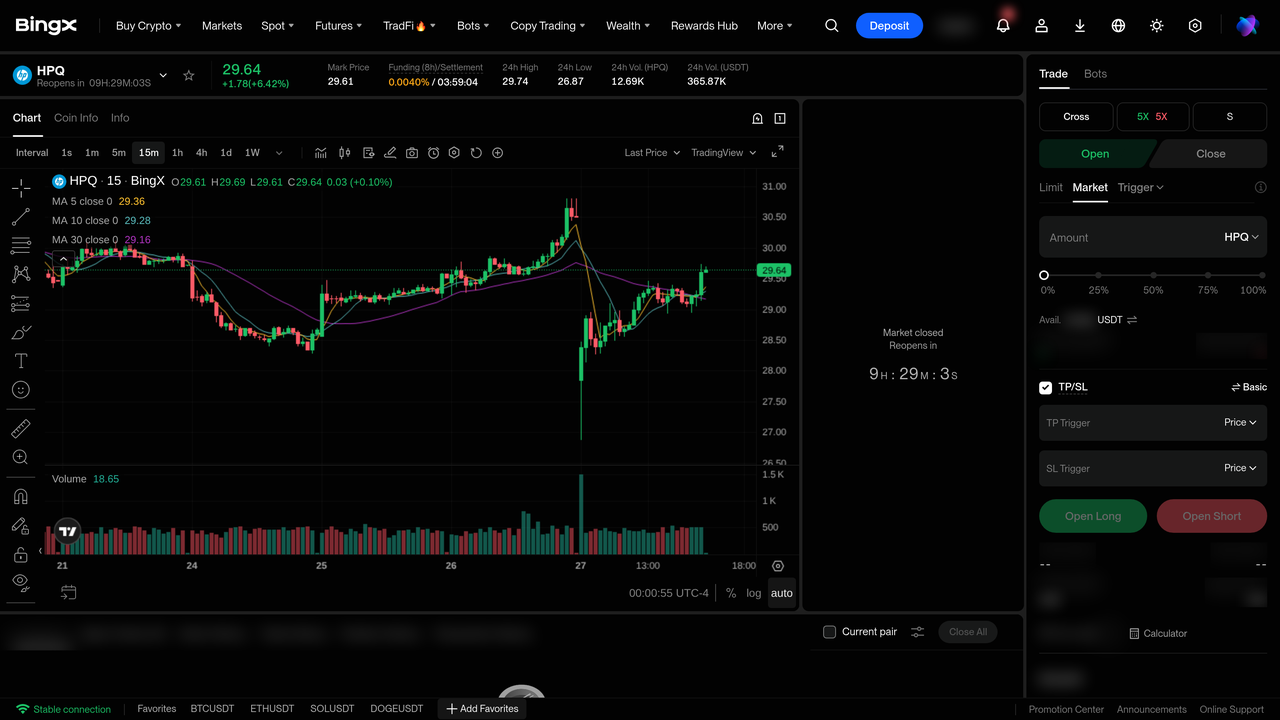
Step 1: Access BingX TradFi. Sign up and navigate to the specialized TradFi section on the main BingX exchange dashboard.
Step 2: Select HP Inc. (HPQ). Search for and select the HPQ-USDT perpetual futures contract.
Step 3: Choose your direction. Select Open Long if you expect AI-PC adoption, stronger pricing, higher guidance, and margin recovery to support HPQ. Select Open Short if you expect weaker PC demand, component inflation, printing pressure, or slower margin improvement to weigh on the stock.
Step 4: Select leverage and margin mode. Choose Isolated or Cross-Margin based on your risk tolerance. Because HPQ can react sharply to earnings, guidance, PC shipment trends, and margin commentary, conservative leverage and clear position sizing are important.
Step 5: Execute strict risk protocols. Set Take-Profit and Stop-Loss (TP/SL) levels before or immediately after entering the trade. HPQ can move quickly around quarterly earnings, AI-PC shipment trends, component costs, tariff developments, printing demand, free-cash-flow guidance, and share-repurchase updates.
Top 5 Risks to Watch for HPQ Investors in 2026
HP’s outlook depends on the PC replacement cycle, AI-PC adoption, cost control, and the stability of its printing business. These are the main risks to watch.
- PC demand could weaken after the current upgrade cycle. Personal Systems remains HP’s largest business, so softer enterprise or consumer spending could pressure shipments, revenue, and margins even as AI PCs gain share.
- Component inflation and tariffs could pressure margins. Higher memory, processor, logistics, or tariff-related costs may be difficult to fully pass through to customers, especially in a highly competitive PC market.
- AI-PC adoption may not translate into stronger profitability. AI PCs are becoming a larger share of shipments, but the investment case depends on premium pricing and mix producing durable margin improvement rather than simply shifting unit composition.
- Printing remains a structural growth challenge. Lower hardware demand and weaker supplies revenue could offset gains in Personal Systems, making stabilization of the mature printing business important for cash flow and profitability.
- Margin recovery may take longer than expected. HP expects Personal Systems margins to bottom around Q4 FY26, but weaker pricing, higher costs, or slower demand could delay the recovery and pressure earnings expectations.
Final Thoughts: Should You Invest in HP Inc. (HPQ) in 2026?
HPQ offers more of a recovery setup than a pure AI growth story. Q3 revenue and EPS beat expectations, AI PCs reached 46% of shipments, and management raised FY26 earnings and free-cash-flow guidance. The next test is whether stronger product mix and cost actions can translate into a durable margin recovery after the expected Q4 trough.
The bull case strengthens if AI PCs support higher-value sales, Personal Systems margins improve, free cash flow stays strong, and Printing stabilizes. The bear case becomes more likely if component costs remain elevated, PC demand weakens, or margin recovery takes longer than expected. The $21, $27, and $36 scenarios therefore depend mainly on margins, AI-PC monetization, cash flow, and execution.
Risk Reminder: HPQ remains exposed to PC and printing cycles, component inflation, tariffs, competition, foreign exchange, and execution risk. BingX HPQ-USDT is a TradFi perpetual contract and does not provide ownership of HP shares. Investors should conduct independent research and assess their own risk tolerance before trading.
Related Reading
- Top 10 AI Infrastructure Stocks to Buy in 2026: Chip Manufacturing and Design Leaders
- Top 10 AI Hardware Stocks to Watch in 2026: The Architecture Driving Next-Gen Intelligence
- Microsoft (MSFT) Stock Outlook for 2026: Can Azure AI and Copilot Growth Drive MSFT Stock to $550+?
- Dell Stock Price Prediction 2026: $500 AI Server Boom or $1.7B Insider Selling Trap?
- Alphabet (GOOGL) Price Prediction 2026: Can 82% Cloud Growth and AI Push GOOGL Stock to $430?
- IBM (IBM) Price Prediction 2026: Can IBM Recover From the 25% Drop After a Q2 Revenue Miss?
- Intel (INTC) Stock Forecast 2026: Foundry Breakthrough to $89 or Value Trap?
