

ASE Technology Holding is the world's largest outsourced semiconductor assembly and test provider, offering advanced packaging, chip testing and electronics manufacturing services. Its packaging portfolio includes flip-chip, fan-out, 2.5D and 3D integration, system-in-package and wafer-level technologies used across AI accelerators, smartphones, automotive electronics and high-performance computing. The ADR gives U.S. investors exposure to Taiwan's semiconductor packaging supply chain, though results remain sensitive to customer concentration, capacity cycles and currency translation.
The latest quarter showed how quickly AI-related packaging is becoming a larger part of the business. ASE Technology Q2 revenue reached NT$191.06 billion ($6.05 billion), up 27% year over year, while packaging revenue rose 36.3% to NT$126.15 billion ($4.00 billion). Net income increased 180% to NT$21.85 billion ($692 million), supporting a higher 2026 capital-spending plan of $10.5 billion as ASE expands advanced packaging and testing capacity.
The ASX stock forecast for 2026 now centers on two competing views:
- The AI-packaging capacity and utilization case: advanced-packaging demand, stronger utilization and disciplined capital deployment could turn ASE's expanded capacity into durable revenue, margins and cash flow.
- The capacity-cycle and execution case: weaker end demand, slower customer ramps or underused new capacity could delay the expected earnings conversion and pressure returns on investment.
This guide breaks down the ASX stock forecast, 2026 price scenarios, key risks and analyst outlooks, drawing on ASE Technology's July 30 Q2 2026 release, financial materials and market data through September 18, plus how to trade ASX stock futures on BingX TradFi with USDT collateral.
Top 5 Things for ASE Technology Investors to Know in September 2026
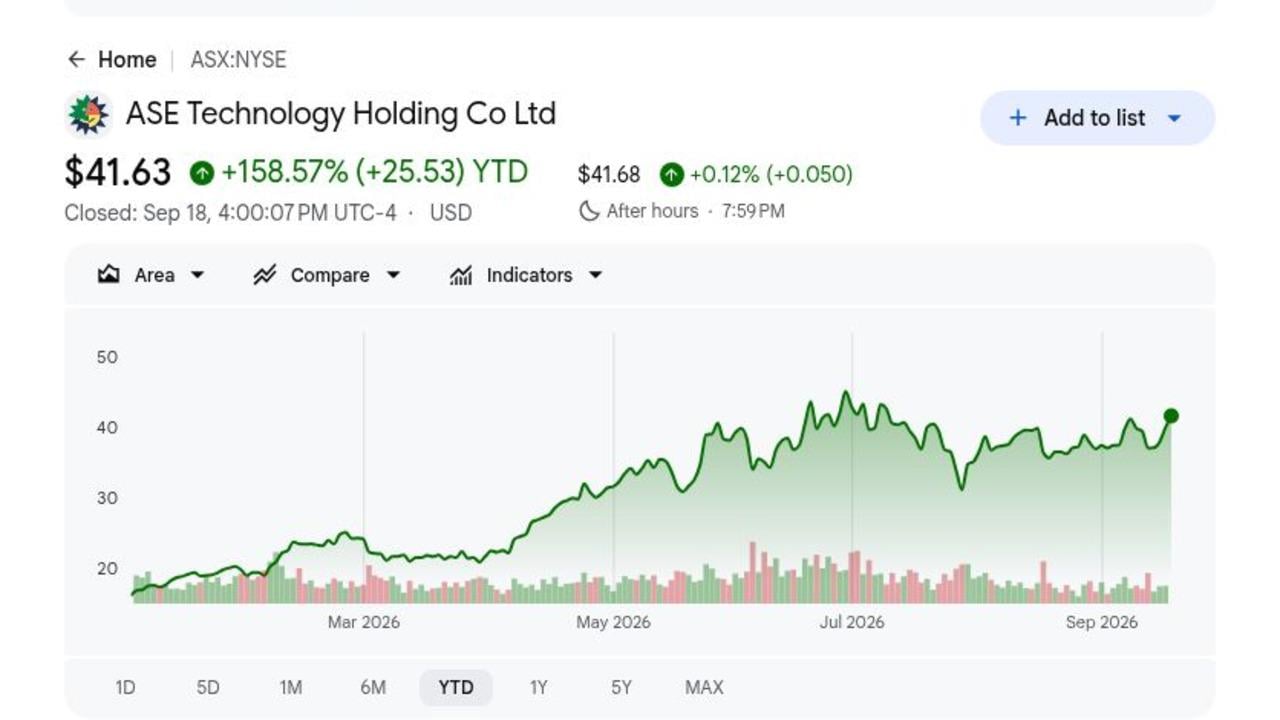
- ASX closed at $41.59 on September 18 after gaining 158.57% over the past year: The rally reflects rapid AI-packaging growth and leaves less room for execution misses. Further upside now depends on new capacity translating into sustained revenue and earnings.
- Q2 revenue reached NT$191.06 billion ($6.05 billion), up 27%: Packaging revenue rose 36.3% to NT$126.15 billion ($4.00 billion), making advanced semiconductor demand the main growth driver. The result provides a strong baseline for the next earnings update.
- Net income rose 180% to NT$21.85 billion ($692 million): Diluted EPS of NT$4.50 ($0.29 per ADR) beat the $0.23 consensus by $0.06. The stronger earnings show that higher packaging demand is already reaching the bottom line.
- 2026 capital spending increased by $2.0 billion to $10.5 billion: The larger budget can support more AI packaging and testing capacity. Returns still depend on utilization, customer demand and disciplined execution as depreciation rises.
- Leading-edge packaging revenue is expected to exceed $3.5 billion in 2026: The target increased from $3.2 billion as customer demand strengthened. Meeting or beating that outlook would provide clearer evidence that ASE's AI-packaging expansion can sustain the current re-rating.
What Is ASE Technology (ASX)?
ASE Technology Holding provides outsourced semiconductor packaging, assembly and testing through ASE, SPIL and related operating units. It receives fabricated wafers from chip designers and foundries, packages individual dies or multi-chip systems, performs wafer probing and final testing, and supplies interconnect materials. Customers span AI, data-center, communications, consumer, automotive and industrial markets. A separate electronics manufacturing business adds system assembly and supply-chain services, giving the group revenue streams beyond core OSAT work.
The long-term strategy centers on leading-edge packaging and test capacity needed for larger AI accelerators and high-bandwidth memory systems. ASE and SPIL are part of TSMC's 3DFabric Alliance, supporting backend packaging and testing around advanced platforms such as CoWoS, InFO and SoIC. SPIL is also a major supplier in NVIDIA's AI-chip ecosystem, with capacity expanding for advanced assembly and testing. Management lifted expected 2026 leading-edge advanced-packaging revenue above $3.5 billion and raised capital spending by $2.0 billion to $10.5 billion. Those commitments can deepen customer relationships, though returns depend on utilization and yield as new capacity enters production.
ASE Technology (ASX) Q2 2026 Earnings Overview: Operating Progress Meets Capital Intensity
ASE delivered Q2 2026 revenue of NT$191.06 billion ($6.05 billion), up 27% year over year, while packaging revenue rose 36.3% to NT$126.15 billion ($4.00 billion). Diluted EPS reached NT$4.50 ($0.29 per ADR), above the $0.23 consensus, and net income increased 180% to NT$21.85 billion ($692 million). Management also raised 2026 capital spending to $10.5 billion, making utilization and returns on new AI capacity the key tradeoff.
|
Financial Metric |
Guidance / Consensus |
Reported / Actual |
Surprise |
|
Q2 2026 net revenue |
NT$190.0B consensus ($6.02B) |
NT$191.06B ($6.05B) |
Beat. up 27% YoY. The result updates the operating baseline. |
|
Q2 diluted EPS |
USD $0.23/ADR consensus |
NT$4.50 ($0.29/ADR) |
Beat. by USD $0.06/ADR. The result updates the operating baseline. |
|
Q2 net income |
— |
NT$21.85B ($692M) |
Beat. Up 180% YoY. The result updates the operating baseline. |
|
Packaging revenue |
— |
NT$126.15B ($4.00B) |
Beat. Up 36.3% YoY. The result updates the operating baseline. |
|
2026 capital spending |
Prior USD $8.5B |
USD $10.5B |
Raised. by USD $2.0B. The result updates the operating baseline. |
|
2026 advanced packaging |
Prior USD $3.2B |
Above USD $3.5B |
Raised. on AI demand. The result updates the operating baseline. |
- Q2 net revenue reached NT$191.06 billion ($6.05 billion), up 27%: Revenue beat the NT$190.0 billion consensus and showed strong demand across ASE's packaging and testing businesses. The result provides a higher revenue base heading into the second half.
- Diluted EPS reached NT$4.50 ($0.29 per ADR), beating consensus by $0.06: The earnings beat shows that stronger revenue is translating into per-share profit. Continued margin improvement will determine how much additional AI demand reaches the bottom line.
- Net income rose 180% to NT$21.85 billion ($692 million): The sharp increase strengthened internally generated capital as ASE expands advanced capacity. Sustained earnings growth can help offset the cash demands of the larger investment plan.
- Packaging revenue increased 36.3% to NT$126.15 billion ($4.00 billion): Advanced semiconductor demand remained the main growth driver. Continued AI packaging growth is central to maintaining the current earnings momentum.
- 2026 capital spending increased by $2.0 billion to $10.5 billion: The larger budget supports advanced packaging and testing expansion. Returns now depend on utilization, customer demand and new capacity entering service on schedule.
ASE Technology (ASX) 2026 Investment Outlook: $50 Bull Case vs. $30 Bear Case
ASE's 2026 outlook depends on whether rapid AI-packaging demand can absorb new capacity fast enough to support margins and returns on the higher capital-spending plan. Strong Q2 growth provides evidence of demand, while utilization and customer timing remain the key risks.
The Bull Case: Strong AI Packaging Demand Pushes ASX Toward $50
The Bull Case assumes advanced packaging demand remains strong as ASE expands capacity for AI accelerators and high-performance computing. Packaging revenue continues growing at a high rate, new capacity reaches healthy utilization and margins improve as volume scales.
A move toward $50 would require leading-edge packaging revenue to meet or exceed the above-$3.5 billion target, stronger utilization across new capacity and continued earnings growth after Q2 net income rose 180%. Stable margins despite the $10.5 billion capex plan would strengthen the case.
The Base Case: Steady Packaging Growth Keeps ASX Between $40 and $46
The Base Case assumes AI-related packaging demand stays healthy, though new capacity ramps gradually and depreciation limits margin expansion. Packaging remains the main growth engine while broader semiconductor demand stays mixed.
Under this scenario, ASX could trade mainly between $40 and $46. Continued packaging growth, progress toward the $3.5 billion advanced-packaging target and stable margins would support the range. Slower utilization or weaker customer demand would cap the upper end.
The Bear Case: Slower AI Demand Pulls ASX Toward $30
The Bear Case assumes AI-packaging demand slows or customers delay capacity commitments while ASE continues spending heavily on expansion. Lower utilization would leave depreciation and other fixed costs rising faster than revenue, pressuring margins and free cash flow.
A move toward $30 would become more likely if advanced-packaging revenue misses the 2026 target, packaging growth slows sharply or margins weaken as the $10.5 billion investment program ramps. Lower earnings expectations would add further pressure.
ASX Stock Price Forecasts for 2026 By Wall Street Analysts
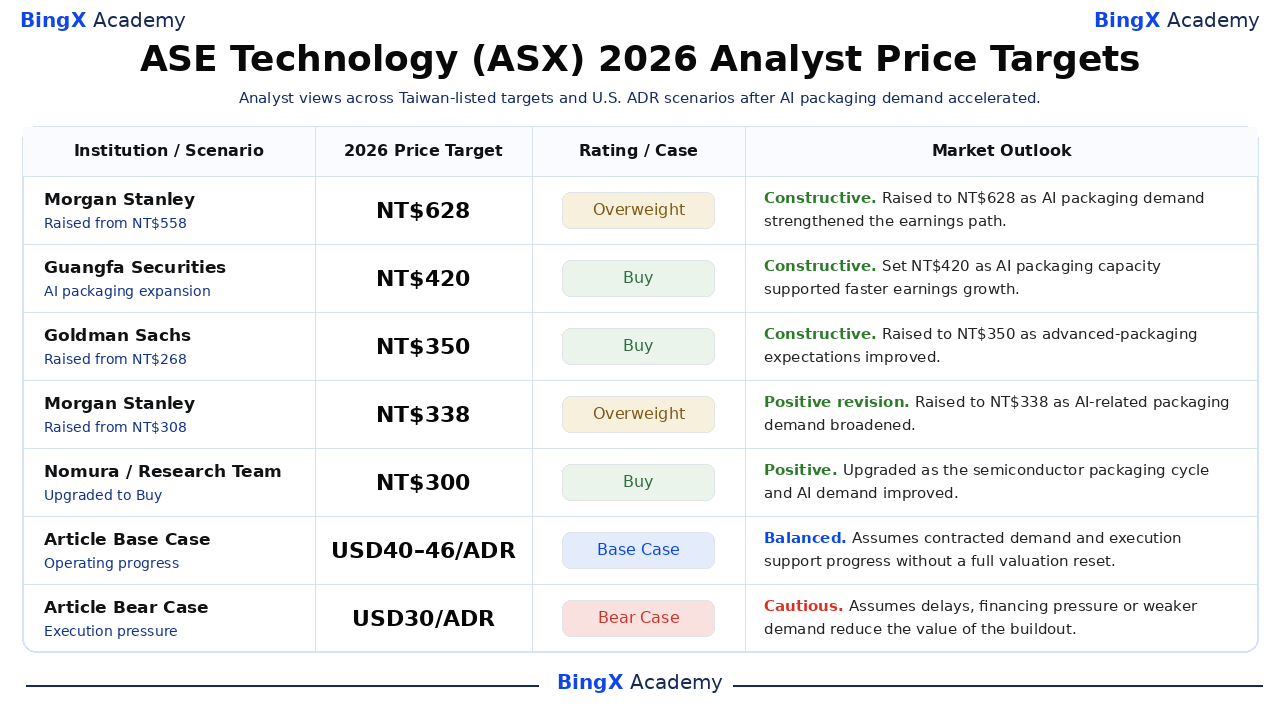
Analyst actions show a wide spread between long-term strategic potential and near-term execution risk. The table retains dated actions and uses the article's Base and Bear cases only as editorial scenarios. The dispersion reflects different assumptions for customer timing, capital intensity, margins and conversion into per-share cash flow.
|
Institution |
2026 Price Target |
Rating |
Market Outlook |
|
Morgan Stanley |
NT$628 |
Overweight |
Constructive. August 3: Raised the Taiwan-listed target from NT$558 as leading-edge packaging and testing demand strengthened. |
|
Guangfa Securities |
NT$420 |
Buy |
Constructive. March 15: Set a bullish Taiwan-listed target as AI packaging capacity and earnings estimates moved higher. |
|
Goldman Sachs |
NT$350 |
Buy |
Constructive. February 6: Raised the Taiwan-listed target from NT$268 after stronger advanced-packaging expectations. |
|
Morgan Stanley |
NT$338 |
Overweight |
Positive revision. February 6: Raised the Taiwan-listed target from NT$308 as AI-related packaging demand broadened. |
|
Nomura |
NT$300 |
Buy |
Positive. October 30: Upgraded the U.S. ADR-linked company from Neutral to Buy as the packaging cycle improved. |
|
Article Base Case |
USD $40–$46/ADR |
Base Case |
Balanced. Assumes operating progress supports the project without a full valuation reset. |
|
Article Bear Case |
USD $30/ADR |
Bear Case |
Cautious. Assumes delays or weaker demand compress earnings and valuation. |
How to Trade ASE Technology (ASX) Stock on BingX
Trade ASE Technology's operating milestones, demand outlook and valuation using BingX TradFi and BingX AI tools. Because ASX can react sharply to earnings, guidance and project updates, define the catalyst and risk limits before entering a position.
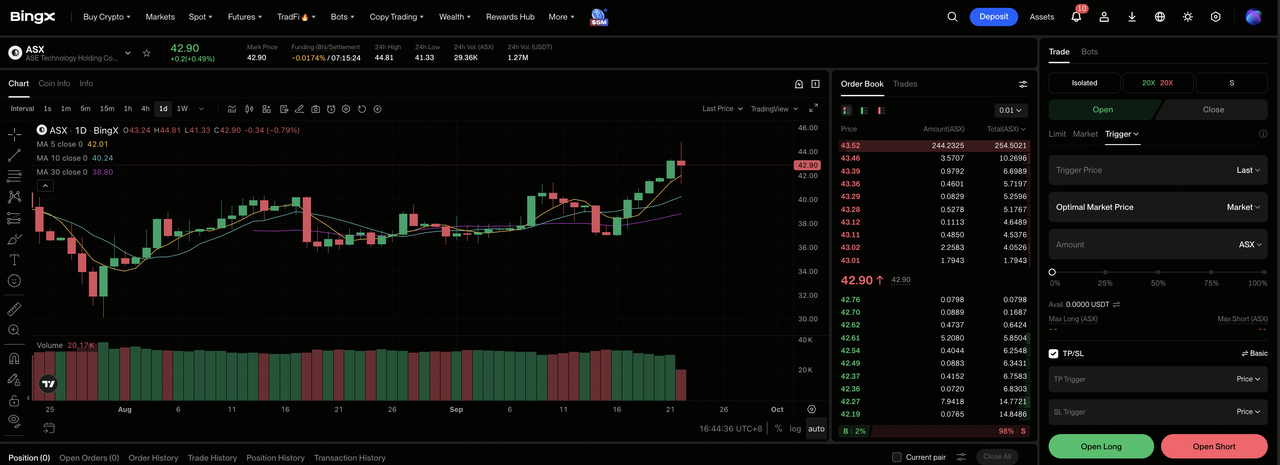
Step 1: Access BingX TradFi. Sign up and navigate to the specialized TradFi section on the BingX exchange dashboard.
Step 2: Select ASE Technology (ASX). Search for and select the ASX-USDT perpetual futures contract.
Step 3: Choose your direction. Select Open Long if execution and demand strengthen. Select Open Short if delays, weaker utilization or financing pressure damage the thesis.
Step 4: Select leverage and margin mode. Choose Isolated or Cross-Margin based on your risk tolerance. The stock's large 2026 range shows why conservative leverage and clear sizing matter.
Step 5: Execute strict risk protocols. Set Take-Profit and Stop-Loss (TP/SL) levels before or immediately after entering the trade. Monitor earnings, guidance, financing and named project milestones.
Top 5 Risks to Watch for ASE Technology Investors in 2026
ASE's outlook depends on AI demand, customer timing, capacity utilization and returns on its larger investment plan. These risks can weaken margins, cash flow and the valuation assigned to future growth.
- Capacity expansion could arrive before demand: ASE raised 2026 capital spending to $10.5 billion. If new packaging capacity ramps faster than customer demand, depreciation and other fixed costs could pressure margins and free cash flow.
- Large customers can create timing risk: Advanced packaging programs often depend on a relatively small number of major semiconductor customers. Delayed product launches or order changes could leave new capacity underused and shift revenue between quarters.
- AI demand could normalize: Packaging revenue rose 36.3% in Q2 as AI-related demand accelerated. Slower accelerator or high-performance-computing investment could weaken utilization and reduce the returns expected from new capacity.
- Higher spending could pressure cash returns: Expanding advanced packaging and testing requires substantial equipment and facility investment. If earnings do not grow fast enough, more cash could remain tied up in capacity rather than dividends, buybacks or balance-sheet improvement.
- The strong share-price rally leaves less room for misses: ASX gained 158.57% over the past year. Slower packaging growth, weaker margins or a lower advanced-packaging outlook could compress the valuation even if revenue continues rising.
Final Thoughts: Should You Invest in ASE Technology in 2026?
ASE Technology's 2026 thesis has measurable support from reported financials and named strategic milestones. The opportunity depends on converting demand into revenue and cash flow without losing financial flexibility. Investors should monitor the next operating milestones, customer commitments, capital spending and margins together. The next completed reporting period should make that conversion more visible and separate temporary enthusiasm from durable operating progress.
The Bull Case requires consistent execution and improving returns to support $50. The Bear Case reflects delays, weaker demand or financing pressure that could pull ASX toward $30. A conservative approach would wait for evidence that current investment is producing durable per-share value. The next completed reporting period should make that conversion more visible and separate temporary enthusiasm from durable operating progress.
Risk Reminder: Stock-linked perpetual futures involve leverage and can amplify losses. Analyst targets and article scenarios are conditional reference points, not guarantees.
Related Reading
- Top AI Semiconductor Stocks to Buy in 2026: AI Chips and Supply Chain Complete Guide
- Top High-Performance Computing (HPC) Stocks to Watch in 2026: Accelerated Computing Market Leaders
- Top High-Bandwidth Memory (HBM) Stocks to Buy in the 2026 Memory Supercycle
- NVIDIA (NVDA) Price Prediction 2026: Can AI Infrastructure Growth Drive NVDA Toward $420?
- TSMC (TSM) Price Prediction 2026: Can Record AI Demand Lift TSM Stock to $527?
