



Applied Materials (AMAT) supplies materials-engineering systems and services used to manufacture semiconductors and advanced displays. Semiconductor Systems remains the largest business, while Applied Global Services, advanced packaging and the EPIC Center are becoming more important to long-term growth. This breadth gives Applied Materials exposure to AI, memory and leading-edge logic, though the stock remains sensitive to capital-spending cycles, export rules and manufacturing capacity.
Its latest quarter showed that expansion accelerating. AMAT Fiscal Q3 2026 revenue reached a record $9.115 billion, up 25% year over year, as Semiconductor Systems revenue increased 27% to $7.040 billion. Non-GAAP EPS rose 41% to $3.50, and management guided fiscal Q4 revenue to $10.25 billion at the midpoint, above the $9.54 billion LSEG consensus.
The AMAT stock forecast for 2026 now centers on two competing views:
- The AI materials-intensity case: rising spending on DRAM, high-bandwidth memory (HBM), leading-edge logic and advanced packaging sustains growth above the wider wafer-fab equipment market.
- The cycle-and-valuation case: export restrictions, customer concentration or a slower fab-investment cycle reduce earnings revisions and compress the premium investors assign to AMAT.
This guide breaks down the AMAT stock forecast, 2026 price scenarios, key risks and analyst outlooks, drawing on Applied Materials' August 13 fiscal Q3 earnings release, company disclosures and market data through September 7, plus how to trade AMAT stock futures on BingX TradFi with USDT collateral.
Top 5 Things for AMAT Investors to Know in September 2026
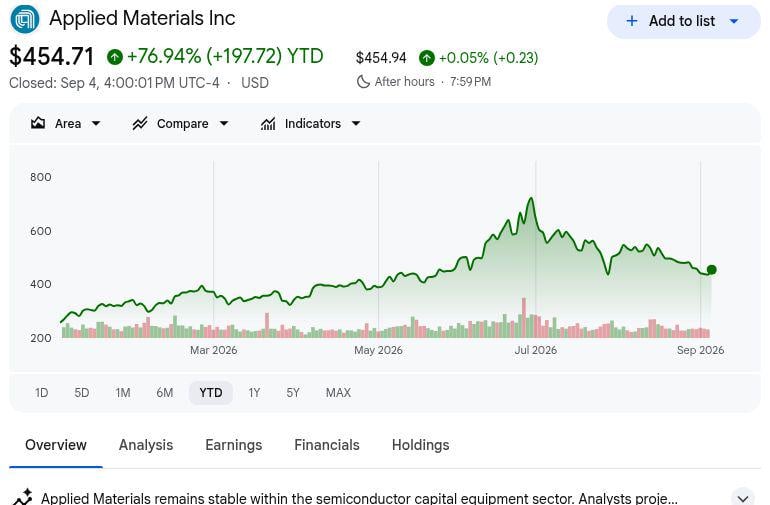
- AMAT was up 76.94% YTD through September 4: Shares closed at $454.71 after gaining 4.31% that day, showing that investors had already priced in significant AI-equipment growth. Further upside now depends more on earnings and guidance upgrades than on sector enthusiasm alone.
- Q3 FY2026 revenue reached a record $9.115 billion, up 25% year over year: Revenue beat the roughly $9.00 billion consensus by about $115 million, while non-GAAP EPS of $3.50 topped the $3.39 estimate by $0.11. The quarter confirmed strong demand across semiconductor systems and services.
- Semiconductor Systems revenue rose 27% to $7.040 billion: Foundry, logic and other applications represented 67% of segment sales, DRAM 26%, and flash 7%. The higher DRAM and advanced-packaging mix strengthens AMAT’s exposure to HBM and AI infrastructure spending.
- Q4 revenue guidance reached $10.25 billion at the midpoint: The $9.75 billion to $10.75 billion range came in above the $9.54 billion LSEG consensus, while non-GAAP EPS guidance reached $4.02 ±$0.20. Meeting the midpoint would require another strong sequential increase.
- EPIC Center partnerships expanded to 11 as Singapore investment reached $500 million: New collaborations with Broadcom, UC Berkeley, and SCREEN SPE broaden Applied Materials’ co-development ecosystem, while the Tampines Campus more than doubles advanced cleanroom capacity in Singapore. These investments strengthen the long-term technology moat but also raise execution and fixed-cost requirements.
What Is Applied Materials (AMAT)?
Applied Materials (AMAT) is a semiconductor-equipment company focused on materials engineering. Its systems are used during chip manufacturing to deposit, remove, modify, and inspect materials as increasingly complex processors and memory devices are built. The portfolio spans deposition, etch, ion implantation, chemical mechanical planarization, metrology, inspection, and advanced packaging, while Applied Global Services provides parts, upgrades, maintenance, and software across the installed base. Its customers include leading foundries, logic producers, and memory manufacturers operating large, capital-intensive fabs.
Its growth strategy is increasingly centered on the process complexity created by AI chips, HBM, and advanced packaging rather than wafer volumes alone. Applied Materials is expanding tools for hybrid bonding, through-silicon vias, and high-layer-count memory, while its EPIC Center brings customers and research partners into earlier co-development of new manufacturing processes. Recent collaborations with Broadcom, UC Berkeley, and SCREEN SPE broaden that ecosystem, while a $500 million Singapore campus expands manufacturing and R&D capacity to support longer-term semiconductor and AI infrastructure demand.
Read More: Top 10 AI Hardware Stocks to Watch in 2026: The Architecture Driving Next-Gen Intelligence
AMAT Q3 FY2026 Earnings Overview: Record Revenue, EPS and Semiconductor Systems Growth
Applied Materials delivered record fiscal Q3 revenue of $9.115 billion versus roughly $9.00 billion expected, non-GAAP EPS of $3.50 versus $3.39 expected, and GAAP net income of $2.538 billion. Semiconductor Systems revenue rose 27% to $7.040 billion, operating cash flow reached a record $3.04 billion, and Q4 revenue guidance of $10.25 billion at midpoint exceeded the $9.54 billion consensus. The central tradeoff is whether growth can stay exceptional as capacity investment, export rules and a richer valuation raise the execution bar.
|
Financial Metric |
Guidance / Consensus |
Reported / Actual |
Surprise |
|
Q3 FY2026 revenue |
$9.00B consensus |
$9.115B |
Beat. About $115M above consensus; up 25% YoY. |
|
Q3 non-GAAP diluted EPS |
$3.39 consensus |
$3.50 |
Beat. Eleven cents above consensus; up 41% YoY. |
|
Q3 GAAP diluted EPS |
— |
$3.17 |
Improved. Up 43% from $2.22 a year earlier. |
|
Q3 GAAP net income |
— |
$2.538B |
Improved. Up 43% year over year. |
|
Q3 GAAP gross margin |
— |
50.30% |
Expanded. Up 150 basis points year over year. |
|
Semiconductor Systems revenue |
— |
$7.040B |
Expanded. Up 27% from $5.564B a year earlier. |
|
Applied Global Services revenue |
— |
$1.781B |
Expanded. Up 22% from $1.463B a year earlier. |
|
Operating cash flow |
— |
$3.04B |
Record. Supported $860M of buybacks and dividends. |
|
Q4 FY2026 revenue outlook |
$9.54B consensus |
$10.25B ± $500M |
Above. Midpoint exceeded consensus by about $710M. |
|
Q4 non-GAAP EPS outlook |
— |
$4.02 ± $0.20 |
Raised. Implies another sequential record at midpoint. |
- Revenue of $9.115 billion grew 25% and set a company record: The result came about $115 million above consensus and marked Applied Materials’ strongest sequential revenue growth on record. That supports the AI-equipment thesis, but the higher base also raises the execution bar.
- Non-GAAP EPS of $3.50 beat consensus by $0.11: Adjusted EPS rose 41% from $2.48 a year earlier, while GAAP EPS increased 43% to $3.17. Earnings grew faster than revenue as margins and operating leverage improved.
- Semiconductor Systems revenue reached $7.040 billion, up 27%: Segment operating margin expanded to 37.7% from 33.0%, while DRAM increased to 26% of the revenue mix from 22%, showing stronger contribution from AI memory and leading-edge process demand.
- GAAP gross margin reached 50.3% after 13 straight quarters of expansion: Margin improved 150 basis points year over year, while non-GAAP operating margin rose 330 basis points to 34.0%. Sustaining those gains remains important as capacity and product mix shift.
- Q4 revenue guidance of $10.25 billion topped consensus by about $710 million: The midpoint implies another sequential increase, while non-GAAP EPS guidance of $4.02 points to another record. The outlook supports 2027 momentum if supply and customer schedules remain on track.
Applied Materials (AMAT) 2026 Investment Outlook: $850 Bull Case vs. $350 Bear Case
The central question is whether AI-led materials intensity can keep Applied Materials growing above the equipment market after a 76.94% YTD gain, or whether cyclicality and a demanding valuation begin to outweigh record financial results.
The Bull Case: Strong AI Chip Equipment Demand Pushes AMAT Toward $850
The Bull Case assumes AI infrastructure spending stays strong across leading-edge logic, DRAM, HBM, and advanced packaging. Semiconductor Systems continues growing faster than the wider wafer-fab equipment market, the $500 million Singapore expansion supports capacity, and EPIC partnerships convert co-development work into commercial tools.
A move toward $850 would require Q4 revenue near or above the $10.25 billion midpoint, non-GAAP EPS around $4.02, and continued gross-margin strength. Stronger 2027 customer visibility, more packaging wins, and upward earnings revisions would provide the clearest confirmation.
The Base Case: Steady Semiconductor Growth Keeps AMAT Between $600 and $700
The Base Case assumes DRAM, foundry-logic, and packaging demand remains healthy as growth moderates from the 25% Q3 pace. Services revenue and the installed base support cash flow, while new manufacturing investment limits further margin expansion.
Under this scenario, AMAT could trade mainly between $600 and $700. Revenue within Q4 guidance, continued Semiconductor Systems growth, and stable margins would support the range, while weaker customer visibility or renewed margin pressure would cap the upside.
The Bear Case: Weaker Chip Spending and Export Pressure Pull AMAT Toward $350
The Bear Case assumes major foundry or memory customers slow capital spending after the current buildout, export controls restrict demand, and new capacity comes online as shipment growth weakens. Lower utilization would reduce operating leverage and pressure earnings expectations.
A move toward $350 would become more likely if revenue falls below guidance, Semiconductor Systems growth turns negative, or gross margin reverses several quarters of improvement. Slower earnings revisions and multiple compression would then pressure the stock.
AMAT Stock Price Forecasts for 2026 By Wall Street Analysts
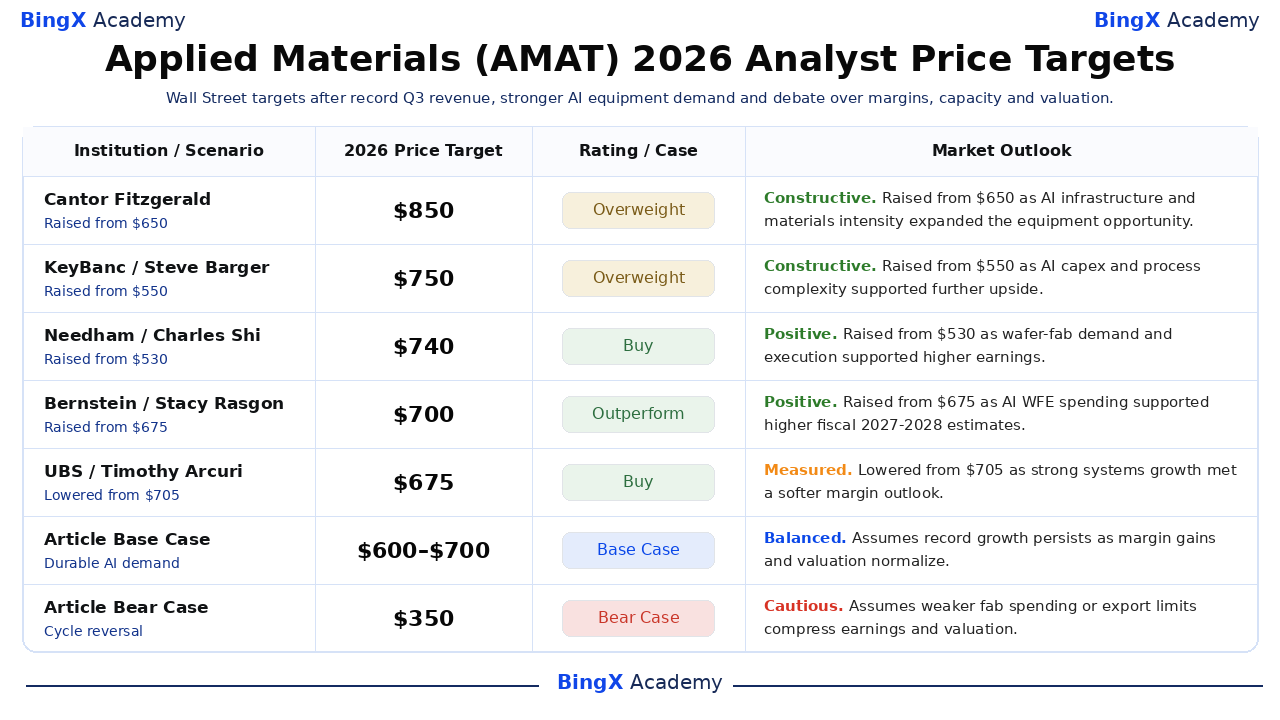
The six selected analyst actions are dated, named third-party targets and are presented from highest to lowest. They range from $650 to $850, compared with AMAT's September 4 close of $454.71. The wide spread captures confidence in AI equipment demand alongside disagreement about margins, capacity and valuation. The final two rows are BingX Academy editorial scenarios rather than Wall Street forecasts.
|
Institution / Scenario |
2026 Price Target |
Rating / Case |
Market Outlook |
|
Cantor Fitzgerald |
$850 |
Overweight |
Constructive. June 29: raised from $650 as AI infrastructure investment and rising materials intensity expanded the equipment opportunity. |
|
KeyBanc |
$750 |
Overweight |
Constructive. June 29: raised from $550 as AI-led capital spending and process-complexity gains supported further upside. |
|
Needham |
$740 |
Buy |
Positive. July 10: raised from $530 as strong wafer-fab equipment demand supported a higher earnings framework. |
|
Bernstein |
$700 |
Outperform |
Positive. August 14: raised from $675 as AI wafer-fabrication spending supported higher fiscal 2027-2028 estimates. |
|
UBS |
$675 |
Buy |
Measured. August 18: lowered from $705 as strong systems growth was balanced by a softer margin outlook. |
|
BofA Securities |
$650 |
Buy |
Measured. August 14: lowered from $720 as solid demand met slower sequential guidance growth than a key peer. |
|
Article Base Case |
$600–$700 |
Base Case |
Balanced. Assumes record growth persists as margin gains and valuation normalize. |
|
Article Bear Case |
$350 |
Bear Case |
Cautious. Assumes weaker fab spending or export limits compress earnings and valuation. |
How to Trade Applied Materials (AMAT) Stock on BingX
Trade Applied Materials' AI-equipment demand, DRAM growth, advanced-packaging momentum and margin outlook using BingX TradFi and BingX AI tools. Because AMAT can react sharply to customer spending, guidance and export-policy changes, traders should define both the catalyst and risk limits before entering a position.
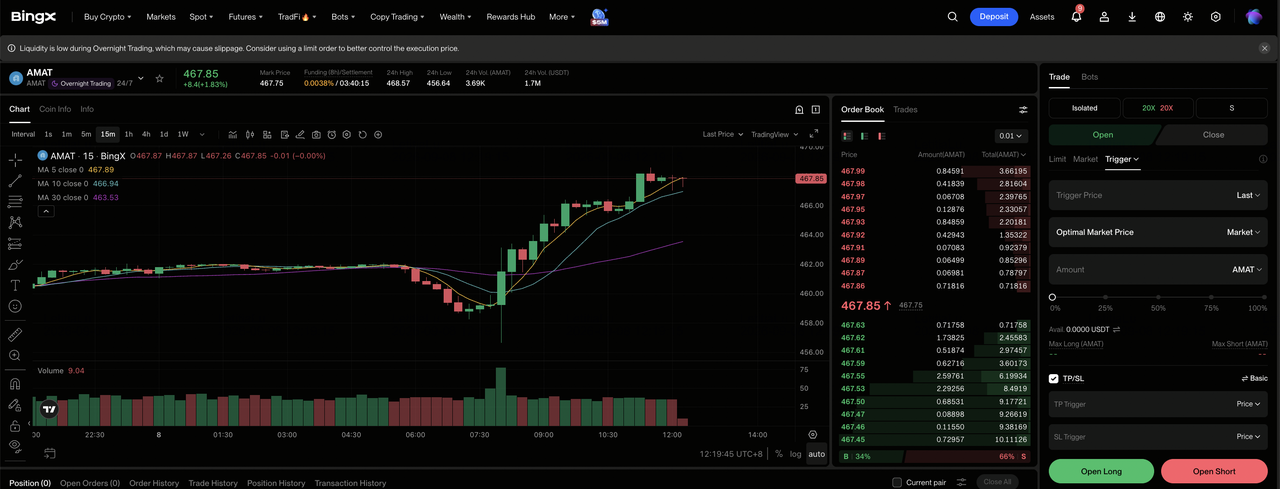
Step 1: Access BingX TradFi. Sign up and navigate to the specialized TradFi section on the BingX exchange dashboard.
Step 2: Select Applied Materials (AMAT). Search for and select the AMAT-USDT perpetual futures contract.
Step 3: Choose your direction. Select Open Long if AI equipment demand sustains record growth and margins remain firm. Select Open Short if fab-spending weakness, export limits or capacity costs reduce earnings expectations.
Step 4: Select leverage and margin mode. Choose Isolated or Cross-Margin based on your risk tolerance. The 76.94% YTD gain and subsequent volatility show why conservative leverage and clear position sizing are important.
Step 5: Execute strict risk protocols. Set Take-Profit and Stop-Loss (TP/SL) levels before or immediately after entering the trade. AMAT can react quickly to earnings, customer capital spending, guidance, supply availability and export-policy changes.
Top 5 Risks to Watch for Applied Materials Investors in 2026
Applied Materials has broad exposure across chip manufacturing, but cyclical customer spending, export controls, capacity expansion, and a strong 2026 share-price run increase the downside if execution weakens.
- A 25% revenue-growth rate creates a tougher comparison: Q3 revenue reached $9.115 billion versus $7.302 billion a year earlier. If customer spending normalizes faster than expected, estimate revisions could flatten even if absolute revenue remains high.
- Export controls can reduce addressable demand: Semiconductor equipment remains exposed to changing U.S. licensing rules, especially for advanced systems sold into China. Tighter restrictions could delay orders, reduce service revenue, and pressure earnings.
- Customer concentration makes fab spending decisions important: A relatively small group of major foundry, logic, and memory producers drives much of equipment demand. One delayed fab or technology transition can shift quarterly shipments and lower factory utilization.
- Capacity investment must convert into profitable shipments: The $500 million Tampines Campus more than doubles advanced cleanroom capacity. If demand arrives later than planned, depreciation and operating costs could pressure margins and cash conversion.
- A 76.94% YTD gain leaves less room for disappointment: AMAT closed at $454.71 after a strong rally. Q4 revenue below the $10.25 billion midpoint, weaker gross margins, or slower Semiconductor Systems growth could trigger both earnings downgrades and multiple compression.
Final Thoughts: Should You Invest in AMAT in 2026?
Applied Materials' Q3 results strengthened the operating case: revenue rose 25% to $9.115 billion, non-GAAP EPS increased 41% to $3.50, Semiconductor Systems revenue advanced 27%, and Q4 guidance exceeded consensus. The counterweight is a 76.94% YTD share-price gain, additional capacity spending and continued exposure to export rules and concentrated customer budgets.
The $600 to $700 Base Case assumes AI, DRAM and advanced-packaging demand sustain growth as margins normalize. The $850 Bull Case requires customer visibility, shipments and earnings revisions to keep improving, while the $350 Bear Case reflects a spending slowdown, export disruption and valuation compression. Investors should track Q4 guidance delivery, Semiconductor Systems growth, gross margin and customer capital spending before treating the current cycle as durable upside.
Risk Reminder: These AMAT scenarios are conditional research estimates, not investment advice or guaranteed returns. Applied Materials shares and AMAT-USDT perpetual contracts can lose value, and leveraged positions may be liquidated. Review current market data, company filings and BingX terms independently before taking risk.
Related Reading
- Top AI Semiconductor Stocks to Buy in 2026: AI Chips and Supply Chain Complete Guide
- Top 10 AI Infrastructure Stocks to Buy in 2026: Chip Manufacturing and Design Leaders
- Top AI Memory Stocks to Buy in 2026: DRAM, HBM, and AI Storage Demand Explained
- Top High-Bandwidth Memory (HBM) Stocks to Buy in the 2026 Memory Supercycle
- Broadcom (AVGO) Price Prediction 2026: Can AI Revenue Growth Push AVGO Toward $600?
- Nvidia (NVDA) Stock Price Outlook for 2026: Can Blackwell and Vera Rubin Take NVDA Back to $300?
