

Qubic (QUBIC) is a high-performance, quorum-based blockchain designed to bridge the gap between distributed ledger technology and true artificial intelligence. Founded by Sergey Ivancheglo (known as Come-from-Beyond), the pioneer behind NXT and IOTA, Qubic eliminates the waste of traditional crypto mining by utilizing energy to train complex neural networks.
On April 1, 2026, Qubic reached a historic milestone by integrating Dogecoin (DOGE) mining into its core architecture. This shift allows the network to bifurcate its hardware: ASICs handle Dogecoin mining to generate external revenue for the ecosystem, while CPUs and GPUs are freed to focus 100% on Aigarth, Qubic’s native AI initiative.
This article explores how Qubic achieves sub-second finality without fees, the mechanics of its Useful Proof-of-Work (UPoW) system, why the Doge-Connect bridge is a game-changer for the $QUBIC tokenomics, and how to trade QUBIC on BingX.
What Is the Qubic (QUBIC) Network?
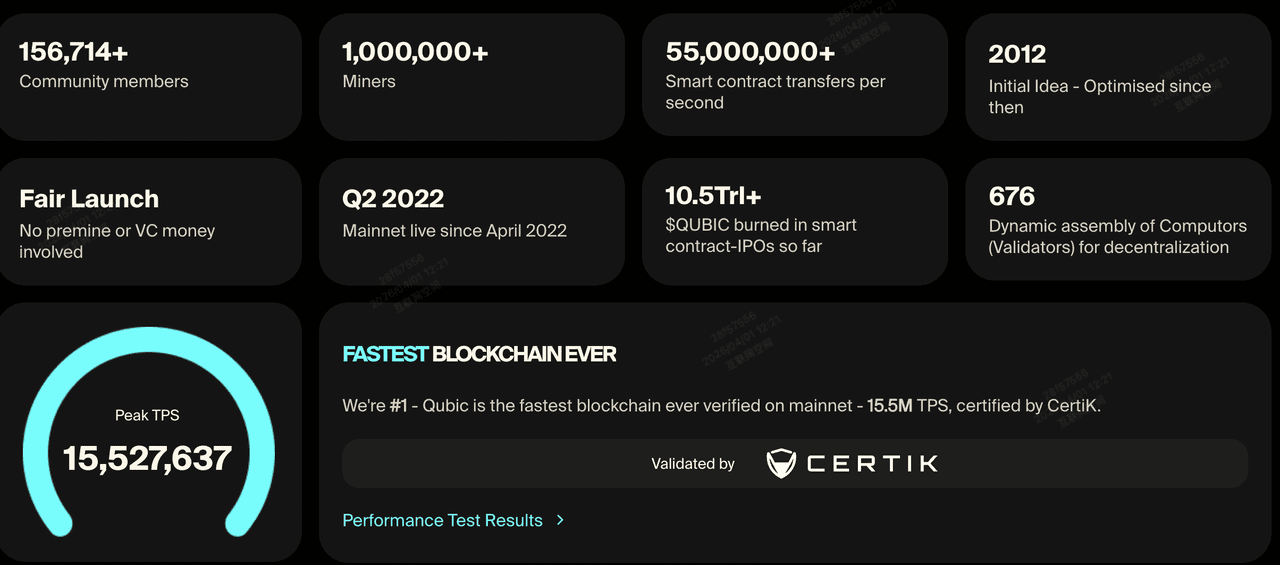
Key performance metrics of Qubic blockchain | Source: Qubic
Qubic is a bare metal Layer 1 protocol, meaning it operates without the overhead of a traditional Operating System or Virtual Machine. This optimization allows it to achieve industry-leading speeds, recently verified by CertiK at a peak of 15.52 million Transactions Per Second (TPS), with smart contract transfers capable of reaching over 55 million per second.
Unlike Ethereum or Solana, Qubic does not charge gas fees for standard transfers. Instead, the network is powered by 676 Computors, a dynamic assembly of validators who execute smart contracts and reach consensus through a Quorum requiring a 2/3+ majority vote (451+ Computors). The platform’s primary mission is to create a decentralized Global Brain through its AI layer, Aigarth, which evolves based on the computational contributions of over 1 million miners worldwide and a growing community of 156,000+ members.
Optimized since the initial idea in 2012, Qubic followed a Fair Launch model with no premine or VC funding, ensuring community-driven decentralization from its mainnet launch in April 2022. The network's unique economic engine has already led to more than 10.5 trillion $QUBIC being burned through smart contract IPOs, underscoring its shift toward a deflationary ecosystem.
The platform’s core innovations include:
- Useful Proof-of-Work (UPoW): Miners solve AI training problems instead of useless math puzzles.
- Feeless Transactions: Send $QUBIC or execute transfers with zero gas costs.
- Smart Contract IPOs: A unique decentralized crowdfunding model for launching applications.
- Bare-Metal Speed: Smart contracts are written in C++ and execute directly on hardware for maximum performance.
How Does the Qubic Ecosystem Work?
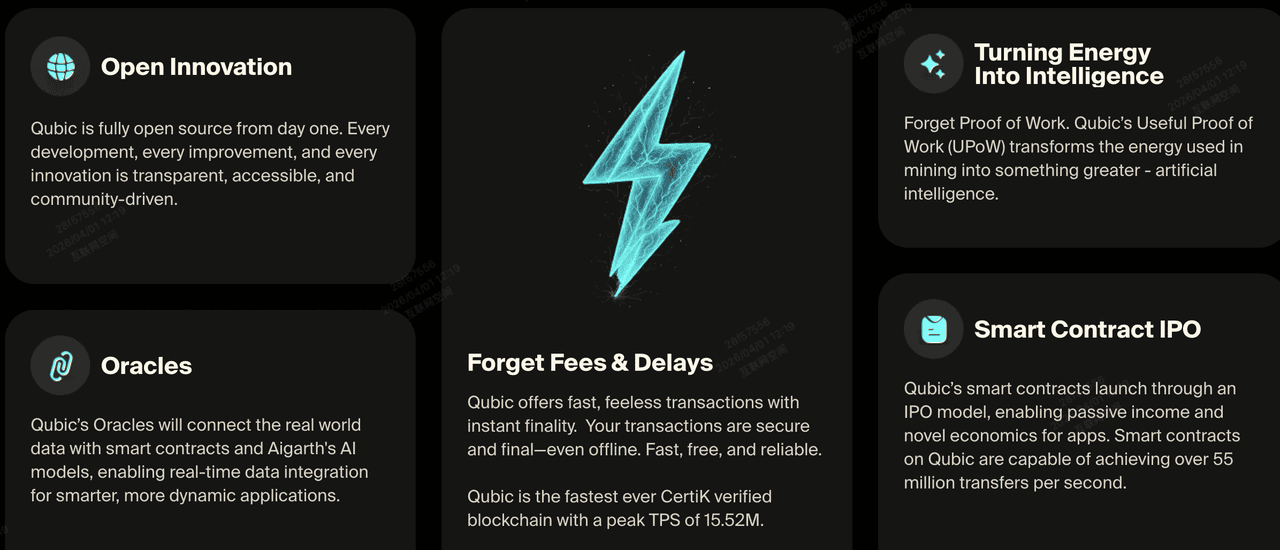
Key features of Qubic Network | Source: Qubic
Qubic operates as a Machine Economy where every component is optimized for speed and utility:
- The Quorum Protocol: The network relies on 676 specialized Computors. Every week (an Epoch), the top-performing miners are promoted to Computor status based on their efficiency in solving AI tasks.
- Aigarth (The AI Layer): This is the soul of Qubic. It uses the massive collective power of the network to build billions of artificial neural networks. By 2027, Aigarth aims to achieve decentralized Artificial General Intelligence (AGI).
- Dogecoin Mining Integration: Launched on April 1, 2026, the Doge-Connect protocol bridges Scrypt ASICs to Qubic. This allows the network to mine DOGE as an external product, using the proceeds to buy back and burn $QUBIC tokens.
- Oracle Machines: These act as the network's eyes, bringing real-world data llike stock prices, sports scores, etc., into Qubic’s smart contracts to enable smart automated decisions.
What Is the $QUBIC Token Used For?
The $QUBIC token, also known as Qubic Units or QU, represents the computational energy of the ecosystem. It is a deflationary utility token with several critical functions:
- Asset for Smart Contract IPOs: Users burn or lock $QUBIC to participate in Smart Contract IPOs, gaining shares in new decentralized applications.
- Execution and Oracle Fees: While standard transfers are free, executing complex smart contracts or calling Oracles requires $QUBIC, which is then burned to reduce supply.
- Governance and Voting: Computors use their status to vote on network upgrades and the distribution of mining rewards.
- Incentive for Miners: $QUBIC is issued to Computors each epoch as a reward for securing the network and training Aigarth.
What Is $QUBIC Tokenomics?
Qubic features one of the most aggressive deflationary models in the AI-crypto sector. There was no pre-mine, no VC allocation, and no team tokens at launch, a Fair Launch in its purest form.
- Fixed Emission: 1 trillion $QUBIC is generated per week (per epoch), primarily distributed to the 676 Computors.
- The Burn Mechanism: As of early 2026, over 10.5 trillion $QUBIC has been burned. This occurs through Smart Contract IPOs and the new Dogecoin buyback mechanism.
- Dogecoin Buyback: The DOGE mined by the network is sold for stablecoins to buy $QUBIC from the market. This creates constant buy-side pressure and further accelerates the burn rate.
Qubic vs. Traditional Blockchains: What Is the Difference?
|
Feature |
Qubic (QUBIC) |
Ethereum (ETH) / Solana (SOL) |
|
Transaction Fees |
Feeless (Free) |
Variable Gas Fees |
|
Consensus |
Quorum (676 Computors) |
PoS (Thousands of Validators) |
|
Mining Purpose |
Useful (AI Training/DOGE) |
Securing Network Only |
|
Finality |
Sub-second (Instant) |
2.5 seconds to 15 minutes |
|
Smart Contracts |
C++ (Bare Metal) |
Solidity/Rust (Virtual Machine) |
|
Architecture |
No OS / No VM |
Virtual Machine Based (EVM/SVM) |
Qubic fundamentally diverges from traditional blockchains like Ethereum or Solana by operating on a bare metal infrastructure, eliminating the overhead of an Operating System or Virtual Machine (VM). While standard Layer 1s utilize a VM like the EVM to interpret code, Qubic executes smart contracts written in C++ directly on the hardware, achieving a CertiK-verified peak of 15.52 million TPS. Furthermore, Qubic replaces the standard wasteful hashing of Proof-of-Work with Useful Proof-of-Work (UPoW). In this model, the network’s 1,000,000+ miners do not solve arbitrary puzzles; instead, they power Aigarth, a decentralized AI layer that builds billions of artificial neural networks, effectively turning electricity into machine intelligence rather than just ledger security.
From a practical economic standpoint, Qubic eliminates the friction of gas fees, offering true feeless transactions for standard transfers, a stark contrast to the volatile fee markets of traditional chains. Governance and security are managed by a fixed set of 676 Computors who reach consensus via a Quorum-based protocol requiring a 2/3+ majority. This structure enables sub-second finality, making it purpose-built for micro-transactions and AI agentic commerce. Unlike the inflationary models of many legacy chains, Qubic’s tokenomics are aggressively deflationary; for example, as of April 2026, the network has burned over 10.5 trillion $QUBIC through its Smart Contract IPO model and the new Dogecoin mining buyback mechanism, which repurposes ASIC energy to create constant buy-side pressure on the native token.
How to Mine Dogecoin (DOGE) on Qubic Network
With the April 1, 2026 launch, miners can now leverage ASIC hardware to contribute to the Qubic ecosystem.
- Hardware: You need a Scrypt-compatible ASIC, e.g., Bitmain Antminer L7 or L9.
- Doge-Connect: Use the official bridge protocol to point your hashrate at a Qubic-partnered pool.
- Dual Workstream: While your ASICs mine DOGE, your CPUs/GPUs can simultaneously earn rewards by training Aigarth’s AI models.
- Payouts: Mined DOGE is converted via the buyback mechanism, rewarding participants in $QUBIC at a projected 110% efficiency compared to standard mining.
Read more: How to Mine Dogecoin in 2026: A Complete Guide
Why Mine DOGE on Qubic: Key Benefits
Mining Dogecoin through Qubic’s Doge-Connect protocol offers a strategic advantage by leveraging specialized hardware to maximize network efficiency and miner profitability. Unlike traditional solo or pool mining, Qubic’s architecture allows Scrypt ASICs to handle 100% of the hashing workload while simultaneously freeing up the network’s CPU and GPU resources for AI training, ensuring no computational cycles are wasted.
This dual-workstream model creates a self-reinforcing economic loop where the external revenue generated from DOGE is used to buy back and burn $QUBIC tokens. For the individual miner, this provides a projected yield of approximately 110% compared to standard mining, effectively turning aging hardware into a high-utility asset for the decentralized AI economy.
Read more: What Are the Top Proof-of-Work (PoW) Coins to Mine in 2026?
How to Trade Qubic (QUBIC) on BingX
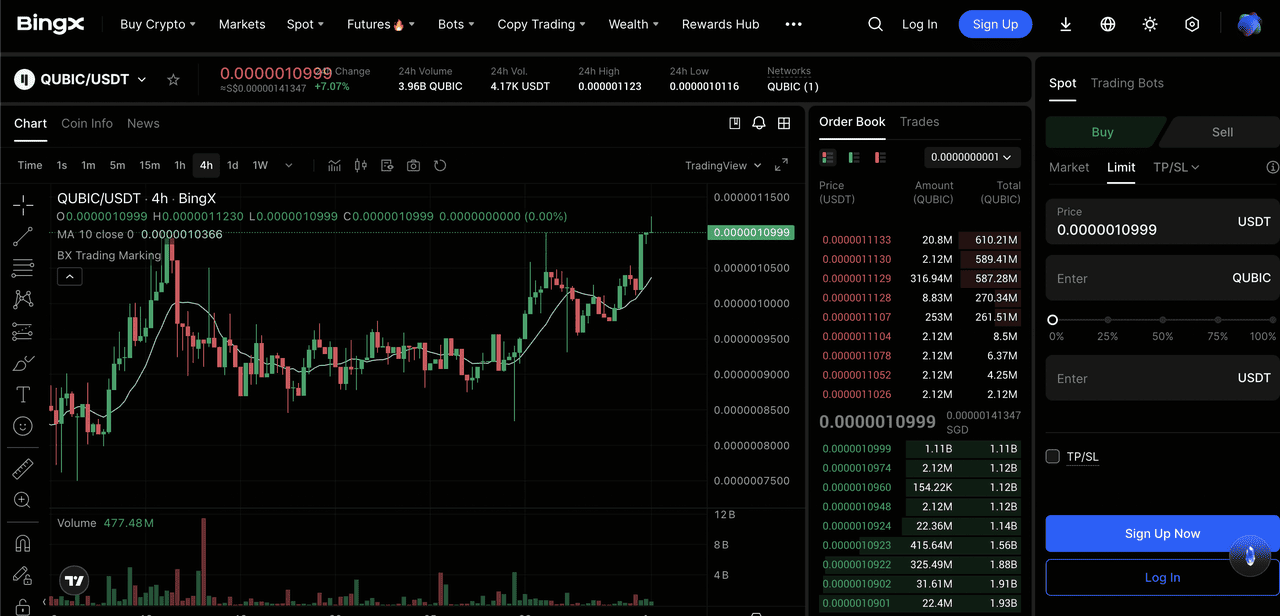
Maximize your trading efficiency by using BingX AI to analyze real-time market sentiment and technical indicators for $QUBIC during its high-volatility Dogecoin transition phase.
Buy, Sell, or HODL QUBIC on the Spot Market
- Deposit or Purchase USDT: Log in to your BingX account and ensure your Fund Account has USDT. You can deposit USDT from an external wallet or purchase it directly using a credit card or P2P trading.
- Access the QUBIC/USDT Pair: Navigate to the Spot tab on the top menu and search for QUBIC. Select the QUBIC/USDT trading pair to open the interactive charting terminal.
- Buy QUBIC: In the trading panel, select the Buy tab. Choose a Limit Order to set a specific entry price or a Market Order to buy instantly at the current best available price. Enter the amount of USDT you wish to spend and click Buy QUBIC.
- Sell or HODL: To take profits, switch to the Sell tab and execute a sell order back into USDT. Alternatively, to HODL, simply keep your $QUBIC in your BingX Account or move it to the official Qubic Web/Mobile wallet for long-term storage and participation in the ecosystem’s growth.
Learn more about how to buy Qubic Network in our comprehensive guide.
5 Key Considerations Before Investing in Qubic (QUBIC)
Before allocating capital to the $QUBIC ecosystem, it is essential to evaluate the structural risks of its bare metal architecture and the technical dependencies of its high-performance AI model.
- Founder Reputation: Sergey Ivancheglo’s history with IOTA and NXT brings immense technical credibility but also a radical approach to blockchain design.
- High Supply, High Burn: While the total supply of QUBIC tokens is in the trillions, the burn rate is accelerating. Check the latest Burn vs. Emission stats on the Qubic explorer.
- AI Complexity: Aigarth is a long-term research project. Its success is tied to the evolution of decentralized AI.
- Dogecoin Transition: Monitor the 3-phase rollout of DOGE mining in April 2026 for network stability and hashrate growth.
- Bare-Metal Risks: Operating on bare metal offers speed but requires high-quality hardware and maintenance from the Computor set.
Final Thoughts: Is Qubic the Future of AI Blockchain?
As of April 2026, Qubic has transitioned from a theoretical Useful Proof-of-Work model into a functional, multi-chain revenue generator. The successful integration of Dogecoin mining via the Doge-Connect bridge effectively bifurcates the network’s hardware demands, allowing ASICs to generate external value while CPUs and GPUs focus entirely on training the Aigarth AI. This structural shift, combined with recent data showing epochs where token burn exceeded emission, suggests that Qubic’s economic model is capable of sustaining high-performance, feeless infrastructure through externalized compute utility rather than traditional transaction tax.
For the practical participant, $QUBIC represents a unique convergence of the AI and DePIN (Decentralized Physical Infrastructure Networks) sectors. Its bare-metal C++ execution and sub-second finality make it a specialized environment for high-frequency AI agents and micropayment ecosystems that are often cost-prohibitive on Virtual Machine-based chains. However, potential investors must weigh these technical advantages against the inherent risks of a low-float supply and the experimental nature of its AGI research. As with any early-stage Layer 1, the long-term valuation is strictly tied to sustained developer adoption and the network’s ability to maintain its 15.5M TPS performance under real-world stress.
Risk Reminder: Digital asset investments, particularly in specialized AI protocols like $QUBIC, carry extreme price volatility and technical risk. Always perform your own research, monitor the 52-epoch halving cycles, and only trade capital you can afford to lose. BingX is not responsible for any trading losses incurred.
Related Reading
- How to Mine Dogecoin in 2026: A Complete Guide
- Who Owns the Most Dogecoin in 2026? Top 10 DOGE Rich List Revealed
- Top 5 Dogecoin Whale Trackers: Tools, Alerts, and Trading Strategies in 2026
- What Are the Top Proof-of-Work (PoW) Coins to Mine in 2026?
- What Are the Top 10 DePIN Crypto Projects to Know in 2026?